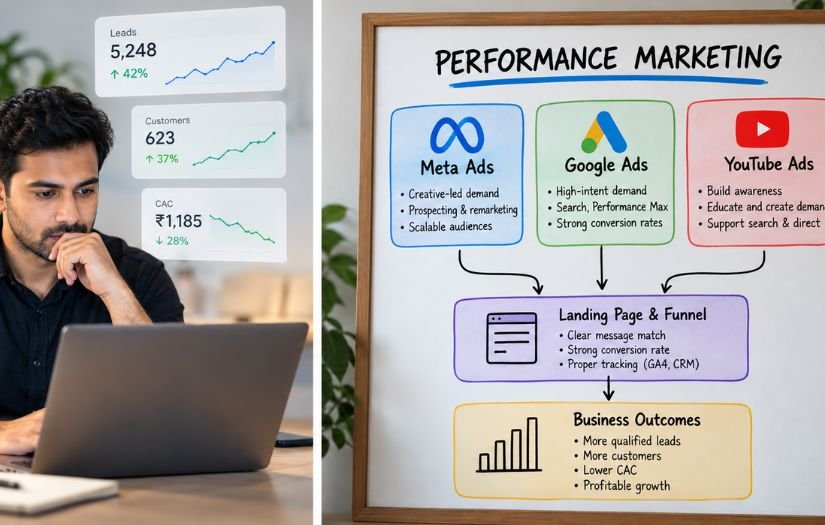
What I Actually Do as a Performance Marketer in India
I have been working hands-on with paid advertising for almost 10 years, and one thing has become very clear to me: managing campaigns is only a small part of performance marketing.
If all I did was create campaigns, change budgets and report CPL or ROAS, I would consider the job incomplete.
When I am responsible for paid growth, I am trying to answer a much bigger question:
Where is the business losing or creating money across the acquisition journey, and what should I change next?
That can take me inside Meta Ads one day, a landing page the next day and a CRM report after that.
Sometimes I increase the budget.
Sometimes I reduce it.
Sometimes I ask for completely new creatives.
And sometimes I tell the team that I do not think the advertising account is the main problem at all.
I Do Not Separate Ads From the Funnel
The way I look at paid acquisition is something like this:
Ad → Click → Landing Page → Lead or Purchase → Qualified Customer → Revenue
I want to know where that chain starts getting weaker.
If the ad is barely getting attention, I am looking at the message, creative and audience.
If people are clicking but not converting, I start questioning the landing page, offer and message match.
If leads are coming in cheaply but the sales team cannot close them, I do not celebrate the CPL. I want to understand why those leads are not turning into customers.
This broader way of looking at acquisition is also how I explained my approach in my Performance Marketing Expert in India guide.
I Use Meta, Google and YouTube for Different Jobs
I do not decide that a business needs Meta Ads, Google Ads and YouTube Ads just because those are the platforms I know how to manage.
I first try to understand how people discover and buy the product.
If somebody is already searching for the solution, Google can give me access to existing demand.
If I need to interrupt the right person with an offer they were not actively searching for, Meta can be much more useful.
If the product needs explanation, education or a stronger argument before somebody converts, YouTube can become extremely powerful.
I have used YouTube at substantial lead-generation scale. One education campaign generated more than 66,300 leads at approximately ₹76 CPL, and that experience is one of the reasons I think about YouTube very differently from simply buying cheap video views. I have broken down more of that approach in my YouTube Ads Expert in India page.
The Platform Is Usually Not the Strategy
This is probably one of the biggest changes in how I think compared with earlier in my career.
I used to spend more time thinking about campaigns.
Now I spend much more time thinking about the system around the campaigns.
A brilliant Google Ads structure cannot rescue a weak offer forever.
A high-CTR Meta creative cannot compensate for a landing page that destroys intent after the click.
A cheap YouTube lead is not useful if the person was never likely to become a customer.
That is also why I like looking at campaign evidence in context rather than showing isolated screenshots. My EdTech Google Ads case study, for example, looks at the relationship between spend, conversion volume and cost per conversion instead of treating one metric as the entire story.
What I Am Ultimately Responsible For
I still watch CTR, CPC, CPM, CPL, CPA, conversion rate and ROAS.
I need those numbers because they help me diagnose what is happening.
But none of them is the final objective.
The final objective is to build an acquisition system where the business can put money in, acquire the right customers and continue doing that at economics it can sustain.
That is what I actually mean when I describe myself as a performance marketer.
And across Meta Ads, Google Ads and YouTube Ads, almost every decision I make comes back to that idea.
How I Actually Work With Meta Ads
Meta Ads is one of the platforms where I have spent the most time over the years, but I do not approach it as a targeting game.
My first question is usually not, “Which audience should we test?”
It is:
What exactly are we trying to make this person believe, notice or do?
That sounds simple, but it changes how I build the entire campaign.
I Start With the Offer and the Angle
If the offer is weak, campaign structure will not rescue it for very long.
So before I get too deep into audiences, I want to understand the offer itself.
Why should somebody care?
What problem are we solving?
What proof do we have?
What objection is most likely to stop the conversion?
What makes this offer worth clicking now instead of ignoring it?
Once I understand that, I can build creative angles around the actual buying reason instead of just producing more ads.
I Use Creative to Qualify the Audience
This is something I care about a lot.
A good Meta creative should not only attract attention. It should attract the right attention.
If the ad is too broad, too sensational or too disconnected from what happens after the click, the campaign may produce cheap traffic but weak business outcomes.
I have seen this happen many times in lead generation.
The CPL looks great, the dashboard looks healthy, but the sales team says the leads are not serious.
At that point, I do not immediately start searching for a new audience.
I first want to know whether the ad itself is attracting the wrong type of user.
I Do Not Change Targeting Just Because Performance Dropped
When Meta performance starts weakening, I try to diagnose the reason before changing things.
If CTR has dropped sharply while CPM is stable, I may suspect the creative or message.
If CTR is still healthy but landing-page conversion has fallen, I will look much more closely at the page and the offer.
If CPL has increased but lead quality has improved, I may not consider that a problem at all.
If frequency is increasing and the same creatives have been running for too long, fatigue becomes a much stronger possibility.
The point is that I do not want to confuse the symptom with the cause.
I Pay a Lot of Attention to What Happens After the Click
Meta can send volume quickly, and that makes funnel weaknesses very visible.
I have seen campaigns blamed for poor conversion when the real issue was a slow mobile landing page, weak trust, a confusing form or a mismatch between the ad promise and the page.
This is why I consider CRO part of performance marketing rather than a completely separate activity.
I explained this broader way of thinking in my guide to evaluating a performance marketing expert, because one of the biggest differences I look for is whether someone can diagnose beyond the ad account.
I Prefer Creative Systems Over Random Creative Volume
I am not a fan of producing dozens of random creatives just to say we are testing aggressively.
I would rather understand what is working and then build around that learning.
If a proof-led angle is winning, I want more ways to express proof.
If objection handling is working, I want to identify the strongest objections and build separate creatives around them.
If one hook attracts clicks but produces poor-quality leads, I want to know why before creating five more versions of the same hook.
For me, creative testing should create knowledge, not just more files in a folder.
I Look at Meta Differently Once We Start Scaling
A campaign that works at ₹5,000 per day does not automatically behave the same way at ₹20,000 or ₹50,000 per day.
As spend rises, I watch whether Meta is still finding similar-quality users or whether it is starting to buy weaker traffic just to spend the additional budget.
I also watch what happens to creative performance, landing-page conversion, lead quality and actual CAC.
This is where I care less about one-day fluctuations and more about whether the economics are holding as volume increases.
What I Ultimately Want From Meta Ads
I do not want Meta to give me the cheapest possible lead.
I want Meta to give me enough of the right leads or customers at a cost the business can sustain.
That distinction is important because the cheapest campaign inside Ads Manager is not always the campaign I would scale.
If another campaign produces better-quality customers, stronger revenue or a healthier CAC, I may prefer it even if its front-end CPL looks worse.
For me, Meta Ads becomes valuable when the platform data and the business data are telling the same story.
How I Actually Work With Google Ads
Google Ads is very different from Meta because in many campaigns I am not trying to create demand from scratch.
I am trying to capture demand that already exists.
That changes the way I think about the account.
Instead of asking only, “Who should see this ad?” I am asking:
What is this person actually trying to accomplish when they search?
I Care More About Search Intent Than Keyword Volume
A keyword can have thousands of searches and still be a poor keyword for the business.
Another keyword may have much lower volume but bring people who are much closer to taking action.
I have seen accounts where a small set of high-intent searches produced much better business outcomes than broad keyword expansion designed simply to increase traffic.
That is why I do not judge Google Search campaigns by traffic volume alone.
I want to know whether the search terms reflect the kind of demand we actually want to buy.
The Search Term Report Often Tells Me More Than the Keyword List
When I take over or audit a Google Ads account, one of the places I spend time is the actual search queries.
The keyword tells me what we asked Google to target.
The search term tells me what the user really typed.
That difference can expose wasted spend very quickly.
I look for irrelevant intent, research-heavy queries, competitor searches, informational searches and patterns that deserve their own campaign or negative keyword.
I also look for queries that are converting repeatedly because they can reveal demand we did not initially structure around.
I Separate Traffic Quality From Conversion Tracking
One mistake I try to avoid is assuming a campaign is healthy just because Google is reporting conversions.
I first want to know what the conversion actually represents.
Is it a completed lead form?
A phone call?
A purchase?
A page visit?
A button click?
If the conversion action is weak or incorrectly configured, automated bidding can become very good at generating the wrong outcome.
This is one reason I treat tracking as part of campaign strategy rather than something that gets set up once and forgotten.
I Have Seen the Difference Between Cheap Traffic and Useful Traffic
One of my Google Ads campaigns in the EdTech space generated approximately 656 attributed conversions from ₹71,000 in spend at around ₹109 per conversion.
The interesting part for me was not simply the cost per conversion.
I wanted to understand what type of searches were producing those conversions, how consistently they were coming in and whether the landing page was continuing the same intent created by the ad.
I have documented that campaign in my EdTech Google Ads case study.
In another Ayurveda lead-generation campaign, Google Ads produced more than 5,000 leads at approximately ₹87.65 CPL from around ₹4.41 lakh in spend.
That campaign gave me a much better sense of how search demand behaves when you move beyond a small test and start working with meaningful lead volume.
You can see the numbers in my Ayurveda Google Ads case study.
I Do Not Mix Brand and Non-Brand Performance in My Head
This is especially important when somebody shows me a strong Google Ads ROAS.
If a large part of the conversions are coming from branded searches, I want to know that.
Brand campaigns can be very efficient because the user may already know the company and be close to converting.
That does not make them useless, but I would not use their performance to judge how efficiently we are acquiring completely new demand.
I prefer understanding brand, non-brand, competitor and remarketing performance separately before making decisions.
I Use Automation, but I Do Not Hand Over My Judgment to It
Google Ads has become much more automated over the years.
Smart Bidding, broad match and Performance Max can work very well when the system has the right conversion signals and enough useful data.
But I do not believe automation removes the need for strategy.
If the wrong conversion is being optimized, the automation can scale the wrong behaviour faster.
If the account structure hides weak traffic behind blended results, automation does not automatically make that traffic valuable.
I still want to understand what Google is optimizing toward and whether that outcome makes sense for the business.
Performance Max Is Something I Evaluate in Context
I do not treat Performance Max as automatically good or bad.
I look at the business model, available creative, conversion data, product feed if ecommerce is involved and how much visibility I need into the traffic.
For some accounts it can become an important scaling layer.
For others, I may want stronger Search foundations before giving more control to automation.
The decision depends on what the account needs, not on whether Performance Max happens to be the latest campaign type Google is pushing.
The Landing Page Still Matters Just as Much
High-intent traffic is valuable, but it can also be expensive.
If I am paying a premium for someone actively searching for the solution, I do not want to waste that intent on a weak landing page.
I look closely at whether the headline matches the query, whether the offer is immediately understandable, whether trust is visible and whether the conversion path creates unnecessary friction.
Sometimes improving that experience gives me more room to scale than another round of bid adjustments.
What I Ultimately Want From Google Ads
I want to capture valuable demand without paying for every possible search around the category.
That means knowing which intent is worth buying, which conversions actually matter and how much the business can afford to pay for them.
For me, a strong Google Ads account is not the one with the most campaigns or the most sophisticated structure.
It is the one where search intent, conversion tracking, landing-page experience and business economics are aligned closely enough that I can confidently decide where to spend more and where to pull back.
How I Actually Work With YouTube Ads
YouTube Ads is one of the channels where I think the difference between “running ads” and actually understanding the platform becomes very obvious.
You can get a lot of views very cheaply.
You can also get almost no meaningful business outcome from those views.
So when I work with YouTube, I am not thinking about video views first.
I am thinking about:
Can I use video to move the right person from attention to interest to action at a cost that makes sense?
I Treat the First Few Seconds as the Real Auction
Before targeting, bidding or campaign structure can help me, the viewer has to stay long enough to hear the message.
That is why I care so much about the opening.
If the first few seconds feel like a generic advertisement, most people are mentally gone before the real pitch even starts.
I want the opening to immediately signal one of three things:
- This is relevant to you
- This problem may be costing you something
- There is a reason to keep watching
That does not mean using clickbait.
It means getting to the point quickly.
I Do Not Judge YouTube Ads by View Rate Alone
A high view rate can be useful, but it is not the goal.
I have seen video campaigns where people watched, engagement looked healthy and the business result was still weak.
If the campaign objective is lead generation, I care much more about whether the audience moves from the video to the landing page and eventually converts.
This is also why I wrote separately about why YouTube Ads can generate views but no leads.
Views are only valuable when they are part of the right acquisition journey.
I Use YouTube When the Offer Needs Explanation
There are products where a static ad or search ad can communicate enough in a few seconds.
There are others where the buyer needs more context.
Education, coaching, higher-consideration services and certain lead-generation offers can benefit from a format where you have more time to explain the problem, build belief and create a reason to act.
This is where YouTube can become much stronger than simply treating it as an awareness channel.
One of My Largest Lead Generation Campaigns Came From YouTube
One education campaign I worked on generated more than 66,300 leads at approximately ₹76 CPL from around ₹50.4 lakh in advertising spend.
What mattered to me was not just that the CPL was low.
The more meaningful part was that the system continued producing a large volume of leads while spend scaled significantly.
That required more than finding one winning audience or one lucky video.
We kept working on creative, audience quality, remarketing, funnel performance and the relationship between volume and CPL as the campaign grew.
I have explained more of that experience on my YouTube Ads Expert in India page.
I Think About Targeting as a Starting Point, Not the Entire Strategy
YouTube gives you multiple ways to reach people, but I do not expect targeting alone to create performance.
I can target relevant audiences and still fail if the video is weak.
I can have a strong video and still waste money if the audience has no real connection to the offer.
The two have to work together.
When I build campaigns, I think about who the person is, what they are likely watching, what problem they are already aware of and how much education they need before they are ready to respond.
I have broken down that side of the strategy in my YouTube Ads targeting guide for India.
Remarketing Is Usually Part of the YouTube System
I rarely think of YouTube as one isolated campaign.
Someone may watch the video, visit the site, leave and convert later through another touchpoint.
That is why I like building remarketing around people who have already shown meaningful intent.
A person who watched a large part of the video or visited the landing page is very different from a completely cold user.
The message should usually reflect that.
I have a separate breakdown of how I approach that in my YouTube Ads remarketing guide.
I Do Not Keep Scaling the Same Creative Forever
This is especially important with YouTube.
A video can work extremely well and then slowly start losing efficiency as the audience sees it repeatedly or the strongest pocket of demand gets exhausted.
When that happens, I do not want to wait until CPL has completely broken before preparing the next creative.
I prefer having new hooks, proof, objections and angles ready before the existing winner is exhausted.
What I Ultimately Want From YouTube Ads
I do not want cheap views.
I do not want a video with a strong watch rate that produces no business outcome.
I want YouTube to help me reach people who need more explanation, educate them efficiently and move enough of them into the funnel at a cost the business can support.
When that happens, YouTube stops being an awareness platform and becomes a serious performance channel.
How I Decide Where the Next Rupee of Ad Spend Should Go
This is where performance marketing becomes much more interesting than platform management.
Once Meta, Google and YouTube are all available as options, the question is no longer:
“Which platform is better?”
The real question is:
“Where can the next ₹1 of spend create the most useful business outcome?”
That answer can change from week to week.
I Do Not Split Budget Equally Across Platforms
I do not believe in giving Meta 33%, Google 33% and YouTube 33% just because all three channels are active.
Budget should follow opportunity.
If Google is capturing strong high-intent demand at an acceptable CAC, I may keep pushing Search until I start seeing clear signs of diminishing returns.
If Meta is producing stronger customer volume through creative-led prospecting, more of the budget may move there.
If YouTube is opening a larger audience that needs education before converting, I may use it to create demand that Google later captures.
I want each platform to earn its role.
I Look at Marginal Performance, Not Just Average Performance
This is something I think becomes more important as spend grows.
A campaign may have an average CPL of ₹300, but that does not mean the next ₹50,000 will also produce leads at ₹300.
The historical average tells me what has already happened.
For scaling decisions, I care about what is happening to efficiency as additional budget enters the system.
If Meta was producing customers efficiently at ₹3 lakh per month but CAC starts rising sharply once we cross ₹5 lakh, I do not ignore that just because the blended monthly number still looks acceptable.
I want to understand the cost of the additional growth.
I Compare Business Outcomes, Not Platform Dashboards
Meta and Google can both claim credit for the same customer.
YouTube may influence somebody who later searches the brand and converts through Google.
If I simply compare reported platform ROAS, I can make the wrong budget decision.
So I try to bring the conversation back to the business level.
What happened to total spend?
What happened to total customers?
What happened to blended CAC?
What happened to revenue?
Did qualified lead volume actually increase?
Did the sales team see better or worse quality?
Those questions help me avoid optimizing three dashboards independently while the overall acquisition system moves in the wrong direction.
Sometimes I Keep an Apparently Weaker Channel Running
This is where platform-level reporting can become misleading.
Imagine YouTube looks weaker on last-click conversions than Google Search.
That does not automatically mean I should turn YouTube off.
If YouTube is introducing new people to the brand and branded search volume increases afterward, the channel may be contributing earlier in the journey.
I would want to test that relationship before cutting spend.
This is also why I do not judge YouTube purely by views or immediate conversions, something I discuss in more detail in my YouTube Ads metrics guide.
I Also Watch for Channel Saturation
Every channel has a limit.
Sometimes Google simply does not have enough additional search volume at the economics I want.
Sometimes Meta needs more creative before it can absorb additional spend efficiently.
Sometimes a YouTube campaign has already reached the strongest audience segments and CPL begins climbing as we expand.
When I see that, I do not try to force the same channel to keep growing forever.
I start looking for the next source of incremental demand.
The Funnel Can Change Where I Spend
Budget allocation is not only about ad-platform efficiency.
If Google sends fewer leads but those leads close at a much higher rate, I may be willing to pay a higher CPL there.
If Meta produces cheaper leads but a lower percentage become customers, I want to evaluate the true acquisition cost rather than celebrating the cheaper front-end number.
This is the same reason I keep coming back to CAC rather than treating CPL or ROAS in isolation.
I covered that broader decision-making approach in my performance marketing approach.
My Budget Allocation Is Usually a Continuous Decision
I do not set a channel mix once and leave it untouched for three months.
I keep asking:
Where are we seeing the strongest combination of volume, quality and sustainable acquisition cost right now?
Then I move budget accordingly.
Sometimes that means scaling the clear winner.
Sometimes it means protecting a channel that plays an important supporting role.
And sometimes it means taking money away from advertising altogether until the funnel is ready to absorb more traffic.
For me, that is a much more useful way to manage paid growth than trying to make every platform look successful at the same time.
What I Do When Performance Starts Dropping
This is probably the part of performance marketing where experience matters the most.
Launching campaigns is relatively easy.
The harder part is knowing what to do when something that was working suddenly stops working.
I do not have one fixed checklist where I blindly change the same three things every time.
I first try to understand where the deterioration actually started.
I Compare the Funnel Before I Touch the Campaign
If CPL or CPA suddenly increases, I do not immediately change targeting or bidding.
I break the movement down.
Did CPM change?
Did CTR change?
Did CPC change?
Did landing-page conversion rate change?
Did lead quality change?
Did the sales conversion rate change?
Those numbers usually tell me where to start looking.
If CPM jumped but CTR and conversion rate stayed stable, I am dealing with a different problem than if CPM stayed flat and landing-page conversion collapsed.
If CTR Drops, I Usually Look at the Message First
On Meta and YouTube especially, a declining CTR can be an early sign that the creative is losing its ability to get attention.
That may be fatigue.
It may also mean the audience mix has changed as the campaign scaled.
Or the offer may simply be less compelling than it was earlier.
I do not automatically label every CTR decline as “creative fatigue.”
I compare frequency, audience expansion, CPM, spend changes and the performance of individual creatives before reaching that conclusion.
If Clicks Are Fine but Conversions Drop, I Move Down the Funnel
This is where people sometimes waste weeks rebuilding campaigns that were not actually broken.
If CTR is stable and traffic quality looks similar, but conversion rate suddenly falls, I start looking at the landing page.
Was something changed?
Is the page loading properly on mobile?
Did a form stop working?
Did pricing change?
Did the offer change?
Is there a mismatch between what the ad promises and what the page delivers?
I have seen surprisingly large performance drops come from relatively small funnel issues.
If CPL Is Good but Sales Are Weak, I Stop Celebrating the CPL
This is one of the most important lessons I have learned from lead-generation campaigns.
A cheap lead can become very expensive if nobody buys.
If the sales team tells me lead quality has deteriorated, I want that information quickly.
Then I start breaking the leads down by campaign, audience, creative, keyword or source to see where the quality changed.
Sometimes the campaign generating the cheapest leads is the first campaign I would reduce.
Google Ads Gives Me Different Diagnostic Clues
With Google Search, I often go straight into search terms when performance changes.
I want to know whether Google has started matching us to weaker intent.
I also check whether competitors have become more aggressive, CPCs have moved, impression share has changed or a previously strong query is no longer converting the same way.
If automated bidding is involved, I also want to make sure the conversion signal feeding the system has not changed.
This is one reason I pay so much attention to the relationship between traffic quality and conversion tracking in Google Ads rather than treating the reported CPA as the whole story.
YouTube Can Look Healthy While the Funnel Is Weak
YouTube can be especially deceptive because the top-of-funnel metrics may still look good.
The video can continue getting views.
View rate can remain healthy.
CPV can stay cheap.
And lead volume can still collapse.
When that happens, I start looking at click-through behaviour, audience quality, landing-page conversion and whether the video is attracting viewers who are interested enough to watch but not interested enough to act.
I have covered this problem separately in my guide on YouTube Ads getting views but no leads.
I Compare Against the Right Time Period
I try not to overreact to one bad day.
Paid media naturally moves.
A campaign can have an unusually strong Monday and a weak Tuesday without anything fundamentally changing.
So I usually compare enough data to separate normal volatility from a genuine trend.
The amount of data I need depends on the account.
A campaign spending ₹50,000 per day gives me meaningful information much faster than one spending ₹1,000 per day.
I Change One Important Thing for a Reason
When performance drops, there is always a temptation to change targeting, bids, creative, landing page and budget at the same time.
I try to avoid that.
If I change everything together and performance improves, I may never know what actually fixed it.
I prefer forming a hypothesis, making the highest-impact change I can justify and watching whether the data supports that decision.
Sometimes My Decision Is to Do Nothing
This is probably one of the hardest decisions in paid media.
Not every fluctuation requires intervention.
I have seen good campaigns damaged because somebody became uncomfortable with two weak days and started making aggressive changes.
If the underlying funnel still looks healthy and I do not see enough evidence of a structural problem, I may leave the campaign alone.
Performance marketing is not only knowing what to change.
It is also knowing when not to change something that is still fundamentally working.
Why I Spend So Much Time Outside the Ad Platforms
One of the biggest changes in how I work today is that I spend much less time thinking only inside Meta Ads, Google Ads or YouTube Ads.
The more accounts I have managed, the more obvious it has become that a large percentage of performance problems are created somewhere else.
The ad platform may be doing exactly what it is supposed to do.
The landing page may be the problem.
The offer may be the problem.
The tracking may be wrong.
The sales team may not be following up properly.
Or the business may simply be asking paid media to solve something that paid media cannot fix.
I Look at the Landing Page as Part of the Campaign
I do not consider the landing page somebody else’s responsibility once the click leaves the ad platform.
If I am paying for the click, I care deeply about what happens after it.
I look at whether the headline continues the promise made in the ad.
I look at whether the offer is immediately understandable.
I look at mobile experience, page speed, trust, proof, form length and whether the CTA feels like the natural next step.
I also look for unnecessary friction.
If someone already has high intent from Google Search, I do not want to make them work hard to understand what we do.
If someone comes from Meta or YouTube with less intent, I may need much more explanation before asking for the conversion.
I Do Not Treat Conversion Rate as Just a Website Metric
Conversion rate directly affects how much I can afford to pay for traffic.
If a page converts 2% of visitors and I can improve it to 3%, that changes the economics of the campaign significantly even if CPC does not move at all.
That can give me room to bid more aggressively, reach more expensive audiences or scale into traffic that previously looked unprofitable.
This is why I think CRO and media buying are much more connected than they are usually treated.
I Pay Attention to Message Match
This is one of the first things I look for when CTR is healthy but conversion rate is weak.
If an ad says one thing and the landing page opens with something completely different, the user has to mentally reconnect the two experiences.
That friction can be enough to lose the conversion.
I want the user to feel that the page is exactly where they expected to arrive after clicking the ad.
I Want Proof Close to the Decision
I have seen pages where the strongest testimonial, case study or business proof is buried halfway down the page.
For high-consideration offers, I often want that proof much closer to the point where the user is deciding whether to trust us.
It could be a result, testimonial, client logo, demonstration or anything else that reduces uncertainty.
The exact format depends on the business.
I Check Tracking Before I Trust the Dashboard
If the conversion data is wrong, almost every optimization decision after that can also be wrong.
So I want to know exactly what Meta, Google and GA4 are counting.
I check whether the primary conversion is actually meaningful.
I look for duplicate firing.
I look at whether thank-you pages or form submissions are being counted correctly.
I also want to know whether platform numbers roughly reconcile with CRM or ecommerce data at the business level.
I do not expect perfect agreement because attribution systems work differently, but I do want the numbers to make sense.
I Care More About Qualified Outcomes Than Front-End Conversions
This becomes especially important in lead generation.
If Meta says one campaign has the lowest CPL, Google shows another campaign has a higher conversion rate and YouTube is producing cheaper volume, that still does not tell me which source is best.
I want to know which leads are qualified.
I want to know which ones are answering calls.
I want to know which ones are becoming customers.
If I can connect that information back to the source, creative, keyword or campaign, my optimization becomes much more useful.
Sometimes I Would Fix the Funnel Before Spending More
I have no problem recommending that we pause aggressive scaling for a few days if I think the funnel is wasting too much of the traffic we are already buying.
There is little point increasing ad spend by 50% if a broken form, weak landing page or poor follow-up process is losing a large percentage of the opportunity.
This is the same principle I discussed in my guide to evaluating a performance marketing expert: I think one of the strongest signs of good performance marketing is knowing when the ad account is not the main problem.
This Is Also Why I Like Looking at Real Campaign Evidence
When I document campaigns, I try not to present one isolated metric as the whole success story.
My EdTech Google Ads case study and Ayurveda Google Ads case study both show the relationship between spend and conversion volume because I think context matters much more than a single attractive number.
My View Is Simple
If I am responsible for performance, I cannot stop caring once the user clicks the ad.
The campaign, landing page, tracking and follow-up are all part of the same acquisition system.
And if one part of that system is weak, I want to find it before I spend more money trying to compensate for it.
How I Scale Campaigns Without Letting CAC Run Away
Scaling is where a campaign usually becomes much less predictable.
At a small budget, the platform can often concentrate spend on the easiest conversions.
Once I ask it to spend significantly more, it has to find additional volume somewhere.
That is the point where I stop asking only, “Is the campaign profitable?” and start asking:
“What is happening to the cost of the next layer of growth?”
I Do Not Expect CAC to Stay Perfectly Flat
If a campaign is generating customers at ₹1,000 CAC and I double the spend, I do not automatically expect it to continue at exactly ₹1,000.
Some deterioration can be completely acceptable.
The question is whether the business can still make money at the new acquisition cost.
If the allowable CAC is ₹1,800, I may happily accept movement from ₹1,000 to ₹1,250 if that increase gives me significantly more customer volume.
Trying to protect the lowest possible CAC at all costs can sometimes prevent a business from scaling at all.
I Look at the Additional Volume, Not Just the Blended Number
This is one of the things I pay much more attention to now than I did earlier in my career.
Suppose a campaign has historically spent ₹5 lakh at ₹1,000 CAC.
We increase the spend to ₹7 lakh and the blended CAC becomes ₹1,100.
That does not immediately worry me.
I want to understand how expensive the additional customers became.
The blended number can hide what is happening at the margin.
That matters because eventually the cost of incremental growth can rise much faster than the account average suggests.
On Meta, Creative Capacity Often Determines How Far I Can Scale
I have seen Meta campaigns where the audience was not the biggest constraint.
The real constraint was that we were asking the same few creatives to absorb more and more budget.
Once frequency increases and the winning message starts losing its edge, CAC can move very quickly.
That is why I do not like waiting until performance collapses before producing the next creative batch.
If I know we want to scale aggressively, I want the creative pipeline ready before the budget increase.
On Google, Available Demand Can Become the Limit
Google Search behaves differently.
If we already have strong coverage on the highest-intent searches, I cannot manufacture unlimited additional search volume just by increasing the budget.
At some point I may have to expand into broader queries, different match behaviour, additional geographies or other campaign types.
Each expansion usually comes with a different level of intent.
So I watch whether the extra spend is still buying the kind of demand I actually want.
I would rather accept that Search has reached a sensible limit than force more spend into weaker queries simply to hit a media budget.
YouTube Scaling Depends Heavily on Creative and Audience Expansion
My larger YouTube campaigns taught me that scaling rarely comes from one audience and one video forever.
As spend increases, I need enough creative variation and enough audience depth to keep finding new people without destroying CPL.
That was part of the challenge in the education campaign that eventually generated more than 66,300 leads at approximately ₹76 CPL from around ₹50.4 lakh in spend.
The campaign had to continue evolving as the volume increased.
This is why I think about structure, remarketing and creative together rather than treating YouTube scaling as a simple budget increase. I have explained the campaign-building side in my YouTube Ads campaign structure guide.
I Scale the Funnel Along With the Media
If I double the traffic but the landing page conversion rate falls, I have not really doubled the opportunity.
If lead volume doubles but the sales team cannot follow up properly, I may actually make the business less efficient.
If ecommerce sales increase but inventory or fulfilment cannot keep up, the advertising success creates an operational problem.
So before a major increase in spend, I also want to know whether the rest of the business can absorb the volume.
I Do Not Increase Every Campaign Just Because the Account Is Working
Usually there are parts of the account I trust more than others.
I may have one Meta creative angle that is producing consistently strong customers.
I may have a group of Google Search terms with very clear commercial intent.
I may have a YouTube audience and video combination that has already proven it can handle more volume.
I prefer scaling where I have evidence first.
Then I use testing to create additional places where the account can grow.
I Also Have a Point Where I Stop
Scaling is not a competition to see how much money I can force the platforms to spend.
If incremental CAC becomes uncomfortable, lead quality starts deteriorating, creative is exhausted or the funnel cannot handle more volume, I would rather slow down.
Sometimes the right move is to hold the budget steady while we improve the system.
Sometimes I move the next rupee into another platform.
And sometimes I simply accept that we have reached the efficient limit of that particular campaign for now.
For me, good scaling means growing volume while keeping the economics inside a range the business is genuinely comfortable with.
Anything beyond that is just spending more money.
How I Measure Whether Paid Growth Is Actually Working
I do not like judging performance marketing from one metric.
There have been campaigns where CPL looked excellent but sales were weak.
There have also been campaigns where CPL increased slightly but the business outcome improved because the quality of leads was better.
That is why I usually think about measurement in layers.
I Start With the Business Outcome
Before looking at CTR, CPC or CPM, I want to understand what the business is actually trying to improve.
For ecommerce, that may be profitable new-customer revenue.
For lead generation, it may be qualified opportunities and closed customers.
For a course business, it may be paid customers at a CAC the business can sustain.
Once that is clear, the platform metrics become diagnostic tools rather than the final score.
I Look at CAC Before I Get Too Excited About CPL
This is especially important in lead generation.
Suppose Campaign A generates 1,000 leads at ₹100 CPL and Campaign B generates 700 leads at ₹150 CPL.
If I stop there, Campaign A looks clearly better.
But if Campaign B produces twice as many paying customers, I may happily pay the higher CPL.
That is why I want to connect the advertising source with what happens later in the funnel whenever the data allows me to.
The closer I can get to actual customer acquisition cost, the more confident I become about budget decisions.
ROAS Is Useful, but I Still Want Context
I use ROAS regularly, especially in ecommerce and direct-response businesses.
But I do not treat a high ROAS number as automatically good.
I want to know:
- How much was spent to achieve it?
- Was the revenue coming from new or existing customers?
- Was branded demand included?
- Was remarketing carrying a large share of the result?
- What margin does the business actually make on that revenue?
A 6X ROAS at low spend can be less useful to the business than a 4X ROAS at significantly higher profitable volume.
The answer depends on the economics.
I Use CTR, CPC and CPM to Diagnose, Not to Celebrate
I still look at these metrics every day in the right context.
If CPM suddenly rises, that gives me one clue.
If CPM stays stable but CTR collapses, that tells me something different.
If CPC is healthy but conversion rate falls, I move further down the funnel.
These metrics help me understand why CAC or CPL changed.
I do not consider a campaign successful simply because CTR is high.
A high CTR that brings the wrong user can actually create a worse funnel.
Conversion Rate Tells Me How Well We Are Using the Traffic
This is one of the metrics I pay a lot of attention to because it connects media cost with the funnel.
If CPC stays exactly the same but conversion rate improves, the economics of the campaign can change dramatically.
That is one reason I spend so much time looking at landing pages and CRO instead of assuming the next improvement has to come from inside the ad account.
I Compare Platform Data With Real Business Data
Meta may report one number.
Google Ads may report another.
GA4 may show something different again.
I do not expect them to match perfectly because the attribution logic is different.
What I care about is whether the overall picture makes sense when I compare it with CRM, sales or ecommerce data.
If the platforms are reporting tremendous growth but the business is not seeing more customers or revenue, I want to understand why.
I Look at Volume and Efficiency Together
This is something I think gets missed when people compare campaigns.
Efficiency without scale can be misleading.
Scale without efficiency can destroy the economics.
I want both numbers on the table.
For example, my Ayurveda Google Ads case study includes more than 5,000 leads at approximately ₹87.65 CPL from around ₹4.41 lakh in spend.
For me, the spend and conversion volume are important because they give context to the CPL.
The same is true with the education YouTube campaign where more than 66,300 leads were generated at approximately ₹76 CPL from around ₹50.4 lakh in spend.
The scale changes how I interpret the efficiency.
I Use Different Metrics for Different Funnel Stages
I would not judge a prospecting campaign and a remarketing campaign in exactly the same way.
I also would not judge YouTube purely by the same metrics I use for Google Search.
A search user may already have very high intent.
A YouTube viewer may be discovering the offer for the first time.
The role of the channel matters.
I have gone deeper into that specifically for YouTube in my YouTube Ads metrics guide.
I Always Come Back to One Question
After all the dashboards, attribution reports and campaign metrics, I eventually come back to this:
Is the business acquiring enough of the right customers at a cost that leaves room to grow?
If the answer is yes, I look for ways to scale it.
If the answer is no, I use the metrics to find where the system is breaking.
That is how I try to keep performance marketing connected to actual business performance rather than letting the dashboard become the objective.
Looking for a Performance Marketer in India?
If you are looking for someone to manage paid growth, I would suggest looking beyond whether they know Meta Ads, Google Ads or YouTube Ads individually.
The bigger question is whether they can connect those platforms with the offer, creative, landing page, tracking, customer acquisition cost and actual business outcome.
That is how I approach performance marketing after almost 10 years of working hands-on across paid acquisition.
If you want a broader view of how I think about paid growth, you can read my Performance Marketing Expert in India page.
If you are currently comparing people to manage your acquisition, my guide to choosing a performance marketing expert in India explains the criteria I would personally use.
And if you want to discuss your own campaigns, funnel or acquisition challenges, you can work with me.