Quick Answer
Which YouTube Ads Metrics Actually Matter?
The YouTube Ads metrics I care about depend on what stage of the funnel I am trying to diagnose.
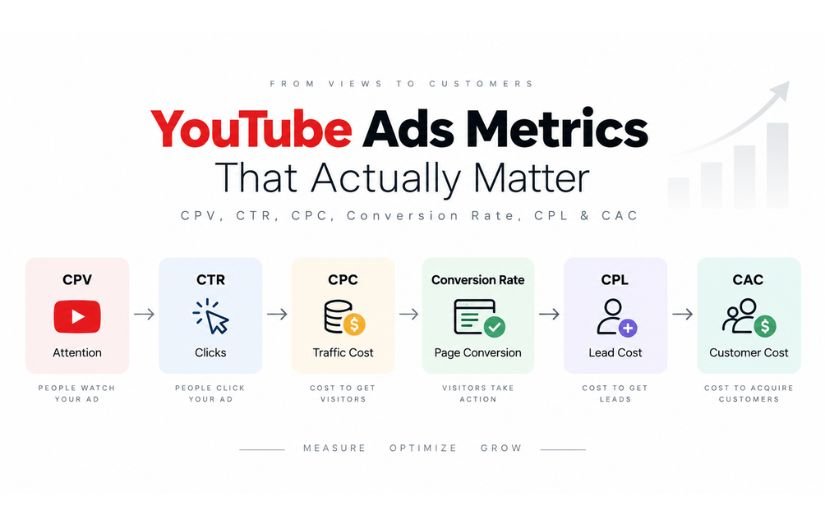
CPV tells me about the cost of attention. CTR tells me whether viewers are interested enough to click. Conversion rate tells me whether the landing page and offer are working. CPL tells me what each lead costs. CAC tells me whether the entire acquisition system makes business sense.
I do not treat any one of these metrics as the ultimate KPI.
I prefer reading them as a chain:
CPV → CTR → CPC → Conversion Rate → CPL → Qualified Lead Rate → Sales Conversion → CAC.
I’m Deepak Singh, Performance Marketing Expert based in New Delhi. My work focuses on paid acquisition across YouTube Ads, Google Ads, Meta Ads, CRO, analytics and marketing automation.
In one education and coaching acquisition system, approximately ₹50.4 lakh in advertising spend generated more than 718,000 clicks and 66,300 leads at an average CPL of approximately ₹76.
That experience reinforced something I still use today: a campaign can look strong on CPV or CTR and still be a poor business campaign if the leads do not qualify or customers are too expensive to acquire.
If you are trying to understand the economics behind these numbers, I have also explained them in my guide to YouTube Ads cost in India.
In this guide, I’ll break down the YouTube Ads metrics I actually use, what each one tells me and where advertisers often misread them.
Written by Deepak Singh
Performance Marketing Expert
How I Read YouTube Ads Metrics as a Funnel
I do not look at YouTube Ads metrics as isolated numbers.
I use them to understand what is happening at each stage of the acquisition journey.
CPV: What Does Attention Cost?
CPV, or cost per view, tells me how much I am paying for someone to watch the ad long enough to count as a view.
A low CPV can be useful, but it does not automatically mean the campaign is strong.
If views are cheap but users are not clicking or converting, then the campaign may simply be generating inexpensive attention rather than useful business intent.
CTR: Are Viewers Interested Enough to Click?
CTR helps me understand whether the creative and offer are creating enough interest for users to take the next step.
If CPV is acceptable but CTR is weak, I usually investigate the hook, message, offer and call to action before blaming the landing page.
CPC: What Does Traffic Cost?
CPC tells me how much I am paying to move a viewer from YouTube to the website or landing page.
I do not try to minimize CPC at any cost.
A more expensive click can still be valuable if that traffic converts at a stronger rate and produces better-quality leads.
Conversion Rate: Is the Landing Page Doing Its Job?
Once users reach the landing page, conversion rate becomes one of the most important metrics.
If CTR is healthy but conversion rate is weak, I start looking at the page, offer, message match, proof, form friction and mobile experience.
CPL: What Does Each Lead Cost?
CPL tells me the combined efficiency of the audience, creative, traffic and landing page.
This is where YouTube Ads begin to connect directly with lead-generation economics.
But I still do not stop at CPL.
CAC: Does the Entire Acquisition System Work?
CAC, or customer acquisition cost, tells me what it ultimately costs to acquire a paying customer.
This is usually more important to the business than whether the campaign has the cheapest CPV, CPC or CPL.
If I had to summarize the relationship simply, it would be:
CPV tells me about attention. CTR and CPC tell me about traffic. Conversion rate and CPL tell me about lead generation. CAC tells me whether the business outcome works.
What Each Metric Tells Me When Performance Drops
The value of these metrics is not just reporting. I use them to diagnose where the campaign may be breaking.
Low CPV but Weak CTR
This usually tells me that attention is cheap, but the creative is not generating enough intent.
I would look at the hook, message, offer and call to action before making major landing-page changes.
Strong CTR but Weak Conversion Rate
If users are clicking but not converting, the problem may sit after the ad.
I would investigate message match, landing-page clarity, proof, form friction, page speed, mobile usability and offer strength.
Good Conversion Rate but High CPL
If the landing page is converting reasonably well but CPL is still high, traffic may simply be too expensive.
I would then look more closely at CPC, audience cost and whether the campaign is reaching users efficiently.
Low CPL but Poor Lead Quality
This is one of the most important warning signs.
A campaign can look excellent inside Google Ads while producing leads that are irrelevant, unreachable or unlikely to buy.
In that situation, I would investigate the audience, creative promise, offer and form qualification rather than celebrating the low CPL.
Good Lead Quality but High CAC
If leads are relevant but customer acquisition cost remains high, I look beyond media metrics.
The issue may be lead-to-sale conversion, follow-up speed, counselling quality, pricing, objection handling or the broader sales process.
Strong Top-of-Funnel Metrics but No Leads
If views, CPV and CTR all look healthy but leads are missing, I would focus heavily on the landing page, conversion action and tracking setup.
I have covered this diagnostic process in more detail in my guide to why YouTube Ads get views but no leads.
My Rule: Follow the Drop-Off
I do not optimize the metric that looks the most interesting.
I follow the funnel and look for the point where performance changes from healthy to weak.
That usually tells me where the next optimization should happen.
Why I Do Not Use Universal YouTube Ads Benchmarks
One of the most common mistakes I see is judging YouTube Ads against one fixed CPV, CTR, CPL or conversion-rate benchmark.
I prefer using benchmarks as directional context rather than as pass-or-fail rules.
Different Offers Produce Different Economics
A low-ticket lead magnet, a high-ticket service, an education program and a real estate enquiry can all produce very different conversion rates and acceptable CPLs.
The business model changes what a healthy metric looks like.
Audience Intent Changes Performance
A cold prospecting audience will usually behave differently from a warm remarketing audience.
Comparing both against the same CTR, conversion rate or CPL target can create misleading conclusions.
Creative Quality Can Change the Entire Funnel
Stronger creative can improve CTR, reduce wasted traffic and attract better-fit users.
Weak creative can make the targeting look bad even when the audience itself is reasonable.
Landing Page Quality Changes What a Good CPC Means
A campaign can afford a higher CPC if the landing page converts strongly enough.
Likewise, extremely cheap clicks are not valuable if almost nobody converts after reaching the page.
Lead Quality Changes What a Good CPL Means
A ₹200 lead can be more valuable than a ₹100 lead if the more expensive lead has a much higher probability of becoming a customer.
This is why I do not scale campaigns based only on the lowest CPL.
CAC Should Be Read Against Customer Value
Customer acquisition cost only makes sense when compared with the economics of the business.
A CAC that looks expensive in one business may be completely sustainable in another if customer value and margins are higher.
I Prefer Internal Benchmarks
Once an account has enough reliable data, I find its own historical performance more useful than generic industry averages.
I compare audiences, creatives, funnel stages and time periods to understand what is improving or deteriorating inside that specific acquisition system.
The same principle applies when structuring campaigns. I prefer building around the data and business objective rather than copying a universal template. I explain that approach in my guide to YouTube Ads campaign structure.
Which YouTube Ads Metrics I Prioritize at Each Funnel Stage
I do not give every metric the same importance at every stage of the campaign.
The metric I prioritize depends on what I am trying to understand.
At the Attention Stage: CPV and View Behaviour
At the top of the funnel, I look at whether the campaign is generating attention efficiently and whether the video is holding enough interest to create the next action.
CPV can help me understand the cost of attention, but I never treat it as the final success metric.
At the Traffic Stage: CTR and CPC
Once the video is getting views, I want to know whether enough users are interested enough to click.
This is where CTR and CPC become more useful because they show how efficiently the campaign is turning attention into site traffic.
At the Lead Generation Stage: Conversion Rate and CPL
After users reach the landing page, I focus much more heavily on conversion rate and CPL.
This tells me whether the traffic is converting and whether the combined audience, creative and landing-page system is producing leads efficiently.
At the Qualification Stage: Lead Quality
Once leads are coming in, I want to know whether those leads are actually relevant.
This is where I look at qualification rate, contactability, sales feedback and any other downstream signal the business can reliably provide.
At the Revenue Stage: Sales Conversion and CAC
As soon as enough sales data is available, I want to connect advertising performance back to customer acquisition cost.
This is where the campaign moves from media optimization into business economics.
For Remarketing: Conversion Rate, CPL and Frequency
Remarketing audiences already know the brand, so I usually care less about whether they can generate cheap views and more about whether they are converting efficiently without being overexposed.
That is why I pay close attention to conversion rate, CPL, downstream quality and frequency when evaluating warm audiences.
You can see how I apply that logic in my guide to YouTube Ads remarketing.
For me, the key is simple: use the metric that best explains the stage of the funnel you are trying to improve.
How I Use YouTube Ads Metrics Together to Make Decisions
The biggest mistake I try to avoid is making decisions from one metric without checking what is happening around it.
I prefer reading several metrics together so that the diagnosis is based on the full acquisition path.
Low CPV + Low CTR
This can mean the campaign is generating inexpensive attention but not enough intent.
I would usually investigate the creative, audience relevance and offer before treating the low CPV as a positive result.
High CPV + Strong CTR
This does not automatically mean the campaign is bad.
If the users who do watch are highly relevant, click at a strong rate and convert efficiently, the higher CPV may still be acceptable.
Strong CTR + High CPC
If CTR is strong but CPC remains expensive, I would look at auction cost, audience competitiveness and whether the traffic quality justifies the price.
The right question is not whether the click is cheap. It is whether the click produces enough value further down the funnel.
Strong CTR + Weak Conversion Rate
This usually shifts my attention toward the landing page, offer and message match.
The ad may be doing its job, but the post-click experience may not be strong enough to convert the interest being generated.
Low CPL + Weak Lead Quality
This is a classic example of why CPL should not be used alone.
If the leads do not qualify, connect or buy, I would rather pay more for a stronger lead than optimize aggressively toward the cheapest form submission.
Higher CPL + Strong Sales Conversion
A more expensive lead can still produce better business economics if it converts to a customer at a much stronger rate.
This is where CAC becomes more important than CPL.
Good Media Metrics + Poor CAC
If CPV, CTR, conversion rate and CPL all look reasonable but CAC is still too high, I would investigate what happens after lead generation.
The problem may sit in lead qualification, sales follow-up, pricing, closing rate or the economics of the offer itself.
My Preferred Decision Chain
I usually work through the numbers in this order:
Attention Cost → Click Behaviour → Traffic Cost → Landing Page Conversion → Lead Cost → Lead Quality → Sales Conversion → Customer Acquisition Cost.
This keeps optimization connected to business outcomes rather than isolated platform metrics.
If you want to see how these metrics fit into the broader acquisition process, review my YouTube Ads lead generation framework.
Common YouTube Ads Metrics Mistakes I Avoid
Most reporting problems do not come from missing data. They come from reading the right data in the wrong way.
1. Treating Low CPV as Success
Cheap views can look impressive, but they mean very little if the campaign is not generating clicks, leads or customers.
I use CPV as an attention metric, not as proof that the campaign is working.
2. Optimizing Only for High CTR
A strong CTR can be useful, but it can also come from messaging that attracts curiosity rather than qualified intent.
I always check what happens after the click before judging the creative as a winner.
3. Chasing the Cheapest CPC
The cheapest traffic is not automatically the best traffic.
I would rather pay more for clicks that convert and produce qualified leads than optimize toward low-cost visitors who never become customers.
4. Judging Landing Pages Without Looking at Traffic Quality
A weak conversion rate does not always mean the landing page is the only problem.
If the audience or creative is attracting the wrong users, even a strong landing page can struggle to convert.
5. Scaling the Lowest CPL Campaign
This is one of the biggest mistakes I avoid.
I want to know whether the leads qualify, connect with the sales team and eventually become customers before allocating more budget.
6. Ignoring Lead Quality Data
If the advertising dashboard says performance is strong but the sales team says the leads are poor, I do not ignore that feedback.
Platform metrics and downstream business data need to be read together.
7. Comparing Cold and Remarketing Metrics Directly
Warm audiences already have familiarity with the brand, so their CTR, conversion rate and CPL can naturally look stronger than cold acquisition.
I prefer evaluating them according to their role in the funnel rather than expecting prospecting and remarketing to produce identical metrics.
8. Using Generic Benchmarks as Hard Rules
Industry averages can provide context, but they do not know your margins, offer, audience quality or sales process.
I prefer using account history and business economics as the primary benchmark once enough reliable data is available.
9. Ignoring Tracking Problems
Incorrect conversion tracking can make good campaigns look weak and weak campaigns look strong.
Before making major optimization decisions, I want confidence that the conversion being reported represents the action the business actually cares about.
10. Stopping the Analysis at CPL
CPL is useful, but it is not the finish line.
For lead-generation campaigns, I ultimately want to connect advertising performance with qualified leads, sales conversion and customer acquisition cost.
If your campaign metrics look healthy but leads are still missing, my guide to why YouTube Ads get views but no leads covers the diagnostic process in more detail.
Frequently Asked Questions About YouTube Ads Metrics
What Is a Good CPV for YouTube Ads?
I do not use one universal CPV benchmark for every campaign.
A useful CPV depends on audience quality, campaign objective, competition and what happens after the view. A low CPV is only valuable if those viewers also create meaningful downstream actions.
What Is a Good CTR for YouTube Ads?
I treat CTR as a directional metric rather than a fixed pass-or-fail number.
The more important question is whether clicks are turning into conversions, qualified leads and customers at acceptable economics.
Is CPL More Important Than CTR?
For lead-generation campaigns, CPL is usually closer to the business outcome than CTR.
But I still use CTR to diagnose creative performance and CPL to understand the combined efficiency of audience, creative and landing-page conversion.
What Is the Difference Between CPL and CAC?
CPL measures how much it costs to generate a lead.
CAC measures how much it costs to acquire a paying customer.
A campaign can have a low CPL and still have a poor CAC if very few leads eventually become customers.
Which Metric Matters Most for YouTube Ads?
There is no single metric that matters most in every situation.
For awareness I may care more about attention metrics. For lead generation I focus more on conversion rate, CPL and lead quality. For business performance, CAC becomes much more important.
Can a High CPC Still Be Profitable?
Yes.
If the traffic converts at a strong rate and produces valuable customers, a higher CPC can still result in better overall economics than cheaper traffic with weak conversion quality.
Why Is My CPL Low but Sales Are Poor?
This can happen when the campaign is attracting users who complete the lead action but are poorly matched to the offer.
I would investigate audience quality, creative messaging, qualification criteria, sales follow-up and lead-to-sale conversion.
Should I Compare My Metrics With Industry Benchmarks?
Benchmarks can provide context, but I would not use them as strict targets.
Once enough account data exists, I usually prefer comparing performance with your own historical results, audience segments, creatives and downstream business outcomes.
How Often Should I Review YouTube Ads Metrics?
I review campaign performance regularly, but I try not to overreact to short-term fluctuations.
The amount of data needed before making a decision depends on spend, conversion volume and how quickly the funnel produces reliable signals.
What Should I Do If All My Top-Level Metrics Look Good but CAC Is Still High?
I would look beyond the ad account.
The issue may sit in qualification, sales conversion, pricing, follow-up, offer structure or other parts of the customer acquisition process after the lead is generated.
Sources & Methodology
This article combines my own performance marketing experience with official Google Ads documentation and first-hand campaign data.
Where I refer to my YouTube Ads results, the figures come from an education and coaching acquisition system that generated more than 66,300 leads at an average CPL of approximately ₹76, along with more than 718,000 clicks from approximately ₹50.4 lakh in advertising spend.
These figures represent a specific campaign and business context. They should not be treated as universal benchmarks or guaranteed outcomes for other advertisers.
The framework in this article reflects how I personally use metrics such as CPV, CTR, CPC, conversion rate, CPL, lead quality, sales conversion and CAC to diagnose different stages of the acquisition funnel.
For platform definitions and measurement concepts, I refer to official Google Ads documentation covering YouTube advertising, views, clicks, conversions, conversion tracking, campaign reporting and optimization.
I intentionally avoid presenting one universal CPV, CTR, conversion-rate or CPL benchmark because acceptable performance depends on the audience, offer, funnel, business model, margins and downstream conversion economics.
The methodology throughout this article is therefore based on reading YouTube Ads metrics as a connected funnel rather than treating any single advertising metric as proof of campaign success.
Want Help Understanding What Your YouTube Ads Metrics Are Really Telling You?
If your campaign has a low CPV or strong CTR but still struggles to generate profitable customers, I would look beyond the surface-level numbers.
The goal is to understand how attention, traffic, conversion rate, CPL, lead quality and CAC connect across the full acquisition funnel.
You can also review my YouTube Ads cost guide, my YouTube Ads lead generation framework, or my guide to YouTube Ads campaign structure.
If your metrics look good but conversions are still weak, see 10 things I check when YouTube Ads get views but no leads.
If you want help auditing your YouTube Ads performance and identifying where the funnel is breaking, you can work with me.