Quick Answer
How Should You Structure YouTube Ads Remarketing?
I do not treat YouTube Ads remarketing as one audience containing everyone who has interacted with the business.
I prefer separating users based on what they did, how much intent they showed and where they dropped out of the acquisition journey.
A simple remarketing structure can include video viewers, website visitors, landing-page visitors, users who started but did not complete a conversion, and existing leads who may need a different follow-up message.
The message should also change as the user moves deeper into the funnel. Someone who watched a video for the first time usually needs a different ad from someone who visited the landing page and almost completed the form.
I’m Deepak Singh, Performance Marketing Expert based in New Delhi. I use remarketing as one layer inside a broader YouTube Ads lead generation system, alongside audience targeting, creative, landing pages, tracking and scaling.
In one education and coaching acquisition system, approximately ₹50.4 lakh in advertising spend generated more than 66,300 leads at an average CPL of approximately ₹76. Remarketing was part of the wider acquisition approach rather than a standalone growth tactic.
In this guide, I’ll explain how I segment warm audiences, how I match the message to funnel stage, which users I prioritize first and how I evaluate whether remarketing is actually improving acquisition performance.
Written by Deepak Singh
Performance Marketing Expert
The Remarketing Audiences I Build First
I prefer starting with a small number of warm audience groups that represent meaningfully different levels of intent.
The goal is not to create every possible remarketing segment. It is to separate users based on how close they appear to be to taking the next step.
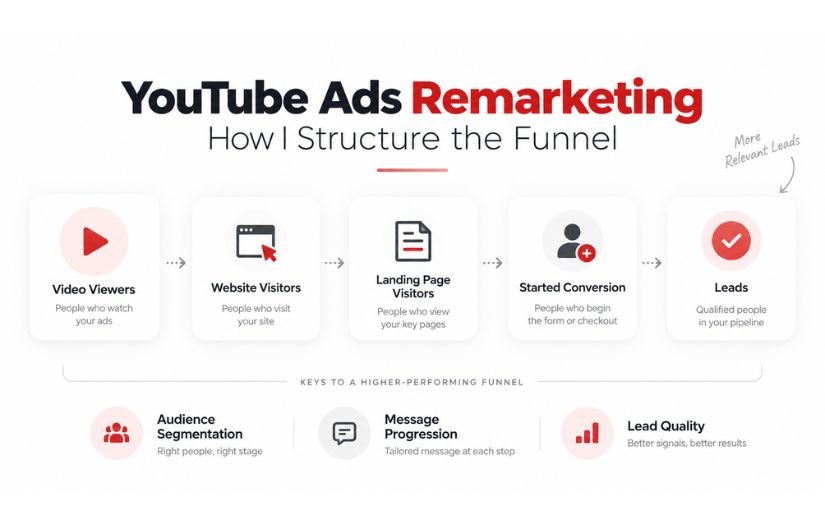
1. Video Viewers
Users who watched a meaningful portion of a video have already shown more interest than someone who simply received an impression.
I may use these audiences to continue the conversation with stronger proof, a clearer offer or a more direct call to action.
2. Website Visitors
Website visitors have taken an additional step beyond watching the video.
I want to understand which pages they visited and whether their behaviour suggests general curiosity or stronger commercial intent.
3. Landing Page Visitors Who Did Not Convert
This is one of the most important remarketing groups for lead-generation campaigns.
These users were interested enough to click the ad and reach the conversion page but left without completing the desired action.
I may use follow-up creative to address objections, add proof, clarify the offer or remind them what they were considering.
4. Funnel Drop-Off Audiences
If the funnel contains multiple steps, I prefer identifying where users stopped.
Someone who started a registration, application or enquiry but did not finish it can require a very different message from someone who only visited the first page.
5. Existing Leads
Existing leads should not automatically receive the same acquisition message as cold users.
Depending on the sales cycle, they may need education, proof, FAQs, case studies or another step that helps move them toward qualification or purchase.
6. Existing Customers
Existing customers may need to be excluded from acquisition campaigns, or they may be useful for upsell, cross-sell or retention depending on the business.
I prefer making this decision intentionally rather than allowing existing customers to remain mixed into prospecting and remarketing audiences by default.
Keep Audience Segmentation Practical
I would rather have a few remarketing groups with clear purpose and enough volume than many tiny audiences that are difficult to evaluate.
The broader cold, warm and remarketing segmentation logic connects directly with the approach I explain in my guide to YouTube Ads targeting in India.
How I Match Remarketing Messages to Funnel Stage
I do not like showing the same remarketing ad to every warm user.
The message should reflect what the user already knows, what they have already done and what is most likely stopping them from taking the next step.
For Video Viewers
Someone who watched the video but never visited the website may still need more context before they are ready to convert.
I would usually test stronger proof, a clearer value proposition or a more direct explanation of the offer.
For Website Visitors
Website visitors have already shown stronger interest, so I can often move the message closer to the decision.
That might mean focusing on differentiation, outcomes, testimonials, FAQs or the specific problem the offer solves.
For Landing Page Visitors Who Did Not Convert
These users are especially important because they reached the conversion page but did not complete the action.
I would look at possible reasons such as uncertainty, lack of proof, weak urgency, form friction or confusion about the offer.
The remarketing message should try to remove one of those barriers rather than simply repeating the original ad.
For Users Who Started but Did Not Finish
If someone started a registration, application or enquiry and then dropped out, I would treat them as a higher-intent audience.
The creative can be much more direct and focus on completion, reassurance, deadlines, support or the remaining step.
For Existing Leads
Existing leads may already understand the offer but still need help moving toward qualification or purchase.
Depending on the business, I might use case studies, testimonials, objection handling, demonstrations or educational content to support the sales process.
For Existing Customers
Existing customers usually should not keep seeing the same acquisition message.
They may need to be excluded completely, or moved into a different strategy for upsell, cross-sell, retention or referral.
Remarketing Works Better When the Message Progresses
I think of remarketing as a sequence rather than repetition.
The user should feel that the message is moving forward with them through the funnel, not showing them the same ad again and again.
This progression is especially important in longer decision cycles such as education, which is why remarketing is a key part of how I structure YouTube Ads for EdTech lead generation.
How I Prioritize Remarketing Audiences
Not every warm audience deserves the same budget or the same urgency.
I usually prioritize remarketing based on a combination of intent, recency, funnel depth and conversion potential.
Higher-Intent Users Come First
Someone who reached the landing page, started a form or entered the application process is usually more valuable than someone who only watched a small portion of a video.
I would generally give more attention to users who moved further through the funnel.
Recency Matters
A user who interacted with the business yesterday may be more likely to convert than someone whose last interaction was several months ago.
I prefer keeping recent, high-intent users separate when the audience size is large enough to make that practical.
Different Funnel Stages Need Different Windows
The right remarketing window depends on the business and decision cycle.
A low-consideration offer may need a shorter follow-up period, while education, real estate or high-ticket services may require a longer window because users take more time to decide.
Do Not Let Low-Intent Audiences Consume the Entire Budget
Large video-viewer audiences can look attractive because they provide scale, but I do not want them to crowd out smaller, higher-intent segments such as landing-page visitors or incomplete applicants.
I prefer allocating spend based on conversion value rather than audience size alone.
Prioritize Based on Downstream Performance
If one remarketing audience produces a lower CPL but poor lead quality, while another produces more expensive but stronger leads, I may prefer the second group.
The same principle applies here as in prospecting: the closer the metric gets to the final business outcome, the more weight I give it.
My Preferred Priority Order
A simple priority structure can look like this:
Started Conversion → Landing Page Visitor → Website Visitor → High-Engagement Video Viewer → Broader Video Viewer.
I would still adjust this based on actual campaign data, but it gives me a practical starting point for remarketing funnel design.
How I Measure Whether Remarketing Is Actually Working
Remarketing can look efficient simply because the audience already knows the brand, so I try to evaluate it carefully rather than assuming every warm-audience conversion is incremental.
Start With Conversion Rate
I expect warmer audiences to convert better than cold traffic in many cases, but I still want to understand whether that improvement is meaningful enough to justify the spend.
Compare CPL With Prospecting
A lower CPL from remarketing can be a positive signal, but it should be interpreted in context.
If the same users were likely to convert anyway, a cheap remarketing CPL can overstate the actual value of the campaign.
Look at Lead Quality
I want to know whether remarketing is producing stronger leads, not just cheaper leads.
That means comparing qualified lead rate, sales conversion and customer acquisition cost where enough downstream data is available.
Watch Frequency
Remarketing audiences are usually smaller, so frequency can rise faster than it does in cold campaigns.
If users are seeing the same creative too often, performance can deteriorate and the campaign can become annoying rather than useful.
Measure by Funnel Stage
I prefer separating performance by audience type where possible.
A landing-page visitor, incomplete applicant and video viewer may have very different conversion behaviour, so combining them into one reporting bucket can hide useful information.
Evaluate Incremental Value
The most important question is whether remarketing is helping move users further through the funnel rather than simply claiming conversions from people who were already going to convert.
I look at remarketing as one layer inside the complete acquisition system, not as a separate channel that should receive credit for everything that happens after the first interaction.
Connect Remarketing Back to Acquisition Economics
Ultimately, I want to know whether remarketing improves the economics of the full funnel.
That means looking beyond CPV or CPC and connecting performance with the wider metrics I discuss in my guide to YouTube Ads cost in India, including CPL, lead quality and customer acquisition cost.
Common YouTube Ads Remarketing Mistakes I Avoid
Remarketing is powerful, but it becomes wasteful very quickly when every warm user is treated the same.
1. Putting Every Warm User Into One Audience
A video viewer, landing-page visitor and incomplete applicant have very different levels of intent.
I prefer separating them when audience size allows so that messaging and budget can reflect funnel depth.
2. Showing the Same Ad Again and Again
Remarketing should move the conversation forward.
If the user keeps seeing the same creative with the same message, frequency can increase without adding any new reason to convert.
3. Ignoring Recency
Someone who interacted yesterday may behave very differently from someone whose last interaction was 90 days ago.
I prefer giving more weight to recent, higher-intent users where practical.
4. Using Remarketing to Compensate for a Weak Funnel
If the offer, landing page or conversion process is weak, remarketing will not fix the core problem.
I use remarketing to support a working funnel, not to hide a broken one.
5. Forgetting to Exclude Converted Users
If someone has already completed the intended action, they may need to be excluded from that acquisition sequence.
Otherwise, budget can be wasted repeatedly targeting users who have already converted.
6. Letting Frequency Rise Too High
Remarketing audiences are smaller, so repeated exposure can increase quickly.
I watch frequency and creative performance to understand when the audience needs fresh messaging or a longer break.
7. Judging Success Only by Cheap CPL
Remarketing often produces lower CPL because the audience already knows the brand.
I still want to know whether those leads are qualified and whether the campaign is contributing meaningful incremental value.
8. Over-Segmenting Small Audiences
Too many tiny audience groups can make delivery unstable and reporting difficult.
I prefer practical segmentation with enough volume to learn from the data.
For me, the strongest remarketing structure is usually simple: segment by intent, match the message to the stage, control frequency, exclude completed conversions and evaluate downstream quality.
Frequently Asked Questions About YouTube Ads Remarketing
What Is YouTube Ads Remarketing?
YouTube Ads remarketing means reaching users who have already interacted with the business, such as video viewers, website visitors, landing-page visitors or users who started but did not complete a conversion.
What Is the Difference Between Remarketing and Retargeting?
In everyday marketing usage, the terms are often used interchangeably. In this article, I use remarketing to describe paid follow-up campaigns aimed at users who have already shown some level of interest.
Who Should I Remarketing to First?
I usually prioritize users based on funnel depth and intent. Someone who started a form or visited the conversion page is generally more valuable than someone who only watched a small portion of a video.
Should Video Viewers and Website Visitors Be in the Same Audience?
Not always. They can represent different levels of intent, so I prefer separating them when the audience size is large enough to support meaningful delivery and measurement.
How Long Should a YouTube Remarketing Window Be?
The right window depends on the buying cycle. A low-consideration offer may need a shorter window, while education, real estate or high-ticket services may require a longer period.
Should I Use the Same Creative for Remarketing?
I usually prefer changing the message as users move deeper into the funnel.
Warm audiences may respond better to proof, FAQs, objections, urgency, case studies or a more direct call to action than completely cold users.
Can Remarketing Reduce CPL?
It can, because remarketing audiences already have some familiarity with the business. However, I would still evaluate lead quality and downstream conversion rather than assuming a lower CPL automatically means better performance.
How Do I Know If Remarketing Is Working?
I look at conversion rate, CPL, lead quality, frequency and downstream customer acquisition performance.
The key question is whether remarketing is actually helping users move further through the funnel and improving the economics of the overall acquisition system.
Should Existing Customers Be Excluded From Remarketing?
Often, yes, if the campaign is focused on new-customer acquisition.
Existing customers may instead need a separate strategy for retention, upsell, cross-sell or referral.
Sources & Methodology
This article combines my own performance marketing experience with current Google Ads documentation and first-hand campaign data.
Where I refer to my YouTube Ads results, the figures come from an education and coaching acquisition system that generated more than 66,300 leads at an average CPL of approximately ₹76, along with more than 718,000 clicks from approximately ₹50.4 lakh in advertising spend.
These figures represent a specific campaign and business context. They should not be treated as universal benchmarks or guaranteed outcomes for other advertisers.
The remarketing framework in this article reflects how I personally structure warm-audience follow-up across video viewers, website visitors, landing-page visitors, incomplete conversions, existing leads and customers.
For current platform information, I refer to official Google Ads documentation covering YouTube advertising, audience segments, remarketing, Demand Gen and conversion tracking.
The recommendations in this article are intended to explain how I think about remarketing as part of a complete acquisition funnel rather than suggest that every business should use the same audience windows, exclusions or campaign structure.
Need Help Structuring Your YouTube Remarketing Funnel?
If your YouTube campaigns are generating traffic but too many users drop out before converting, I would look at how warm audiences are being segmented and what message each group sees next.
The strongest remarketing setup usually connects audience intent, funnel stage, creative progression, exclusions, frequency and downstream conversion quality rather than simply showing the same ad repeatedly.
You can review my YouTube Ads lead generation framework, see how I structure YouTube Ads targeting in India, or study the 66,300+ lead YouTube Ads case study.
If you want help building or improving your YouTube remarketing funnel, you can also work with me.