Quick Answer
Why Are Your YouTube Ads Getting Views but No Leads?
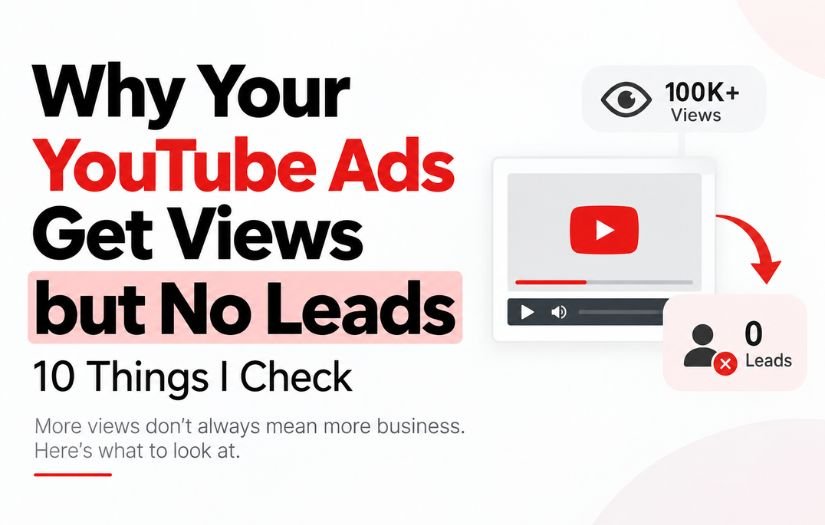
If your YouTube Ads are generating views but very few leads, I would not assume that YouTube itself is the problem.
The breakdown can happen at several points: the wrong audience may be watching, the video may not create enough intent, the offer may be weak, users may not click, the landing page may not convert, tracking may be broken or the conversion action may require too much commitment.
I usually diagnose the problem through the complete acquisition chain:
View → Click → Landing Page → Lead → Qualified Lead → Customer.
I’m Deepak Singh, Performance Marketing Expert based in New Delhi. My work focuses primarily on paid acquisition across YouTube Ads, Google Ads, Meta Ads, CRO, analytics and conversion systems.
In one education and coaching acquisition system, approximately ₹50.4 lakh in advertising spend generated more than 66,300 leads at an average CPL of approximately ₹76, along with more than 718,000 clicks.
You can see the complete methodology in my 66,300+ lead YouTube Ads case study and the wider system in my YouTube Ads lead generation framework.
I also publish practical performance marketing and YouTube Ads content on my YouTube channel.
In this guide, I’ll walk through the 10 things I check first when YouTube Ads are getting attention but failing to turn that attention into leads.
Written by Deepak Singh
Performance Marketing Expert
10 Things I Check When YouTube Ads Get Views but No Leads
When a campaign is generating views but not enough leads, I work through the funnel systematically rather than changing random settings inside Google Ads.
1. Is the Audience Actually Relevant?
The first thing I check is whether the campaign is reaching people who are realistically connected to the offer.
Cheap views from a weak audience can make the campaign look efficient at the top of the funnel while producing almost no commercial intent.
I look at targeting logic, audience signals and downstream conversion behaviour rather than judging the audience only by reach or CPV.
I explain this process in more detail in my guide to YouTube Ads targeting in India.
2. Is the Video Attracting the Right Viewer?
A video can generate views without generating the right kind of attention.
If the hook is too broad, entertaining or curiosity-driven without connecting clearly to the offer, the campaign may attract viewers who were never likely to become leads.
I want the creative to make the target customer feel that the message is specifically relevant to their problem or desired outcome.
3. Is There a Clear Reason to Click?
Views do not automatically turn into website traffic.
If users are watching but CTR is weak, I check whether the video clearly explains what the viewer should do next and why taking that action is worth it.
The CTA should connect directly with the value proposition rather than appearing as a generic instruction at the end of the video.
4. Is the Offer Strong Enough?
Sometimes the targeting and creative are reasonable, but the offer itself is not compelling enough to make users take action.
I ask whether the user understands what they are getting, whether the value is clear and whether the next step feels worth the effort required.
5. Does the Landing Page Match the Ad?
If the video creates one expectation and the landing page communicates something different, conversion rate can fall immediately.
I check whether the headline, promise, offer and CTA on the page continue the same conversation that started in the video.
6. Is the Landing Page Converting Properly?
If users are clicking but very few are becoming leads, the landing page becomes one of the first places I investigate.
I look at page clarity, mobile experience, form friction, proof, loading issues and whether there are too many competing actions.
7. Is Conversion Tracking Working Correctly?
Sometimes the campaign appears to have no leads because tracking is incomplete, duplicated or firing on the wrong action.
I want to verify that the conversion being reported actually represents the business action we care about before making optimization decisions.
8. Are We Asking for Too Much Too Soon?
A cold YouTube viewer may not be ready to complete a long application, book a sales call or provide extensive personal information immediately.
If the conversion action requires too much commitment, I consider whether a simpler first step would create a better bridge between the ad and the final business objective.
9. Are Interested Users Being Remarketed To?
Many users will watch, click or visit the landing page without converting during the first interaction.
If there is no structured follow-up, the business may be losing users who showed genuine interest but needed more proof, time or information before taking action.
This is where a properly structured YouTube Ads remarketing funnel can become valuable.
10. Are We Measuring Leads or Business Outcomes?
The final thing I check is whether the campaign is being judged only by lead volume or by what happens after the lead is generated.
A campaign with fewer leads can still be stronger if those leads qualify and convert at a higher rate.
I ultimately want to understand CPL, lead quality, lead-to-sale conversion and customer acquisition cost rather than optimizing only toward the cheapest form submission.
These ten checks help me identify whether the problem sits in the audience, creative, offer, landing page, tracking, conversion action, remarketing or downstream sales process.
How I Diagnose Where the Funnel Is Breaking
Once I know the campaign is getting views but not enough leads, I try to identify the exact stage where users are dropping out.
I prefer diagnosing the funnel in sequence rather than making changes everywhere at once.
Step 1: Views Are Coming, but CTR Is Weak
If the campaign is generating views but very few clicks, I look first at the hook, message, offer and call to action.
The audience may be relevant, but the creative may not be giving users a strong enough reason to take the next step.
Step 2: CTR Is Acceptable, but Landing Page Conversion Is Weak
If users are clicking but not converting, the problem may be after the ad.
I check message match, page clarity, form friction, proof, mobile usability and whether the offer is easy to understand.
Step 3: Leads Are Coming, but CPL Is Too High
If the funnel is generating leads but the CPL is higher than the business can support, I look at both media efficiency and conversion efficiency.
That includes audience cost, CPC, landing-page conversion rate and the strength of the offer.
I explain how these metrics connect in my guide to YouTube Ads cost in India.
Step 4: CPL Looks Good, but Lead Quality Is Weak
This is where the campaign can become misleading.
A low CPL can look like success until the sales team reports that the leads are irrelevant, unreachable or poorly matched to the offer.
I then look at which audiences, creatives and messages are producing those leads and whether the campaign is attracting the wrong type of prospect.
Step 5: Lead Quality Is Good, but Sales Are Weak
If the leads are relevant but few are becoming customers, I would investigate what happens after acquisition.
That can include follow-up speed, counselling or sales quality, objection handling, pricing, offer structure and the overall sales process.
Step 6: Performance Was Good, Then Suddenly Dropped
If a campaign that was working starts deteriorating, I look for changes in creative response, audience performance, frequency, conversion rate, tracking or downstream lead quality.
I avoid assuming that every performance drop requires a major campaign restructure.
My Diagnostic Order
I usually work through the funnel in this order:
Audience → Creative → CTR → Landing Page → Conversion Rate → CPL → Lead Quality → Sales Conversion → Customer Acquisition Cost.
This approach helps me change the part of the system that is actually broken instead of reacting to one surface-level metric.
What I Change First Based on the Signal I See
I do not make the same optimization when every YouTube campaign underperforms. The first change depends on where the data suggests the problem actually exists.
If Views Are Cheap but CTR Is Weak
I usually start with the creative rather than the landing page.
I would test a stronger hook, clearer problem, more specific value proposition or a better reason for the viewer to click.
If CTR Is Strong but Leads Are Weak
If people are clicking but not converting, I shift attention toward the landing page, offer and conversion action.
The ad may already be doing its job. The problem may be what happens after the click.
If CPL Is High Across Every Audience
If multiple audiences are producing similar weak economics, I would question whether the problem is bigger than targeting alone.
I would look at the offer, landing-page conversion rate, creative-message fit and tracking before creating dozens of new audience segments.
If One Audience Has Cheap Leads but Poor Quality
I would not automatically scale that audience.
I would compare it with audiences producing more expensive but better-qualified leads and look at what happens further down the funnel.
If Remarketing Converts but Cold Traffic Does Not
This can suggest that users need more education, proof or repeated exposure before they are ready to act.
In that situation, I would examine whether the cold creative is asking for too much too early and whether the funnel needs a better bridge between first exposure and conversion.
If Performance Drops After Scaling
I check whether the campaign is reaching less responsive users, whether creative performance has weakened, whether landing-page conversion has changed and whether lead quality has deteriorated.
Scaling can expose weaknesses that were less visible at a smaller budget.
If the Numbers Look Fine but Sales Are Still Weak
I move beyond Google Ads and look at the business process.
The issue may be lead qualification, response time, counselling, sales follow-up, pricing or the offer itself rather than the advertising platform.
This is why I use a full-funnel approach rather than treating YouTube Ads as an isolated media-buying activity. The same logic sits behind my broader YouTube Ads lead generation framework.
A Real Example: Why Views Alone Tell Me Very Little
One reason I do not judge YouTube campaigns by views alone is that I have seen how different the economics look once you follow users further through the funnel.
In one education and coaching acquisition system, approximately ₹50.4 lakh in advertising spend generated more than 718,000 clicks and 66,300 leads at an average CPL of approximately ₹76.
The important part was not simply generating large-scale attention. The campaign had to connect audience selection, video messaging, landing-page conversion, remarketing and measurement into one acquisition system.
Education Campaigns Make Funnel Quality Especially Visible
My background includes both performance marketing for education businesses and digital marketing training. You can also view my public Udemy instructor profile.
That experience has made one thing very clear to me: a learner watching a video is not the same as a learner who is ready to register, enquire or purchase.
The campaign has to create enough relevance and trust to move that person from attention toward an actual business outcome.
High View Volume Can Hide a Weak Funnel
A campaign can generate thousands of views and still fail if users are not clicking, the landing page is not converting or the leads being generated are poor quality.
That is why I look at what happens after the view rather than treating video consumption as the final result.
The Same Principle Applies Beyond EdTech
This diagnostic approach applies to coaching, service businesses, real estate, digital products and other lead-generation models as well.
The exact funnel may change, but the core question remains the same: where does attention stop turning into commercial intent?
You can see how I apply this thinking specifically to education businesses in my guide to YouTube Ads for EdTech lead generation.
The Metrics I Use to Identify the Real Problem
When YouTube Ads are getting views but not enough leads, I do not look at one metric in isolation. I use each metric to understand where the funnel may be breaking.
CPV: Is the Campaign Generating Attention Efficiently?
CPV helps me understand how efficiently the campaign is generating video views.
A low CPV can be useful, but it does not tell me whether the right audience is watching or whether those viewers have enough intent to become leads.
CTR: Are Viewers Interested Enough to Take the Next Step?
If views are strong but CTR is weak, I usually investigate the creative, offer and call to action.
The campaign may be earning attention without creating enough motivation to click.
CPC: How Expensive Is the Traffic?
CPC helps me understand how much the campaign is paying to move users from YouTube to the landing page.
I would still avoid judging CPC alone because more expensive traffic can be more valuable if it converts at a stronger rate.
Landing Page Conversion Rate: Is the Page Turning Traffic Into Leads?
If CTR is acceptable but leads remain weak, landing-page conversion rate becomes one of the most important metrics.
A poor conversion rate can indicate message mismatch, weak proof, form friction, usability problems or an offer that is not strong enough.
CPL: What Does Each Lead Actually Cost?
CPL tells me whether the combined audience, creative and landing-page system is producing leads efficiently.
I still compare it with lead quality before deciding whether a campaign is successful.
Qualified Lead Rate: Are We Attracting the Right People?
This is where many campaigns that look good inside Google Ads can start looking very different.
If the leads are cheap but very few qualify, I would investigate the audience, messaging and conversion criteria.
Lead-to-Sale Rate: Are Leads Becoming Customers?
If lead quality appears acceptable but sales remain weak, I look further down the funnel.
This can reveal problems in follow-up, qualification, counselling, pricing or the sales process itself.
Customer Acquisition Cost: Does the Complete System Make Business Sense?
Customer acquisition cost is the metric I ultimately want to understand once enough sales data is available.
The cheapest CPV, CPC or CPL means very little if the business cannot acquire customers at sustainable economics.
This is why I prefer diagnosing YouTube Ads through the full chain rather than asking whether one isolated platform metric is good or bad.
Frequently Asked Questions About YouTube Ads Getting Views but No Leads
Why Are My YouTube Ads Getting Views but No Conversions?
The most common reason is that attention is not turning into enough intent. The issue can sit in the audience, creative, offer, landing page, conversion action or tracking setup.
I would diagnose the complete funnel rather than assume that high view volume means the campaign should automatically generate leads.
Does a High View Rate Mean My YouTube Ad Is Working?
Not necessarily. A high view rate can show that users are watching the video, but it does not tell you whether they are clicking, converting or becoming customers.
For lead-generation campaigns, I would give more weight to CTR, landing-page conversion rate, CPL and lead quality.
What Should I Check First If YouTube Ads Are Not Generating Leads?
I would start with the sequence: audience relevance → creative → CTR → landing page → conversion tracking → CPL → lead quality.
This helps identify where the biggest drop-off is happening before making major changes.
Can the Audience Be the Problem Even If Views Are Cheap?
Yes. Cheap views can come from users who are easy to reach but poorly matched to the offer.
I would compare audience performance using downstream conversion and lead-quality data rather than CPV alone.
Can a Bad Landing Page Cause YouTube Ads to Fail?
Yes. If users are clicking the ad but not converting, the landing page can become the main bottleneck.
I would review message match, offer clarity, proof, mobile experience, form friction and page usability.
Should I Change the Targeting or the Creative First?
It depends on the signal. If views are coming but CTR is weak, I would usually inspect creative and messaging first. If CTR is reasonable but lead quality is weak, I would look more closely at targeting and offer fit.
Can Remarketing Help If Users Are Clicking but Not Converting?
Yes. Remarketing can help bring back users who showed interest but were not ready to convert during the first interaction.
The key is to show them a more relevant follow-up message rather than simply repeating the original ad.
How Long Should I Wait Before Deciding YouTube Ads Are Not Working?
I would not use the same number of days for every business. The campaign needs enough traffic and conversion data to identify whether the problem is the audience, creative, landing page or offer.
A high-volume lead-generation funnel can produce useful signals much faster than a low-volume, high-ticket business.
Should I Stop a Campaign If It Gets Views but No Leads?
Not immediately. First identify whether the campaign is failing before the click, after the click or further down the funnel.
If the problem is fixable, such as weak creative, poor message match or landing-page friction, the campaign may still have potential after those issues are addressed.
Sources & Methodology
This article combines my own performance marketing experience with current Google Ads documentation and first-hand campaign data.
Where I refer to my YouTube Ads results, the figures come from an education and coaching acquisition system that generated more than 66,300 leads at an average CPL of approximately ₹76, along with more than 718,000 clicks from approximately ₹50.4 lakh in advertising spend.
These figures represent a specific campaign and business context. They should not be treated as universal benchmarks or guaranteed outcomes for other advertisers.
The diagnostic framework in this article reflects how I personally investigate YouTube campaigns across audience relevance, creative, CTR, landing-page conversion, tracking, CPL, lead quality, sales conversion and customer acquisition cost.
For current platform information, I refer to official Google Ads documentation covering YouTube advertising, audience targeting, Demand Gen, conversion tracking and campaign optimization.
The recommendations in this article are intended to explain how I diagnose performance problems systematically rather than suggest that every campaign with views but no leads has the same underlying issue.
Want Help Fixing a YouTube Ads Funnel That Gets Views but No Leads?
If your YouTube Ads are generating attention but not enough leads, I would first identify the exact stage where the funnel is breaking before increasing budget or rebuilding the campaign.
The problem could be audience quality, creative, CTR, landing-page conversion, tracking, offer strength, remarketing or downstream lead quality.
You can also review my YouTube Ads lead generation framework, my guide to YouTube Ads targeting in India, or my YouTube Ads remarketing structure.
For more practical videos on YouTube Ads, Google Ads and performance marketing, visit my YouTube channel.
If you want me to review or improve your acquisition funnel, you can also work with me.