Quick Answer
How Should You Structure a YouTube Ads Campaign?
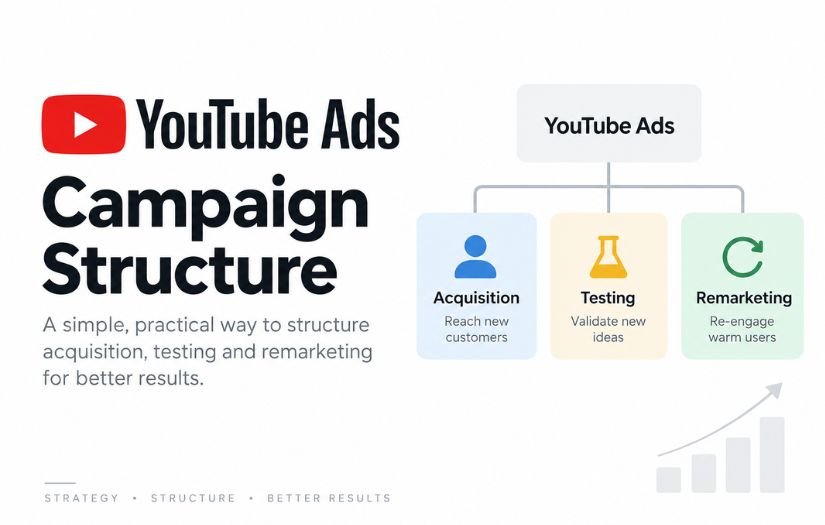
I prefer structuring YouTube Ads around three clear jobs: acquisition, testing and remarketing.
Acquisition campaigns are built to reach new potential customers. Testing campaigns help me evaluate audiences, creatives, offers and messaging without unnecessarily disturbing proven setups. Remarketing campaigns follow up with users who have already interacted with the business.
The objective is not to create the maximum number of campaigns.
The objective is to create enough separation that I can understand where performance is coming from, what is being tested and which audiences are already familiar with the brand.
I’m Deepak Singh, Performance Marketing Expert based in New Delhi. My work spans YouTube Ads, Google Ads, Meta Ads, conversion optimization, analytics and marketing automation.
In one education and coaching acquisition system, approximately ₹50.4 lakh in advertising spend generated more than 66,300 leads at an average CPL of approximately ₹76, along with more than 718,000 clicks.
That experience reinforced something I still follow today: campaign structure should make decision-making easier, not create complexity for the sake of complexity.
If you want the broader funnel behind this approach, start with my YouTube Ads lead generation framework.
In this guide, I’ll explain how I separate acquisition, testing and remarketing, how I decide what deserves its own campaign and how I avoid overcomplicating the account.
Written by Deepak Singh
Performance Marketing Expert
My YouTube Ads Campaign Structure
I usually think about YouTube Ads in three buckets: Acquisition → Testing → Remarketing.
Each bucket has a different job, and I try to keep those jobs clear.
1. Acquisition Campaigns
Acquisition campaigns are designed to reach new potential customers who have not yet interacted with the business.
This is where I usually run the core audience strategy, primary creative angles and the main lead-generation offer.
I want acquisition campaigns to answer one question clearly: Can we consistently turn cold traffic into qualified leads or customers at acceptable economics?
If you want to understand how I approach cold audiences, I have explained that in more detail in my guide to YouTube Ads targeting in India.
2. Testing Campaigns
I prefer keeping important tests separate when mixing them into a proven campaign would make the data harder to interpret.
Testing can include new audiences, new creative hooks, new offers, landing-page variations or different messaging angles.
The goal is not to create a permanent testing graveyard with dozens of campaigns.
The goal is to create a controlled environment where I can understand what changed and whether that change actually improved performance.
3. Remarketing Campaigns
Remarketing campaigns are built for users who already have some level of familiarity with the business.
That can include video viewers, website visitors, landing-page visitors, incomplete conversions, existing leads or customers depending on the objective.
I usually separate remarketing because these users have different intent and should not always receive the same message as completely cold traffic.
I explain my full approach in how I structure YouTube Ads remarketing.
Why I Keep These Three Jobs Separate
When acquisition, testing and remarketing are mixed together without a clear reason, it becomes harder to understand what is actually driving results.
Separating them gives me cleaner answers around audience quality, creative performance, budget allocation, scaling and funnel stage.
How I Structure Acquisition Campaigns
Acquisition campaigns are where I focus on reaching new potential customers and proving that the offer can work with cold traffic.
I try to keep the structure simple enough that performance can scale without becoming difficult to manage.
Separate by Meaningful Audience Logic
I do not create a new campaign for every small targeting variation.
I separate audiences when they represent a genuinely different hypothesis, intent level or strategic approach that I want to measure independently.
For example, a custom audience built around high-intent search behaviour may deserve different treatment from a much broader prospecting audience.
Keep the Core Offer Consistent
When testing acquisition, I prefer not to change audience, creative, offer and landing page all at the same time.
If too many variables move together, it becomes difficult to understand what actually improved or damaged performance.
Use Creative to Qualify the Audience
The video should not simply attract attention.
I want it to help qualify the viewer by making the problem, audience and offer clear enough that irrelevant users are less likely to continue.
This is especially important when a campaign is getting views but not enough conversions. I have covered that diagnostic process in why YouTube Ads get views but no leads.
Measure Beyond the First Conversion
I do not want an acquisition campaign to win only because it generates the cheapest form submissions.
I want to know whether those leads qualify, whether they move through the sales process and whether the eventual customer acquisition cost makes sense.
Protect Proven Acquisition Campaigns From Constant Changes
If a campaign is producing stable results, I avoid using it as a playground for every new idea.
Major new tests can be moved into a separate testing structure first, then successful ideas can be introduced into the broader acquisition setup once there is enough evidence.
How I Structure Testing Campaigns
Testing campaigns exist to answer specific questions without creating unnecessary noise inside proven acquisition campaigns.
I try to keep each test focused enough that the result is easy to interpret.
Test One Major Variable at a Time
If I am testing a new audience, I prefer keeping the offer and landing page reasonably consistent.
If I am testing a new creative angle, I do not want several other major variables changing at the same time.
The cleaner the test, the easier it is to understand what actually caused the performance difference.
Use Testing Campaigns for New Audience Ideas
New custom segments, broader targeting approaches or different intent groups can be tested separately before they are introduced into the main acquisition structure.
This helps me compare performance without immediately disrupting a campaign that is already stable.
Use Testing Campaigns for New Creative Angles
Creative tests can include a different hook, problem statement, offer presentation, proof angle or call to action.
I am usually looking for a meaningful change in behaviour rather than a cosmetic variation that tells me very little.
Test Offers and Landing Pages Carefully
Offer and landing-page tests can have a large impact on conversion rate, so I treat them as separate hypotheses rather than minor creative changes.
If both the offer and page change together, I make sure I understand that I am testing a new funnel experience, not just a new ad.
Promote Winners Into the Main Structure
A testing campaign should not remain separate forever just because it started as a test.
If an audience, creative or funnel variation consistently performs well, I can move that learning into the main acquisition setup and simplify the account again.
Kill Weak Tests Without Overreacting
Not every test needs a long life.
If a variation produces consistently weak signals across CTR, conversion rate, CPL or lead quality after enough data, I would rather stop it and move to the next hypothesis than keep forcing spend into it.
The objective of testing is to generate useful learning that improves the main acquisition system, not to create more campaigns.
How I Structure Remarketing Campaigns
Remarketing campaigns are where I separate users who already know the brand from completely cold audiences.
The structure depends on audience size, funnel depth and how different the follow-up message needs to be.
Separate by Intent When the Data Supports It
I do not want a casual video viewer and someone who almost completed a lead form treated exactly the same.
When audience size allows, I separate users based on actions such as video engagement, website visits, landing-page visits and incomplete conversions.
Use Different Messaging for Different Funnel Stages
Remarketing should move the conversation forward.
A user who has already visited the landing page may need proof, objection handling or a stronger reason to act rather than another introductory ad.
Exclude Users Who Have Already Completed the Goal
If the campaign is focused on generating new leads, I usually want completed leads or customers excluded from that acquisition sequence.
They may belong in a different retention, upsell or cross-sell strategy instead.
Watch Audience Size and Frequency
Remarketing pools are naturally smaller than cold audiences, so frequency can rise much faster.
I monitor whether the same users are seeing the ads too often and whether creative performance starts weakening.
Do Not Over-Segment Small Remarketing Pools
There is a point where extra segmentation creates more complexity than useful insight.
If the audience is too small, I would rather combine logically similar warm users than create multiple campaigns that cannot gather enough data.
Evaluate Remarketing as Part of the Whole Funnel
Remarketing can often show a lower CPL because the audience already has familiarity with the business.
I still want to understand whether it is genuinely helping more users convert and whether the total acquisition economics improve.
You can see the complete audience logic in my guide to YouTube Ads remarketing and funnel structure.
How I Decide What Deserves Its Own Campaign
One of the easiest ways to overcomplicate YouTube Ads is to create a separate campaign for every audience, creative or small variation.
I prefer creating a new campaign only when the separation helps me make a better decision.
Create a Separate Campaign When the Objective Is Different
If one campaign is focused on cold acquisition and another is focused on remarketing, I usually want those goals separated.
The audiences, messaging and economics can be different enough that combining them may make performance harder to interpret.
Create a Separate Campaign When the Test Needs Clean Data
A major new audience, offer or creative concept may deserve its own testing campaign if mixing it into an existing setup would make the result difficult to read.
The separation should help answer a specific question.
Create a Separate Campaign When Budget Control Matters
Sometimes I want a particular audience or strategy to receive a controlled amount of spend instead of competing directly with everything else.
In that case, campaign-level separation can give me clearer budget control.
Do Not Separate Campaigns Just Because You Can
If two audiences have similar intent, use the same offer and need the same messaging, there may be very little value in splitting them into multiple campaigns.
Too much fragmentation can make learning slower and account management unnecessarily difficult.
Do Not Build the Account Around Naming Conventions
A neat naming system is useful, but campaign structure should reflect actual business logic rather than an obsession with creating perfectly categorized folders inside Google Ads.
My Rule Is Simple
I ask one question before creating another campaign: Will separating this help me control budget, measure performance or make a better optimization decision?
If the answer is no, I usually keep the structure simpler.
How I Allocate Budget Across Acquisition, Testing and Remarketing
I do not use one fixed percentage split for every YouTube Ads account.
Budget allocation depends on audience size, funnel maturity, conversion volume and how much proven data already exists.
Acquisition Usually Gets the Largest Share
If the objective is growth, most of the budget usually needs to stay focused on reaching new potential customers.
I want enough spend in acquisition to generate meaningful volume without starving the core growth engine.
Testing Needs Enough Budget to Produce a Real Signal
A test with almost no spend can create false conclusions.
I prefer giving a test enough budget to judge whether the audience, creative or funnel variation is genuinely stronger or weaker than the current setup.
Remarketing Budget Should Match Audience Size
Remarketing audiences are smaller, so I do not want to force a large budget into a pool that cannot absorb it efficiently.
If the audience is limited, excessive budget can simply increase frequency without creating proportional incremental conversions.
Move Budget Based on Evidence
If a test consistently outperforms the current acquisition setup, I can move more budget toward that learning.
If remarketing becomes saturated, I can reduce spend there and redirect budget toward prospecting or new tests.
Do Not Confuse Budget Growth With Scaling
Increasing daily spend is easy. Scaling profitably is harder.
I watch how CPL, lead quality and downstream customer acquisition change as spend increases rather than assuming that performance at a small budget will remain identical at a larger one.
This is where cost metrics need to be read together. I explain that relationship in more detail in my guide to YouTube Ads cost in India.
The structure should ultimately help answer a simple question: where can the next rupee of budget create the most useful business outcome?
Common YouTube Ads Campaign Structure Mistakes I Avoid
A good YouTube Ads structure should make optimization easier. If the account becomes difficult to understand, the structure is probably creating more complexity than value.
1. Creating Too Many Campaigns Too Early
I avoid splitting every audience, creative and targeting idea into separate campaigns before there is enough volume to justify it.
Too much fragmentation can spread budget too thin and make it harder to reach useful conclusions.
2. Mixing Cold Acquisition and Remarketing Without a Clear Reason
Cold prospects and warm users usually have different levels of intent.
If they are mixed together, it can become difficult to understand whether performance is coming from genuine new-customer acquisition or from users who already knew the brand.
3. Running Every Test Inside the Best-Performing Campaign
A proven campaign does not need to become the testing ground for every new idea.
I prefer protecting stable setups when a major test could introduce unnecessary volatility or make the data harder to interpret.
4. Changing Too Many Variables at Once
If the audience, creative, offer and landing page all change together, I may know that performance changed but not why it changed.
I prefer tests that produce a clear learning I can actually use elsewhere in the account.
5. Giving Remarketing More Budget Than the Audience Can Absorb
Warm audiences can look efficient, which makes it tempting to keep increasing budget.
But if the audience is small, extra spend may simply increase frequency rather than create meaningful additional conversions.
6. Scaling Based Only on CPL
A campaign with the cheapest CPL is not automatically the campaign I want to scale.
I also look at lead quality, qualification rate, sales conversion and customer acquisition cost wherever that data is available.
7. Keeping Old Tests Running Forever
Testing campaigns should produce a decision.
If the test has clearly succeeded or failed, I prefer using that learning and simplifying the account rather than leaving unnecessary campaigns running indefinitely.
8. Treating Campaign Structure as Permanent
The right structure can change as budget, audience size, creative volume and conversion data grow.
I prefer an account structure that can evolve with the business rather than forcing every future campaign into a rigid setup created months earlier.
For me, the best YouTube Ads campaign structure is usually the one that makes it easiest to understand what is working, what is being tested, where budget is going and what should happen next.
Frequently Asked Questions About YouTube Ads Campaign Structure
How Many YouTube Ads Campaigns Should I Run?
There is no fixed number that works for every account.
I prefer creating separate campaigns only when the separation helps with budget control, measurement, testing or funnel-stage management.
Should Acquisition and Remarketing Be Separate Campaigns?
In many cases, yes, because cold audiences and warm audiences have different levels of intent and often need different messaging.
Keeping them separate can also make it easier to understand how much performance is coming from new-user acquisition versus existing audience demand.
Should I Create a Separate Campaign for Every Audience?
Usually not.
If audiences have similar intent and are being tested with the same offer and messaging, excessive separation can create unnecessary fragmentation.
Should Creative Testing Have Its Own Campaign?
It can make sense when the test is significant enough that running it inside a proven campaign would make the result harder to interpret.
For smaller creative variations, a separate campaign may not always be necessary.
How Much Budget Should Go to Remarketing?
I base remarketing budget on the size and quality of the warm audience rather than using one universal percentage.
A small remarketing pool cannot always absorb large budgets efficiently without frequency increasing quickly.
How Much Budget Should Go to Testing?
The test needs enough spend to produce a useful signal.
If the budget is too small, it can be difficult to distinguish a genuinely strong test from normal performance variation.
When Should I Move a Winning Test Into the Main Campaign?
I usually want enough evidence that the improvement is meaningful and not just a short-term fluctuation.
Once the learning is reliable, I can introduce it into the broader acquisition structure and simplify the account again.
Can Too Many Campaigns Hurt YouTube Ads Performance?
Too much fragmentation can spread budget and conversion data across many campaigns, making learning and optimization more difficult.
I prefer the simplest structure that still gives me the control and insight I need.
What Is the Best YouTube Ads Campaign Structure?
I do not believe there is one universal structure.
My preferred approach is to separate acquisition, meaningful testing and remarketing while keeping the account simple enough to understand and manage.
Sources & Methodology
This article combines my own performance marketing experience with current Google Ads documentation and first-hand campaign data.
Where I refer to my YouTube Ads results, the figures come from an education and coaching acquisition system that generated more than 66,300 leads at an average CPL of approximately ₹76, along with more than 718,000 clicks from approximately ₹50.4 lakh in advertising spend.
These figures represent a specific campaign and business context. They should not be treated as universal benchmarks or guaranteed outcomes for other advertisers.
The acquisition, testing and remarketing structure described in this article reflects how I personally think about separating campaign objectives, controlling budgets, evaluating tests and keeping YouTube Ads accounts understandable as they grow.
For current platform information, I refer to official Google Ads documentation covering YouTube advertising, Demand Gen, audience targeting, conversion tracking and campaign optimization.
The exact structure I would use can change depending on budget, conversion volume, audience size, funnel complexity and the amount of reliable data already available in the account.
Need Help Structuring Your YouTube Ads Campaigns?
If your account has become difficult to manage, I would first simplify the structure around clear jobs: acquisition, testing and remarketing.
The objective is not to create more campaigns. It is to make budget allocation, testing, measurement and scaling easier to understand.
You can also review my YouTube Ads lead generation framework, my guide to YouTube Ads targeting in India, or my detailed YouTube Ads remarketing structure.
If your campaigns are already generating views but struggling to produce conversions, see 10 things I check when YouTube Ads get views but no leads.
If you want help reviewing or restructuring your YouTube Ads acquisition system, you can work with me.