Case Study Snapshot
5,030 Conversions at ₹87.65 Cost per Conversion for an Ayurveda Company
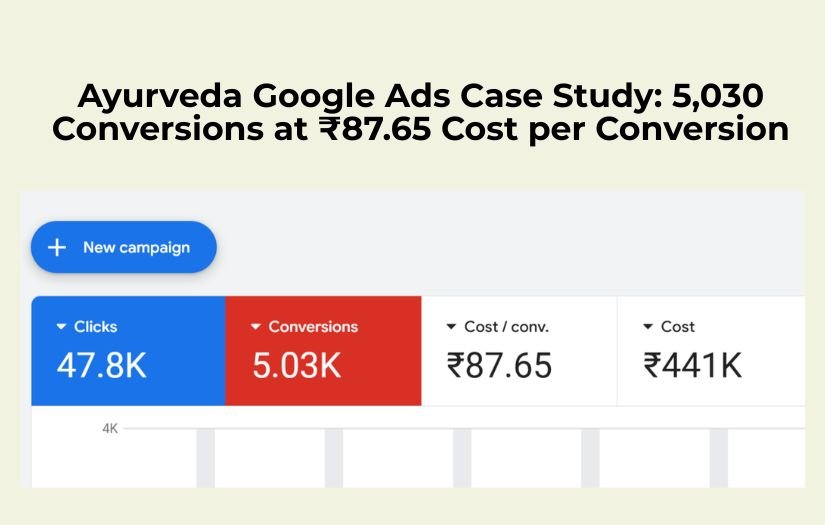
In this Google Ads campaign for an Ayurveda company, approximately ₹4.41 lakh in advertising spend generated 5.03K attributed conversions at an average cost per conversion of ₹87.65.
The campaign also generated approximately 47.8K clicks, giving us enough traffic and conversion volume to evaluate performance beyond a small sample of results.
The screenshot below is taken directly from the Google Ads account and shows the reported campaign performance.
Campaign results:
Clicks: 47.8K
Attributed Conversions: 5.03K
Average Cost per Conversion: ₹87.65
Advertising Spend: ₹441K, approximately ₹4.41 lakh
I’m Deepak Singh, Performance Marketing Expert. My work across performance marketing has included Google Ads, YouTube Ads, Meta Ads, lead generation, funnel optimization and acquisition strategy across multiple industries.
This case study breaks down the campaign performance, what the numbers actually tell us and how I evaluate a result like this from a performance marketing perspective.
Campaign Objective and Business Context
This campaign was built for an Ayurveda company using Google Ads as a lead generation channel.
The objective was to generate a meaningful volume of leads while keeping acquisition cost controlled enough to support continued campaign growth.
What the Campaign Needed to Achieve
The campaign needed to attract users with enough intent to enquire about the Ayurveda company’s products or services rather than simply generating low-cost traffic.
The acquisition system therefore needed to balance traffic volume, lead volume and cost per lead.
Why This Campaign Is Useful as a Case Study
The Google Ads account shows approximately 47.8K clicks and 5.03K leads from ₹4.41 lakh in advertising spend.
The reported average cost per lead was approximately ₹87.65.
This gives us enough volume to evaluate the campaign as a real acquisition system rather than a small test with only a few conversions.
What I Look at in an Ayurveda Lead Generation Campaign
For a campaign like this, I would not judge performance only by the number of clicks.
I want to understand whether the campaign is generating enough qualified leads, whether CPL remains stable as volume increases and whether the business can convert those leads further down the funnel.
The Core Acquisition Question
The key question is simple: can Google Ads consistently turn relevant search and audience demand into leads at a cost the business can support?
In this case, the campaign generated more than 5,000 leads while maintaining an average CPL below ₹90 according to the Google Ads account.
What the Campaign Numbers Tell Us
The screenshot gives us four important performance signals: 47.8K clicks, 5.03K leads, ₹87.65 cost per lead and ₹4.41 lakh in advertising spend.
Approximately ₹9.23 Average Cost per Click
Based on the reported ₹4.41 lakh spend and 47.8K clicks, the campaign generated traffic at an approximate average cost of ₹9.23 per click.
I would not judge the campaign on CPC alone because inexpensive traffic only becomes valuable when it turns into useful leads.
More Than 5,000 Leads Generated
The campaign generated approximately 5.03K leads.
At this level of conversion volume, there is enough data to start identifying stronger patterns across audiences, campaigns, keywords, creatives and landing-page behaviour.
₹87.65 Average Cost per Lead
The reported average cost per lead was approximately ₹87.65.
This is the metric that connects media spend more directly with the acquisition objective because it shows how efficiently the campaign was turning paid traffic into leads.
Approximately 10.5 Leads per 100 Clicks
A simple comparison of the reported clicks and leads gives approximately 10.5 leads for every 100 clicks.
I treat this as a directional calculation rather than a replacement for the conversion-rate metric reported directly inside Google Ads.
Why I Look at These Metrics Together
The useful story is not just that the campaign generated 47.8K clicks or that the CPL was below ₹90.
The stronger signal is that the campaign combined traffic volume, lead volume and controlled acquisition cost across approximately ₹4.41 lakh in spend.
That is how I prefer evaluating Google Ads performance: not by asking whether clicks were cheap, but whether paid traffic consistently produced leads at an economically useful cost.
What I Would Check Before Scaling This Ayurveda Lead Generation Campaign
The campaign was already generating more than 5,000 leads at an average CPL of ₹87.65, but I would not scale it based on CPL alone.
Before increasing spend further, I would want to confirm that the leads were commercially useful and that the campaign could maintain efficiency at a larger budget.
1. Lead Quality
The first thing I would check is whether the leads were relevant to the Ayurveda company’s actual offer.
A low CPL is valuable only when a reasonable percentage of those leads can move further through the sales process.
2. Lead-to-Sale Conversion
I would compare campaign segments not only by CPL but also by how many leads eventually became customers.
This helps identify whether the cheapest leads are actually the most valuable leads.
3. CPL Stability Across Campaign Segments
The account-level average was ₹87.65, but individual campaigns, audiences, keywords or ad groups may have performed very differently.
I would look for the segments that were producing both meaningful volume and stable acquisition cost.
4. Traffic Quality
With 47.8K clicks, even a small amount of irrelevant traffic can create significant wasted spend.
I would review whether the traffic being generated was closely aligned with the company’s actual products, treatments or enquiry intent.
5. Landing Page Conversion
The campaign generated approximately 5.03K leads from 47.8K clicks, so the post-click experience clearly played an important role.
I would still look for opportunities to improve message match, trust, form friction and mobile usability before pushing substantially more budget into the same funnel.
6. Performance as Spend Increases
A campaign that produces leads at ₹87.65 CPL at ₹4.41 lakh in spend may not maintain exactly the same economics at a much larger budget.
I prefer increasing spend gradually while watching lead quality, CPL and downstream sales performance.
The objective is not simply to generate more leads. It is to generate more useful leads while keeping the acquisition economics sustainable.
What This Ayurveda Google Ads Result Proves and What It Does Not
I prefer separating the campaign evidence from the conclusions that would require additional sales and revenue data.
What the Google Ads Screenshot Directly Shows
The account screenshot reports approximately 47.8K clicks, 5.03K conversions, ₹87.65 cost per conversion and ₹441K in advertising spend.
These conversions were leads for the Ayurveda company.
It Shows Meaningful Lead Volume
Generating more than 5,000 leads gives this campaign substantially more evidential value than a small test with only a few conversions.
It also provides enough volume to evaluate campaign segments and scaling decisions with more confidence.
It Shows More Than Traffic
The campaign did not just generate 47.8K clicks.
A meaningful share of that traffic also completed the lead action being measured, which is why the result is more useful than reporting clicks or impressions alone.
It Does Not Independently Prove Revenue or Profitability
The screenshot does not show sales revenue, customer acquisition cost, lifetime value, refunds or profit.
I would therefore not use this screenshot alone to make a claim about ROAS or overall profitability.
It Does Not Mean Every Ayurveda Campaign Can Achieve ₹87.65 CPL
The reported CPL belongs to this specific campaign, offer, audience, landing page and period of execution.
Another Ayurveda business could see very different economics depending on positioning, geography, competition, conversion action and downstream sales process.
It Does Not Prove One Tactic Created the Entire Result
The screenshot confirms the outcome, but it does not independently tell us which campaign element contributed most to performance.
To answer that, I would need the campaign-level breakdown across audiences, ads, keywords, landing pages and other funnel components.
Why I Still Consider This Strong First-Hand Evidence
The combination of ₹4.41 lakh in spend, 47.8K clicks, more than 5,000 leads and an average CPL of ₹87.65 gives us a clear documented example of Google Ads lead generation performance.
For me, that is the right way to present a case study: show the platform evidence, explain the context and avoid claiming more than the available data can support.
What I Learned From This Ayurveda Lead Generation Campaign
This campaign reinforced a few practical lessons about Google Ads lead generation for a high-intent category like Ayurveda.
Lead Volume Needs to Be Read With Lead Quality
More than 5,000 leads is a meaningful result, but volume alone is not enough.
The real value comes from understanding whether those leads were relevant, contactable and commercially useful for the business.
CPL Is a Strong Operational Metric, but Not the Final Business Metric
The ₹87.65 CPL gives a useful view of acquisition efficiency.
But I would still want to connect that number with lead-to-sale conversion and customer acquisition cost before making a final profitability judgment.
Search Intent Matters More Than Cheap Traffic
In a category like Ayurveda, not every click has the same commercial value.
I would prefer traffic with stronger treatment, product or enquiry intent over broader traffic that may be cheaper but less likely to convert into a useful lead.
Small Funnel Improvements Can Matter at This Volume
With 47.8K clicks, even modest improvements in landing-page conversion rate can create a meaningful increase in lead volume.
That is why I look at the acquisition system as a combination of traffic quality and post-click conversion rather than focusing only on ad-platform settings.
Scaling Needs Discipline
Once a campaign is producing leads at a stable CPL, the temptation is to increase budget aggressively.
I prefer scaling in stages and watching whether the economics hold as the campaign reaches more users and broader demand.
The Bigger Lesson
For me, the strongest takeaway is simple: a good Google Ads campaign does not just generate cheap clicks. It consistently turns relevant traffic into useful leads at a cost the business can support.
Frequently Asked Questions About This Ayurveda Google Ads Case Study
What Type of Business Was This Campaign For?
This campaign was for an Ayurveda company using Google Ads for lead generation.
How Much Was Spent on Google Ads?
The Google Ads screenshot shows approximately ₹441K in advertising spend, which is approximately ₹4.41 lakh.
How Many Clicks Did the Campaign Generate?
The campaign generated approximately 47.8K clicks.
How Many Leads Were Generated?
The campaign generated approximately 5.03K leads.
What Was the Average Cost per Lead?
The reported average cost per conversion was approximately ₹87.65, and the conversion action in this campaign represented a lead.
What Was the Approximate Cost per Click?
Based on approximately ₹4.41 lakh in spend and 47.8K clicks, the estimated average cost per click was around ₹9.23.
What Was the Approximate Lead-to-Click Ratio?
A simple comparison of 5.03K leads with 47.8K clicks gives approximately 10.5 leads for every 100 clicks.
I treat this as a directional calculation rather than a replacement for the conversion-rate metric reported directly inside Google Ads.
Does This Case Study Show Revenue or ROAS?
No. The available screenshot shows spend, clicks, conversions and cost per conversion, but it does not show revenue, ROAS, customer acquisition cost or profit.
Does ₹87.65 CPL Mean Every Ayurveda Campaign Should Achieve Similar Results?
No. CPL can vary significantly depending on the offer, geography, audience, competition, landing page, conversion action and sales process.
What Is the Main Lesson From This Campaign?
The main lesson is that Google Ads performance should be evaluated through the complete path from traffic to leads to downstream business outcomes.
In this case, the combination of 47.8K clicks, 5.03K leads and ₹87.65 CPL provides a clear documented view of lead generation performance at meaningful scale.
Sources & Methodology
This case study is based on a real Google Ads dashboard screenshot from a lead generation campaign for an Ayurveda company.
The screenshot directly shows approximately 47.8K clicks, 5.03K conversions, ₹87.65 cost per conversion and ₹441K in advertising spend.
In this campaign, the conversion action represented a lead, which is why I refer to the 5.03K reported conversions as approximately 5,030 leads throughout this case study.
Where I refer to approximately ₹4.41 lakh in spend, I am converting the platform-reported ₹441K figure into the Indian numbering format for readability.
The approximate ₹9.23 cost per click and 10.5 leads per 100 clicks mentioned in this case study are calculated from the reported spend, click and lead figures rather than copied directly from the screenshot.
I have intentionally avoided making unsupported claims about revenue, ROAS, customer acquisition cost, customer lifetime value or profitability because those figures are not visible in the available campaign evidence.
The purpose of this case study is to document a real Google Ads lead generation result for an Ayurveda company, explain what the available data shows and clearly separate verified campaign performance from interpretation.
Want Help Improving Google Ads Lead Generation for Your Business?
If your Google Ads campaigns are generating traffic but CPL is too high or lead quality is inconsistent, I would first look at the complete acquisition system rather than changing bids in isolation.
The biggest opportunities usually sit across traffic quality, campaign structure, ad messaging, landing-page conversion, tracking and downstream lead quality.
You can also explore my broader performance marketing approach or review more performance marketing case studies to see how I evaluate acquisition across different industries and platforms.
If you want help auditing, restructuring or scaling your Google Ads lead generation campaigns, you can work with me.