How I Start a Performance Marketing Audit
When I conduct a performance marketing audit, I do not start inside Meta Ads, Google Ads or YouTube Ads looking for random campaign mistakes.
I start with the business.
Before I can decide whether an account is performing well or badly, I need to understand what a customer is worth, what the business can afford to pay to acquire that customer and what the real commercial objective is.
That context changes everything about how I approach a performance marketing account audit.
A ₹1,000 CAC can be excellent for one business and completely unworkable for another.
A ₹300 CPL can look expensive until I discover those leads convert into customers much more frequently than the ₹150 leads coming from another campaign.
If I ignore those differences and go straight into campaign settings, the audit may produce a long list of optimizations without solving the actual growth problem.
My Performance Marketing Audit Starts With Business Economics
Before I audit Meta Ads, Google Ads, YouTube Ads or any other paid media channel, I want to understand the economics behind the acquisition.
I normally start by asking:
- What is the average order value or customer value?
- What is the approximate gross margin?
- What percentage of leads become customers?
- What is the current CAC or cost per acquisition?
- How much repeat revenue or LTV exists?
- What acquisition cost is the business actually comfortable with?
- How much is currently being spent across paid media?
Those answers give me the reference point I need before deciding whether a campaign, channel or funnel is genuinely underperforming.
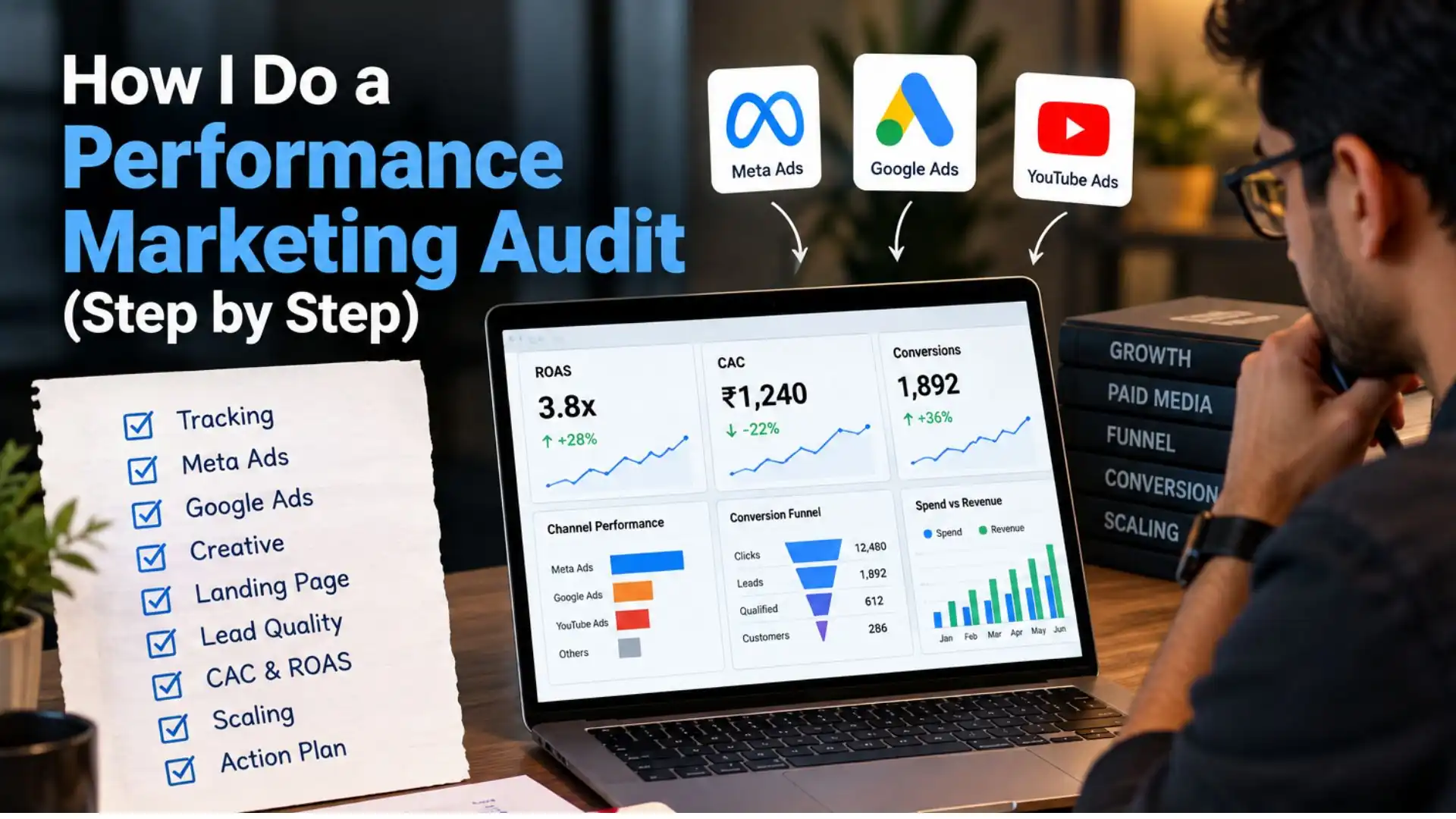
I Ask the Team What They Think Is Broken
Before going deeper into the paid media audit, I also want to hear what the people closest to the business are seeing.
The founder may think CAC has become too high.
The media buyer may believe Meta creative fatigue is the problem.
The sales team may say lead quality has deteriorated.
The developer may tell me the landing page was changed shortly before conversion rate dropped.
None of those opinions automatically becomes my conclusion.
But they give me hypotheses to investigate against the actual data.
Then I Map the Entire Marketing Funnel
I normally reduce the acquisition system to a simple chain:
Spend → Impression → Click → Landing Page → Conversion → Qualified Lead or Customer → Revenue
This becomes the foundation of my marketing funnel audit.
I want to identify the first point where performance begins to deteriorate.
If impressions became much more expensive, I am investigating one type of problem.
If CPM is stable but CTR drops, I start looking at creative, message and audience behaviour.
If clicks remain healthy but conversion rate falls, I move toward the landing page, offer and conversion experience.
If leads continue coming in at a healthy CPL but fewer of them become customers, I move further down the funnel into lead quality, CRM data and sales conversion.
This is why I describe performance marketing as an acquisition system rather than simply campaign management in my Performance Marketer in India guide.
I Compare the Weak Period With the Period When the Account Was Working
I rarely find it useful to audit a performance marketing account from one isolated snapshot.
If the business tells me performance has deteriorated, I want to compare the current period with a period when the account was healthier.
Then I start asking what changed.
Did spend increase significantly?
Did Meta expand into a broader audience?
Did a winning creative begin to fatigue?
Did Google start matching into weaker search intent?
Did the landing page change?
Did the primary conversion action change?
Did lead-to-sale conversion deteriorate?
That before-and-after comparison often tells me much more than simply looking for account-structure mistakes.
A Meta Ads Audit or Google Ads Audit Is Only One Layer
This is one of the most important principles in my framework.
If Meta Ads CPL rises, I do not automatically assume the solution is inside Meta Ads.
If Google Ads CPA gets worse, I do not automatically change bidding or restructure campaigns.
The ad account may still be sending similar-quality traffic while something else in the acquisition system has changed.
The landing page may be converting worse.
The tracking may be incorrect.
The offer may have changed.
The sales team may be following up more slowly.
Or the business may simply be trying to scale beyond the efficient limit of the current funnel.
This broader diagnostic approach is also how I work when I am brought in as a performance marketing consultant.
I Do Not Measure an Audit by How Many Problems I Find
I can usually find dozens of things inside a paid advertising account that could theoretically be improved.
That does not mean they deserve equal attention.
I am much more interested in identifying the few issues having the largest impact on CAC, CPL, conversion rate, lead quality or revenue.
If fixing one landing-page problem is likely to create more value than rebuilding the entire Meta account, I would fix the landing page first.
If Google Ads is wasting budget on weak search intent, that may deserve attention before changing campaign structure.
If the campaign performance is actually healthy but the conversion tracking is wrong, I want to fix measurement before making major optimization decisions.
This Is the Foundation of My Performance Marketing Audit Framework
I start with business economics.
Then I understand what the team believes is happening.
Then I map the acquisition funnel and identify where performance first begins to weaken.
Only after that do I go deeper into campaign structure, Meta Ads, Google Ads, YouTube Ads, creative, landing pages, tracking, lead quality, CAC and scaling.
For me, a useful performance marketing audit is not about finding the maximum number of things to change.
It is about finding the right thing to change first.
Step 2: I Audit Tracking Before I Trust Any Performance Number
Once I understand the business economics, the next thing I want to know is whether the account is measuring the right things.
This part of a performance marketing audit is critical because every optimization decision depends on the quality of the conversion data underneath it.
If tracking is wrong, the campaign can look healthy while the business is actually losing money.
It can also work the other way around.
A campaign may look weaker inside the platform even though the CRM or ecommerce data shows that it is producing valuable customers.
I First Check What the Platform Is Calling a Conversion
I do not assume that a conversion inside Meta Ads or Google Ads automatically represents something meaningful.
I want to know exactly what event is being counted.
Is it a completed purchase?
A submitted lead form?
A phone call?
A booked appointment?
A button click?
A page view?
A thank-you page visit?
The difference matters enormously.
If Google Ads is optimizing toward a button click instead of a completed lead, the platform may become very efficient at generating clicks that never turn into enquiries.
If Meta is counting duplicate purchase events, reported ROAS can look much better than the real business outcome.
I Separate Primary Conversions From Secondary Signals
I like having useful micro-conversions available for analysis.
Things like add to cart, form start, video engagement or checkout initiation can help me understand the funnel.
But I do not want every useful event treated as the main optimization goal.
During a conversion tracking audit, I check whether the platforms are optimizing toward the actions that actually matter to the business.
For ecommerce, that is usually the purchase.
For lead generation, I usually want the completed lead or, ideally, something even closer to a qualified lead or sale if the data can be connected back.
I Check for Duplicate or Broken Conversion Events
This is one of the simplest issues that can create very misleading reporting.
A purchase event may fire twice.
A form submission may be counted both through Google Tag Manager and a thank-you page.
A conversion may fire when someone opens the form rather than when they actually submit it.
If I see unusually high conversion rates, sudden jumps in reported conversions or platform data that does not make sense against CRM or ecommerce numbers, this is one of the first areas I investigate.
I Compare Meta, Google Ads, GA4 and Business Data
I do not expect all of these platforms to show the same number.
They use different attribution logic, lookback windows and ways of assigning credit.
What I want is for the overall picture to make sense.
If Meta reports 300 purchases, Google Ads reports 220, GA4 shows 350 total purchases and the ecommerce platform shows only 190 actual orders, I know I need to investigate before making any aggressive budget decision.
The same applies to lead generation.
If the ad platforms report 1,000 leads but the CRM only contains 720 genuine enquiries, that gap matters.
I Look at Attribution Before I Judge a Channel
This is especially important when Meta, Google and YouTube are running together.
A user may first discover the brand through YouTube.
They may later click a Meta ad.
Then they may search the brand on Google and finally convert.
Several platforms may claim some credit for the same customer.
If I look at each dashboard in isolation, I can easily overestimate total performance.
I do not need perfect attribution to run campaigns.
I do need to understand enough about the customer journey that I do not confuse platform-reported credit with actual incremental growth.
I Check Whether the Tracking Setup Matches the Business Model
An ecommerce account usually needs a different measurement setup from a lead-generation account.
For ecommerce, I care about purchases, order value, new-customer acquisition where possible and whether revenue is being passed correctly.
For lead generation, I care about the lead event, lead quality and ideally what happens after the lead enters the CRM.
If the business has a longer sales cycle, front-end lead volume alone may not be enough.
I may want offline conversion data, qualified lead stages or closed-customer data feeding back into the analysis.
I Check Google Ads Conversion Actions Carefully
In a Google Ads audit, I pay particular attention to which conversion actions are included in the primary conversion column.
If several weak actions are included, Smart Bidding may optimize toward the wrong behaviour.
I also look at whether imported GA4 conversions, native Google Ads conversions and offline conversions are being mixed in a way that creates duplication or confusion.
Automation only becomes useful when the signals being fed into it are useful.
I Check Meta Pixel and CAPI in Context
For Meta Ads, I want to know whether the important events are firing properly and whether browser and server-side events are being deduplicated correctly where Conversions API is being used.
I also look at whether Meta is receiving enough useful conversion data to optimize effectively.
I do not treat CAPI as a magic fix for weak campaigns.
It is part of making the measurement and signal quality stronger.
I Look at the CRM Whenever Lead Quality Matters
This is where a basic paid media audit can become a much more useful performance marketing audit.
If I can see that Campaign A generated 400 leads and Campaign B generated 250, the platform tells me one story.
If the CRM shows Campaign B generated more qualified opportunities and more customers, the business data tells me a much more important story.
That is why I try to connect media data with downstream outcomes whenever possible.
It is also one of the reasons I include tracking and attribution when I work as a performance marketing consultant.
I Do Not Move to Optimization Until I Know What I Can Trust
This is the key point.
I do not need perfect data.
Very few businesses have perfect attribution.
But I do need to know which numbers are reliable enough to make decisions from and which ones need to be treated carefully.
Once I know that, I can move deeper into the account and start evaluating channel performance, campaign structure, traffic quality, creative, landing pages and CAC with much more confidence.
For me, a strong performance marketing account audit depends on one thing before anything else:
making sure the account is optimizing toward a business outcome that is actually real.
Step 3: I Audit the Channel Mix and Where the Budget Is Actually Going
Once I trust the tracking enough to work with the numbers, I move to the next layer of my performance marketing audit: the channel mix.
I want to know where the money is going, what each platform is supposed to do and whether the budget allocation still makes sense.
This sounds basic, but I have seen accounts where Meta, Google and YouTube are all running at the same time without a clear reason for why each channel exists.
That usually creates a lot of activity without enough clarity.
I Start by Mapping Spend Across Meta, Google and YouTube
I normally begin with a simple question:
How much are we spending on each channel, and what is that spend actually producing?
I look at the percentage of total budget going into:
- Meta Ads
- Google Search
- Performance Max
- YouTube Ads
- Remarketing
- Brand campaigns
- Non-brand acquisition campaigns
I am not looking for an equal split.
I am looking for whether the spend distribution reflects the strongest opportunities in the business.
I Want Every Channel to Have a Clear Job
One thing I do not like is when every platform is trying to do everything.
I want to understand the role of each channel.
Google Search may be capturing existing high-intent demand.
Meta may be creating demand through creative and offer positioning.
YouTube may be educating people who need more explanation before they convert.
Remarketing may be helping bring back people who already showed intent.
Those roles can overlap, but I still want a clear reason for why the budget is there.
I explained this channel-by-channel thinking in more detail in my Performance Marketer in India guide.
I Separate Demand Creation From Demand Capture
This distinction becomes very important during a paid media audit.
Google Search often captures demand that already exists.
Meta and YouTube can create or shape demand before someone actively searches.
If I compare all three only by last-click CPA or ROAS, I can make the wrong decision.
For example, YouTube may look weaker on immediate conversions but still influence people who later search the brand and convert through Google.
That does not mean I give YouTube unlimited credit.
It means I want to understand the role it is playing before cutting spend based on one attribution view.
I Look for Over-Reliance on Brand Campaigns
In a Google Ads audit, this is something I pay close attention to.
An account can show an excellent blended ROAS while a large share of the conversions are coming from branded searches.
Those users may already know the company and be very close to buying.
I still value brand campaigns.
But I do not want them hiding weak non-brand acquisition.
I separate brand and non-brand performance so I can understand how much new demand the account is actually acquiring.
I Look at Remarketing Separately Too
Remarketing usually converts better than cold acquisition because the user already knows the business.
If I blend remarketing and prospecting together, the account can look much healthier than the cold acquisition really is.
So I want to know:
How much of the revenue is coming from new users?
How much comes from people already familiar with the brand?
How much budget is being spent trying to acquire new demand?
How much is being spent harvesting demand that already exists?
That separation makes the audit much more useful.
I Check Whether the Budget Is Following Opportunity or Habit
This is one of the questions I like asking during a performance marketing account audit.
Why is Meta getting 60% of the budget?
Why is Google getting 30%?
Why is YouTube getting 10%?
If the answer is “because that is how we have always done it,” I want to investigate further.
Budget allocation should respond to performance, available demand, channel capacity and business economics.
It should not become permanent just because the original media plan said so.
I Look for Channels That Have Hit Their Efficient Limit
Sometimes a channel is still profitable but no longer deserves the next rupee of spend.
That distinction matters.
Suppose Google Search is producing customers at a good CAC, but almost all the high-intent search demand is already being captured.
Increasing budget further may push the account into weaker queries.
At that point, Meta or YouTube may offer better incremental growth even if their average CAC looks slightly higher.
I care about the cost of the next layer of growth, not only historical averages.
I Also Look for Underfunded Winners
The opposite happens too.
I have seen accounts where a strong campaign was limited by budget while weaker campaigns continued receiving spend because nobody had revisited the allocation.
If one channel or campaign is consistently producing acceptable customer acquisition economics and still has room to scale, I want to know why more budget is not moving there.
The answer may be legitimate.
Maybe creative capacity is limited.
Maybe the sales team cannot handle more leads.
Maybe inventory is constrained.
But if there is no real constraint, I may have found a straightforward growth opportunity.
I Compare Channel Performance at the Business Level
I do not rely only on each platform’s reported ROAS or CPA.
If possible, I compare the channel mix against:
- Total qualified leads
- Total customers
- New-customer CAC
- Revenue
- Blended CAC
- Lead-to-sale conversion
- Contribution or margin where available
This helps me see whether the channel allocation makes sense outside the advertising dashboards.
If every platform says performance is improving but blended CAC is getting worse, I know I need to dig deeper.
I Look at Channel Fit, Not Just Channel Popularity
I do not recommend Meta, Google or YouTube because they are popular advertising platforms.
I want to know whether the channel fits how the customer buys.
If people actively search for the solution, Google may deserve a bigger role.
If the market needs to be educated, YouTube may become more important.
If the product benefits from visual creative and interruption-based discovery, Meta can be extremely powerful.
The right channel mix depends on the buying journey.
I Use Case Study Context to Judge What Scale Looks Like
I have seen this difference across my own campaigns.
In one education YouTube campaign, more than 66,300 leads were generated at approximately ₹76 CPL from around ₹50.4 lakh in spend.
That kind of scale taught me something very different about channel capacity than a small test ever could.
In Google Ads, I have also worked on campaigns like the one documented in my Ayurveda Google Ads case study, where more than 5,000 leads were generated from roughly ₹4.41 lakh in spend.
The point is not that one channel is better than the other.
The point is that each platform has a different relationship with demand, scale and acquisition cost.
At the End of This Step, I Want One Clear Answer
After reviewing the channel mix, I want to be able to say:
“This is where the business is currently spending, this is what each channel is doing, and this is where I think the next rupee should or should not go.”
That gives me the context I need before going deeper into individual campaigns, account structure, creative, search terms and funnel performance.
For me, a good performance marketing audit is not only about finding broken campaigns.
It is also about finding whether the overall media allocation still reflects the best growth opportunity available to the business.
Step 4: I Audit Campaign Structure and Traffic Quality Before I Touch Bids
Once I understand the business economics, trust the tracking and know how the budget is distributed across channels, I move into the actual campaign setup.
But even here, I do not start by changing bids or rebuilding everything.
My first question is:
Is the account structured in a way that helps me understand where performance is really coming from?
I Prefer Structure That Makes Decisions Easier
I am not interested in making an account look sophisticated just because it has more campaigns, ad sets or naming conventions.
A good structure should help me answer useful questions quickly.
Which campaigns are acquiring new users?
Which ones are mainly remarketing?
Which products or offers are profitable?
Which audiences, search themes or creative angles are actually driving the result?
If the account is so fragmented that every campaign has too little data, that can become a problem.
If everything is blended together and I cannot isolate what is working, that can also become a problem.
In a Meta Ads Audit, I Look for Unnecessary Fragmentation
One thing I check during a Meta Ads audit is whether the account has been split into too many campaigns and ad sets without enough spend to support that structure.
If the budget is spread too thin, Meta may never get enough conversion data in any one place to learn efficiently.
I also look for the opposite problem.
If prospecting, remarketing, different offers and completely different creative ideas are all mixed together, the blended result may hide what is actually happening.
I want enough separation to make useful decisions, but not so much separation that the account becomes starved of data.
I Look at What Meta Is Actually Spending On
The campaign structure may look fine on paper, but I still want to see where delivery is really happening.
If one ad is receiving 80% of the spend, I want to know why.
If Meta is barely spending on the creatives the team believes are important, I want to understand whether the platform is seeing weaker early signals.
If one audience is absorbing most of the budget, I want to know whether that concentration is helping or limiting scale.
The account structure tells me what we intended to test.
The spend distribution tells me what the platform actually chose to do.
In Google Ads, I Look at Search Intent Before I Look at Fancy Structure
For me, a Google Ads audit becomes much more useful when I go beyond campaigns and keywords and look at the actual search terms.
The keyword tells me what we asked Google to target.
The search term tells me what the user actually typed.
That difference matters.
I look for irrelevant queries, informational intent, broad matches that have drifted too far and expensive searches that are consuming spend without producing useful conversions.
I also look for the opposite.
Sometimes strong converting search themes are buried inside broader campaigns and deserve their own structure or more budget.
I Separate Brand, Non-Brand and Competitor Traffic
This is another thing I do not like blending together during a paid media audit.
Brand traffic usually behaves very differently from non-brand traffic.
Someone searching the company name may already be close to buying.
Someone searching a generic category term may be comparing several options.
Competitor traffic behaves differently again.
If I combine all three and look only at blended CPA or ROAS, I can get a very misleading view of customer acquisition performance.
I Check Whether Performance Max Is Hiding Too Much of the Story
Performance Max can be very useful, but during a performance marketing account audit I still want to understand what role it is playing.
I look at whether it is mainly capturing branded demand, whether Shopping traffic is doing most of the work, whether creative assets are useful and whether the conversion signals are strong enough for automation to make good decisions.
I do not judge Performance Max simply by whether the headline ROAS looks good.
I want to know what kind of demand it is actually capturing and whether it is adding incremental value.
For YouTube, I Look at Audience, Creative and Funnel Together
YouTube is one of the channels where account structure by itself tells me very little.
I want to know which audiences are receiving spend, which videos are holding attention, which creatives are driving clicks and whether those clicks are converting downstream.
A YouTube campaign can generate very cheap views and still be a weak performance campaign.
That is why I look at the relationship between audience quality, creative performance and the landing page rather than judging the campaign from view metrics alone.
I have gone deeper into this in my YouTube Ads campaign structure guide.
I Look for Traffic Quality Before I Blame Conversion Rate
This is an important part of the audit.
A weak landing-page conversion rate does not always mean the landing page is bad.
The traffic may simply be less qualified.
If Google started matching to broader search intent, conversion rate may fall even though the page has not changed.
If Meta scaled into a broader audience, the same thing can happen.
If YouTube targeting became wider, the landing page may suddenly receive more users who are interested enough to click but not ready to convert.
So before I tell the business to redesign the page, I want to understand whether the quality of traffic changed first.
I Compare Campaigns by More Than CPL or CPA
During a performance marketing audit, I try not to label one campaign as the winner simply because it has the lowest front-end cost.
I look at:
- Spend level
- Conversion volume
- CPL or CPA
- Landing-page conversion rate
- Lead quality
- Customer acquisition cost where available
- How performance changes as spend increases
This is also why I like documenting spend and conversion volume in my EdTech Google Ads case study and Ayurveda Google Ads case study rather than presenting one isolated metric as the entire result.
I Look for Campaigns That Should Probably Be Combined
Sometimes the audit reveals that several campaigns are doing almost the same job.
They may target similar audiences, use similar creatives and optimize toward the same conversion.
If none of them has enough volume, consolidating can sometimes give the platform stronger data and make management simpler.
I do not combine campaigns just because consolidation is fashionable.
I combine them when the existing fragmentation is making learning and optimization worse.
I Also Look for Campaigns That Need More Separation
The opposite can be true.
If one campaign mixes several offers, countries, funnel stages or very different levels of intent, I may not be able to tell what is actually working.
In that case, more separation can improve both analysis and budget control.
Again, the decision depends on whether the structure helps me make better decisions.
At the End of This Step, I Want to Understand the Flow of Traffic
I want to know:
Where is the budget going?
What kind of users are we buying?
What intent do they have?
Which campaigns are actually driving meaningful volume?
Which parts of the account are fragmented unnecessarily?
Which areas are too blended to diagnose properly?
Once I understand that, I can move into the next part of the audit with much more confidence.
That next layer is usually creative performance, because in Meta and YouTube especially, weak creative can make a perfectly reasonable campaign structure look broken.
Step 5: I Audit Creative Performance Before I Blame the Audience
Once I understand the traffic quality and campaign structure, I move into creative.
For Meta Ads and YouTube Ads especially, this is one of the most important parts of my performance marketing audit.
I have seen accounts where the targeting was blamed repeatedly even though the real problem was that the market had already seen the same message too many times.
I have also seen the opposite.
A creative can have strong CTR and still bring the wrong kind of user.
So I do not judge creative only from engagement metrics.
I Start With the Hook
The first thing I want to know is whether the ad is getting the right person’s attention.
On Meta, that often means the first line, first frame or first few seconds.
On YouTube, the opening matters even more because the viewer can mentally leave the ad almost immediately.
I look at whether the hook clearly identifies the problem, audience or promise.
If the message is too generic, the ad may disappear into the feed even if the rest of the creative is strong.
I Look at the Angle, Not Just the Asset
I do not think of creative testing as simply producing more images and videos.
I want to understand which angles are working.
For example:
- Problem-solution
- Proof or case study
- Product demonstration
- Objection handling
- Comparison
- Offer-led messaging
- Educational or explanatory creative
If one proof-led creative performs well, I do not only create another version with a different background.
I ask why proof is working.
Then I build more creative ideas around that learning.
I Compare CTR With Downstream Performance
This is where I think a basic ad audit and a deeper performance marketing audit start to separate.
A creative with the highest CTR is not automatically the best creative.
I want to know what happens after the click.
Does that creative produce a strong landing-page conversion rate?
Does it generate qualified leads?
Does it bring customers at an acceptable CAC?
I have seen ads that attracted a lot of clicks because the hook was very broad or sensational, but the quality of those users was weak.
The platform metric looked strong.
The business outcome did not.
I Look for Creative Fatigue, but I Do Not Assume Every Drop Is Fatigue
If performance starts falling after a creative has been running for a long time, fatigue becomes one possibility.
But I do not automatically label it that way.
I look at frequency, CTR, CPM, spend, audience expansion and how the creative performed over time.
If frequency rises and CTR falls while other conditions remain similar, fatigue becomes a stronger explanation.
If CTR stays stable but conversion rate drops, I may look somewhere else entirely.
I want evidence before I replace a creative that may still be doing its job.
I Check Whether the Account Has Enough Creative Diversity
This matters a lot when the business wants to scale.
If the entire Meta account depends on two winning ads, I already see a potential constraint.
Those ads may continue working for now, but the business has very little room if they fatigue.
I look at whether there are enough:
- Hooks
- Angles
- Formats
- Proof elements
- Objections
- Offers
- Creative concepts
I am not looking for volume for the sake of volume.
I am looking for enough variety to keep learning and support future spend.
I Look at Creative by Funnel Stage
I do not expect the same ad to work equally well for every stage of the customer journey.
A cold user may need a stronger problem or education angle.
A warm user may respond better to proof, objections, testimonials or a more direct offer.
Remarketing creative should usually acknowledge that the person already knows something about the business.
If the same message is being used for everyone, I often see an opportunity to improve relevance.
In YouTube Ads, I Audit More Than the Thumbnail or View Rate
For YouTube, I look at the full relationship between the video and the conversion journey.
I want to know whether the opening holds attention, whether the message develops clearly and whether the CTA gives the viewer a reason to act.
I also compare view behaviour with click and conversion behaviour.
A video can have a strong view rate and still produce weak lead generation.
I have covered this problem in more detail in my YouTube Ads views but no leads guide.
I Use Creative Data to Write the Next Brief
This is one of the most valuable outputs of a paid media audit.
I do not want the creative team leaving with feedback like:
“Make better ads.”
I want to be more specific.
Maybe proof-led ads are producing stronger conversion quality.
Maybe the strongest hook identifies one specific customer problem.
Maybe UGC-style creatives are getting attention but polished product demonstrations are converting better.
Maybe one objection keeps appearing in sales calls and has not been addressed in the ads at all.
Those observations become the next creative brief.
I Also Look at Whether the Ad and Landing Page Tell the Same Story
This is where creative and CRO begin to overlap.
If an ad promises one thing and the landing page immediately talks about something else, the user has to reconnect the journey mentally.
That can damage conversion even if the creative itself is strong.
I want the message, offer and expectations created by the ad to continue naturally after the click.
What I Want to Know at the End of the Creative Audit
By the end of this step, I want clear answers to a few questions:
Which creative angles are actually working?
Which ads are attracting attention but weak-quality traffic?
Which winners are beginning to fatigue?
Does the account have enough creative depth to support more spend?
What should the next creative batch test?
Once I understand that, I can move further down the funnel.
Because if the ads are getting the right people to click but performance is still weak, the next place I audit is the landing page and conversion experience.
Step 6: I Audit the Landing Page and CRO Before I Spend More Money
If the ads are bringing the right people but conversion is still weak, I move directly into the landing page and conversion experience.
This is where a performance marketing audit becomes much more than an ad account review.
I do not want to keep paying for more traffic if the page is wasting a large percentage of the traffic we already have.
I Start With Message Match
The first thing I check in a landing page audit is whether the page continues the promise made in the ad.
If a Meta ad talks about one specific problem but the landing page opens with a generic company headline, I immediately see friction.
If someone searches for a very specific solution on Google and lands on a broad homepage, the same problem can happen.
I want the user to feel:
“Yes, this is exactly what I clicked for.”
The stronger that continuity is, the less work the visitor has to do to understand the offer.
I Check Whether the Offer Is Clear Immediately
I do not want the visitor scrolling through half the page before understanding what is being offered.
During a CRO audit, I look at whether the first section answers basic questions quickly:
- What is this?
- Who is it for?
- Why should I care?
- What is the main benefit?
- What should I do next?
If those answers are unclear, I usually expect conversion rate to suffer no matter how good the media buying is.
I Look at the Page Through the Traffic Source
I do not think every visitor needs the same landing-page experience.
A person coming from Google Search may already have strong intent.
They may need clarity, proof and a direct conversion path.
A cold Meta visitor may need more context before they are ready to act.
A YouTube viewer may need the landing page to continue an argument that started inside the video.
That is why I review landing-page performance by traffic source whenever enough data exists.
If Google converts at 8% and Meta converts at 2%, I do not immediately assume Meta traffic is bad.
The difference may reflect intent.
It may also tell me that the page is better suited to high-intent visitors than cold traffic.
I Audit Mobile Before I Get Too Excited About Desktop
In many paid campaigns, mobile is where most of the traffic actually lands.
So during a performance marketing account audit, I do not judge the page only from a laptop.
I check:
- How quickly the page loads
- Whether the headline is readable immediately
- Whether buttons are easy to tap
- Whether forms are comfortable to complete
- Whether pop-ups block important content
- Whether proof appears clearly
- Whether the checkout or lead flow works without friction
A page can look excellent on desktop and still destroy paid traffic on mobile.
I Look for Friction in Forms and Checkout
If the campaign is generating leads, I review the form carefully.
How many fields are we asking for?
Are all of them necessary at this stage?
Is the form asking for information the sales team never uses?
Does the user understand what happens after submission?
For ecommerce, I look at cart and checkout friction.
Unexpected costs, weak payment options, unnecessary steps and trust concerns can all reduce conversion after the advertising has already done its job.
I Check Whether the Page Has Enough Proof
One thing I look for repeatedly is where trust is being built.
Does the page have customer reviews?
Testimonials?
Case studies?
Demonstrations?
Results?
Client logos?
Guarantees or clear policies where appropriate?
The exact proof depends on the business.
But if the visitor is being asked to spend money or share contact information, I want enough evidence to reduce uncertainty.
I Look at the CTA in Context
I do not judge a CTA only by whether the button is visible.
I want to know whether the visitor has enough reason to click it at that point.
“Book a Call” can work well for someone who already understands the offer.
It can feel too aggressive for someone who has only seen one cold ad and knows almost nothing about the business.
Sometimes the issue is not the button text.
The issue is that the page has not built enough desire or trust before asking for the action.
I Compare Conversion Rate Before and After Major Changes
If the business says performance suddenly deteriorated, I want to know whether the landing page changed around the same time.
A redesigned page can look better visually and still convert worse.
A new form can create more friction.
A new headline can weaken message match.
A pricing change can alter buying behaviour.
If I have historical conversion data, I compare the current page with the previous version instead of assuming the newer design must be better.
I Do Not Treat Conversion Rate as a Universal Benchmark
This is important.
A 3% conversion rate may be excellent in one funnel and weak in another.
The traffic source, offer, price, intent and type of conversion all matter.
I care more about whether the conversion rate is strong enough for the economics of that specific business.
If paid traffic becomes profitable at 4% conversion and the page is currently at 2%, then CRO becomes a major growth opportunity.
I Look at the Full Path, Not Just the Landing Page
A marketing funnel audit does not stop at the first page.
I look at what happens after the initial conversion step too.
For lead generation, that may include:
- Thank-you page
- Appointment booking
- CRM entry
- Sales follow-up
For ecommerce, that may include:
- Product page
- Cart
- Checkout
- Payment
- Post-purchase experience
If a large percentage of users are disappearing at one stage, I want to know that before spending more money upstream.
I Use CRO to Create More Room for Paid Media
This is one of the reasons I care so much about conversion rate optimization.
If CPC stays exactly the same but landing-page conversion improves, CAC can improve without touching the ad account.
That can give me more room to bid, scale or enter audiences that were previously too expensive.
This is why I consider CRO part of performance marketing, which is also how I describe my broader approach in my Performance Marketing Expert in India guide.
I Do Not Redesign a Page Just Because I Found Problems
This is another important principle.
A full redesign is not always the right answer.
Sometimes the biggest opportunity is one headline.
Sometimes it is better proof.
Sometimes it is reducing form friction.
Sometimes it is fixing mobile speed.
I prefer identifying the highest-impact hypothesis first and testing that before rebuilding everything.
At the End of the CRO Audit, I Want to Know Whether the Page Is Helping or Limiting Scale
I want clear answers to questions like:
Is the page continuing the promise made in the ad?
Is the offer clear?
Is mobile conversion healthy?
Is there unnecessary friction?
Is trust strong enough?
Are different traffic sources converting differently?
Where exactly are users dropping out of the funnel?
Once I understand those things, I can stop guessing whether the problem is media or CRO.
And if the landing page is the biggest constraint, I would rather fix that before asking Meta, Google or YouTube to send me more traffic.
Step 7: I Audit Lead Quality, Customer Quality and What Happens After the Conversion
This is the point in a performance marketing audit where I move beyond the ad platforms and the landing page.
If the business generates leads, I want to know whether those leads are actually useful.
If the business generates purchases, I want to know what kind of customers are being acquired.
Because the cheapest conversion is not always the most valuable conversion.
I Do Not Stop at CPL
CPL is useful, but it can also be misleading.
Suppose Campaign A generates leads at ₹200 and Campaign B generates leads at ₹350.
At first glance, Campaign A looks much better.
But if Campaign B produces stronger lead quality, higher sales conversion and better customers, I may prefer the higher CPL.
That is why I want to move from:
Lead → Qualified Lead → Opportunity → Customer
as far as the available data allows.
I Ask the Sales Team What They Are Actually Seeing
One of the most useful parts of a lead-generation audit is talking to the sales side of the business.
I want to know:
- Which leads are answering calls?
- Which sources generate serious prospects?
- Which campaigns produce low-intent enquiries?
- Which objections appear repeatedly?
- Which leads move fastest toward a sale?
The sales team often sees patterns that never appear inside Meta Ads or Google Ads.
If that feedback is consistent, I want it reflected in optimization decisions.
I Compare Lead Quality by Source
During a performance marketing account audit, I try to break quality down by channel and campaign wherever possible.
Meta may generate lower CPL but weaker qualification.
Google Search may generate more expensive leads but stronger commercial intent.
YouTube may generate large volume but require stronger nurturing before the lead converts.
I do not assume any one pattern will always be true.
I want the actual CRM and sales data to tell me what is happening in that specific business.
I Look at Creative Quality Through the Sales Lens
This is where creative analysis becomes even more useful.
If one ad generates cheap leads but the sales team says those leads are weak, I want to understand why.
Maybe the hook is too broad.
Maybe the promise attracts curiosity rather than genuine intent.
Maybe the ad does not qualify the user enough before the click.
Maybe the offer is attracting the wrong audience segment.
This is why I do not judge creative only from CTR or CPL.
I want to know what type of person the message is bringing into the funnel.
I Look at Form Quality and Qualification
Sometimes lead quality can be improved before the sales team ever speaks to the prospect.
I audit whether the form is too easy, too hard or missing useful qualification.
A very short form may increase lead volume but reduce seriousness.
A very long form may reduce volume unnecessarily.
I want the form to collect enough information to support the sales process without creating avoidable friction.
I Audit Follow-Up Speed
This is one of the areas where businesses sometimes blame paid media for a sales-process problem.
If a lead comes in and nobody contacts them for several hours or several days, the chance of conversion can fall sharply.
I want to know:
- How quickly new leads are contacted
- How many follow-up attempts are made
- Whether WhatsApp, phone and email are being used appropriately
- Whether leads are being routed to the right salespeople
- Whether older leads are being nurtured
If the follow-up process is weak, improving CPL may not create much additional revenue.
I Check Whether the CRM Can Connect Outcomes Back to Marketing
Ideally, I want the CRM to tell me more than the total number of leads.
I want to know which source, campaign or channel produced:
- Qualified leads
- Appointments
- Opportunities
- Customers
- Revenue
The closer I can connect those outcomes back to acquisition, the better I can judge real campaign quality.
This is also why I consider CRM feedback part of performance marketing rather than a separate sales-only issue.
For Ecommerce, I Look at Customer Quality Differently
In ecommerce, the post-conversion analysis changes.
I want to understand whether the campaigns are bringing:
- New customers
- Repeat customers
- Higher or lower AOV customers
- Customers with stronger repeat purchase behaviour
- Customers acquired at a sustainable contribution margin
A platform may report strong ROAS, but if most of the revenue comes from returning customers who would likely have purchased anyway, I interpret the result differently.
I Look at New-Customer CAC Separately Where Possible
This becomes especially important for ecommerce growth.
Blended ROAS can look healthy because returning customers convert efficiently.
But if the business wants growth, I also want to know what it costs to acquire a genuinely new customer.
That number helps me judge whether paid media is creating new demand or mainly harvesting existing customer value.
I Check Whether the Sales Team Can Handle the Volume
This becomes important when campaigns start scaling.
If the sales team can properly handle 300 leads per day and paid media suddenly generates 800, lead quality may appear to fall simply because follow-up quality has collapsed.
The advertising may have succeeded in generating volume while the business failed to absorb it.
That is why I include operational capacity in the audit when lead volume is meaningful.
I Look at Revenue Per Lead Where the Data Is Available
CPL tells me what it costs to generate the lead.
Revenue per lead tells me much more about what that lead is worth.
If one channel generates ₹500 CPL leads but much higher revenue per lead than another channel generating ₹250 CPL leads, the higher CPL may still be the better acquisition source.
This is where the audit starts moving from media metrics toward business economics.
I Use This Step to Decide What the Platforms Should Optimize Toward
If the business has enough downstream data, I may want to improve the conversion signals being sent back to Meta or Google.
Instead of optimizing only toward every lead, the business may eventually benefit from feeding stronger signals such as qualified leads or closed customers where the setup supports it.
The better the platform understands what a valuable conversion looks like, the more useful automation can become.
At the End of This Step, I Want to Know Whether the Conversion Is Actually Valuable
I want clear answers to questions like:
Are the cheapest leads becoming customers?
Which campaigns produce the strongest lead quality?
Is sales follow-up hurting conversion?
Are we measuring new customers separately?
Does the CRM support meaningful attribution?
Can the business actually handle the volume being generated?
This is the point where a performance marketing audit becomes much more useful than a simple ads audit.
Because I am no longer asking only whether the campaigns generate conversions.
I am asking whether those conversions are turning into customers and revenue the business actually wants.
Step 8: I Audit CAC, ROAS and the Economics of Scaling
Once I understand traffic quality, creative, landing-page conversion and what happens after the conversion, I move into the economics.
This is where I try to answer one of the most important questions in the entire performance marketing audit:
Is the business acquiring customers at a cost that is actually sustainable?
I do not want to scale a campaign simply because the platform says ROAS is good or CPL is low.
I want to know whether the business can afford the acquisition cost and whether that economics still holds as spend increases.
I Start With Allowable CAC
Before judging whether current CAC is good or bad, I want to know the approximate ceiling.
That ceiling depends on the business model.
For ecommerce, I may look at AOV, gross margin, discounts, fulfilment cost and repeat purchase behaviour.
For lead generation, I may look at lead-to-sale conversion, average customer value and the revenue generated from each qualified opportunity.
For subscription or repeat-purchase models, LTV and payback period may matter more than first-order profitability.
Without that context, CAC is just a number.
I Separate Platform CPA From Real Customer Acquisition Cost
This is another area where dashboards can create false confidence.
Meta may report a purchase at ₹900.
Google Ads may report another conversion at ₹1,100.
But after attribution overlap, cancellations, invalid leads or weak qualification, the real cost to acquire a customer may be higher.
That is why I try to compare platform-reported CPA with the actual business-level CAC wherever possible.
I Look at New-Customer CAC Separately
This matters especially in ecommerce.
If existing customers are returning and purchasing again, blended ROAS can look strong even while the cost of acquiring new customers is getting worse.
I want to separate repeat revenue from acquisition performance whenever the data allows me to.
If the business wants growth, new-customer CAC usually tells me much more than blended platform ROAS alone.
I Use ROAS, but I Do Not Let ROAS Make the Decision by Itself
ROAS is useful.
But during a paid media audit, I always want to know what is behind the number.
I ask:
- How much was spent?
- How much of the revenue came from new customers?
- How much came from remarketing?
- How much came from branded demand?
- What margin is left after the sale?
- How does ROAS change as spend increases?
A 6X ROAS at very low spend may not tell me much about scale.
A 3.5X ROAS at much higher profitable volume may be far more valuable to the business.
I Look at Marginal CAC, Not Only Average CAC
This is one of the most important things I look at once the account is already spending meaningfully.
Historical average CAC tells me what has happened so far.
What I really care about for scaling is:
What does the next layer of growth cost?
Suppose a campaign spent ₹5 lakh at ₹1,000 CAC.
Then spend increases to ₹7 lakh and blended CAC becomes ₹1,100.
That may still look healthy.
But I want to understand what CAC the additional ₹2 lakh produced.
The incremental cost of growth can rise much faster than the blended average reveals.
I Check Whether the Channel Is Reaching Its Efficient Limit
Every channel has limits.
Meta may start reaching weaker audiences as spend expands.
Google Search may run out of high-intent demand.
YouTube may require broader targeting or more creative to absorb additional budget.
If the marginal CAC is rising rapidly, I want to know whether the channel itself is becoming saturated or whether something else in the funnel is weakening.
I Look at Scaling Through Creative Capacity
For Meta and YouTube especially, scaling often depends heavily on whether the creative system can support more spend.
If two winning creatives are carrying the entire account, I see a scaling risk.
If the business wants to double spend but has no pipeline of new hooks, angles or proof-led creatives, I would not assume the current winners can carry the extra budget forever.
That is why I include creative depth in the economics of scaling, not only in the creative audit itself.
I Check Whether the Funnel Can Absorb More Volume
Scaling paid media without scaling the rest of the business can create misleading results.
If lead volume doubles but the sales team cannot respond quickly enough, lead-to-sale conversion may fall.
If ecommerce traffic doubles but checkout performance weakens under load or inventory becomes limited, acquisition economics can deteriorate outside the ad account.
I want to know whether the system can actually handle the growth being requested.
I Compare Channels Based on the Next Rupee, Not Only the Past Rupee
This is where channel allocation becomes strategic.
If Meta historically produced the lowest CAC but is now close to saturation, the next rupee may be better spent on Google or YouTube.
If Google has strong high-intent demand still available, I may move more budget there.
If YouTube is creating new demand at a reasonable cost, I may accept a slightly higher front-end CAC if the channel expands the total customer pool.
I care about where the next unit of budget is most likely to create useful incremental growth.
I Look at Payback Period Where It Matters
For subscription businesses, repeat-purchase models or businesses with meaningful LTV, first-order ROAS may not be the complete story.
I want to know how long it takes to recover the acquisition cost.
A higher CAC may be acceptable if the payback period is still healthy and customer value increases predictably over time.
The opposite is also true.
A low CAC does not help much if customer retention is weak and the economics break after acquisition.
I Check Whether Scaling Is Still Creating Profitable Incremental Revenue
This is ultimately the point.
I do not want to scale because the platform allows me to spend more.
I want to scale because additional spend still creates enough additional customers or revenue to make the economics worthwhile.
If that relationship starts breaking, I want to know where and why.
This Is Where I Decide Whether to Scale, Hold or Pull Back
By the end of this part of the performance marketing account audit, I want to be able to say one of three things:
Scale: the economics are healthy and the system has room for more volume.
Hold: performance is acceptable, but I want stronger creative, CRO or operational capacity before increasing spend.
Pull back: incremental CAC has moved beyond what the business can comfortably sustain.
That decision is never based on one platform metric alone.
I look at spend, CAC, ROAS, conversion rate, lead quality, channel capacity, creative depth and the business economics together.
That is the point where the audit stops being a collection of observations and starts becoming an actual growth decision.
Step 9: I Turn the Performance Marketing Audit Into a Prioritized Action Plan
Finding problems is the easy part of a performance marketing audit.
The harder part is deciding what should be fixed first.
I have seen audits become almost useless because they end with 40 recommendations and no clear order.
The team leaves knowing that many things could improve, but nobody knows what to do on Monday morning.
I do not want my audit to end that way.
I Separate Critical Problems From Nice-to-Have Improvements
Not every issue deserves the same priority.
If purchase tracking is broken, that usually matters more than reorganizing campaign names.
If Google Ads is spending heavily on irrelevant search terms, that may deserve attention before testing another bidding strategy.
If Meta creative is exhausted, producing the next creative batch may be more important than rebuilding the entire account structure.
If landing-page conversion has collapsed, I may temporarily care much less about finding another audience.
I try to distinguish between:
- Problems actively wasting money
- Problems limiting scale
- Problems reducing measurement quality
- Opportunities that could improve performance
- Changes that are useful but not urgent
I Usually Prioritize by Impact, Confidence and Effort
When several opportunities exist, I think about three things.
Impact: If we fix this, how much can it realistically change CAC, CPL, conversion rate or revenue?
Confidence: How strong is the evidence that this is actually the problem?
Effort: How difficult or slow will the change be to implement?
A high-impact, high-confidence fix that can be implemented quickly usually moves to the top of my list.
I Fix Measurement Problems Before Making Aggressive Media Decisions
If I do not trust the conversion data, I am careful about making major changes to the campaigns.
For example, if Google Ads is optimizing toward duplicate conversions, I would rather fix that signal before redesigning the entire bidding strategy.
If Meta purchase tracking is overstating results, I do not want to scale based on that number.
A clean measurement foundation makes every decision after it more reliable.
I Separate Immediate Fixes From Tests
This is another distinction I make in my performance marketing audit framework.
Some things are clearly broken and should simply be fixed.
A broken form does not need an A/B test.
Duplicate conversion tracking does not need a hypothesis.
Irrelevant search terms wasting budget do not need weeks of debate.
Other recommendations are genuine hypotheses.
Maybe a proof-led landing-page headline will convert better.
Maybe a new Meta creative angle will improve lead quality.
Maybe consolidating campaigns will give the platform stronger conversion data.
Those should be tested rather than treated as guaranteed improvements.
I Usually Build the First Action Plan Around the Next 30 Days
I prefer a short execution window over a huge six-month list.
The exact timeline depends on the business, but I often think about the first month in roughly three layers.
First: stop obvious leakage.
Fix tracking errors, weak traffic quality, broken funnel steps or major budget waste.
Second: improve the biggest conversion constraint.
That may be creative, landing-page CRO, qualification or campaign structure.
Third: create the next scaling opportunity.
That may mean new creative angles, additional high-intent search coverage, another channel or increasing budget where the economics support it.
I Assign a Metric to Every Important Recommendation
I do not like recommendations that cannot be evaluated later.
If I say we should improve the landing page, I want to know which metric should move.
Conversion rate?
Cost per lead?
Checkout completion?
If I recommend a new creative angle, I want to know whether I am trying to improve CTR, downstream conversion, lead quality or CAC.
If I recommend scaling a campaign, I want an acceptable CAC range that tells us when the increase is still working.
Without a success metric, it becomes too easy to claim that every change was useful.
I Also Document What I Would Not Change
This is something I think is underrated.
During an account audit, I may find campaigns or structures that are not how I would personally build them from scratch.
That does not automatically mean I should change them.
If something is producing stable results and I have no strong evidence that changing it will improve the business outcome, I may leave it alone.
I do not rebuild accounts just to make them look like my preferred structure.
I Want Clear Ownership for Every Action
A recommendation without an owner usually sits in a document.
If the creative team needs to produce five new angles, somebody should own that.
If tracking needs to be repaired, the developer or analytics person needs a clear brief.
If sales feedback needs to be connected with campaign data, somebody has to make that process happen.
If the media buyer needs to reduce spend on one campaign and move it elsewhere, that decision should be explicit.
This becomes especially important when I am working with an existing team through performance marketing consulting.
I Review the Audit Against What Actually Happens Next
An audit is not proven correct because the presentation sounded convincing.
The market still has to validate the recommendations.
If I believe a landing-page change will improve conversion and the test performs worse, I change my view.
If I think a new creative angle will improve lead quality and it does not, I want to understand why.
If scaling Google Search increases CAC faster than expected, I adjust rather than defending the original plan.
I treat the audit as the beginning of a better decision process, not as a document that can never be questioned.
The Final Output Should Be Simple Enough to Act On
At the end of my performance marketing account audit, I want the business to understand four things clearly:
- What is working and should be protected
- What is broken and should be fixed immediately
- What should be tested next
- Where I believe the next growth opportunity exists
If the team cannot understand those four things after the audit, I probably made the audit too complicated.
For me, the quality of a performance marketing audit is not measured by the number of slides, observations or recommendations.
It is measured by whether the business can make better acquisition decisions immediately after it.
Step 10: The Red Flags I Look for During a Performance Marketing Audit
By the time I reach this stage of a performance marketing audit, I usually have a fairly clear picture of how the acquisition system is working.
There are also a few patterns that immediately make me investigate deeper.
None of these automatically means the account is bad.
But when I see them, I know there is a good chance the headline performance numbers are hiding something important.
1. Excellent ROAS With Very Low Spend
If an account is showing 8X or 10X ROAS, I do not immediately assume it is an exceptional acquisition system.
I first check the spend level.
A very high ROAS at ₹30,000 per month tells me something completely different from maintaining strong economics at ₹10 lakh or ₹25 lakh per month.
I also check how much of that revenue is coming from brand, remarketing and existing customers.
2. Very Cheap Leads With No CRM Visibility
This is one of the biggest red flags in lead generation.
If the team proudly tells me CPL has fallen by 40%, my next question is usually:
“What happened to qualified leads and sales?”
If nobody knows, I do not yet know whether performance actually improved.
A cheap lead is only useful if enough of those leads eventually create business value.
3. Every Platform Claims Strong Performance but the Business Is Not Growing
I pay close attention when Meta says ROAS is strong, Google Ads says conversions are increasing and GA4 looks healthy, but total customers or revenue are barely moving.
That can indicate attribution overlap, heavy remarketing, branded demand or conversion tracking that is overstating the incremental impact of advertising.
I do not immediately distrust the platforms.
I do investigate why the platform story and the business story are different.
4. The Account Is Constantly Being Changed
Too much optimization can be a problem.
If budgets, audiences, bids, campaigns and creatives are being changed every day without a clear reason, it becomes difficult to know what actually caused performance to move.
I prefer changes driven by a hypothesis.
If the team cannot explain why a change was made and what metric it was supposed to improve, I see a weak testing process.
5. The Account Has Not Been Changed for Months
The opposite can also worry me.
If Meta creatives have been running unchanged for months, Google search terms have not been reviewed and nobody remembers the last landing-page test, I want to understand why.
Stable campaigns do not need unnecessary disruption.
But a completely passive account can also mean opportunities and problems are being missed.
6. Brand and Non-Brand Performance Are Blended Together
This is particularly important in a Google Ads audit.
If branded Search is generating very efficient conversions, it can make the entire account look stronger than new-customer acquisition really is.
I want to understand those two types of demand separately before I judge the account.
7. Prospecting and Remarketing Are Being Judged as if They Are the Same
Remarketing audiences already know something about the business.
I expect them to behave differently from completely cold users.
If remarketing performance is being used to justify the efficiency of the entire paid media strategy, I separate it out.
I want to know whether the business can still acquire new customers efficiently.
8. One Creative Is Carrying the Entire Meta Account
A single winning ad can be great.
It can also become a major scaling risk.
If most of the spend and conversions depend on one creative, I want to know what happens when that ad fatigues.
I would rather use the current winner to understand the underlying angle and develop the next generation of creatives before performance collapses.
9. Google Ads Is Optimizing Toward Too Many Primary Conversions
If page views, button clicks, form starts and actual leads are all being treated as primary conversion actions, I become cautious.
Automated bidding needs a clear definition of what success means.
If weak signals are mixed with valuable conversions, the platform can optimize toward behaviour that looks productive without producing the outcome the business really wants.
10. Performance Max Looks Great but Nobody Knows Why
If Performance Max is producing strong reported results, I still want to understand the account around it.
Is branded demand contributing heavily?
Is Shopping doing most of the work?
Is the feed strong?
Are the conversion actions meaningful?
I do not switch off a profitable Performance Max campaign simply because visibility is limited.
But I do want enough context to understand what I am scaling.
11. Landing-Page Conversion Has Fallen but Nobody Has Checked the Page
I see this more often than I would expect.
The media team keeps changing audiences and bids while the actual conversion problem sits after the click.
If CTR and traffic quality remain relatively stable but conversion rate falls, the landing page becomes one of my first places to investigate.
12. The Sales Team Says Lead Quality Is Poor but Marketing Says the Campaign Is Working
For me, that is not a healthy disagreement to ignore.
I want to connect the two datasets.
Maybe the sales team has a follow-up problem.
Maybe the ads really are attracting weaker leads.
Maybe one specific campaign is responsible.
The answer matters because optimizing purely for CPL can make the situation worse.
13. Spend Increased but Nobody Checked Marginal CAC
If the account moved from ₹5 lakh to ₹10 lakh per month, I do not only compare the new blended CAC with the old one.
I want to understand what the additional spend actually cost.
That tells me whether the campaign is genuinely scaling or simply hiding expensive incremental growth inside a still-acceptable average.
14. There Is No Clear Owner for Performance
This is less technical, but it can become one of the biggest problems.
If the agency owns Meta, someone else owns Google, the sales team owns the CRM and nobody owns the overall acquisition economics, each part can appear successful independently while the total system performs poorly.
I want somebody looking across media, funnel, tracking, lead quality, CAC and revenue.
This is one of the reasons I think performance marketing expertise should extend beyond individual platforms, which I discuss in my Performance Marketing Expert in India guide.
15. Nobody Can Explain Why the Account Is Performing Well
This is probably the red flag I care about most.
If an account is performing strongly but nobody can explain which audiences, search themes, creative angles, funnel improvements or customer segments are driving the result, scaling becomes risky.
I do not need a perfect explanation for every conversion.
But I do want enough understanding to know what should be protected and what can be expanded.
Red Flags Are Starting Points, Not Automatic Conclusions
I do not audit accounts using rigid rules.
A structure that looks unusual can still work extremely well.
A campaign with high CPL can still produce excellent customers.
A very simple account can outperform a complicated one.
The red flag only tells me where I should ask another question.
My job during a performance marketing account audit is to investigate whether that pattern is actually hurting the business before I recommend changing it.
What My Final Performance Marketing Audit Deliverable Looks Like
By the end of a performance marketing audit, I do not want the business to receive a document full of screenshots, observations and generic best practices.
I want the audit to answer a much more practical question:
What should we do next, in what order, and what result should we expect to learn from each action?
I Start With an Executive Summary
The first part should be understandable even to someone who never opens Meta Ads or Google Ads.
I summarize the account in business terms.
That usually means explaining:
- What is currently working
- Where I believe the biggest performance constraint sits
- Where budget appears to be leaking
- Whether tracking is reliable enough to make decisions
- Whether CAC or CPL is sustainable
- Whether I believe the account has room to scale
I want the founder or marketing head to understand the situation without having to interpret 30 campaign screenshots.
Then I Break the Audit Down by Layer
I normally organize the findings around the same acquisition system I used to diagnose the account.
That can include:
- Business economics and allowable CAC
- Tracking and attribution
- Channel and budget allocation
- Meta Ads performance
- Google Ads performance
- YouTube Ads performance where relevant
- Creative strategy
- Landing page and CRO
- Lead or customer quality
- Scaling opportunities
This makes it much easier to understand whether the problem is isolated to one platform or spread across the wider acquisition system.
I Separate Evidence From My Interpretation
This is important to me.
If conversion rate fell from one period to another, that is an observation.
If I believe the fall was caused by a landing-page change, that is a hypothesis until I have enough evidence to support it.
I do not want to present every interpretation as certainty.
A useful paid media audit should make it clear what the data shows, what I believe is happening and what I would test to validate that belief.
I Mark What I Would Fix Immediately
Some findings do not need further testing.
If duplicate conversions are inflating Google Ads data, I want that fixed.
If Meta is sending traffic to a broken mobile page, I want that fixed.
If irrelevant search terms are consuming meaningful budget, I want that waste reduced.
If the CRM is not capturing leads properly, that becomes a priority.
These are not strategic experiments.
They are problems preventing the business from making good decisions.
I Keep a Separate List of Tests
Then I create the hypotheses I actually want the team to test.
For example:
- Test a proof-led Meta creative against the current problem-led winner
- Test a stronger message match between Google Search ads and the landing page
- Test additional form qualification to improve lead quality
- Test a different YouTube opening hook
- Test whether consolidating fragmented campaigns improves learning
- Test a new landing-page headline or proof section
Each test should have a clear reason behind it.
I Give Every Important Recommendation a Priority
I usually think about recommendations in three groups.
Priority 1: fix immediately because the issue is actively hurting performance or measurement.
Priority 2: test next because there is a strong opportunity to improve CAC, conversion or lead quality.
Priority 3: improve later once the larger constraints have been addressed.
This prevents the team from spending two weeks improving something minor while a much bigger problem continues wasting money.
I Also Identify What I Would Scale
An audit should not be only about problems.
I want to identify what is already working and deserves more attention.
That might be a specific creative angle.
A group of high-intent Google search terms.
A landing page with strong conversion.
A YouTube audience producing efficient lead volume.
Or a campaign that has room to take more budget without pushing CAC outside the acceptable range.
Protecting and scaling the winners is just as important as fixing the weak areas.
I Include What I Would Stop Doing
This is another part I think audits often avoid.
Sometimes the right recommendation is not another test.
It is to stop spending money on something that has repeatedly failed to justify itself.
That may be a weak campaign, a poor search theme, an exhausted creative or a channel the business is trying to force because it believes it “should” be there.
I am comfortable recommending that something be reduced or stopped when the evidence supports it.
I Want a Clear 30-Day Execution Plan
At the end, I like turning the findings into something the team can actually execute over the next few weeks.
A typical sequence might look like:
Week 1: fix tracking, obvious budget leakage and broken funnel issues.
Week 2: launch the highest-priority creative and CRO tests.
Week 3: evaluate early signals, shift budget and refine the tests.
Week 4: identify what deserves additional scale and what should be stopped or reworked.
The exact plan changes with the business, but I want the audit to create momentum rather than become a document that sits in Google Drive.
The Deliverable Should Make the Next Decision Easier
That is ultimately how I judge the quality of a performance marketing account audit.
Does the team know what is actually wrong?
Do they know what is already working?
Do they know what to fix first?
Do they know what to test?
Do they know where I would put the next rupee of budget?
If those answers are clear, the audit has done its job.
This is also the way I approach audits when working as a performance marketing consultant: the value is not in producing more observations, but in making the next acquisition decision much clearer.