What I Actually Do as a Performance Marketing Consultant in India
When a business hires me as a performance marketing consultant, I do not see my job as simply reviewing Meta Ads or Google Ads and suggesting a few optimizations.
I am trying to understand the entire paid acquisition system and answer one question:
Where is the business losing efficiency, and what should we change first?
Sometimes the answer is inside the ad account.
Sometimes it is the creative.
Sometimes it is the landing page, tracking, offer, CRM or sales follow-up.
That is why I treat consulting as a diagnosis and decision-making role, not just a platform-management role.
I Usually Start With the Business, Not the Dashboard
Before I recommend anything, I want to understand the economics.
What is the average order value or customer value?
What CAC can the business actually afford?
How does lead quality look?
What percentage of leads become customers?
Which products, services or offers are actually worth scaling?
If I do not understand those numbers, it is very easy to optimize the wrong metric.
Then I Look at the Acquisition System
I normally think about the funnel like this:
Traffic Source → Creative or Search Intent → Landing Page → Conversion → Qualified Lead or Customer → Revenue
I want to know where the biggest drop is happening.
If CTR is weak, I may look at message, creative or audience.
If traffic is strong but conversion rate is poor, I move toward the landing page and offer.
If CPL looks good but sales are weak, I want to understand lead quality and what happens after the lead enters the CRM.
If CAC starts rising while spend increases, I start looking at audience saturation, search-demand limits, creative fatigue and funnel efficiency.
I Am Not Tied to One Platform
I work across Meta Ads, Google Ads and YouTube Ads, but I do not try to force all three into every account.
I want to understand where the demand is and how the buyer behaves.
Google may be the strongest channel when intent already exists.
Meta may be better when the business needs to create demand through creative and offer positioning.
YouTube can become extremely useful when the product needs more explanation before someone is ready to convert.
I explained how I actually work across all three channels in my Performance Marketer in India guide.
Consulting Is Different From Just Managing Campaigns
There are situations where a business already has an internal media buyer or agency.
They may not need another person pressing buttons inside the account.
What they may need is someone to step back, look at the whole system and identify what is being missed.
That can include campaign structure, creative direction, CRO, tracking, attribution, budget allocation or scaling strategy.
This is where consulting can be especially useful.
What I Want the Business to Get From Me
I do not want the output of consulting to be a long document full of observations.
I want the business to leave with a clear understanding of:
- What is actually working
- What is underperforming
- Why I think it is happening
- What should be fixed first
- What should be tested next
- Where I would increase or reduce spend
For me, good consulting should reduce confusion.
It should make the next decisions much clearer.
That is also why I think performance marketing expertise should be evaluated on decision quality, not just platform knowledge, something I discuss in my guide to choosing a performance marketing expert in India.
When I Would Recommend Consulting Instead of Full Account Management
Not every business needs to hand over its ad accounts to someone else.
Sometimes the better decision is to keep execution in-house and bring in an experienced performance marketing consultant to diagnose the account, challenge the current strategy and improve the decision-making.
I usually think consulting makes the most sense when the business already has people who can execute, but the team is unsure what should change, what should be prioritized or why performance has stopped improving.
You Already Have a Media Buyer or Internal Team
If you already have someone managing Meta Ads, Google Ads or YouTube Ads every day, replacing them may not be necessary.
They may know the account extremely well.
What they sometimes need is another experienced person looking at the same data without being attached to the existing strategy.
I can review the account, challenge assumptions, identify gaps and give the internal team a clearer testing and scaling direction.
You Have an Agency but Want an Independent Second Opinion
This is another situation where consulting can be useful.
You may be receiving reports every month and still not feel confident about what is actually happening.
Maybe ROAS looks fine but new-customer growth is weak.
Maybe CPL keeps increasing and every explanation is “the market is competitive.”
Maybe spend is rising but nobody can clearly explain where the next improvement should come from.
An independent audit can help separate normal performance volatility from genuine strategic problems.
Your Campaigns Worked Before but Have Stopped Scaling
This is one of the most common situations where I would look beyond basic campaign management.
The business may already have winning campaigns.
The issue is that every attempt to increase spend pushes CAC up too quickly.
At that point, I want to understand whether the limit is coming from creative fatigue, audience saturation, search demand, landing-page conversion, offer strength or something deeper in the funnel.
I covered how I think about this problem in more detail in my Performance Marketer in India guide.
You Are Spending Money but Do Not Trust the Tracking
If Meta, Google Ads, GA4 and the CRM are all telling different stories, scaling becomes difficult.
I do not expect attribution systems to match perfectly.
But I do want the business to understand what each platform is counting and whether the conversion signals being used for optimization are reliable enough.
Consulting can be useful here because the problem may not require a new media buyer at all.
It may require fixing how the existing acquisition system is measured.
You Want to Enter a New Paid Channel
A business that is already doing well on Meta may want to test Google Search.
A strong Google Ads account may be considering YouTube.
Or an ecommerce business may want to add Performance Max without losing control of its existing acquisition economics.
In these cases, I can help evaluate whether the new channel actually makes sense, how I would structure the initial test and what would need to be true before I increased the budget.
For YouTube specifically, I have a separate YouTube Ads Consultant in India page where I go deeper into that channel.
You Need Strategy More Than Daily Execution
There is a big difference between knowing how to change a bid and knowing whether the bid should be changed at all.
If the team can execute campaign changes, build creatives and edit landing pages, consulting can focus on the higher-level questions.
What should we test?
What should we stop?
Which channel deserves more budget?
Why is CAC rising?
What is the biggest constraint on scale?
Which metric are we optimizing that may not actually matter?
When I Would Prefer Full Account Management
Consulting is not always the right model either.
If nobody internally has the time or experience to execute recommendations, a strategy document by itself will not create much value.
If campaigns need daily monitoring, creative coordination, tracking work, budget changes and continuous testing, then a more hands-on management arrangement may make more sense.
For me, the choice comes down to a simple question:
Does the business mainly need better decisions, or does it need someone to make and execute those decisions every day?
If execution already exists, consulting can be very effective.
If execution is missing too, I would rather be clear about that from the beginning than pretend a few strategy calls will solve the problem.
What I Review Before I Recommend Any Changes
I do not like jumping into an account and changing things on day one just to show activity.
Before I recommend anything, I want enough context to understand what the business has already tried, where the numbers are coming from and what the actual constraint seems to be.
Otherwise, it is very easy to “optimize” something that was not broken.
I Start With the Business Numbers
I want to know the basic economics before I look too deeply at campaign performance.
That usually includes:
- Average order value or customer value
- Gross margin where relevant
- Lead-to-sale conversion rate
- Current CAC or CPL
- Repeat purchase or LTV if it matters
- Monthly ad spend
- What the business considers an acceptable acquisition cost
These numbers help me judge whether the current performance is actually good or only looks good inside the advertising platform.
Then I Look at the Channel Mix
I want to understand where the budget is currently going.
How much is being spent on Meta?
How much on Google?
Is YouTube being used?
Are brand and non-brand campaigns separated?
Is remarketing carrying too much of the reported performance?
Are we relying too heavily on one platform?
I am not looking for a perfect channel mix. I am looking for whether the current allocation makes sense for how the customer actually discovers and buys the product.
I Review Campaign Structure, but I Do Not Obsess Over Structure for Its Own Sake
I still look at how the account is organized.
I want to know whether campaigns are easy to understand, whether different objectives are mixed together and whether budget is being fragmented unnecessarily.
But I do not believe a more complicated structure is automatically a better structure.
If a simpler setup gives the platform enough data and makes decision-making clearer, I am perfectly comfortable keeping it simple.
I Look at Creative and Messaging
For Meta and YouTube especially, I want to see what the market is actually responding to.
Which hooks are getting attention?
Which ads are producing conversions?
Which creatives look strong at the click level but weak once lead quality is considered?
Are all the ads saying essentially the same thing?
Is the creative pipeline strong enough to support the amount of spend the business wants to reach?
I do not only look at which ad is winning. I want to understand why it may be winning.
I Review Search Intent in Google Ads
For Google Search, I spend time on the actual queries people are using.
A campaign can look healthy at the keyword level while a meaningful amount of spend is leaking into weaker search intent.
I look for irrelevant searches, overly broad traffic, missed negative keywords, strong converting themes and whether brand traffic is making the overall account look better than non-brand acquisition really is.
My EdTech Google Ads case study and Ayurveda Google Ads case study both reflect how much I care about conversion volume and spend context rather than just isolated headline metrics.
I Check the Landing Pages
If the business is paying for traffic, I want to see where that traffic lands.
I look at message match, page speed, mobile usability, offer clarity, proof, form friction and whether the CTA makes sense for the level of intent coming from that channel.
A Google Search visitor may arrive with strong intent.
A cold Meta or YouTube visitor may need much more context.
I do not expect the same landing-page experience to work equally well for every source.
I Check Tracking Before I Trust the Conclusions
This is one of the areas where I can become quite cautious.
If Meta says one thing, Google Ads says another, GA4 says something else and the CRM numbers do not remotely reconcile, I do not want to make aggressive budget decisions until I understand the difference.
I check what counts as a conversion, whether events are firing properly, whether duplicate conversions exist and whether the platform is optimizing toward something the business actually values.
I do not need every number to match perfectly.
I do need the measurement setup to be reliable enough that we are not scaling based on false confidence.
I Want Sales or CRM Feedback for Lead Generation
This is one of the most useful pieces of information in lead-generation accounts.
I want to know whether the leads are answering, qualifying and buying.
If the CRM can connect that back to campaign, source or creative, even better.
That information can completely change which campaigns I consider strong.
A ₹500 CPL campaign that produces serious buyers can be much more valuable than a ₹250 CPL campaign full of weak enquiries.
I Look for the Biggest Constraint First
After reviewing everything, I do not usually come back with 50 recommendations that all have the same priority.
I want to identify the few things that are most likely limiting performance right now.
That could be creative.
It could be the landing page.
It could be poor tracking.
It could be weak search intent.
It could be lead quality.
It could simply be that the business is trying to scale past the efficient limit of its current acquisition system.
For me, the value of a performance marketing audit is not how many problems I can find.
It is whether I can identify which problems are worth fixing first.
What I Can Help With as a Performance Marketing Consultant
The scope of consulting depends on what the business actually needs.
I do not believe every engagement should include the same checklist of services.
If the real problem is Meta creative fatigue, there is no point spending most of the time rebuilding Google Ads.
If the real problem is poor lead quality, I would rather investigate the funnel and CRM feedback than obsess over lowering CPL by another 10%.
That said, there are a few areas where I am most useful.
Paid Media Strategy Across Meta, Google and YouTube
I can review how the current paid media mix is structured and whether the budget allocation makes sense.
That can include questions like:
- Which platform should be the primary acquisition channel?
- Where should prospecting and remarketing budgets sit?
- Is too much spend concentrated in one channel?
- Is the business trying to force scale where demand is limited?
- Should another channel be tested before increasing the existing budget?
I do not try to make every platform equally important.
I want each platform to have a clear role in the acquisition system.
If you want to see how I think about that channel allocation in practice, I have explained it in more detail in my Performance Marketer in India guide.
Meta Ads Audit and Growth Strategy
With Meta Ads, I usually look beyond campaign settings.
I review creative angles, offer positioning, audience quality, funnel conversion, lead quality and whether the account can realistically absorb more spend.
I also look at what is happening as budgets increase.
If performance weakens after scaling, I want to understand whether the problem is creative fatigue, audience expansion, landing-page conversion or the economics of the offer itself.
I am much more interested in diagnosing the cause than making random changes just to make the account look active.
Google Ads Audit and Search Strategy
For Google Ads, I look closely at search intent.
I review keywords, actual search terms, conversion tracking, brand versus non-brand performance, bidding behaviour and how much of the account is dependent on existing demand.
I also look at whether automation is being given the right signals.
Smart Bidding and Performance Max can work very well, but only if the conversion data being fed back into the system is meaningful.
My EdTech Google Ads case study and Ayurveda Google Ads case study show the kind of conversion-volume and spend context I look at when evaluating Google Ads performance.
YouTube Ads Strategy
YouTube is one of the channels where I can go quite deep because I have managed it at meaningful lead-generation scale.
I can review campaign structure, audience strategy, video hooks, creative fatigue, remarketing, landing-page conversion and whether the campaign is being judged by the right metrics.
I have worked on an education campaign that generated more than 66,300 leads at approximately ₹76 CPL from around ₹50.4 lakh in spend.
That experience taught me that YouTube performance depends on much more than simply finding cheap views.
For businesses specifically looking for help with that channel, I have a separate YouTube Ads Consultant in India page.
Creative Strategy and Testing Direction
I do not position myself as a designer or video editor.
What I can do is use performance data to tell the creative team what I think should be tested next.
If proof-led ads are winning, I want more proof angles.
If one objection keeps appearing in sales conversations, I may want creatives that address that objection directly.
If a Meta or YouTube campaign is losing efficiency because the same creative has absorbed too much spend, I want to build the next round before the current winner is completely exhausted.
For me, creative strategy should come from a combination of customer understanding and campaign data.
Landing Page and CRO Review
A significant part of my consulting can happen after the click.
I review whether the page continues the promise made in the ad, whether the value proposition is clear, whether proof appears in the right places and whether the conversion path creates unnecessary friction.
I also look at the experience from the perspective of traffic source.
A high-intent Google Search visitor and a cold Meta visitor may need very different levels of explanation before converting.
If I believe the landing page is the biggest constraint, I would rather say that clearly than spend weeks trying to compensate for it inside the ad account.
Tracking and Attribution Review
I can also review whether the measurement setup is good enough to support the decisions being made.
That includes Meta Pixel or CAPI where relevant, Google Ads conversion tracking, GA4, CRM data and the relationship between platform-reported conversions and actual business outcomes.
I do not expect attribution to be perfect.
I do expect the business to know what it is optimizing toward.
If the tracking is misleading, I would rather fix that before scaling aggressively.
Lead Quality and Funnel Diagnosis
For lead-generation businesses, I care a lot about what happens after the lead is generated.
I can work with CRM or sales feedback to understand whether the campaigns producing the cheapest leads are also producing the best opportunities.
If they are not, I may recommend changing creative, targeting, qualification, offer positioning or the metric being used to judge success.
I do not want the business optimizing for leads that the sales team does not want.
Scaling and Budget Allocation
If the campaigns are already working, the next question is usually how far they can scale.
I look at where additional spend is still producing acceptable economics and where CAC is starting to rise too quickly.
I also compare channels rather than assuming the winner at the current spend level should receive every additional rupee.
Sometimes the next growth opportunity is more Meta spend.
Sometimes it is Search.
Sometimes it is YouTube.
And sometimes the right answer is to improve the funnel before increasing media spend at all.
The Main Thing I Am Selling Is Decision Quality
I can review campaigns, funnels, tracking and creative, but the real value I try to bring is clarity around what should happen next.
I want the business to know what I would fix first, what I would test second, what I would stop doing and what I would scale if the numbers support it.
That is how I think about performance marketing consulting.
Not as a collection of disconnected services, but as a way to make better acquisition decisions across the entire system.
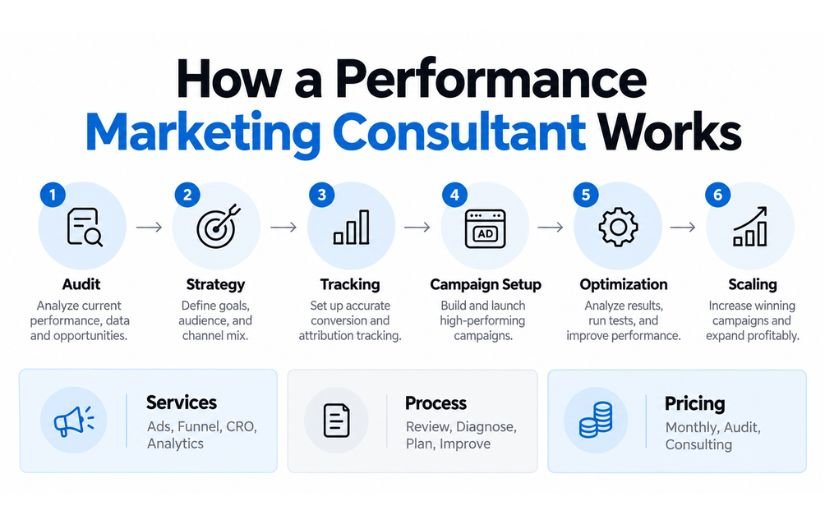
How My Performance Marketing Consulting Process Works
I like consulting engagements to be simple.
I do not want the business spending weeks preparing decks, reports and explanations before I can start understanding the problem.
I would rather get access to the real numbers, understand the business context and move toward the highest-impact decisions quickly.
Step 1: I Understand the Business and the Goal
I start by understanding what the business is actually trying to achieve.
That sounds obvious, but the goal is often not as clear as it first appears.
“We want more leads” is not enough for me.
I want to know how many leads the sales team can handle, what percentage normally converts, what a customer is worth and what acquisition cost still makes sense.
For ecommerce, I want to understand AOV, margin, repeat behaviour and how much room exists between revenue and actual contribution.
Step 2: I Review the Existing Acquisition Data
Then I go through the current performance.
Depending on the business, that may include Meta Ads, Google Ads, YouTube Ads, GA4, CRM data, landing pages and sales reports.
I am trying to build a picture of what has already happened before I start forming opinions about what should happen next.
I also want to understand which numbers the team currently trusts and which ones they do not.
Step 3: I Find the Biggest Bottleneck
This is where I try to avoid the classic audit problem of finding 40 things that could theoretically be improved.
Most accounts do not need 40 changes at the same time.
They usually have a small number of issues creating a large percentage of the pain.
It may be weak creative.
It may be poor landing-page conversion.
It may be expensive search traffic.
It may be weak lead quality.
It may be tracking that nobody trusts.
Or it may be that the business has already scaled the existing channel close to its efficient limit.
I want to identify that bottleneck before recommending activity.
Step 4: I Prioritize What I Would Change First
Once I understand the likely constraint, I put the recommendations in order.
I usually think in terms of impact and effort.
If one landing-page fix can materially improve conversion, I may put that above creating a completely new campaign structure.
If the account is buying irrelevant Google searches every day, cleaning that traffic may come before testing a new bidding strategy.
If Meta performance is being limited by a weak creative pipeline, I want the next creative batch moving before we discuss aggressive budget increases.
Step 5: I Build a Testing Plan
I do not want recommendations to stop at “improve creatives” or “optimize the landing page.”
I want the team to know what I would actually test.
That might mean testing a proof-led Meta angle against a problem-solution angle.
It may mean separating high-intent Google searches into a cleaner campaign.
It may mean testing a shorter landing page against the existing version.
It may mean changing the qualification process so the campaign is judged on stronger leads instead of total lead volume.
The test should have a reason behind it.
Step 6: We Review What Happened
A consulting recommendation is still a hypothesis until the market gives us an answer.
Some ideas will work.
Some will not.
When a test fails, I do not see that as a reason to defend the original recommendation.
I want to understand what the result taught us and use that learning to decide what comes next.
This is the same way I approach paid media generally, which I have broken down in more detail in my Performance Marketer in India guide.
The Process Can Be One-Off or Ongoing
Some businesses only need a deep audit and strategic direction.
Others benefit from ongoing consulting where I continue reviewing performance, discussing new tests and helping the team make decisions as spend grows.
I do not think one model is automatically better.
If the main problem can be diagnosed in one focused engagement, I would not make it unnecessarily complicated.
If the business is actively scaling and the questions keep changing every week, an ongoing relationship can make more sense.
What I Want at the End of the Process
I want everyone involved to know what happens next.
Not just what is wrong.
Not just what the dashboard says.
But exactly what we are going to change, why we are changing it and what result would tell us whether the decision was correct.
For me, that is what makes consulting useful.
How I Think About Performance Marketing Consulting Pricing
I do not think performance marketing consulting should be priced only by the number of hours spent on calls.
The value usually comes from identifying the right problem, preventing wasted spend and helping the team make better decisions faster.
At the same time, I do not believe in giving every business the same consulting fee without understanding the scope first.
A business spending ₹2 lakh per month on one platform has very different requirements from a business managing ₹25 lakh across Meta, Google and YouTube.
The Scope Matters More Than the Number of Meetings
Before I quote for consulting, I would normally want to understand what I am actually being asked to solve.
Is this a one-time account audit?
Do you need ongoing strategic support?
Am I reviewing one channel or the entire acquisition system?
Do I need to look at creative, landing pages, tracking and CRM data as well?
Will I only provide recommendations, or will I also work closely with the internal team while those recommendations are implemented?
Those differences matter much more to me than simply saying, “This includes four calls per month.”
One-Time Audit and Strategy Engagement
This model usually makes sense when the business wants an independent assessment of the current setup.
I would review the relevant accounts, funnel and available business data, identify the biggest issues and provide a prioritized action plan.
The goal is not ongoing campaign management.
The goal is to answer questions such as:
- What is actually holding performance back?
- Where is budget being wasted?
- What should the team fix first?
- Which campaigns should be scaled or reduced?
- What should be tested next?
For a business with an existing marketing team, this can sometimes be all that is required.
Ongoing Performance Marketing Consulting
Ongoing consulting makes more sense when the business is actively running campaigns and wants regular strategic input as conditions change.
In this model, I may review performance periodically, discuss tests with the team, evaluate results and help decide where the next budget should go.
This can be useful when an internal media buyer already handles daily execution but the business wants more experienced oversight around strategy, scaling, CRO and acquisition economics.
Consulting Across Multiple Channels Costs More Than Looking at One Account
A Meta Ads review can be relatively focused.
An engagement covering Meta, Google Search, Performance Max, YouTube, GA4, landing pages and CRM data is naturally much broader.
The amount of analysis required increases because I am no longer evaluating one platform.
I am trying to understand how several channels interact with the same customer journey.
That is also why I do not like quoting based purely on ad spend.
Spend matters, but complexity matters too.
Ad Spend Still Changes the Level of Responsibility
A ₹50,000 mistake in an account spending ₹1 lakh per month is very different from a small percentage mistake in an account spending ₹25 lakh per month.
As spend increases, I usually need to pay more attention to marginal CAC, creative capacity, channel saturation, tracking reliability and whether small efficiency losses are becoming expensive at scale.
That level of responsibility affects how I think about the scope of an engagement.
I Do Not Like Percentage-of-Spend Pricing for Pure Consulting
For full campaign management, a percentage-of-spend model can sometimes make sense.
For consulting, I generally prefer pricing based on the actual scope and level of involvement.
I do not want my incentive to become “the client spends more, therefore I earn more” if the correct recommendation is actually to reduce spend and fix the funnel first.
The commercial model should support good decisions.
What I Would Need Before Giving an Exact Fee
I would usually want to know:
- Which platforms are currently active
- Approximate monthly ad spend
- The primary business objective
- Whether campaigns are already running
- Who currently handles execution
- Whether landing pages and tracking are part of the scope
- Whether the requirement is one-time or ongoing
Once I understand those things, it becomes much easier to define the work properly.
I Would Rather Price the Right Engagement Than Sell the Largest One
If I believe a focused audit can solve the immediate problem, I would rather recommend that than push the business into ongoing consulting unnecessarily.
If the account needs continuous strategic involvement, I would say that too.
And if the business actually needs somebody executing campaigns every day rather than consulting, I would rather identify that before the engagement begins.
For me, performance marketing consulting pricing should reflect the problem being solved, the complexity of the acquisition system and how involved I need to be in helping the team solve it.
Who I Think Performance Marketing Consulting Is Best For
I do not think consulting is the right model for every business.
It works best when there is already enough data, enough activity and enough internal capacity to turn recommendations into action.
If the business is still extremely early and has barely run any campaigns, there may not be much to diagnose yet.
You Are Already Spending and Want Better Decisions
This is usually the clearest fit.
If Meta Ads, Google Ads or YouTube Ads are already active and the business is spending meaningful money every month, even small mistakes can become expensive.
At that stage, better decision-making can often be more valuable than simply adding more campaign activity.
I can look at where the money is going, what the platforms are actually producing and whether the current acquisition economics make sense.
You Have a Team That Can Execute
Consulting works very well when there is already a media buyer, marketing manager, creative team, developer or agency that can implement recommendations.
I do not need to become another layer between the business and execution.
I can focus on diagnosis, prioritization and strategy while the existing team moves quickly.
In many cases, that is more efficient than replacing people who already understand the business.
You Are Stuck at a Certain Spend Level
This is another situation where I think consulting can add a lot of value.
The campaigns may already be profitable, but every attempt to scale causes CAC to deteriorate too quickly.
That usually means there is a constraint somewhere.
It could be creative capacity, audience depth, available search demand, landing-page conversion, offer strength or lead quality.
I would rather find that constraint than keep increasing the budget and hoping the platform eventually fixes it.
You Are Getting Leads but Not Enough Customers
This is especially common in lead generation.
If the dashboard shows healthy CPL but the sales team is unhappy, I would want to understand the gap between the lead and the actual customer.
The problem may be targeting.
It may be the creative attracting weak intent.
It may be poor qualification.
It may even be the follow-up process.
This is exactly why I do not judge performance marketing only from the front-end metrics, which I also explain in my Performance Marketing Expert in India guide.
You Want an Independent View Before Making a Big Change
Sometimes the business is about to change agencies, rebuild the account, increase spend significantly or move into a new advertising channel.
That is a good time to get another perspective.
A second opinion can help answer whether the current problem really requires a complete rebuild or whether a smaller set of changes could solve it.
I would rather prevent an unnecessary reset than recommend one just because starting again looks more dramatic.
You Want to Build a More Mature Acquisition System
As spend grows, performance marketing usually becomes less about individual campaign tricks and more about the system around them.
Creative production has to keep up.
Tracking has to become more reliable.
CRM feedback becomes more important.
Budget allocation across channels becomes harder.
And the business needs a clearer view of CAC, contribution and what additional growth is actually costing.
This is where consulting can move beyond fixing campaigns and help improve how the entire acquisition process is managed.
Who I Probably Would Not Be the Right Fit For
If you are looking for someone to guarantee a fixed ROAS or CPL before understanding the business, I would not be the right fit.
If the only goal is to spend more regardless of the economics, I would probably challenge that.
If there is no internal capacity to implement anything and you need someone doing daily execution across the entire account, then consulting alone may not be enough.
And if the business is not willing to look at the landing page, creative, tracking or sales process because “the problem must be the ads,” I would find that difficult to work with.
The Best Fit Is Usually Simple
I work best with businesses that already have some traction, are serious about paid acquisition and want to understand what is actually limiting growth.
They do not need someone to tell them everything is fine.
They need someone willing to look at the data, challenge assumptions and help decide what should happen next.
That is the kind of performance marketing consulting work I enjoy most.
What I Need From a Business Before We Start
I do not need a perfect reporting setup before I can start consulting.
But I do need enough access and context to understand what is really happening.
The better the underlying information, the more useful my recommendations can be.
Access to the Advertising Accounts
If I am reviewing Meta Ads, Google Ads or YouTube Ads, I prefer looking at the actual account rather than working only from screenshots.
Screenshots can show me a result.
The account shows me how that result was produced.
I want to see campaign history, spend changes, creative performance, search terms, conversion actions, audience behaviour and how performance changed over time.
Landing Pages and the Conversion Journey
I also want to see what happens after the click.
That may include landing pages, checkout pages, lead forms, thank-you pages or whatever journey the user goes through before becoming a lead or customer.
If the ads are bringing the right traffic but the funnel is leaking, I need to be able to see that.
Real Business Numbers
This is where consulting becomes much more useful.
I want to know what a customer is worth, what the business can afford to pay to acquire one and whether the current numbers leave room to scale.
For lead generation, I want lead-to-sale conversion if it is available.
For ecommerce, I want enough information around AOV, margin and repeat purchase behaviour to understand whether the reported ROAS is actually healthy.
If those numbers are confidential, they do not have to be shared publicly. But internally, they make the analysis much stronger.
CRM or Sales Feedback for Lead Generation
If the business generates leads, I would ideally like some visibility into what happens after the form is submitted.
Which leads are qualified?
Which campaigns are producing the strongest opportunities?
Which leads are becoming customers?
What objections does the sales team hear repeatedly?
I have seen enough lead-generation campaigns to know that the cheapest source inside Ads Manager is not always the best source for the business.
Previous Tests and What the Team Already Learned
I do not want to recommend the same test that failed three months ago just because nobody told me it had already been tried.
I like understanding what the team has tested, what happened and what they believe they learned from it.
Sometimes I may still recommend revisiting an old test if I think the conditions have changed, but I want to make that decision knowingly.
I Also Want to Know What the Business Thinks the Problem Is
This is useful even if I eventually disagree.
The founder may believe lead quality is the issue.
The media buyer may believe creative fatigue is the issue.
The sales team may think volume is fine but follow-up speed is hurting conversion.
Those different perspectives often help me find where I should investigate first.
I Do Not Need Perfect Data to Start
Most real businesses do not have perfect attribution.
There may be missing CRM data, inconsistent UTM tracking or historical campaigns that were not structured cleanly.
That does not stop me from working.
I just want to know what I can trust and what I should treat carefully.
My goal is not to make the data look perfect before making any decision.
My goal is to get enough reliable evidence to make the next decision better than the last one.
That is also why I prefer working from actual campaign and business context rather than isolated performance screenshots, which is the same approach I use across the case studies on my Performance Marketing Expert in India page.
What My Experience Looks Like in Practice
I do not think a consulting page should rely only on saying “I have experience.”
I prefer connecting that experience with actual campaign outcomes, because that gives more context to how I think.
Across almost 10 years of performance marketing work, I have managed paid acquisition across Meta Ads, Google Ads and YouTube Ads for education, ecommerce, coaching, digital products, services and lead-generation businesses.
That work has included more than ₹150Cr in attributed revenue, 10L+ leads and 2L+ paid customers across different businesses and funnels.
Large-Scale Lead Generation
One of the clearest examples is an education campaign where YouTube Ads generated more than 66,300 leads at approximately ₹76 CPL from around ₹50.4 lakh in spend.
What matters to me about that result is not only the CPL.
It is the combination of volume and spend.
Getting a campaign to work at a small budget is one thing.
Keeping acquisition reasonably efficient while moving through a much larger amount of spend is a different challenge.
You can see more of how I think about that channel on my YouTube Ads Expert in India page.
Google Ads Across Different Business Models
I have also worked on Google Ads campaigns where the job was very different from YouTube.
In one EdTech campaign, approximately 656 attributed conversions were generated from around ₹71,000 in spend at roughly ₹109 per conversion.
That campaign is documented in my EdTech Google Ads case study.
In an Ayurveda lead-generation campaign, Google Ads generated more than 5,000 leads at approximately ₹87.65 CPL from around ₹4.41 lakh in spend.
You can see that breakdown in my Ayurveda Google Ads case study.
Ecommerce Has Taught Me to Look Beyond Platform ROAS
Ecommerce work has made me much more cautious about looking at ROAS without understanding the rest of the business.
I have worked on D2C campaigns generating significant tracked revenue across categories such as hair care, fashion and other consumer products.
In those accounts, I care about new-customer CAC, contribution margin, repeat purchase behaviour and whether the business is actually creating profitable incremental revenue.
A strong platform ROAS is useful, but I still want to know what is behind it.
Different Businesses Need Different Acquisition Logic
The way I think about a ₹499 digital product is different from the way I think about a high-consideration education lead.
The way I evaluate a D2C ecommerce account is different from a real-estate lead-generation funnel.
The platforms may be the same, but the economics, buying cycle, creative requirements and definition of a good conversion can be completely different.
That range of experience is one reason I do not like applying one fixed “best practice” to every account.
I Use Past Results as Evidence, Not as Guarantees
I would never tell a new business that because I generated a certain CPL or ROAS somewhere else, I can guarantee the same number for them.
Different offers, markets, pricing, competition, landing pages and sales processes produce different outcomes.
What previous work can show is whether I have dealt with meaningful spend, meaningful conversion volume and the kinds of problems that appear once campaigns move beyond a small test.
That is the experience I bring into a consulting engagement.
What Happens After You Contact Me for Performance Marketing Consulting?
I like the first step to be simple.
I do not want you filling out a long questionnaire before we even know whether I can help.
I usually just need enough context to understand the business, what is currently running and what problem you are trying to solve.
Step 1: You Share the Current Situation
That can be as simple as telling me:
- What your business does
- Which ad platforms are active
- Your approximate monthly ad spend
- What is currently working
- What is not working
- What you want to improve
I do not need everything to be perfectly organized.
I just need enough context to decide whether the problem is something I can genuinely help with.
Step 2: I Tell You Whether Consulting Makes Sense
I do not assume consulting is always the right answer.
Sometimes the business actually needs hands-on campaign management.
Sometimes it needs better tracking.
Sometimes the real issue is creative volume, landing-page conversion or sales follow-up.
If I think consulting is not the right model for the problem, I would rather say that before we begin.
Step 3: We Define the Scope
If the fit makes sense, I define what I would actually review.
That may include Meta Ads, Google Ads, YouTube Ads, landing pages, tracking, CRM data, creative performance or a combination of them.
I also clarify whether the engagement is a one-time audit or ongoing strategic support.
I prefer agreeing on that upfront so both sides know exactly what the engagement is meant to solve.
Step 4: I Review the Data Before Giving Strong Opinions
I do not like making confident recommendations from a 20-minute introductory call.
I may have early hypotheses, but I want to see the actual data before deciding what the business should change.
That usually means reviewing the relevant ad accounts, funnel and business numbers.
Once I understand the system properly, I can separate symptoms from actual causes.
Step 5: I Give You a Prioritized Action Plan
I do not want the outcome to be a generic audit containing dozens of observations.
I want the recommendations to have an order.
What should be fixed immediately?
What should be tested?
What should be left alone?
Where would I increase spend?
Where would I reduce it?
What information do we still need before making a bigger decision?
That prioritization is usually the most important part.
Step 6: We Decide What Happens Next
For some businesses, the team can take the recommendations and execute everything internally.
That may be the end of the consulting engagement.
For others, I may continue reviewing performance and helping the team evaluate what happens after the changes are implemented.
I do not think every client needs an ongoing retainer by default.
The engagement should continue only if there is a clear reason for it.
You Can Start by Sharing the Problem
If your campaigns are already running and you are not sure whether the main issue is media buying, creative, CRO, tracking, lead quality or scaling, that is enough context to start a conversation.
You do not need to diagnose the problem before contacting me.
That is part of what I am there to help with.
Frequently Asked Questions About Performance Marketing Consulting
What Does a Performance Marketing Consultant Actually Do?
A performance marketing consultant helps diagnose what is limiting paid growth and recommends what should change next.
That can involve Meta Ads, Google Ads, YouTube Ads, creative strategy, landing pages, CRO, tracking, attribution, lead quality, CAC and budget allocation.
The exact scope depends on where the problem actually sits.
Do You Manage Campaigns or Only Give Recommendations?
Consulting and full account management are different engagements.
In a consulting setup, my primary role is diagnosis, strategy, prioritization and helping the existing team make better decisions.
If the business needs daily execution as well, I would rather identify that upfront than pretend consulting alone will solve it.
Can You Audit an Existing Meta Ads or Google Ads Account?
Yes.
I can review an existing account to understand where spend is going, what is producing results, what may be wasting budget and what I would prioritize next.
I usually prefer looking at the actual account rather than only screenshots because the historical context matters.
Do You Work With YouTube Ads as Well?
Yes.
YouTube Ads has been a significant part of my lead-generation experience, including an education campaign that generated more than 66,300 leads at approximately ₹76 CPL.
If YouTube is the main requirement, you can also read my YouTube Ads Consultant in India page.
Can You Help if My CPL Is Good but Sales Are Poor?
Yes, and this is exactly the kind of situation where I would not stop at the ad-platform data.
I would want to understand lead quality, creative messaging, qualification, CRM data, follow-up and where the gap between the lead and the customer begins.
A low CPL is not very useful if the leads rarely become customers.
Can You Help if My Campaigns Were Working but Have Stopped Scaling?
Yes.
I would look at what changed as spend increased.
That may include creative fatigue, audience saturation, weaker search intent, falling conversion rate, deteriorating lead quality or simply reaching the efficient limit of the current channel.
Do You Work Only With Businesses in India?
No.
My positioning on this page is as a performance marketing consultant in India, but the work itself can be done remotely.
What matters more to me is whether I understand the business model, acquisition economics and advertising channels involved.
How Much Does Performance Marketing Consulting Cost?
I do not use one fixed fee for every business.
The pricing depends on the number of channels, account complexity, monthly spend, whether funnel and tracking are part of the review and whether the requirement is a one-time audit or ongoing support.
I prefer defining the problem first and then pricing the actual scope required to solve it.
Do I Need a Large Ad Budget Before Consulting Makes Sense?
Not necessarily.
But consulting becomes more useful when there is enough campaign data to diagnose and enough spend for better decisions to have a meaningful financial impact.
If the business has barely started advertising and there is almost no data yet, the requirement may be closer to campaign setup and initial strategy than a deep performance audit.
What Platforms Do You Work Across?
My core paid media experience is across Meta Ads, Google Ads and YouTube Ads, along with CRO, analytics, tracking and the broader acquisition funnel.
You can see how I work across those channels in my Performance Marketer in India guide.
How Do I Know Whether I Need a Consultant or Someone to Manage the Account?
I would look at what capability is currently missing.
If you already have people who can execute but are unsure what to change or how to scale, consulting can make sense.
If nobody is available to implement the recommendations and the account needs daily attention, full management may be the better model.
Looking for a Performance Marketing Consultant in India?
If your paid campaigns are already running but you are not confident about what should happen next, that is usually the point where consulting becomes useful.
You may be dealing with rising CAC, weak lead quality, inconsistent tracking, creative fatigue, poor landing-page conversion or simply uncertainty around where the next budget increase should go.
My role is to help you identify the real constraint, prioritize the right fixes and make better decisions across Meta Ads, Google Ads, YouTube Ads, CRO, tracking and the broader acquisition funnel.
If you want to understand how I think about paid growth more broadly, you can read my Performance Marketing Expert in India page.
If you want to see how I actually work across Meta, Google and YouTube, my Performance Marketer in India guide goes deeper into that process.
And if you are currently evaluating different experts before making a decision, you may also find my guide to choosing a performance marketing expert in India useful.
If you want me to review your current acquisition setup and help you figure out what I would fix, test or scale next, you can work with me.