Hiring a Facebook Ads expert in India is easy. Finding someone who can make good decisions with your advertising budget is much harder.
Most profiles sound similar. You will see claims around ROAS, scaling, targeting, creative testing, Meta Ads strategy and lead generation. The difficult part is separating someone who knows Ads Manager from someone who understands the full acquisition system.
If I were hiring a Facebook Ads expert for my own business, I would not start by asking, “What ROAS can you give me?” I would evaluate how the person thinks, what evidence they ask for, how they diagnose problems and whether they can connect Meta performance to actual business outcomes.
These are the 10 things I would check.
1. Do they understand your business economics before discussing campaign structure?
A Facebook Ads expert should not need your entire financial model before the first conversation, but they should want to understand what a successful customer is worth to the business.
That usually means asking about more than your target CPL or ROAS.
For ecommerce, I would expect questions around average order value, gross or contribution margin where available, new versus returning customers, cancellations, refunds, COD behaviour, repeat purchase and the acquisition cost the business can realistically support.
For lead generation, I would want to understand what happens after the lead arrives. How many leads are contactable? How many qualify? How many become opportunities? How many eventually become paying customers?
Why this matters
A campaign can look efficient inside Meta Ads Manager while creating weak economics for the business.
A ₹300 lead is not automatically better than a ₹500 lead. If the ₹500 leads qualify and close at a significantly higher rate, the more expensive campaign may create the lower customer acquisition cost.
The same principle applies to ecommerce. A strong platform ROAS can look attractive while hiding a weak new-customer mix, high cancellations or poor contribution.
What I would ask the expert
“Before you recommend a campaign structure, what business numbers would you want from us?”
A strong answer should go beyond CPM, CPC, CTR and platform ROAS. The expert should be thinking about the economics the advertising is supposed to produce.
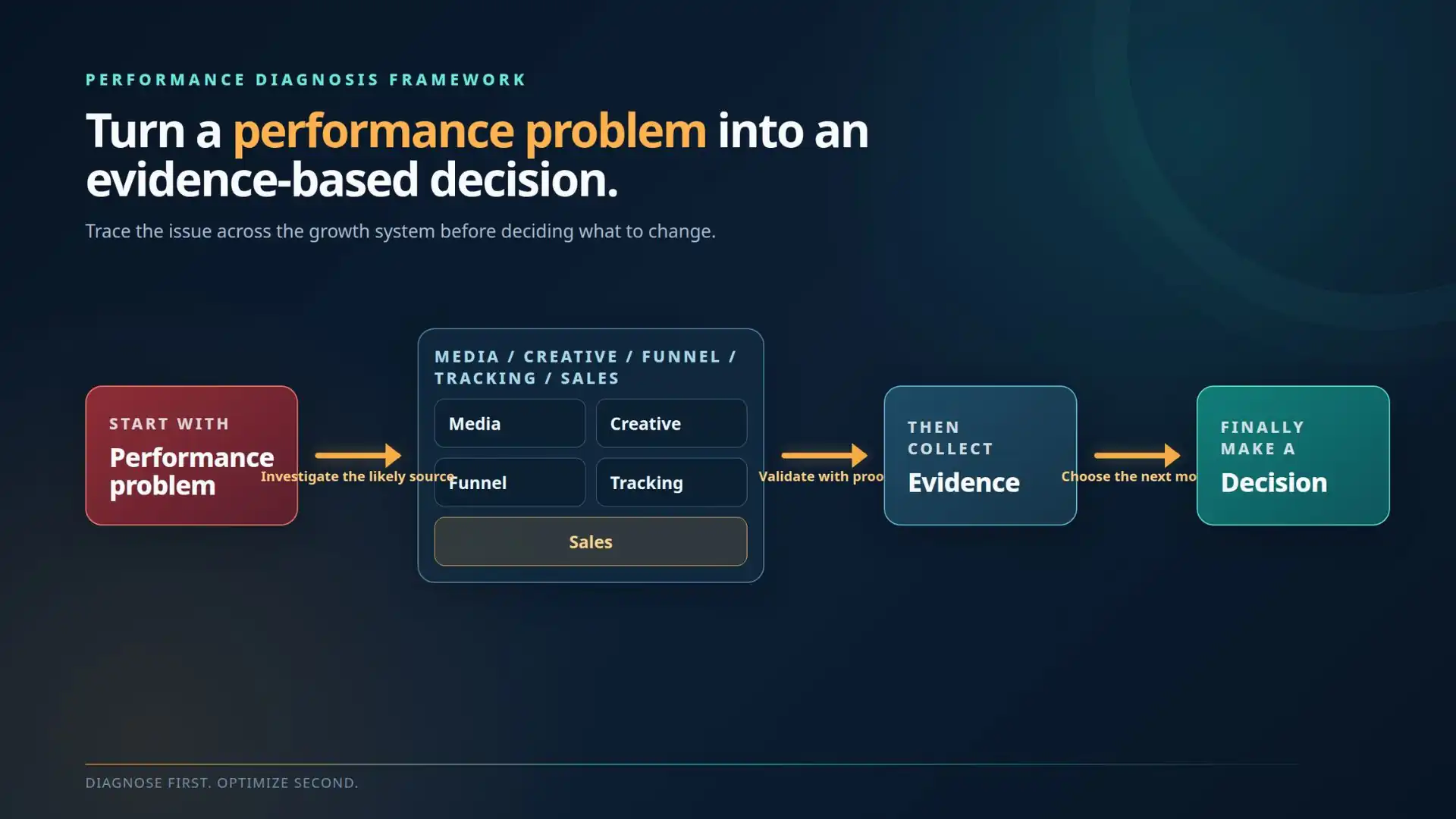
2. Can they diagnose a problem before changing the campaign?
One of the biggest differences between an operator and a real performance marketer is what happens when performance deteriorates.
If CPL increases, the answer is not automatically a new audience. If ROAS falls, the answer is not automatically to switch off the campaign.
The first job is to determine what changed.
For example, if CPL increases
The problem could be more expensive traffic. CPM or CPC may have increased while landing-page conversion remained stable.
Or traffic costs may be almost unchanged while the landing page converts fewer visitors.
Another possibility is creative. The campaign may still generate clicks, but the message could be attracting people with weaker intent.
Tracking can create another explanation. If the conversion event is missing, duplicated or firing differently, the reported CPL may move even when the underlying acquisition has not changed in the same way.
What I would ask
“If our CPL suddenly increased by 40%, what would you check before changing targeting?”
I would look for a diagnostic answer: delivery, creative, click behaviour, landing-page conversion, event quality, lead quality and downstream outcomes.
If the immediate answer is simply “I would test new audiences,” I would want to understand why.
3. Do they evaluate creative as an acquisition variable, not just an ad asset?
Meta advertising has become increasingly creative-led, but “we test creatives” tells you very little.
I would want to understand what the expert is actually testing.
Are they testing different visual edits of essentially the same message? Or are they testing different customer problems, objections, offers, proof mechanisms, hooks and buying motivations?
Creative can change who enters the funnel
A creative does more than earn attention. It creates an expectation before the click.
A very broad promise may produce more clicks or leads while attracting people with weaker buying intent. A more specific message may reduce raw response volume but improve qualification.
This is why I would not judge creative exclusively on CTR or cost per lead.
For ecommerce, I would want to connect creative angles to purchases, new-customer economics and landing-page behaviour.
For lead generation, I would want to compare creative-level CPL with downstream lead quality where that data exists.
What I would ask
“How do you decide what creative to test next?”
A useful answer should include customer insight, offer, previous performance, objections, creative concepts and a learning process. It should not be limited to “we make more videos when performance drops.”
Meta itself supports structured testing approaches, including A/B testing for eligible advertising setups. Testing becomes useful when it is designed to answer a decision rather than create activity for its own sake.
4. Can they show relevant proof, and explain what the proof actually means?
Case studies matter, but screenshots are easy to misunderstand.
A screenshot showing 8X ROAS tells you very little without context.
Was it prospecting or remarketing? What attribution setting was being used? What period did it cover? Was it revenue or fulfilled revenue? Was it one campaign or an entire account?
The same problem exists with lead-generation screenshots.
₹50 CPL sounds impressive until you discover that the sales team considered most of the enquiries irrelevant.
Look for scoped evidence
A good case study should make clear what the number represents.
For example, in my own documented work, Meta Ads generated ₹1.43Cr+ in COD revenue for a D2C hair-oil business. I use that as evidence of hands-on Meta ecommerce experience, not as a claim that every order was delivered profitably or that another business will reproduce the same result.
I have also worked on women’s fashion ecommerce where documented revenue crossed ₹1.05Cr with 493% growth.
Those numbers are useful because they establish relevant experience. They are not guarantees.
What I would ask
“Can you walk me through one result and explain exactly what the metric represents?”
I would pay as much attention to the caveats as the headline number.
5. Do they understand tracking, attribution and measurement?
A Facebook Ads expert does not need to be your developer, but they should understand whether the numbers they are optimizing can be trusted.
That includes familiarity with Meta Pixel, conversion events, Conversions API, website analytics, CRM data and the differences between platform-reported conversions and business records.
Why this matters
Suppose Meta reports 100 leads while the CRM shows 82 usable records.
The solution is not to automatically choose whichever number looks better. The job is to understand the definitions, event behaviour, attribution and data flow behind the difference.
The same applies to ecommerce.
Meta may attribute a purchase that another analytics platform attributes differently. Orders can later cancel, refund or fail fulfilment. Platform attribution and business accounting answer related but different questions.
What I would ask
“If Meta, GA4 and our CRM show different numbers, how would you decide what to optimize against?”
I would expect an answer based on definitions, reconciliation and business purpose, not the claim that one dashboard is always correct.
6. Do they look beyond Ads Manager when performance is weak?
Paid advertising is one component of the acquisition journey.
An expert who treats every performance problem as an Ads Manager problem will eventually optimize around issues that advertising cannot solve.
The complete path may look more like this
Ad → Click → Landing Page → Conversion → Qualification or Purchase → Follow-Up → Customer → Revenue.
A weak outcome can emerge anywhere in that chain.
An ad may attract the right visitor while the landing page creates confusion.
A campaign may generate qualified enquiries while the sales response is slow.
An ecommerce campaign may acquire orders efficiently while cancellations make the apparent performance misleading.
This is why I consider CRO, funnel behaviour, tracking and downstream outcomes part of performance marketing, even when the engagement itself is focused on Meta Ads.
My performance marketing funnel framework goes deeper into how I connect paid traffic with the stages after the click.
What I would ask
“How do you determine whether a weak result is caused by advertising, the page, the offer or what happens after the lead?”
The expert does not need to personally rebuild every landing page or manage the sales team. They should, however, be capable of identifying when the constraint sits outside the ad account.
7. Do they measure the metric that matches your actual business objective?
There is no single Meta Ads metric that tells you whether a business is growing profitably.
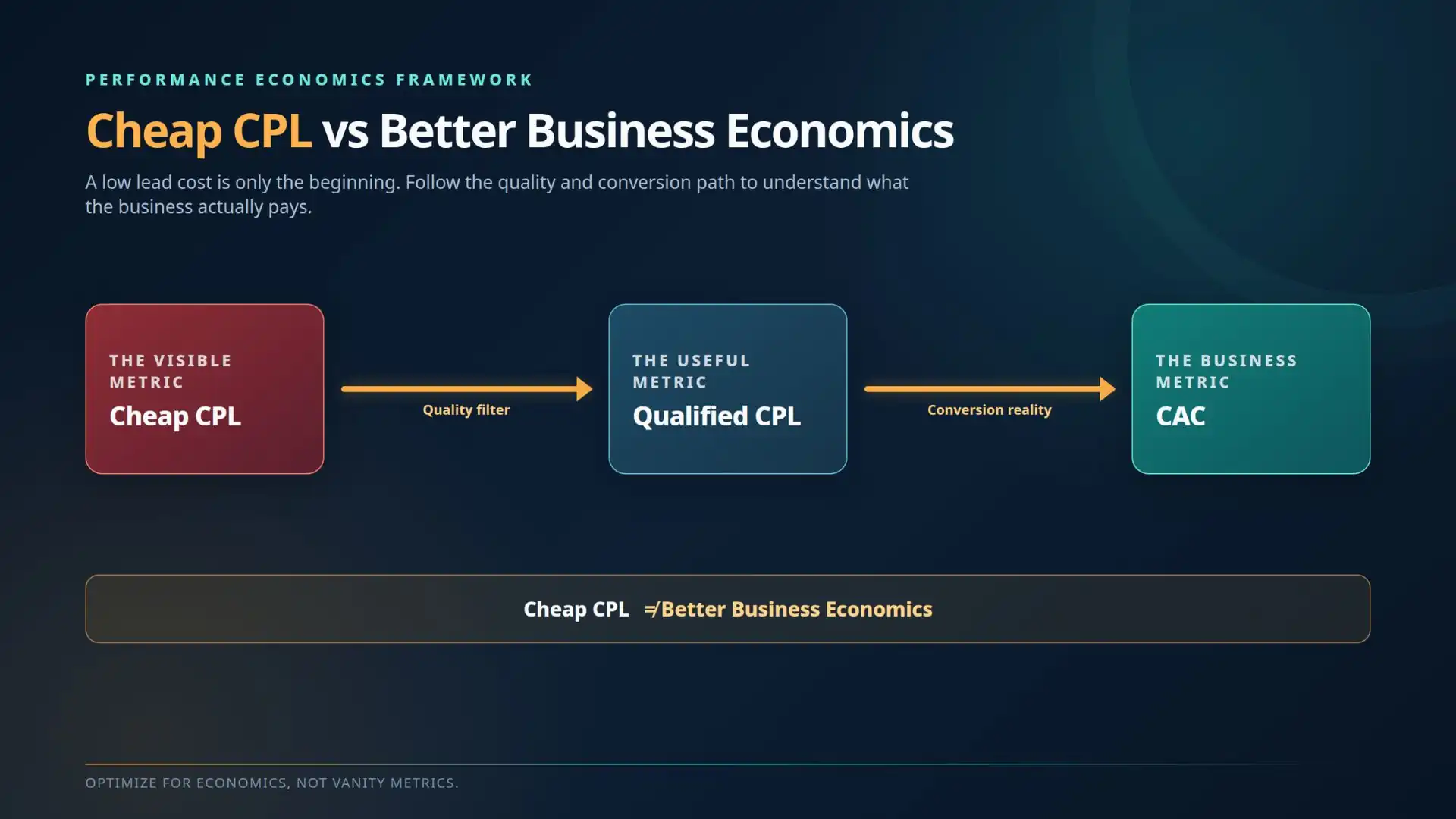
CTR helps explain response to the ad. CPC tells you what traffic costs. CPL or CPA measures a conversion event. ROAS relates attributed revenue to advertising spend.
Each answers a different question.
Lead generation needs downstream metrics
If your business sells through calls or consultations, raw CPL should rarely be the end of the analysis.
You may also need qualified lead cost, appointment cost, opportunity cost or eventual customer acquisition cost depending on the funnel.
That is the philosophy behind my Facebook Ads lead-generation consulting approach: optimize for business-quality acquisition, not simply the cheapest form submission.
Ecommerce needs more context than ROAS
ROAS matters, but it should be interpreted alongside CAC, AOV, margin, customer mix and fulfilment where those variables materially affect profitability.
I explain the distinction in more detail in my ROAS vs CAC guide.
What I would ask
“Which metric would you optimize for in our business, and what would make you change that metric?”
The second half of that question is important. The right KPI can change as the business, funnel and campaign objective change.
8. Will your business retain control of its advertising assets?
This is operational rather than strategic, but it can become extremely important when a relationship ends.
I would want the business to understand who owns and controls the relevant Meta assets, and what level of access is being granted to the person managing campaigns.
Meta provides different forms of Page access, including task access for work through tools such as Ads Manager. Full control carries much broader permissions, including the ability to manage access itself.
That is one reason I would not give the highest possible access level automatically when a more appropriate permission level can do the job.
Clarify this before work begins
Ask who controls the Page, Business Portfolio, ad account, dataset or pixel, Instagram account and other relevant assets.
Also ask what happens to access if the engagement ends.
The exact setup can vary by business and account structure. The important thing is that ownership and access are deliberate rather than discovered during an offboarding dispute.
What I would ask
“Which assets need access, what permission level do you need, and what remains under our control?”
A professional should be able to explain the requirement clearly.
9. Can they explain when to scale, hold, test or stop?
Anyone can say they know how to scale Facebook Ads.
The more revealing question is what conditions need to be true before they increase spend.
Scaling should be a decision, not a ritual
If performance is profitable at ₹10,000 per day, that does not prove the same economics will hold at ₹20,000.
Additional budget may push the campaign into more expensive inventory, broader demand or a different customer mix.
Creative capacity can also become a constraint. So can landing-page conversion, fulfilment, inventory or the sales team’s ability to follow up.
I think of scaling as profitable incremental growth, not simply increasing the budget of whatever campaign has the highest current ROAS.
What I would ask
“What would make you increase our budget, and what would make you hold it even if Meta ROAS looks good?”
A thoughtful answer may involve new-customer CAC, creative evidence, conversion rate, contribution, lead quality or operational capacity depending on the business.
That type of decision-making matters more to me than a generic promise to “scale winning campaigns.”
10. Is the working relationship clear before you hire them?
A talented advertiser can still be the wrong hire if the commercial and operating model does not fit your business.
Clarify what you are actually buying.
Who will run the account?
If you speak to a senior strategist during the sales process, ask whether that same person will make campaign decisions after onboarding.
If someone else will operate the account, understand their role and experience.
What is included?
Clarify whether the engagement covers media buying only or also creative strategy, actual creative production, tracking, reporting, landing-page recommendations, CRM feedback or other work.
Two providers quoting very different fees may not be selling the same scope.
My guide to Facebook Ads management cost in India explains why management fees should be evaluated alongside what the provider actually owns.
What happens when you disagree?
Ask how decisions are documented, how often performance is reviewed and what happens when the business wants to test a different direction.
You are not looking for someone who agrees with every request. You are looking for someone who can explain the evidence behind a recommendation.
What happens if the relationship ends?
Understand notice periods, asset access, outstanding creative, reporting, tracking ownership and any other handover requirements before signing.
A clean exit process is part of a professional engagement.
A simple way to score a Facebook Ads expert before hiring
I would not select someone on a single impressive case study. I would score the overall quality of their thinking.
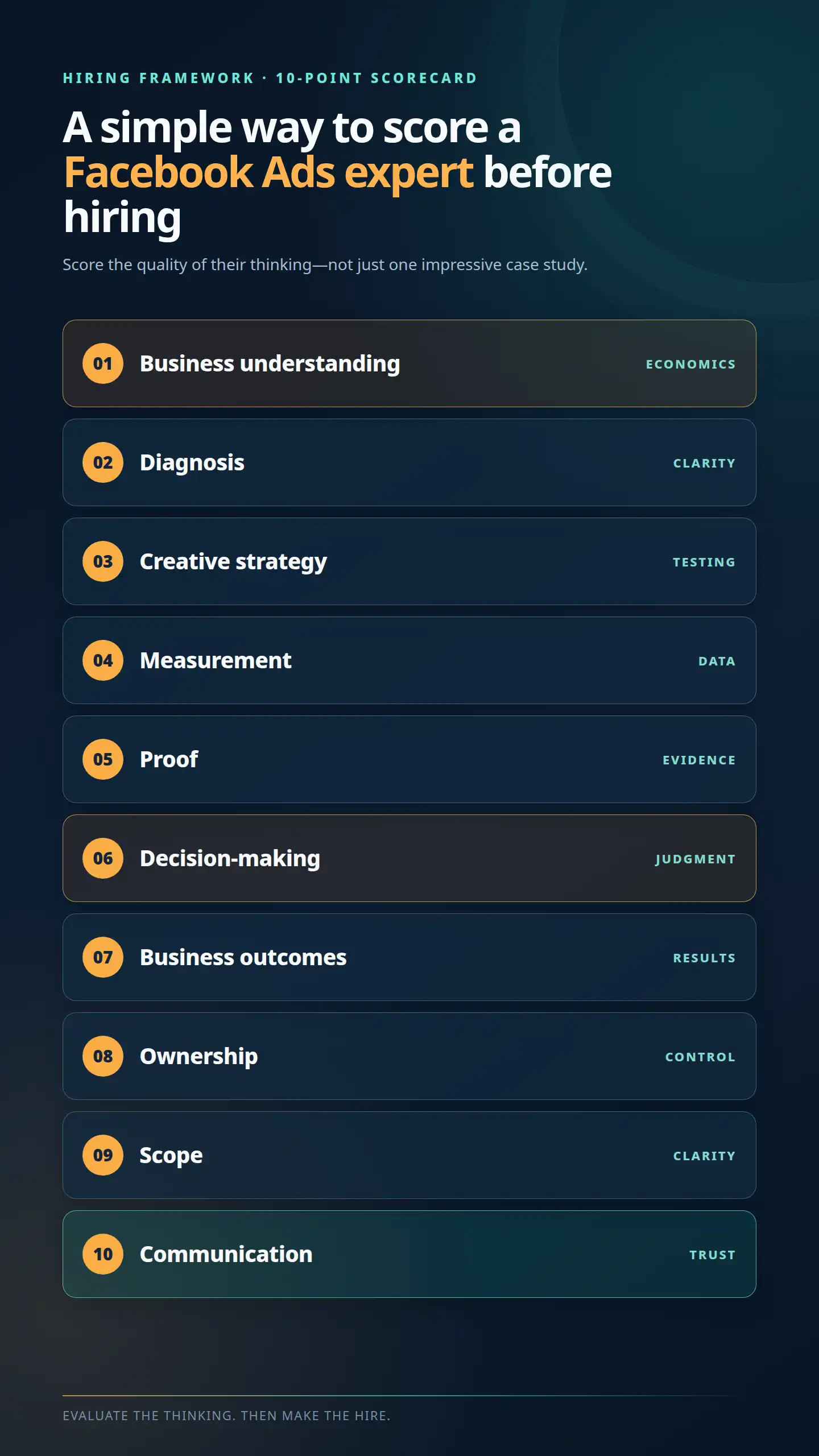
- Business understanding: Do they understand your acquisition economics, not only your ad metrics?
- Diagnosis: Can they separate media, creative, funnel, tracking and sales problems?
- Creative strategy: Do they test ideas and customer motivations rather than endless cosmetic variations?
- Measurement: Can they work with Pixel, CAPI, analytics and downstream business data?
- Proof: Are their case studies properly scoped rather than just impressive screenshots?
- Decision-making: Can they explain when to scale, hold, test or stop?
- Business outcomes: Do they care about qualified leads, customers and CAC rather than only platform metrics?
- Ownership: Are account access and asset control clear?
- Scope: Do you know exactly what they will and will not own?
- Communication: Can they explain uncertainty and trade-offs without hiding behind jargon?
You do not need a perfect score in every category. A specialist may intentionally have a narrow scope.
The important thing is knowing what you are hiring them to solve.
Expert, consultant, freelancer or agency: which one should you hire?
The labels overlap, so I would focus more on the operating model than the title.
A Facebook Ads expert may be the right fit when specialist Meta capability and hands-on judgment are the priority.
A Facebook Ads consultant makes more sense when the primary need is diagnosis, strategy, account review or repeated senior-level decision support.
A Facebook Ads freelancer can work well when you want direct access to a hands-on operator without a larger agency structure.
A larger Facebook Ads agency can make sense when the engagement requires broader capacity, multiple specialists or a wider service scope.
If you want someone to actively operate the campaigns over time, evaluate the actual responsibilities included in Facebook Ads management services.
The correct model depends on the problem you are trying to solve.
Red flags I would not ignore
A guaranteed ROAS before understanding the business. Forecasting is useful. Certainty about an unseen account is different.
An obsession with targeting while ignoring creative. Audience decisions matter, but targeting is not a substitute for a compelling offer and creative system.
Case studies with no context. Ask what the number represents, the time period and the actual business objective.
No interest in what happens after the conversion. This is especially dangerous for lead generation.
Confusion about account ownership and access. Clarify this before onboarding.
Every problem has the same solution. If performance issues always lead to new targeting, new campaign structures or more budget, diagnosis is probably too shallow.
How I think about Facebook Ads expertise
I have spent almost 10 years working hands-on across performance marketing, including Meta Ads, Google Ads, YouTube Ads, CRO, analytics, attribution, tracking and acquisition funnels.
That experience has made me less interested in finding the cleverest Ads Manager trick and more interested in locating the actual acquisition constraint.
Sometimes the next rupee should go into media.
Sometimes it should go into better creative, a stronger landing page, measurement repair, sales follow-up or another part of the customer journey.
The role of a good Facebook Ads expert is not simply to spend the budget. It is to use the available evidence to decide where the business has the best opportunity to improve acquisition.
Before you hire a Facebook Ads expert in India
Do not make the decision based only on price, a polished sales call or the highest ROAS screenshot.
Look at how the person thinks.
Ask how they diagnose a weak campaign. Ask how they measure lead or customer quality. Ask how they connect creative, tracking and funnel behaviour to the numbers inside Meta Ads Manager.
Most importantly, ask what evidence would cause them to change their recommendation.
That question tells you whether you are hiring someone to operate a dashboard or someone capable of making performance marketing decisions.
If you are currently evaluating your Meta Ads account or deciding what kind of support you need, you can see how I approach Facebook Ads consulting or review my broader Facebook Ads experience and approach.