What should a Facebook Ads consultant for lead generation actually improve?
A Facebook Ads consultant for lead generation should help you buy more suitable customers, not simply more form submissions. I connect the promise in the ad to the people who respond, the leads your team can contact, the opportunities that qualify and the customers who justify the spend.
If those stages are disconnected, a lower cost per lead can hide a more expensive acquisition system. The consulting decision is to find the broken stage before changing audiences, creative or budget.
Four points I would settle first
- A good lead meets your agreed buyer criteria and gives the business a realistic chance to start the next conversation.
- CPL measures the price of a response. Qualified-lead cost and customer acquisition cost answer different, deeper questions.
- Meta can influence the promise, response and measurement path; your business must own contact, qualification rules and selling.
- More budget is justified by healthy incremental customer economics and follow-up capacity, not a cheap form-fill report.
On this page
- When specialist consulting fits
- What counts as a good lead
- How the ad and form shape quality
- My Lead Quality Feedback Loop
- CPL, qualified leads and customer economics
- When to increase the Meta budget
- What a useful consultation should produce
When does lead-generation consulting make sense?
Consulting makes sense when you have a decision the Ads Manager cannot answer alone. Perhaps enquiries are arriving but few become conversations, or the team says quality is poor while Meta reports an improving CPL. I would define that disagreement before recommending a campaign rebuild.
The scope is more specific than my general Facebook Ads consulting approach. Here the central question is whether Meta is producing reachable, suitable prospects who can become customers at acceptable economics.
If you need a bounded assessment of an existing account, a Facebook Ads audit may be the appropriate first step. If the main requirement is daily campaign operation, creative launches and routine monitoring, review ongoing Facebook Ads management instead.
I would be cautious about hiring any consultant who promises a fixed CPL before seeing the offer, lead definition, sales cycle and follow-up data. The number that matters depends on what a suitable customer is worth and what it costs to acquire one.
What counts as a good Facebook or Instagram lead?
A good lead is not just a valid phone number. It is a person who fits the offer, understands whether the next step is an enquiry, appointment, application or sales call, and can be contacted within a process your business can deliver. Define those conditions before comparing campaigns.
For one business, qualification may mean location, budget and timing. For another, it may mean eligibility for a programme or a specific service need. I would ask the sales team to write criteria that can be recorded consistently in the CRM, not a vague label such as “good quality.”
Separate three problems that look alike in Ads Manager
Unreachable: the record is duplicate, invalid or never connects after a documented contact attempt. I would inspect form friction, data capture, routing and the business’s response process before blaming the audience.
Unsuitable: the person answers but is outside the agreed location, price, eligibility or need. That points toward the ad promise, offer explanation, qualification questions or audience mix.
Unclosed: the person is contactable and fits, yet does not buy. The next diagnosis includes sales conversation, offer, timing, price, trust and competition. Another audience test may do nothing for this group.
Those labels need dates and consistent dispositions. A lead still awaiting a first call is not evidence of poor targeting, and an open sales opportunity should not be counted as a lost customer prematurely.
How do the ad promise and capture path change lead quality?
The creative teaches people what to expect before they submit. If an ad implies a free answer but the sales conversation starts with a high-commitment service, the resulting low-intent enquiries are partly a promise problem. I would test clearer language before narrowing targeting blindly.
Price range, eligibility, service area and the actual next step can all filter expectations. This may reduce lead volume and raise CPL while making more of the remaining conversations useful. Whether that trade-off is good must be tested against qualified leads and customers.
Instant form or landing page?
Meta offers both instant forms and website forms for lead generation, along with form and CRM options described in its lead-generation guide. An instant form can reduce the steps to submit; a landing page gives more room to explain a complex offer and set expectations.
Neither route guarantees better buyers. I would compare cohorts on contactability, qualification and customer outcomes, while checking mobile speed and message match on a website route. A longer form is useful only when its questions reveal fit or improve the handoff, not because friction sounds sophisticated.
Meta’s documented options include CRM lead retrieval and a conversion-leads approach using downstream data. Whether a particular integration or optimization setting is available and suitable should be checked in the current account. Better signal quality does not remove the need for accurate CRM stages.
The Lead Quality Feedback Loop I use to find the next decision
The Lead Quality Feedback Loop evaluates each Meta lead cohort through Promise, Response, Contact, Qualification, Customer, Economics and Feedback; each stage pairs a signal with evidence, a possible constraint and the next decision. It separates unreachable, unsuitable and unclosed leads before recommending another audience or budget change.
I would follow the same group of leads through the stages, allowing enough time for its sales cycle. A mixed report of this week’s leads and last month’s customers can make one campaign look stronger or weaker for the wrong reason.
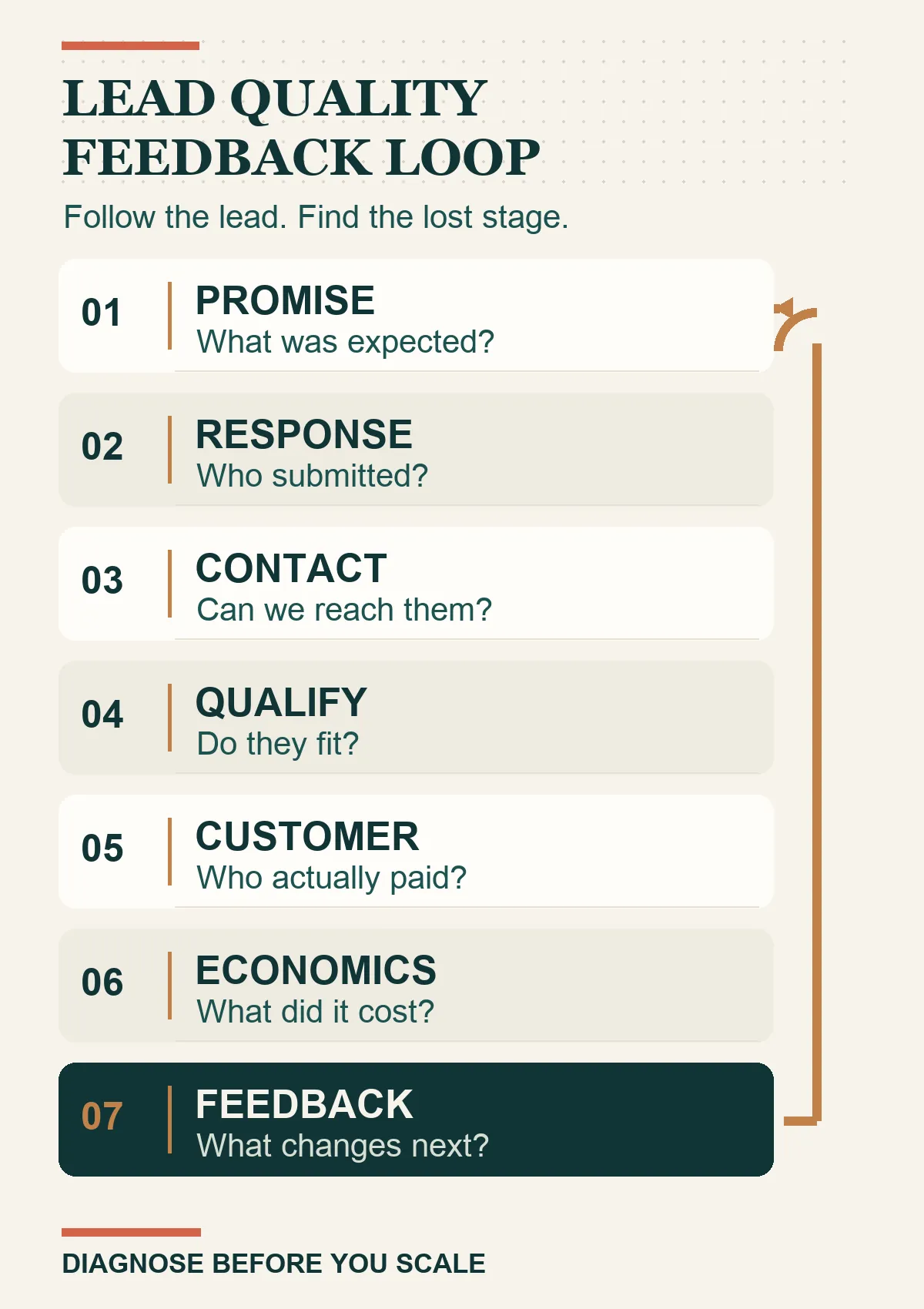
- Promise: compare the claim in the ad with the actual offer, price and next step. If sales repeatedly corrects an expectation the ad created, revise the creative promise.
- Response: inspect which creative and form produced the submission, and whether duplicate or irrelevant records cluster around one path. If response quality differs, test the path rather than treating all leads as equal.
- Contact: inspect valid details, routing, first-attempt time and documented attempts. If suitable people are not reached, fix capture or follow-up before cutting a promising campaign.
- Qualification: apply the same buyer criteria across sources and record explicit reasons for rejection. If unsuitable prospects dominate, clarify offer and eligibility or change the acquisition test.
- Customer: connect qualified opportunities to paid outcomes after enough time has passed. If the pipeline qualifies but closes poorly, review the sales conversation and offer with the business.
- Economics: compare media spend with qualified leads and genuinely new customers, then add the business’s other acquisition costs. If the cost is above the allowable level, identify which stage creates the gap.
- Feedback: return consistent outcomes by campaign and creative to the advertising decision. Keep, repair, retest or scale the path that produces suitable customers, rather than rewarding the cheapest form fills.
The framework is a decision tool, not a promise that I personally run your sales team. Advertising recommendations can change creative, form route, campaign structure and measurement. The business owns response capacity, honest CRM dispositions and the sales process that turns an opportunity into a customer.
Why can a higher CPL produce cheaper customers?
CPL equals ad spend divided by leads. Cost per qualified lead equals ad spend divided by leads meeting the agreed criteria. Media-only CAC equals ad spend divided by genuinely new customers attributed to that lead cohort. These are different denominators, so they should not be used interchangeably.
Consider a hypothetical comparison. Campaign A and Campaign B each spend ₹40,000 over the same period. Assume the resulting new customers are correctly matched to each cohort after the same sales cycle; these figures are an illustration, not results from my campaigns.
- Campaign A: 400 leads, 40 qualified leads and 4 new customers. CPL is ₹100, cost per qualified lead is ₹1,000 and media-only CAC is ₹10,000.
- Campaign B: 200 leads, 80 qualified leads and 10 new customers. CPL is ₹200, cost per qualified lead is ₹500 and media-only CAC is ₹4,000.
Campaign B has twice the CPL yet supplies twice as many qualified leads and more than twice as many new customers for the same spend. I would investigate why its promise and conversion path attract better-fit people, then ask whether that result remains healthy with more spend.
Media-only CAC still excludes consultancy or agency fees, creative production, sales effort, software and other costs the business may include in fuller acquisition economics. Attribution can also be incomplete or duplicated across channels. Match customers carefully before treating a platform number as the business’s final CAC.
My experience includes 10 lakh+ leads and 2 lakh+ paid customers across broader acquisition work, but these are aggregate figures, not Meta-only totals or one matched cohort. That scale is why I care about the handoff between the lead report and the customer record rather than assuming a low CPL proves growth.
In a documented coaching and education campaign, YouTube Ads generated 66,300+ leads at approximately ₹76 CPL from approximately ₹50.4 lakh in spend. That is YouTube Ads proof, not Facebook Ads proof. It illustrates a measurement point: even a large lead count and clear CPL do not, by themselves, tell us the qualified-customer outcome.
What feedback should sales send back to the advertising decision?
A usable CRM record needs more than “good” or “bad.” I would ask for a source or campaign identifier, submission date, first contact attempt, contact outcome, qualification reason, opportunity stage and eventual customer outcome. This lets us compare like-for-like cohorts without asking sales to become media buyers.
Response time matters because an interested person can become difficult to reach while waiting, but a fast call cannot rescue an irrelevant offer. I separate the two problems: contact process belongs mainly to the business; creative expectations and capture design are areas advertising can influence.
When the data is reliable and the account setup supports it, downstream qualified outcomes may be useful feedback for Meta. I would verify the event definition and consent or data-handling requirements with the business before using such a signal. Sending inconsistent “qualified” events is worse than honestly admitting that the stage is not yet measured well.
The broader performance marketing funnel explains how acquisition and follow-up connect. Here I keep the review narrower: which Meta lead cohort became a real sales conversation, and which decision should change because of that?
If lead quality falls, where would I look first?
I start with the stage where the loss appears. A rising share of unreachable records calls for a different response from a stable qualified-lead rate with fewer purchases. I would avoid changing five campaign settings at once because that destroys the evidence we need.
- Creative expectation mismatch: prospects repeat a promise the business never made. Review ad language, proof, price cues and the first page or form screen.
- Loose qualification: reachable people fail clear eligibility rules. Compare rejection reasons by form and creative; test useful questions or clearer conditions.
- Weak follow-up: qualified-looking submissions go uncontacted or wait too long. Fix routing and owner accountability before declaring the media source low quality.
- Offer or sales problem: suitable prospects engage but decline after the conversation. Review the offer, objections and sales process with the business rather than assuming targeting is the cause.
- Measurement gap: sales outcomes are missing, delayed or unlinked to source. Repair the CRM definition and cohort matching before moving major budget.
This is where almost 10 years of hands-on performance marketing across Meta Ads, tracking, CRO and CRM workflows helps my judgement. The practical skill is not knowing another targeting option; it is identifying which evidence would change the next recommendation.
When should you increase the Meta lead-generation budget?
I would increase spend when a sufficiently mature cohort shows acceptable new-customer economics, the next test has a clear hypothesis and the business can respond to additional suitable leads. A low CPL without contact and sales evidence is not a scaling case.
Watch what happens at the margin. A campaign may keep its average CPL while the next group of leads qualifies less often, or CPL may rise while customer quality improves. The next rupee belongs where the expected customer contribution is strongest, which may mean creative, a better landing page or sales response capacity before more media.
If the problem is mostly outside Meta, another audience test can make the report busier without fixing acquisition. When qualification criteria or attribution are unclear, I would start with a smaller diagnostic test and an agreed decision threshold. I do not promise a universal CPL, CAC or timeline.
What should a lead-generation consultation produce?
A useful consultation should end with a prioritized decision, the evidence behind it and a clear owner for the next action. That could be a creative promise test, a form-versus-page comparison, a CRM stage repair, a sales follow-up change or a decision to hold budget until customer outcomes mature.
To make that discussion useful, bring the offer and price range, target customer definition, recent Meta campaign and creative data, form or landing-page path, lead export, CRM dispositions, contact timing, customer outcomes and an acceptable acquisition-cost range. Incomplete data is workable if we identify exactly what is missing.
I can advise on ad strategy, creative direction, conversion path, measurement and the budget decision. Your team owns the truth of lead dispositions, response process and actual sales outcome; implementation responsibilities should be agreed before work begins.
How should you think about consulting cost?
Separate the consulting fee from media spend and any creative, page, tracking or sales-process work. The right scope depends on whether you need one decision, repeated advisory input or hands-on execution. I would agree on deliverables and owners before comparing quotes; no fee alone tells you whether customer acquisition will improve.
For a broader review of credentials and Meta capability, see my Facebook Ads expert page. If your immediate problem is a lead-to-customer gap, bring the funnel evidence to a consultation and we can identify the first decision worth making.