When you need a Facebook Ads audit, start with the decision you cannot make
A Facebook Ads audit service in India should help you answer a specific question about an account that is already spending: what is limiting qualified acquisition, and what should change first? I would not start with a list of settings that look untidy. I would start with the decision you are struggling to make, then trace the evidence from Meta delivery through the landing page, lead or order, and business outcome.
If your cost per lead is rising, the answer is not automatically a new audience. If reported ROAS looks excellent, the answer is not automatically more budget. Either headline can conceal a measurement problem, a funnel leak or a shift in customer quality. A useful audit distinguishes those explanations and states what is still uncertain.
- Audit the acquisition system, not just the ad account. Campaign settings matter, but so do events, creative, landing pages and the quality of customers or leads that follow.
- Ask for evidence that separates causes. The same weak metric can call for very different actions.
- Agree the scope before work begins. An audit is a bounded diagnosis; campaign changes, tracking repairs and ongoing management need their own ownership and agreement.
On this page
- When an audit is useful
- What I would review
- What to prepare
- How I separate competing causes
- What a useful audit should give you
- Audit, consulting or management?
- Request a scoped audit
When is a Facebook Ads audit useful?
Consider an audit when your team has enough activity to observe a pattern but cannot explain it confidently. Spend may be increasing without a corresponding rise in qualified enquiries. Meta may report purchases while finance sees cancellations or weak contribution. A new agency may have inherited an account with unclear events, creative history or ownership. You may be considering more budget and want to know whether the present system can absorb it.
In each case, the audit question should be concrete. “Find every problem” is too broad. “Are the higher lead costs coming from media delivery, page conversion or a change in what we count as a lead?” is answerable. So is “Are we acquiring more new customers at a sustainable cost, or mostly recording repeat orders from people who already know us?”
There are limits. If conversion events were never recorded, historical diagnosis may be inconclusive. If there is no CRM or order-status data, I can inspect the journey and tracking but cannot certify lead quality or fulfilled revenue from a platform dashboard alone. I would make that gap visible instead of filling it with an assumption. A business may need measurement repair before it needs a detailed scaling recommendation.
What I would review in a Meta Ads account
I would agree the business question and review period first. Then I would look for the shortest chain of evidence that could answer it. The exact depth depends on the account, access and available data. This is a Meta-specific commercial review, rather than a complete cross-channel exercise like my performance marketing audit framework.
Delivery, structure and budget
Campaign objective and optimization event tell me what the platform is being asked to find. I would look at how prospecting and retargeting are separated, where spend has moved, whether useful audiences or creative tests receive enough exposure, and whether frequent edits have made comparisons unreliable. I do not assume a complicated structure is sophisticated. Sometimes a simpler structure makes the actual decision clearer.
Budget is a business choice, not a reward for the campaign with the prettiest ROAS. I want to know whether an extra rupee is likely to reach new demand at an acceptable acquisition cost. Retargeting can report a strong return while prospecting does the harder work of finding new buyers. The review should show that mix rather than merge it into one reassuring average.
Creative, offer and destination
Ads can fail before or after the click. I would compare the message in the creative with the promise on the page, the type of response it attracts, and the conversion step that follows. A creative may earn cheap clicks from the wrong people. A compelling offer may be weakened by a slow page, unclear eligibility, friction in the form, or a checkout that loses buyers. Rebuilding audiences will not fix a page that cannot convert relevant visitors.
I look for patterns across concepts, not only individual winning ads. Which customer objection does a creative answer? What is the offer asking someone to believe? Does the landing page deliver that promise? If the account is running lead generation, I would also ask whether the sales team can distinguish a qualified enquiry from a form completion. For the broader relationship between paid traffic and the journey after the click, see my performance marketing funnel guide.
Events, attribution and business outcomes
Meta Pixel and Conversions API are useful only if the events being sent represent the actions the business cares about and are interpreted correctly. I would inspect which events appear, when they fire, whether duplicate or missing signals are plausible, and how those observations compare with site analytics, CRM and order records. I would not diagnose a particular integration defect without seeing its evidence. Tracking repair may require the site or analytics owner, not just an Ads Manager edit.
For lead generation, I want to connect platform leads to qualification, contact and eventual sales where the data exists. For ecommerce, I want to distinguish placed orders from fulfilled orders, especially when cash on delivery and cancellation are material. Average order value, margin and repeat purchase can change what an acceptable acquisition cost means. Platform CPA is not automatically business CAC; platform ROAS is not automatically contribution. The fuller metric trade-off is in my ROAS vs CAC analysis.
What should you prepare for an account audit?
Start with one or two decisions the audit must support. For example: “Should we increase prospecting spend?”, “Why did qualified leads fall after the last creative change?” or “Can we trust the purchase value being reported?” That makes the review more useful than a generic scorecard.
Where available, I would ask for the following evidence for a comparable period before and after the change you are concerned about:
- Appropriate role-based access to the Meta ad account and relevant measurement views, agreed for the audit scope.
- Campaign history, budget changes, major creative and offer changes, and the conversion events being used for optimization.
- The landing pages, forms or checkout path receiving the traffic, plus site analytics where available.
- CRM stages, sales feedback or order records that show what happened after a platform conversion.
- Business economics that affect the decision, such as gross or contribution margin, average order value, refunds, cancellations and repeat purchase.
Share only the access needed for the agreed review; full ownership-level access should not be the default request. Ask who will receive access, what they may change, and when access will be removed. An audit can often begin with observation rather than permission to edit. If you cannot share sensitive customer data, aggregate outcome counts and clear definitions may still help, but we should mark any conclusion that remains limited.
My Competing-Cause Audit: diagnose before changing spend
I call this the Competing-Cause Audit. I name the plausible reasons for a weak number, identify the evidence that would separate them, and only then rank a reversible next action with an owner and a review signal. That sequence matters because the same dashboard symptom can demand opposite responses. A diagnosis is useful when it tells you which decision would change if the evidence points one way rather than another.
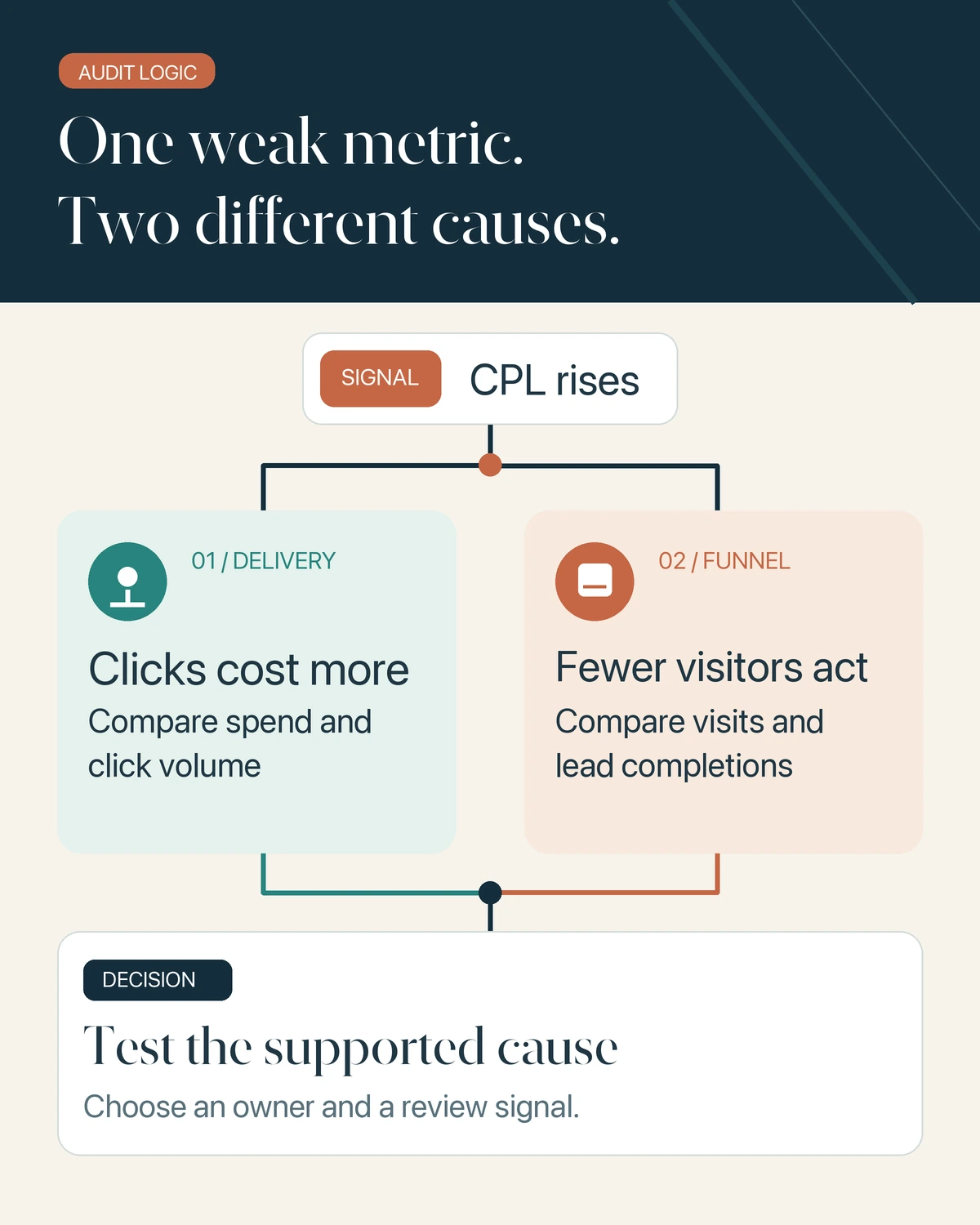
Example: cost per lead rises
Suppose, hypothetically, that reported CPL rises after a campaign refresh. One explanation is that impressions or clicks now cost more. Another is that visitors still arrive but fewer complete the form. A third is that the form completion event changed. A fourth is that a new creative attracts more curious but less qualified people. The dashboard headline alone cannot distinguish them.
I would compare delivery costs, click volume, landing-page visits, form completions, event counts and qualified-lead outcomes over comparable periods. If click costs increased while visit-to-lead conversion and qualification held steady, delivery or demand conditions deserve attention. If click costs held steady but page conversion fell, inspect the offer, message match and page experience. If reported leads moved while CRM leads did not, investigate counting. If cheap leads rose but sales acceptance fell, optimize for customer quality, not the cheapest form fill.
These are diagnostic branches, not a claim that one repair will always work. The next action could be a narrow creative test, a measurement check or a page change. I would want one owner and a review signal that lets the team decide whether the hypothesis was right.
Example: Meta reports strong ROAS
Imagine a second hypothetical account where reported ROAS looks strong but the owner cannot see new-customer growth. The first question is not how to protect that ROAS percentage. It is whether the spend is generating profitable incremental demand. A remarketing-heavy mix may capture orders from returning customers. A change in attribution may alter what Meta claims. High average order value can lift ROAS even if fewer customers are acquired, while lower margin or more cancellations can erode the value of those orders.
I would compare new and returning customer counts, order status, prospecting and retargeting spend, customer acquisition cost, and contribution where the business can provide it. If new-customer CAC remains healthy as spend rises, a lower platform ROAS might still support more growth. If platform ROAS rises because more budget follows people already close to buying, the business may have less new acquisition than the dashboard suggests. The comparison should be made over a period long enough for the sales or order cycle, not from one good day.
In my documented D2C hair-oil work, Meta Ads generated ₹1.43 crore+ in cash-on-delivery revenue. I use that result as evidence of hands-on Meta acquisition experience, not as proof that every reported order was fulfilled profitably or that another account can repeat it. COD revenue, order quality and contribution answer different questions. That distinction is exactly why I would review business outcomes alongside platform numbers.
What should a useful audit result let you do?
A good result is a decision you can act on, with the evidence and uncertainty attached. It should distinguish observed facts from plausible explanations, say what could change the business outcome, and identify dependencies outside the ad account. The exact format can be agreed for the engagement; I would not sell a fixed number of findings without knowing the account.
For each material finding, I would want to know: what was observed, what comparison supports it, which competing explanation has not yet been ruled out, what next test or repair is proportionate, who needs to own it, and what signal tells us to keep or reverse the change. If a tracking issue blocks a trustworthy CAC calculation, that is itself a finding with an owner and a sequence. An audit should not pretend the uncertain number is precise.
Priority follows the decision at stake. A broken purchase event can undermine budget allocation across the account. A weak creative concept may warrant a controlled test rather than a full rebuild. A landing-page mismatch may have more leverage than another audience adjustment. I prefer to make the dependency visible: the media team may recommend the test, while the site or sales team may need to carry it out. If no one owns the follow-through, even an accurate audit becomes a document that sits unread.
Audit, consulting or ongoing management?
Choose an audit when you need a bounded, evidence-based answer before committing to a larger change. It can be useful if you already have an internal operator or agency: they can implement the agreed recommendations after the diagnosis. The audit should state whether it is read-only, what data it covers and what implementation is outside scope.
Choose Meta Ads consulting when the need is repeated strategic judgment across decisions, teams and changing conditions. Choose ongoing Facebook Ads management when you need someone to operate, test and improve campaigns over time. One relationship can lead to another, but an audit request should not silently become a management contract.
My wider Facebook Ads expert profile explains the experience behind my Meta work. For this service, the important question is narrower: can the available evidence locate the constraint and support the next decision? Almost 10 years of hands-on performance marketing make me cautious about quick verdicts from a single dashboard view. I want the acquisition story to match what the business actually receives.
Questions to settle before commissioning the audit
Can you audit an account run by another agency?
Yes, if the business can authorize appropriate access and agree a cooperative scope. The purpose should be to test the account and business evidence, not to assign blame from incomplete screenshots. Agree who can answer questions about past changes and who will own any follow-up.
What if our tracking is unreliable?
Then measurement quality becomes an early audit question. Some account and creative observations may still be possible, but claims about CAC, ROAS or scaling should be qualified until the events and business records can be reconciled. Sometimes the most valuable first recommendation is to fix what is counted.
Is implementation included in an audit?
Do not assume it is. Before work begins, agree what diagnosis includes, whether any limited verification changes are allowed, who will implement recommended tests or repairs, and how the outcome will be reviewed. That boundary protects both the client and the operator.
How much does a Facebook Ads audit cost, and how long does it take?
There is no responsible price or turnaround I can promise for an unseen account here. Scope depends on the question, account history, number of journeys to inspect, data access and whether CRM or order outcomes are available. Ask for a written scope, deliverable, fee, timing, access level and exclusions before approving the work. A very cheap “audit” that only labels dashboard settings may not answer the decision you actually face.
Request a scoped Facebook Ads audit
If your Meta account is spending but the next budget or optimization decision feels uncertain, tell me the business question first. Share the account’s objective, the change you have observed, the period you want assessed, and whether you can connect platform actions to qualified leads or completed orders. I can then discuss what a bounded audit should examine, what evidence is available, and what the engagement would and would not include.
The strongest audit outcome is not a long list of faults. It is a clearer decision: which cause is supported, which remains uncertain, who can test the next action, and what business signal will tell us whether it worked.