What should you expect from a Facebook Ads expert in India?
A Facebook Ads expert should help your business acquire suitable customers through Meta, then connect campaign decisions to what happens after the click. That includes creative, tracking, conversion, lead quality and customer economics. A better Ads Manager screenshot is useful only when you understand the business outcome behind it.
I’m Deepak Singh, a performance marketing expert based in New Delhi. I have almost 10 years of hands-on experience in digital and performance marketing. My approach to Meta Ads starts with the business problem: are you struggling to generate demand, attract the right people, convert them, or grow without damaging your economics?
If you are looking for a Facebook Ads expert in India, this page explains how I approach that problem, what my documented experience supports, and what I would want to understand before recommending more spend.
Discuss your Meta Ads acquisition challenge, or use the sections below to assess whether my approach fits your business.
Four things I want you to know before hiring
- Low-cost leads and profitable customers are different outcomes. The sales result matters alongside campaign delivery.
- Reported ROAS needs context. Returning customers, attribution, margins and COD fulfilment can change its meaning.
- Proof should match the problem. A campaign result is evidence of relevant experience, not a forecast for your account.
- The next fix may sit outside the ad account. Creative, conversion, sales follow-up or delivery can constrain acquisition.
On this page
- When a Meta Ads specialist is the right fit
- My relevant campaign experience
- How I decide what an account needs
- Lead quality versus cheap leads
- Ecommerce, COD and customer economics
- Scope, reporting and scaling decisions
- What to check before choosing an expert
- Fees, budget and realistic expectations
- Practical onboarding questions
- Discussing your account
When a Meta Ads specialist is the right fit
Facebook Ads and Instagram Ads sit within the wider Meta advertising environment. When someone asks for a Meta Ads expert in India, they are often asking for the same core competence: someone who can connect the offer, creative, audience and conversion journey across relevant Meta placements.
The platform name alone does not define the strategy. A product purchase, a counselling enquiry and a message conversation require different evidence of success. I want to understand the intended customer action before deciding which campaign signal deserves attention.
A specialist can be useful when your business has a viable offer but needs clearer acquisition decisions. For example, you may have sales without a reliable view of new-customer cost, a growing lead list without enough qualified conversations, or creatives that worked earlier but no longer support additional spend.
My Meta experience is relevant to ecommerce and lead-generation businesses. That does not mean every business should prioritize Meta. If buyers already express clear search demand, or the offer depends on a different discovery journey, the channel mix deserves consideration. My broader performance marketing approach includes that wider business and channel perspective.
A good fit is a business willing to examine what happens after the ad. If the only requirement is an assured ROAS, an arbitrary CPL target or more leads regardless of quality, we need to resolve that expectation first.
My relevant campaign experience, with the right context
D2C hair oil: ₹1.43 crore+ COD revenue through Meta Ads
My documented D2C hair-oil campaign work includes ₹1.43 crore+ COD revenue generated through Meta Ads. The documented approach included UGC, testimonials, broad targeting, lookalikes, retargeting and funnel optimization.
This is relevant evidence when you need someone who understands product-led Meta acquisition. It also shows why I look beyond one audience setting. The ad’s promise, the product explanation and the purchase journey need to work together.
I would not present that number as net profit, cash collected after every delivery, or the revenue your business should expect. That revenue figure does not establish those conclusions. COD revenue needs fulfilment and cancellation context before it becomes a useful scaling signal.
Women’s fashion: broader ecommerce growth experience
My documented women’s-fashion work includes ₹1.05 crore+ revenue and 493% growth. That supports my ecommerce experience. Without a channel breakdown, comparison period or growth baseline, I do not label this as a Meta-only result or use it to predict another account’s growth.
For an ecommerce buyer, the useful question is how that experience informs offer, creative and conversion decisions. A revenue figure cannot replace understanding your inventory, contribution margin or customer mix. My D2C ecommerce acquisition framework explains the wider system behind those decisions.
Lead generation and the path to paid customers
I was Head of Performance Marketing at The DM School from February 2021 to August 2026. The documented acquisition work associated with that period includes 10 lakh+ leads and 2 lakh+ paid customers.
Those are broader acquisition figures, not Meta-only totals or matched cohorts from which to calculate a conversion rate. Their relevance here is the connection between generating interest and acquiring paying customers. For counselling-driven businesses, my performance marketing for EdTech article explores that journey in more depth.
When assessing any expert’s results, ask what was counted, over what period and through which channels. Clear limits make proof more useful than a larger-looking number without a definition.
My Meta Acquisition Decision Map: what needs fixing first?
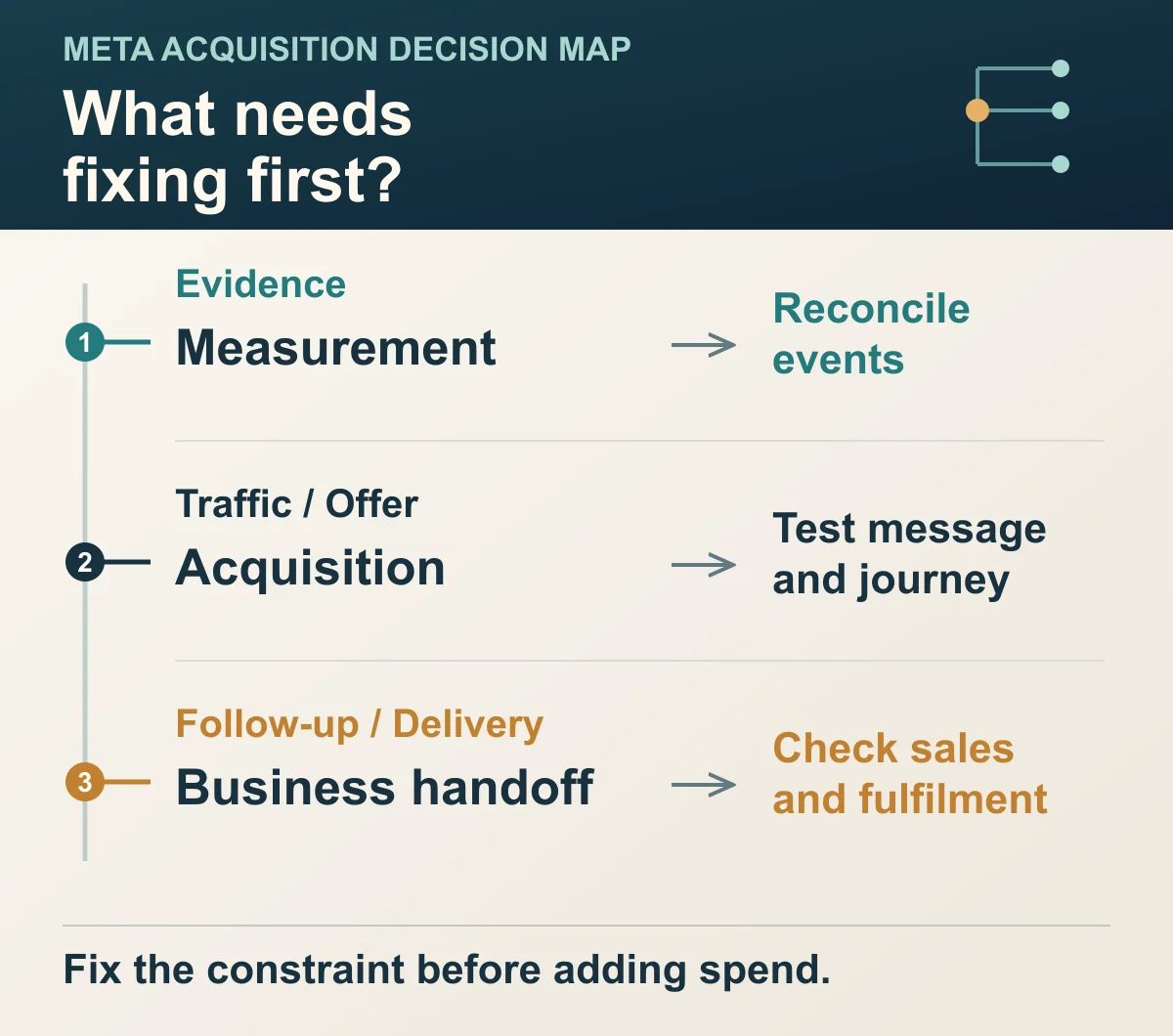
I separate an account problem into three possible constraints: measurement, acquisition and the downstream business handoff. They can coexist, but they do not call for the same response.
The decision map is straightforward: identify the constraint, inspect the campaign signal, match it to downstream evidence, then choose the next action. This is how I frame the diagnosis, rather than treating every weak result as an audience problem.
| Possible constraint | Signal to investigate | Evidence and next decision |
|---|---|---|
| Measurement | Platform purchases and business records disagree | Reconcile dates, attribution and event counting before changing budgets |
| Acquisition | People respond but the wrong prospects or expectations dominate | Inspect creative promises, offer, audience and conversion journey |
| Business handoff | Suitable enquiries or orders fail after acquisition | Inspect sales follow-up, qualification, payment or delivery before buying more volume |
Here is how I would apply it to a lead-generation account:
- Check the count. Are these unique enquiries, repeat submissions or events recorded more than once?
- Check suitability. Do prospects understand the price, eligibility and offer before submitting?
- Check the handoff. Were suitable prospects contacted, and have they had enough time to decide?
- Choose a test. Change the part of the system the evidence implicates, then observe the relevant downstream result.
If the sales team has not contacted suitable enquiries, adding interest exclusions is unlikely to solve the central problem. If the creative attracts people with an expectation the offer cannot meet, faster follow-up alone is unlikely to fix it either.
This is a compact hiring lens, not a complete account audit. My performance marketing audit framework covers the wider diagnostic process.
An account can need a better sales handoff more urgently than a new audience. The useful expert identifies which decision the evidence supports.
Cheap leads can be expensive customers
A low CPL tells you how cheaply a campaign generated its counted leads. It does not tell you how many were relevant, reached, qualified or converted into new paying customers.
Here is a hypothetical example, not a personal campaign result. Assume two comparable lead cohorts have completed their sales cycle. Both spend ₹80,000 on ads, and each customer count represents unique new paying customers attributed to its cohort.
| Hypothetical measure | Cohort A | Cohort B |
|---|---|---|
| Ad spend | ₹80,000 | ₹80,000 |
| Leads | 400 | 200 |
| CPL: spend ÷ leads | ₹200 | ₹400 |
| New paying customers | 8 | 20 |
| Media-only CAC: spend ÷ new customers | ₹10,000 | ₹4,000 |
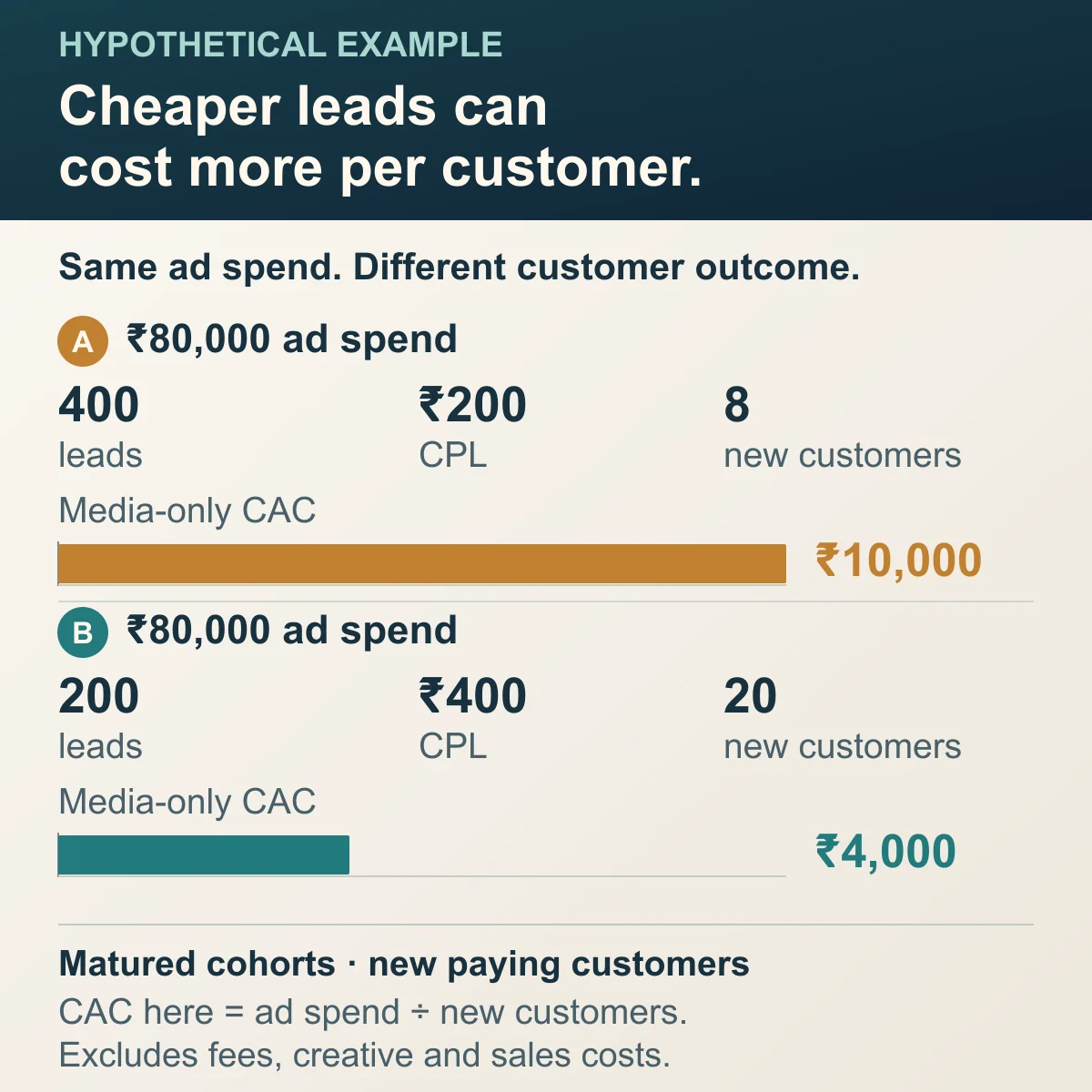
Cohort B has the higher CPL but the lower media-only acquisition cost. That does not prove any one tactic caused the difference. It shows why selecting an expert solely on a promised lead price can reward the wrong outcome.
These calculations exclude management fees, creative production and sales costs. A fuller business CAC calculation needs the relevant acquisition-cost allocation. Customer value and contribution also matter before either cohort can be called profitable.
I would want CRM feedback that distinguishes contacted, qualified, booked, paid and lost prospects. Lost reasons are especially useful: wrong eligibility, unaffordable price and poor follow-up point to different problems. They should not all become one “bad leads” label.
Meta itself discusses connecting business outcomes through Conversions API for Business Messaging in its official India agency ecosystem update. The business principle is relevant: a message or form submission is an intermediate event, not automatically a sale. The specific feedback setup depends on the conversion journey and implementation.
Do not compare last week’s new leads with an older cohort that has already completed its sales cycle. My performance marketing funnel explains how those handoffs connect.
For ecommerce, I separate platform revenue from customer economics
Reported Meta ROAS is useful campaign evidence. I still want to know what it represents: new versus returning customers, the reporting window, order status and the business’s margin structure.
A retargeting campaign can show strong reported ROAS while reaching people who already know the brand. That is not a reason to remove remarketing. It is a reason to ask whether the next rupee is likely to acquire an additional customer, support a useful repeat purchase or simply receive credit for demand that already existed.
Your best-looking campaign may be serving customers you would have acquired anyway. A dashboard alone cannot establish that counterfactual. Prospecting and remarketing deserve separate interpretation, alongside business-level new-customer trends and appropriate incrementality testing where feasible.
COD and contribution change the budget conversation
For COD businesses, I want order status to remain visible. Placed orders, confirmed orders and delivered orders are different stages. Cancellations, failed deliveries, shipping and return costs can change the contribution available to pay for acquisition.
Higher AOV can improve revenue-based ROAS without an equivalent improvement in contribution. A larger basket with weaker margins or higher fulfilment costs is not automatically more scalable. Similarly, a credible repeat-purchase pattern may support a higher acquisition cost, but an optimistic LTV assumption should not fund spend the business cannot sustain.
I prefer to agree on the customer definition, cost allocation and contribution assumptions before treating a CAC threshold as a scaling rule. My ROAS vs CAC comparison explains how I use those metrics together.
What I focus on when assessing and improving a Meta account
My Meta Ads approach spans campaign strategy, creative and audience testing, tracking, conversion and business feedback. The actual engagement should define which responsibilities I handle, which stay with your team and what evidence we can realistically access.
Objective, tracking and creative must describe the same business
I start by checking what the campaign is trying to optimize and whether that event meaningfully connects to the outcome you want. A form submission can be a practical optimization signal, but it still needs quality and sales feedback.
For measurement, I consider Meta Pixel, Conversions API and the business’s own records where relevant. The important question is whether events are counted consistently and meaningfully, not whether a tool’s name appears on a setup checklist. Browser and server paths need validation; no tracking setup guarantees perfect attribution.
Creative testing should explore a business hypothesis. Does the prospect misunderstand the product? Is the offer unclear? Is there an objection the ad avoids? UGC or a testimonial format can help in the right context, but neither substitutes for a useful message.
I also look at the destination. An ad can create the right interest and lose it through a confusing mobile page, an unexplained price or a form that asks for the wrong information. Campaign and conversion decisions need to stay connected.
Scaling is a decision about additional acquisition
Before increasing spend, I want to understand what is likely to constrain the next stage: creative supply, suitable demand, customer economics, sales capacity or fulfilment. If volume grows faster than the team can handle it, platform delivery can improve while the business result deteriorates.
A falling ROAS is a reason to investigate, not an automatic instruction to cut spend. Higher spend may acquire more new customers at a still-acceptable contribution level. The opposite can also happen: a stable blended ROAS can conceal worsening new-customer acquisition.
The budget decision needs an explicit test question and a review point. What outcome would support another increase? What evidence would justify holding or reducing spend? That is more useful than scaling because yesterday’s dashboard was green.
Reporting should connect spend and campaign signals to qualified leads, new customers, sales and the business constraints that affect them. My performance marketing metrics guide covers the broader measurement definitions.
How to choose a Facebook advertising expert without relying on claims alone
A relevant case study is a starting point. The next step is to test how the expert interprets it and what they would need to know about your business.
- Ask for metric definitions. Does “revenue” mean attributed, booked, collected or something else? Are “customers” actually purchases or unique new buyers?
- Ask what remains unknown. A useful expert can explain the limits of a result without inventing missing context.
- Ask for a first diagnostic question. Their reasoning should address your specific bottleneck rather than immediately prescribe broad targeting or retargeting.
- Clarify responsibilities. Who creates and approves ads, fixes the page, maintains tracking and returns sales-quality feedback?
- Clarify the decision standard. Agree on how performance will be assessed, including sales lag and customer economics.
- Keep account ownership clear. Understand access, business assets, reporting and handover before work begins.
You may need a specialist, an agency team or internal ownership with external support. Those are different operating models, not automatic quality rankings. My agency, freelancer and in-house comparison helps assess that wider choice.
I do not offer a guaranteed business result as evidence of expertise. Acquisition depends on the offer, market, creative, conversion and operating conditions. A credible plan should make those dependencies easier to see.
Management fees, ad spend and a meaningful test are separate questions
Ad spend pays for media delivery. A management fee pays for an agreed scope of work. Creative production, landing-page work and technical implementation may involve other costs or responsibilities. Confirm the arrangement rather than assuming they are included.
I would not give you a universal minimum Meta Ads budget without understanding the desired outcome, likely acquisition cost, sales cycle and testing needs. A budget sufficient to collect clicks may still be insufficient to judge paid-customer acquisition.
The cheapest management quote is not necessarily the lowest-cost route to a useful result. Equally, a higher fee is not evidence of better judgment. Compare the work, accountability and evidence you will receive, then assess it against the business decision you need to make.
Before committing, discuss what the proposed test can establish, what it cannot establish, and how much exposure the business can tolerate. You should know why that budget is being proposed, rather than receiving a generic daily-spend recommendation.
Practical questions before working together
What access would you need?
The required permissions depend on the agreed scope. Campaign work may require access to relevant Meta business assets; measurement diagnosis may also require website, analytics or CRM evidence. Use appropriate role-based access, keep business assets under your control and agree what is needed before sharing permissions. Do not send personal passwords as an onboarding shortcut.
Who should produce the creatives?
Clarify this explicitly. Strategy, briefs, editing, production and approvals are separate responsibilities. A testing plan needs a realistic supply of usable assets, but I do not assume every business can produce unlimited videos. The creative plan should reflect your product, team and production capacity.
How soon should results be judged?
Technical delivery checks can begin before a full business result is available. Customer-acquisition assessment needs enough relevant observations and enough time for the conversion journey to mature. A counselling enquiry may not become a paid customer immediately. Agree on review stages and business outcomes rather than treating an arbitrary number of days as a guarantee.
Book a consultation about your Meta Ads account
If you are considering me as your Facebook Ads expert in India, use this website’s contact options to request a consultation. Share your business website, offer, current acquisition stage, approximate ad-spend range and the result you are struggling to improve.
Useful starting information includes what counts as a qualified lead or new customer, how sales or orders are recorded, who handles follow-up, and what creative resources you have. You do not need to share login credentials to explain the problem.
For a wider engagement across acquisition and conversion, you can also review my performance marketing consulting approach.
The goal is a clearer acquisition decision. Sometimes that means better Meta campaigns. Sometimes it means fixing the evidence, offer or business handoff before spending more. I want us to identify that distinction before treating budget growth as progress.