If I Had to Choose Between an Agency, Freelancer or In-House Performance Marketer, I Would Start Here
I do not think there is one universally better model for performance marketing.
I have worked closely enough with paid acquisition to see all three setups work well, and all three fail badly.
The mistake is choosing based on the label.
An agency is not automatically more capable because it has a larger team.
A freelancer is not automatically more efficient because you get direct access.
And hiring in-house does not automatically give you better control.
If this were my own business, I would start with a much simpler question:
What capability am I actually missing right now?
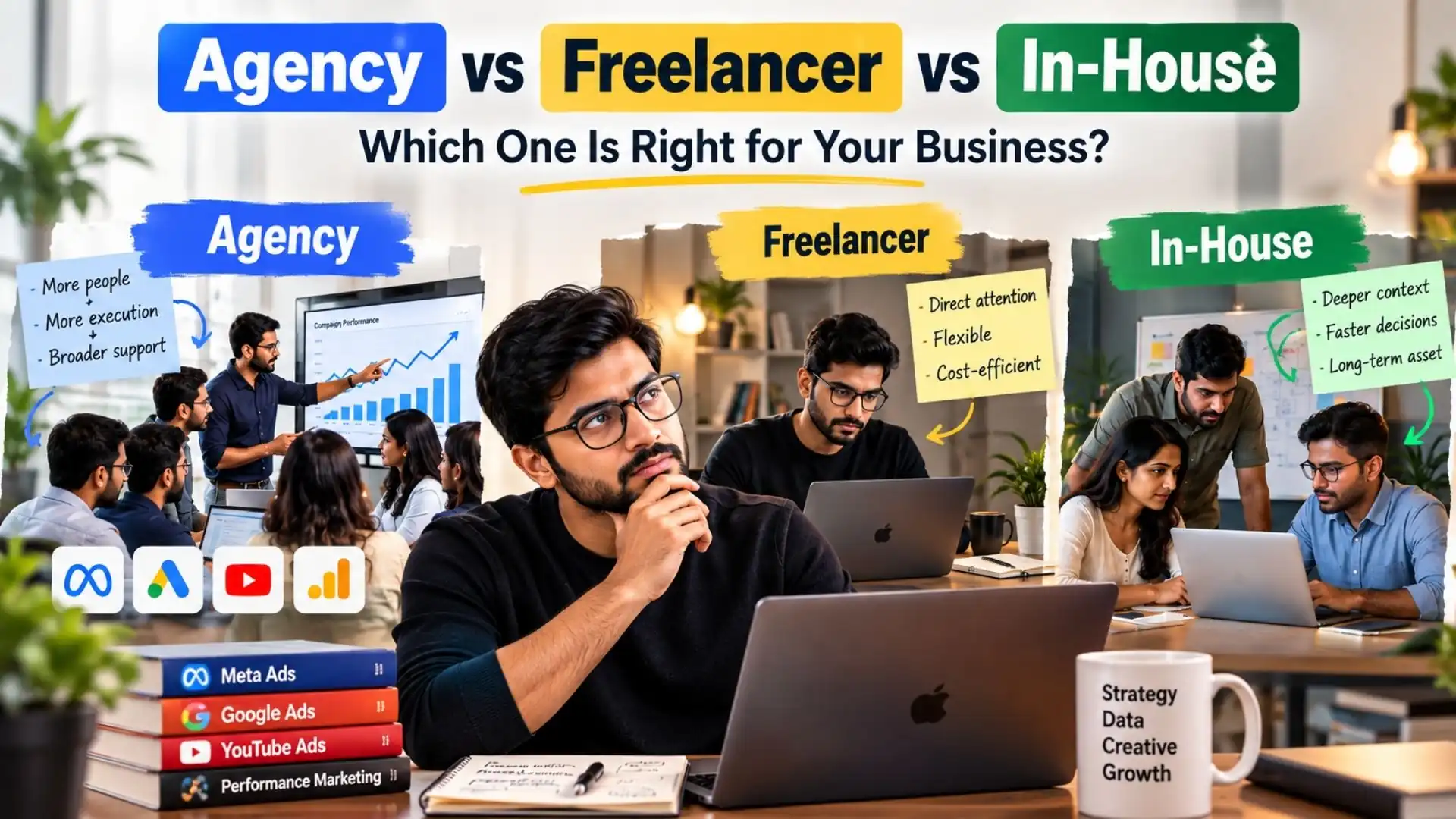
If I Need Execution Capacity, I Think Differently
Suppose I need Meta Ads, Google Ads, landing pages, creatives, reporting and tracking managed continuously.
That is not just a strategy problem.
That is an execution-capacity problem.
In that situation, an agency can make sense because I may need several different skills working together.
But I would still want to know who is actually touching the account every day.
I have seen enough situations where the senior person handles the sales conversation and a much more junior person handles the campaigns.
That does not automatically make the agency bad, but I would want complete clarity before handing over a meaningful budget.
If I Need Direct Senior Attention, a Freelancer Can Be Very Attractive
A strong freelancer or independent performance marketer can give me something agencies sometimes struggle to provide:
Direct access to the person actually making the decisions.
If I have a question about CAC, creative fatigue or why Google Search performance changed, I may be speaking directly to the same person who reviewed the account.
That can make communication much faster.
The trade-off is capacity.
One person can only handle so many accounts properly.
If I need large amounts of creative production, development, tracking support and daily media execution across several channels, I need to understand what that freelancer can realistically handle alone.
If Paid Acquisition Is Core to the Business, In-House Starts Becoming More Interesting
There is a point where performance marketing becomes important enough that I would want some of the capability inside the company.
An in-house person can understand the product, customer, sales team, CRM and internal numbers in a way an external partner may take much longer to learn.
They can also sit closer to creative, product and management decisions.
But I would be careful about hiring one person and assuming I have built an entire performance marketing function.
One media buyer may still need support with creative strategy, CRO, tracking, analytics and landing pages.
I explained why I think the role itself goes far beyond campaign management in my Performance Marketer in India guide.
I Would Not Choose Based on Monthly Ad Spend Alone
People often try to reduce this decision to a simple rule.
“Below this spend, hire a freelancer.”
“Above this spend, hire an agency.”
“At this level, build in-house.”
I do not think it is that clean.
A business spending ₹3 lakh per month may have a complicated acquisition system across several products, markets and channels.
Another business spending ₹15 lakh per month may have one very simple Google Search funnel.
The spend matters, but so do complexity, creative needs, internal team strength and how quickly decisions need to be made.
I Care More About Who Owns the Outcome
This is probably the biggest thing I would evaluate.
Who is responsible when CPL rises?
Who looks at the landing page when conversion rate drops?
Who speaks to sales when lead quality weakens?
Who challenges the creative team when the same angle has been running for six weeks?
Who checks whether the tracking is trustworthy before scaling the account?
If those responsibilities are unclear, the operating model can fail even when everyone involved is individually talented.
My Starting Point Is Always the Gap
If I already have a strong internal team but need experienced strategic input, I may bring in a consultant instead of replacing the team. I have explained that model separately on my Performance Marketing Consultant in India page.
If I have no execution capability at all, consulting alone is probably not enough.
If I have strong execution but weak strategic direction, hiring another junior media buyer will probably not solve the problem.
If I need speed, creative capacity and multi-channel execution, an agency may deserve serious consideration.
If I need direct senior involvement and a simpler operating model, a freelancer may be the better fit.
If paid acquisition is becoming a core internal capability, in-house may be worth building deliberately.
That is how I would frame the decision before comparing cost, team size or promises.
When I Would Choose a Performance Marketing Agency
I would consider an agency when the business needs more than one person can realistically handle well.
That usually means the requirement is not just campaign management.
It may include paid media, creative production, landing pages, analytics, tracking, reporting and sometimes coordination across Meta, Google and YouTube at the same time.
In that situation, an agency can give the business more execution capacity without having to build every role internally.
The Biggest Advantage Is Usually Breadth
A good agency can bring several capabilities together under one roof.
You may have one person thinking about Meta Ads, another handling Google Ads, a designer working on creatives and someone else supporting tracking or landing pages.
That can be very useful when the business is moving fast and does not want to hire four or five separate people.
The real benefit is not the agency name.
It is the amount of useful capability you actually get access to.
I Would Want to Know Who Is Actually Managing the Account
This is probably the first question I would ask.
I do not care only about the person presenting the proposal.
I want to know who will actually open the ad account, review the data and make day-to-day decisions.
I would ask:
- Who is the primary account owner?
- How experienced are they?
- How many other accounts do they manage?
- Who reviews their decisions?
- How often does senior strategy get involved?
If I am spending serious money, I do not want the senior thinking to disappear after the sales call.
I Would Look Closely at Account Load
A very capable media buyer can still do a poor job if they are handling too many accounts.
That is one of the things I think businesses often underestimate.
If one person is responsible for 15 or 20 clients, I would question how deeply they can understand my funnel, creative performance, tracking and sales feedback.
Performance marketing improves when somebody has enough context to notice what is changing.
That becomes harder when the account is just one dashboard among many.
I Would Ask How Creative Actually Gets Produced
This matters a lot for Meta and YouTube.
If the agency says creative is included, I would want to know what that actually means.
Are they creating new concepts?
Are they only resizing existing assets?
Do they write hooks and scripts?
Do they use performance data to brief the next creative batch?
How many useful creative tests can they realistically produce each month?
I would not be impressed by a promise of “20 creatives” if those are just minor variations of the same idea.
I care more about whether the creative process creates new learning.
I Would Check Whether They Understand the Business Beyond the Platforms
If the agency conversation stays entirely inside Meta Ads or Google Ads, I would become cautious.
I want them to ask about CAC, lead quality, margins, sales conversion and the landing page.
If they never ask what happens after the lead is generated, they may end up optimizing for a number that looks good in the dashboard but does not help the business.
This is also one of the main criteria I discussed in my guide to choosing a performance marketing expert in India.
I Would Not Expect an Agency to Be Great at Everything
This is another thing I would be realistic about.
An agency may be excellent at Meta Ads and average at Google Search.
It may be strong at lead generation but less experienced with ecommerce.
It may understand performance media deeply but depend heavily on the client for creative.
I would rather know those strengths and limitations upfront than buy into the idea that one agency is equally strong at every part of growth.
Communication Structure Matters More Than It Sounds
I would want to know how quickly I can get an answer when something important changes.
If CAC suddenly rises 40%, I do not want to wait until the monthly review call to discuss it.
I also do not need ten status calls every week.
I want a clear communication system where important changes are surfaced quickly and routine updates do not create unnecessary meetings.
When I Think the Agency Model Works Best
I would lean toward an agency when the business needs:
- Execution across several channels
- Regular creative production
- Broader operational capacity
- Support beyond one specialist
- A team that can execute without building everything in-house immediately
But I would only choose the agency after understanding exactly who is doing the work, how much attention the account will receive and whether the team understands the business outcome we are actually trying to improve.
For me, the right agency is not the one with the largest team.
It is the one where the right people have enough time, context and accountability to make good decisions with the budget.
When I Would Choose a Performance Marketing Freelancer
I would seriously consider a freelancer when I want direct access to the person actually thinking about the account.
That can be one of the biggest advantages of working with an independent performance marketer.
If I have a question about CAC, creative fatigue, search intent or why performance changed, I am usually speaking directly to the person who reviewed the data and made the decision.
That directness can make the relationship much faster and much clearer.
I Like the Lack of Layers
One thing I value in a freelancer setup is that there are usually fewer people between the problem and the decision.
If the account needs a change, the same person who identifies the issue can often recommend the action immediately.
There is less chance of the strategy getting diluted as it moves from a senior strategist to an account manager and then to a junior media buyer.
For certain businesses, that simplicity is a major advantage.
I Would Still Evaluate the Freelancer Like I Would Evaluate Any Senior Hire
I would not assume someone is strong just because they work independently.
I would still want to see how they think.
I would ask about the kind of accounts they have managed, the level of spend they have handled, how they diagnose performance drops and how comfortable they are looking beyond the ad platforms.
I would also want evidence that they understand the business outcome, not only campaign mechanics.
This is the same standard I use in my guide to choosing a performance marketing expert in India.
The Main Risk Is Capacity
This is where I would be realistic.
A strong freelancer can still become a weak fit if the business requires more execution than one person can handle.
If I need:
- Daily media buying across several platforms
- Constant creative production
- Landing-page development
- Tracking implementation
- Analytics support
- CRM integrations
- Frequent reporting and stakeholder calls
I need to understand how much of that the freelancer can realistically own.
One person can be excellent at strategy and media buying and still not be the right person to build every creative, landing page and tracking setup personally.
I Would Ask How Many Clients They Are Handling
This matters just as much with freelancers as it does with agencies.
If someone has too many active accounts, direct access loses a lot of its value.
I would want to know how much attention my account can realistically receive.
A freelancer handling five complex accounts can already be under more pressure than an agency media buyer with a strong support team.
The operating model does not remove the need to check capacity.
I Would Also Think About Dependency Risk
This is one of the trade-offs people sometimes ignore.
If one freelancer understands the entire account and that person becomes unavailable, the business may suddenly lose a lot of context.
I would reduce that risk by making sure campaign logic, tracking setup, creative learnings and key decisions are documented properly.
The business should not become completely dependent on information that exists only in one person’s head.
A Good Freelancer Can Be Very Strong for Focused Accounts
If the business has a clear offer, a manageable number of channels and an internal team that can support creative or development, a strong freelancer can be extremely efficient.
The freelancer can focus deeply on paid acquisition without the business paying for an entire agency structure it may not need.
This can be especially attractive when the business wants senior-level thinking but does not yet want to hire that capability full-time.
I Would Look for Someone Who Can Say No
This is something I would value a lot.
I do not want a freelancer who agrees to every request because they are worried about losing the client.
If I ask to double the budget and they think the account is not ready, I want them to say that.
If the landing page is the real problem, I want them to tell me.
If Meta is already close to saturation and Google looks like the better next opportunity, I want that recommendation even if they personally prefer working in Meta.
The point of hiring an experienced person is to get judgment, not just compliance.
When I Think the Freelancer Model Works Best
I would lean toward a freelancer when the business needs:
- Direct access to the decision-maker
- Senior hands-on attention
- A simpler communication structure
- Focused paid media expertise
- Strategic thinking without building a full in-house team
I would be more cautious if the business needs a large amount of cross-functional execution that one person cannot realistically provide.
For me, the freelancer model works best when the scope is clear, the person is genuinely experienced and the rest of the business can support the areas that sit outside paid media.
In that setup, a good independent performance marketer can be much more valuable than a larger team with less direct ownership.
When I Would Build an In-House Performance Marketing Team
I would think seriously about bringing performance marketing in-house when paid acquisition has become important enough that I want the knowledge, speed and accountability to sit inside the business.
This usually happens when advertising is no longer a small growth experiment.
It has become one of the main ways the company acquires customers.
At that point, I start caring much more about who owns the learning internally.
The Biggest Advantage Is Context
An in-house performance marketer can understand the business at a level an external partner may take much longer to reach.
They can see what products have the best margins.
They can hear what the sales team is saying about lead quality.
They can understand which customers repeat.
They can work directly with the creative team.
They can see operational problems before those problems become visible inside Ads Manager.
That context can improve decision-making dramatically.
Speed Can Be Much Better In-House
If I notice a landing-page issue, I do not necessarily need to raise a ticket, wait for an agency call and then explain the problem to another team.
I can speak directly to the developer.
If a creative angle is working, I can brief the designer the same day.
If sales says lead quality has changed, I can investigate the source immediately.
That speed becomes very valuable once the account is large enough that delays start costing real money.
I Would Not Hire One Media Buyer and Call It a Team
This is where I think businesses often underestimate what performance marketing actually requires.
A strong media buyer may still need support from:
- Creative strategy
- Design and video editing
- Landing-page development
- CRO
- Analytics and tracking
- CRM or sales operations
If I hire one person and expect them to do all of that at a high level, I may end up creating a bottleneck instead of solving one.
I explained this broader view of the role in my Performance Marketer in India guide.
In-House Gives Me More Control, but It Also Gives Me More Responsibility
If I build internally, I now have to recruit, train and retain the right people.
I need to make sure they keep learning.
I need enough seniority somewhere in the system to challenge weak decisions.
And I need processes so campaign knowledge does not disappear when one employee leaves.
That is the trade-off.
I get more control, but I also take on more management responsibility.
I Would Build In-House When the Economics Justify It
If the business is spending enough every month, the cost of building internal capability can start making more sense.
But I would not use one fixed ad-spend number as the trigger.
I would look at how important paid acquisition is to the business, how complex the funnel is, how much creative is required and how much value the company gains from faster internal learning.
A business spending ₹10 lakh per month on one simple Search account may not need the same team as a business spending the same amount across Meta, Google, YouTube and multiple product lines.
I Would Still Bring in External Expertise Sometimes
Building in-house does not mean I would stop using consultants, freelancers or agencies completely.
There are situations where I would still want an external perspective.
If the team has been staring at the same account for a year, an independent audit can reveal things that have become invisible internally.
If we are entering a channel nobody on the team knows deeply, I may bring in a specialist.
If I need senior strategic input without making another full-time hire, I may use consulting.
That is where a hybrid model can become very effective.
When I Think In-House Works Best
I would lean toward building in-house when:
- Paid acquisition is a core growth channel
- The business needs fast cross-functional collaboration
- There is enough ongoing work to justify dedicated people
- The company wants to retain campaign learning internally
- Creative, product, sales and marketing need to work closely together
- The business is prepared to invest in the team beyond one media buyer
For me, the biggest reason to go in-house is not simply saving agency fees.
It is building performance marketing capability as an asset inside the business.
That becomes much more valuable when paid acquisition is central to how the company grows.
Why I Often Like a Hybrid Model More Than Any One Option
If I were building paid growth for my own business, I would not feel forced to choose only one model forever.
In many cases, I think the strongest setup is a combination.
The business keeps the core learning and decision-making close internally, while external specialists add depth where the internal team is still weak.
An In-House Lead Plus External Specialists Can Work Very Well
This is one of the setups I like most.
The internal performance marketing lead understands the business, product, sales process and economics.
Then a freelancer, consultant or agency can be brought in for specific areas where deeper expertise is needed.
That might be YouTube Ads, Google Ads, tracking, CRO or creative strategy.
The internal person still owns the overall acquisition system.
The external specialist improves a specific part of it.
I Would Rather Add Missing Expertise Than Replace a Good Team
If I already have a media buyer who understands the account and executes well, I would not automatically replace them because performance has plateaued.
I may simply bring in someone more experienced to audit the account, challenge the strategy and help the existing team find the next opportunity.
That can be much less disruptive than changing the entire operating model.
This is one of the situations where a performance marketing consultant can make more sense than another full-time hire.
An Agency Can Handle Execution While the Business Keeps Strategic Ownership
I also like agency relationships where the business does not completely outsource its thinking.
The agency can manage campaigns, creative production and reporting.
But somebody inside the company should still understand CAC, margins, lead quality, revenue and what the business is trying to achieve.
If the company cannot independently tell whether acquisition is healthy, it becomes too dependent on the agency’s interpretation of performance.
A Freelancer Can Become the Senior Layer Above an Internal Team
Another useful model is having junior or mid-level execution internally while an experienced independent performance marketer provides senior oversight.
The internal team handles campaign builds, reporting and routine optimization.
The external expert helps with account structure, scaling, creative direction and difficult decisions.
This can give the business senior thinking without immediately hiring a very expensive full-time growth leader.
I Would Keep Creative Close to Performance Data
No matter which hybrid setup I use, I would make sure creative learning moves quickly between media and production.
If one angle is winning on Meta, the creative team should know.
If a YouTube hook is losing viewers in the first few seconds, the next script should reflect that.
If sales keeps hearing the same objection, that should feed back into ads.
The operating model matters less to me than whether those feedback loops are fast.
I Would Avoid Creating Too Many Layers
A hybrid model can also become messy.
If there is an internal marketing manager, an agency, a consultant, a freelancer and a founder all giving separate instructions, nobody really owns the outcome.
I would make responsibilities very clear.
Who owns strategy?
Who owns execution?
Who owns creative?
Who owns tracking?
Who makes the final budget decision?
If those answers are unclear, adding more people usually makes the problem worse.
The Hybrid Model Works Best When There Is One Clear Owner
For me, this is the key.
You can use agencies, freelancers, consultants and internal people together.
But somebody still needs to own the acquisition system.
That person should understand how Meta, Google, YouTube, creative, CRO, tracking and sales data connect.
I have explained that broader way of thinking in my Performance Marketing Expert in India guide.
If ownership is clear, a hybrid model can give the business the best combination of internal context, external expertise and execution capacity.
In many cases, that is the model I would choose over trying to force one person or one agency to be excellent at everything.
How I Would Choose Based on Business Stage and Ad Spend
I would not use monthly ad spend as the only factor in this decision.
But spend does change the level of risk, complexity and attention the account deserves.
The way I would build a performance marketing setup at ₹2 lakh per month is very different from the way I would think about one at ₹25 lakh per month.
The important thing is not the number itself.
It is what that number means for the business.
If I Were Spending Around ₹2 Lakh Per Month
At this stage, I would usually keep the setup relatively lean.
I would not rush to build a large internal team unless paid acquisition was already clearly becoming the main growth engine.
I would probably prefer one strong freelancer, an experienced hands-on performance marketer or a small specialist agency depending on the complexity of the account.
My priority would be finding product-market fit in paid acquisition, understanding which offers and channels work and making sure the tracking is clean enough to learn from.
I would rather spend money on stronger creative, landing pages and testing than create unnecessary management layers too early.
If I Were Spending Around ₹5 Lakh to ₹10 Lakh Per Month
This is where I would start becoming more demanding about the operating model.
At this level, small inefficiencies are already becoming meaningful amounts of money.
I would want someone who is not only running campaigns but also thinking about:
- Creative testing velocity
- CAC movement as spend increases
- Landing-page conversion
- Lead quality or new-customer quality
- Tracking reliability
- Budget allocation across channels
A strong freelancer can still work very well here if the scope is focused and the business has internal creative or development support.
An agency can also make sense if the account needs more execution capacity.
If paid media is already becoming strategically important, I may start hiring at least one strong internal person who understands the business and can own the relationship with external partners.
If I Were Spending ₹10 Lakh to ₹25 Lakh Per Month
At this level, I would want much stronger internal ownership.
That does not mean I would automatically fire the agency or freelancer.
It means I would not want the entire understanding of customer acquisition to live outside the company.
I would want someone internally who understands the numbers well enough to challenge decisions.
That person should know what is happening to CAC, lead quality, creative performance, funnel conversion and overall revenue as spend changes.
The external partner can still provide execution or specialist expertise, but the business should be able to independently judge whether the acquisition system is healthy.
If I Were Spending ₹25 Lakh Per Month or More
At this level, I would usually treat performance marketing as a serious internal capability.
The financial impact of small mistakes is now too large for the business to operate blindly.
A 10% efficiency loss on ₹25 lakh of monthly spend is ₹2.5 lakh.
That is enough money for me to care deeply about how quickly problems are identified and how much context the decision-maker has.
I would probably want a strong internal performance or growth lead, even if an agency or specialist partner still handles part of the execution.
I would also want tighter connections between media, creative, CRO, analytics and sales or ecommerce data.
This is where the hybrid model I discussed earlier often becomes particularly strong.
But I Would Still Look at Complexity Before Spend
A ₹25 lakh account with one country, one offer and a simple Search funnel can sometimes be easier to operate than a ₹7 lakh account spread across Meta, Google, YouTube, several products and multiple geographies.
That is why I would never use spend bands as rigid rules.
I would look at:
- Number of active channels
- Number of products or offers
- Creative requirements
- Geographies
- Tracking complexity
- Sales cycle
- Internal team strength
- How quickly the business wants to scale
The More Important Question Is What Happens if the Account Goes Wrong
This is how I would really think about it.
If performance deteriorates for two weeks, how expensive is that mistake?
If lead quality drops, how quickly will somebody notice?
If tracking breaks, who will catch it?
If the agency recommends increasing spend, who inside the business can independently judge whether that makes sense?
The larger the financial impact of those decisions, the more I want senior capability close to the business.
My View on Spend and Team Structure
At lower spend, I usually prefer keeping the setup lean and buying the best expertise the business can reasonably afford.
As spend and complexity increase, I gradually want more ownership inside the company.
Eventually, the question stops being whether I should hire an agency or freelancer.
It becomes:
“What should we own internally, and where does external expertise still give us an advantage?”
That is the point where performance marketing starts becoming an organizational capability rather than simply an outsourced service.
How I Compare the Real Cost of an Agency, Freelancer and In-House Team
I would not compare these three models by looking only at the monthly fee or salary.
The cheapest option on paper can become expensive very quickly if performance is weak, execution is slow or the business has to hire several additional people around it.
When I compare cost, I try to look at the complete operating cost.
An Agency Fee Usually Buys More Than One Person
An agency may look expensive compared with one freelancer or one employee.
But the fee may include access to media buying, account management, creative support, analytics and sometimes landing-page or tracking resources.
So I would not compare a ₹2 lakh agency retainer directly with the salary of one performance marketer and conclude that the employee is cheaper.
I would ask what I would still need to hire separately.
If the agency genuinely gives me several useful capabilities, the comparison becomes very different.
With an Agency, I Would Watch the Difference Between What I Pay For and What I Actually Use
This is the other side of the equation.
If I am paying for a large agency setup but my account really receives attention from one junior media buyer and a monthly reporting call, I may be paying for capacity I am not actually benefiting from.
I want to know which resources are genuinely allocated to my business.
Theoretical access to a creative team or analytics department does not mean much if those people rarely touch the account.
A Freelancer Can Be Cost-Efficient When the Scope Is Focused
If I mainly need strong media buying and strategic thinking across one or two channels, a freelancer can be financially very attractive.
I may get direct senior attention without paying for the overhead of a larger agency.
But I would add the cost of everything the freelancer does not provide.
If I still need to hire designers, editors, developers or tracking specialists separately, those costs belong in the comparison too.
I would evaluate the complete system rather than one invoice.
The Real Cost of In-House Is Much More Than Salary
This is where I think the comparison is often oversimplified.
If I hire a performance marketer internally, the cost is not only their monthly salary.
I may also need:
- A designer or creative team
- Video editing support
- Landing-page or development resources
- Analytics and tracking support
- Marketing tools and software
- Recruitment and onboarding
- Management time
- Training and skill development
If I want senior capability across multiple channels, building the full function can become a significant investment.
That investment may still make complete sense if paid acquisition is central to the business.
I just would not pretend the salary of one person represents the full cost.
I Also Think About the Cost of a Bad Hire
This applies to every model.
If I hire the wrong agency, I may lose several months of media spend before realizing the strategy is weak.
If I choose the wrong freelancer, the account may become overly dependent on one person.
If I make the wrong in-house hire, I may spend months recruiting, onboarding and then starting the process again.
Those transition costs are real even though they do not appear in an advertising dashboard.
Management Time Has a Cost Too
An external partner who requires constant follow-up can become very expensive in founder or management time.
An internal team that needs detailed direction every day can create the same problem.
I would prefer a slightly more expensive setup that can make good decisions independently over a cheaper setup that requires me to manage every campaign personally.
The whole reason I hire expertise is to reduce the number of decisions I have to make myself.
I Would Compare Cost Against the Amount of Spend at Risk
This becomes increasingly important as budgets grow.
If I am spending ₹20 lakh every month, paying more for stronger decision-making can be completely rational.
A small improvement in CAC can be worth far more than the difference between two management fees.
The opposite is also true.
If I am spending ₹1 lakh per month, building an expensive multi-person internal team probably makes little financial sense.
The Cheapest Model Is Not Necessarily the Most Profitable
If one setup costs ₹1 lakh more per month but consistently produces better creative, faster decisions and healthier CAC, I would not consider it more expensive in any meaningful business sense.
I would look at the total outcome.
What does the team cost, what advertising budget are they responsible for, and what improvement in customer acquisition do they create?
That is the comparison I care about.
I use the same logic when thinking about performance marketing generally. The management fee is a cost, but poor acquisition decisions can be a much larger one. I have explained that broader business-first approach in my Performance Marketing Expert in India guide.
The Questions I Would Ask Before Hiring Any Agency, Freelancer or In-House Expert
I would not choose any of the three models based only on a proposal, portfolio or impressive case study.
I would want to understand how the person or team actually thinks.
That matters more to me than how polished the pitch looks.
1. What Happens When Performance Drops?
This is one of the first questions I would ask.
I would want to hear how they diagnose the problem.
Do they immediately blame targeting?
Do they look at creative, CTR, CPC, conversion rate, landing page, lead quality and sales data?
Do they know how to separate a media problem from a funnel problem?
The answer tells me a lot about how mature their thinking is.
2. How Do You Decide When to Scale?
I would not be satisfied with an answer like, “We increase the budget when ROAS is good.”
I want to know what they watch as spend increases.
Do they think about marginal CAC?
Do they monitor creative fatigue?
Do they understand when Google Search is reaching the limit of available demand?
Do they know when the sales team or funnel cannot absorb more volume?
Scaling is where weak decision-making becomes expensive very quickly.
3. How Do You Think About Creative?
This matters especially for Meta and YouTube.
I would ask whether they only upload whatever creatives the client provides or whether they actively help shape the creative strategy.
I want to hear how they use campaign data to decide what hooks, angles, proof and objections should be tested next.
If creative is one of the biggest performance levers, I do not want it treated as somebody else’s problem.
4. How Do You Judge Lead Quality?
If the business generates leads, this question is critical.
I would ask:
“What would you do if CPL improves but sales conversion gets worse?”
I want them to care about what happens after the lead is generated.
If they only optimize toward the cheapest lead, I would be cautious.
I have seen enough campaigns where cheap leads created expensive customers.
5. How Do You Work With Landing Pages and CRO?
I would want to know whether they look at the post-click experience or stop caring once traffic leaves the ad platform.
If CTR is healthy and conversion rate is weak, I want somebody who can recognize that the next improvement may need to happen on the landing page.
This is one of the reasons I consider CRO part of performance marketing rather than a completely separate discipline.
6. What Data Do You Trust When Platforms Disagree?
Meta, Google Ads, GA4 and CRM data will not always match.
I would ask how they deal with that.
I do not expect a perfect attribution model.
I do expect them to understand conversion definitions, attribution windows and why multiple platforms may claim credit for the same customer.
If somebody blindly treats one platform dashboard as absolute truth, I would question that.
7. Tell Me About Something That Did Not Work
I actually like this question more than asking for another success story.
Anyone who has managed enough campaigns has had tests fail.
I want to know what they expected, what actually happened and what they changed after seeing the result.
I trust someone more when they can explain a bad decision clearly than when every campaign they describe was supposedly a winner.
8. Who Is Actually Responsible for My Account?
For an agency, I want the name and experience level of the person doing the work.
For a freelancer, I want to understand capacity and how many other accounts they manage.
For an in-house hire, I want to know whether they will genuinely own performance or whether key responsibilities are still scattered across several people.
The title matters much less to me than who actually makes the decisions.
9. What Would Make You Tell Me Not to Increase Spend?
This is one of my favourite questions.
If the answer is “nothing,” I would be worried.
I want someone who is comfortable saying that the funnel is not ready, creative is exhausted, lead quality is deteriorating or CAC is moving beyond an acceptable range.
The person responsible for performance should not be incentivized to recommend more spend every time.
10. What Would You Need From Me to Do Your Best Work?
This question helps reveal whether the person understands the broader system.
A strong answer may include access to CRM data, sales feedback, creative resources, landing-page support or better tracking.
If they say all they need is the ad account, I would probably ask more questions.
I Would Pay More Attention to the Reasoning Than the Exact Answer
I do not expect every strong marketer to answer these questions exactly the way I would.
I care about whether the reasoning is thoughtful, whether they ask for context and whether they connect platform performance with the business outcome.
That is the same standard I use in my guide to evaluating a performance marketing expert in India.
If the answers give me confidence that the person can make good decisions when things become messy, I would be much more comfortable trusting them with the budget.
How I Would Make the Final Decision
After comparing the three models, I would not try to choose the option that looks best on paper.
I would choose the one that solves the biggest weakness in the current setup.
That is the part I think matters most.
If I Need More Hands, I Would Lean Toward an Agency
If the business needs campaign management, creative production, reporting, tracking support and coordination across several channels, I would seriously consider an agency.
The value comes from having multiple capabilities available without hiring each role internally.
But I would only do it if I knew exactly who was responsible for the account and how much senior attention I would actually receive.
If I Need Senior Hands-On Thinking, I Would Lean Toward a Freelancer
If the scope is relatively focused and I want direct access to an experienced person, a strong freelancer can be very attractive.
I especially like this model when the business already has designers, developers or internal marketing support.
The freelancer can stay focused on acquisition instead of trying to become the entire marketing department.
If Paid Acquisition Is Becoming Core to the Company, I Would Start Building In-House
If a large percentage of growth depends on paid media, I eventually want some of that knowledge inside the company.
I want somebody internal who understands the campaigns, business economics, customer behaviour and what external partners are doing.
That does not mean everything has to come in-house immediately.
I would build the capability gradually.
If the Team Is Already Good but Performance Has Plateaued, I Would Not Replace Everyone
This is where I would probably bring in an external specialist or consultant.
If the internal team already executes well, replacing them may destroy useful account knowledge without solving the real issue.
I would rather bring in another experienced perspective to challenge the strategy, identify gaps and help the existing team improve.
That is the type of situation I describe in more detail on my Performance Marketing Consultant in India page.
If I Were Early Stage, I Would Keep the Setup Lean
I would not build a large team before I knew whether paid acquisition could work consistently.
I would rather work with one strong operator, test the offer, understand the funnel and learn where the real constraints are.
Once the business has repeatable acquisition, I can build more infrastructure around it.
If I Were Scaling Aggressively, I Would Care More About Ownership Than Labels
Once spend becomes meaningful, I want somebody clearly responsible for acquisition performance.
It could be an internal growth lead working with an agency.
It could be a senior freelancer working closely with the founder.
It could be an in-house team supported by external specialists.
I care less about what the setup is called and more about whether somebody owns the relationship between media spend, creative, funnel conversion, CAC and revenue.
The Decision I Would Avoid
I would avoid choosing based mainly on price.
A cheaper setup that makes slower or weaker decisions can become much more expensive once media spend is involved.
I would also avoid choosing purely from case-study headlines.
I want to know whether the person or team has the capability my business specifically needs.
My Rule Is Simple
Hire for the bottleneck, not for the title.
If the bottleneck is execution capacity, solve capacity.
If the bottleneck is strategic thinking, solve strategy.
If the bottleneck is internal ownership, build it internally.
If the bottleneck is specialist expertise, bring in the specialist.
That is how I would choose between an agency, freelancer and in-house performance marketing team.
Frequently Asked Questions About Agency vs Freelancer vs In-House Performance Marketing
Is a Performance Marketing Agency Better Than a Freelancer?
Not automatically.
An agency usually gives you more execution capacity across media buying, creative, reporting and sometimes tracking or landing pages.
A strong freelancer can give you more direct senior attention and faster communication.
I would choose based on what the business is missing rather than assuming one model is universally better.
When Should I Hire a Freelancer for Performance Marketing?
I would consider a freelancer when the scope is relatively focused and I want direct access to the person actually making the campaign decisions.
It can work especially well when the business already has internal support for creative, development or analytics.
When Does an Agency Make More Sense?
I would lean toward an agency when the business needs broader execution across multiple channels or disciplines.
If Meta Ads, Google Ads, creative production, reporting and tracking all need continuous attention, one person may simply not have enough capacity.
When Should Performance Marketing Be Brought In-House?
I would start building in-house capability when paid acquisition becomes an important and repeatable part of the company’s growth engine.
The more money, customer data and business learning depend on paid media, the more valuable it becomes to keep some of that knowledge inside the company.
How Much Ad Spend Justifies an In-House Team?
I would not use one fixed number.
Ad spend matters, but so do channel complexity, creative requirements, number of products, sales cycle and how important paid acquisition is to the business.
As spend moves into the ₹10 lakh to ₹25 lakh per month range and beyond, I would generally want much stronger internal ownership, even if external partners still handle part of the execution.
Can I Use an Agency and an In-House Team Together?
Yes, and I often like that model.
An internal person can own the business economics and overall acquisition strategy while the agency provides execution capacity or specialist expertise.
The important thing is making responsibilities clear so strategy, execution and accountability do not become fragmented.
Can a Freelancer Manage Large Ad Budgets?
Yes, if the freelancer has the experience, time and support structure required.
I would care more about their actual capacity, past spend levels and decision-making ability than whether they work independently.
The bigger question is whether one person can realistically support everything the account requires.
What Is the Biggest Risk With an Agency?
For me, one of the biggest risks is assuming that the senior person who sells the engagement will also be deeply involved in the account.
I would always ask who actually manages the campaigns, how experienced they are and how many accounts they handle.
What Is the Biggest Risk With a Freelancer?
The main risks are usually capacity and dependency.
If one person owns all the campaign knowledge and becomes unavailable, the business can lose a lot of context.
I would reduce that risk through documentation, clear processes and making sure important account knowledge remains accessible to the company.
What Is the Biggest Risk With an In-House Team?
The risk is thinking one hire solves everything.
Performance marketing often needs support from creative, CRO, analytics, tracking and development.
If those capabilities are missing, the in-house media buyer can become the bottleneck.
Should I Choose the Cheapest Option?
I would not.
I would compare the total cost of the setup with the amount of media spend it is responsible for and the quality of the decisions being made.
A more expensive team that improves CAC or prevents wasted spend can easily be cheaper for the business overall.
What Would I Personally Optimize for When Choosing?
I would optimize for three things:
Clear ownership, strong decision-making and enough execution capacity.
If the setup gives me those three, I care much less whether it is technically called an agency, freelancer or in-house team.
If you are evaluating the individual person behind the setup as well, my guide to choosing a performance marketing expert in India covers the criteria I would use.
Need Help Choosing the Right Performance Marketing Setup?
If you are deciding between an agency, freelancer or in-house team, I would not start with the label.
I would start with the gap.
Do you need more execution capacity?
Do you need stronger strategic thinking?
Do you need better creative output?
Do you need someone internal who can own acquisition?
Or do you already have a capable team and simply need an experienced second opinion?
Once that is clear, the right model usually becomes much easier to identify.
If you want to understand how I approach paid growth across Meta Ads, Google Ads, YouTube Ads, CRO, tracking and scaling, you can read my Performance Marketer in India guide.
If you already have a team or agency and want independent strategic input, my Performance Marketing Consultant in India page explains how I work in that model.
And if you are evaluating the individual expert behind any of these setups, my guide to choosing a performance marketing expert in India covers the criteria I would personally use.
If you want me to look at your current setup and help you decide what kind of performance marketing structure makes the most sense for your business, you can work with me.