Facebook Ads management should connect each campaign cycle to a business decision
Facebook Ads management services in India should cover the ongoing work of planning, running, measuring and improving Facebook and Instagram campaigns. That includes campaign execution, creative testing, budget decisions and reporting, with a clear connection to the quality of the leads or customers being acquired.
My approach starts with the business outcome you need from that work. More enquiries may be useful. More qualified enquiries that become customers at an acceptable acquisition cost are a stronger basis for deciding what to do next.
I bring almost 10 years of hands-on performance marketing experience across paid media, CRO, analytics and funnels. For a management engagement, that experience needs to translate into a repeatable operating process, with responsibilities and limits agreed for your account.
You should be able to see what was learned, what changed and why the next budget decision makes sense.
- Management continues after setup. The account needs monitoring, useful tests, interpretation and follow-through.
- Creative and measurement belong together. A winning click rate is incomplete evidence if customer quality is weak.
- Some results need time. Operational faults require action; sales and fulfilment outcomes need an appropriate observation window.
- Scope must be explicit. Creative production, development, CRM implementation and sales management are not automatically included.
If you are evaluating an ongoing engagement, start with the account and business information needed for a useful strategy discussion.
On this page
- What the management scope covers
- From account takeover to ongoing improvement
- How I separate urgent checks from outcome reviews
- How performance and scaling should be judged
- What depends on your business and team
- When management fits, and what affects cost
What my Facebook Ads management approach covers
The scope should explain how campaign work will improve the acquisition system. A list of settings or a promise to “optimize daily” is not enough to evaluate the service.
These are the areas I would examine and agree for ongoing Meta Ads management. The exact deliverables depend on the account, business model and implementation support available.
Account strategy, campaign structure and budget allocation
I start with the offer, target customer, conversion goal and economics. An ecommerce purchase campaign and a lead-generation campaign need different definitions of a useful result.
From there, the work can include building campaigns, restructuring an account where justified and deciding how prospecting, testing and retargeting should serve the business. Each part should have a purpose and a budget rationale.
I do not assume every account needs several funnel campaigns or a complicated audience structure. Unnecessary fragmentation can make the account harder to interpret. Equally, a single blended result can hide the difference between attracting new customers and reaching people who already know you.
The practical output is an account plan that explains where spend is going, what each campaign is trying to achieve and what would cause that allocation to change.
Creative testing that produces useful learning
Creative work begins with a buying reason or a customer objection. I want to know which message deserves testing, how the ad will communicate it and what evidence would make the test useful.
That can mean comparing a demonstration with a testimonial, testing an offer explanation or making a qualification point clearer. Changing colours repeatedly does not necessarily answer a meaningful business question.
My documented hair-oil work generated ₹1.43 crore+ in COD revenue through Meta Ads. The approach involved UGC, testimonials, audience work, retargeting and funnel optimization. It demonstrates experience connecting several acquisition components, rather than proof that one creative format guarantees a result.
For ongoing management, I connect creative performance to conversion and customer quality. A stronger CTR may be useful, but it should not override evidence that the message attracts unsuitable enquiries or low-quality orders.
Creative strategy, briefing and performance diagnosis also need to be distinguished from filming, design and editing. We should agree who turns the next test idea into an approved asset.
Tracking, attribution and conversion-path checks
I examine whether the account is measuring the action the business actually values. That includes relevant Meta Pixel and Conversions API considerations, event definitions and the relationship between platform reporting and business records.
Meta Blueprint describes Conversions API as a direct connection between business data and Meta. The appropriate integration depends on the business and available resources. Having a connection is useful, but it does not by itself prove accurate customer economics or perfect attribution.
Measurement review should identify missing, inconsistent or potentially duplicated signals and establish who can investigate the implementation. Technical development is a separate scope question when specialist support is required.
I also check whether the landing page continues the ad’s promise, whether the mobile journey works and where form or checkout friction may be affecting results. Campaign management should surface these problems even when development is owned elsewhere.
The broader performance marketing funnel explains how those stages connect. Within an engagement, the useful output is a prioritized set of actions tied to the account’s current constraints.
From account takeover to ongoing improvement
A management process needs a starting point and a way to retain learning. Otherwise, each reporting period becomes another set of unexplained changes.
- Establish the baseline. Review historical performance, active campaigns, creative, tracking and business outcomes. Record what is known, what is uncertain and what needs immediate attention.
- Agree the first priorities. Decide which problems need repair and which hypotheses deserve testing. Confirm budget boundaries, implementation owners and the evidence needed for review.
- Execute controlled changes. Launch or adjust the agreed work while preserving enough context to understand what changed. Avoid rebuilding the whole account simply to demonstrate activity.
- Review and carry learning forward. Compare the result with the original question, update the test backlog and decide whether to repair, test further, hold or scale.
My performance marketing audit framework covers baseline diagnosis in more depth. Ongoing management adds the execution and repeated review needed after that diagnosis.
The testing rhythm should reflect spend, conversion volume, creative supply and the buying cycle. A promise of a fixed number of new ads tells you little unless those ads answer useful questions and receive enough evidence to assess them.
For each meaningful test, I want a clear hypothesis, the change being made and the outcome being evaluated. If several things must change together, the review should acknowledge that the result cannot cleanly isolate one cause.
A record of rejected ideas and inconclusive tests matters too. It helps avoid repeating work just because a new month has started or a different person is reviewing the account.
Operational checks and customer outcomes run on different clocks
I separate immediate operating checks from the slower review of customer outcomes. Both inform management, but they should not be forced into the same decision timetable.
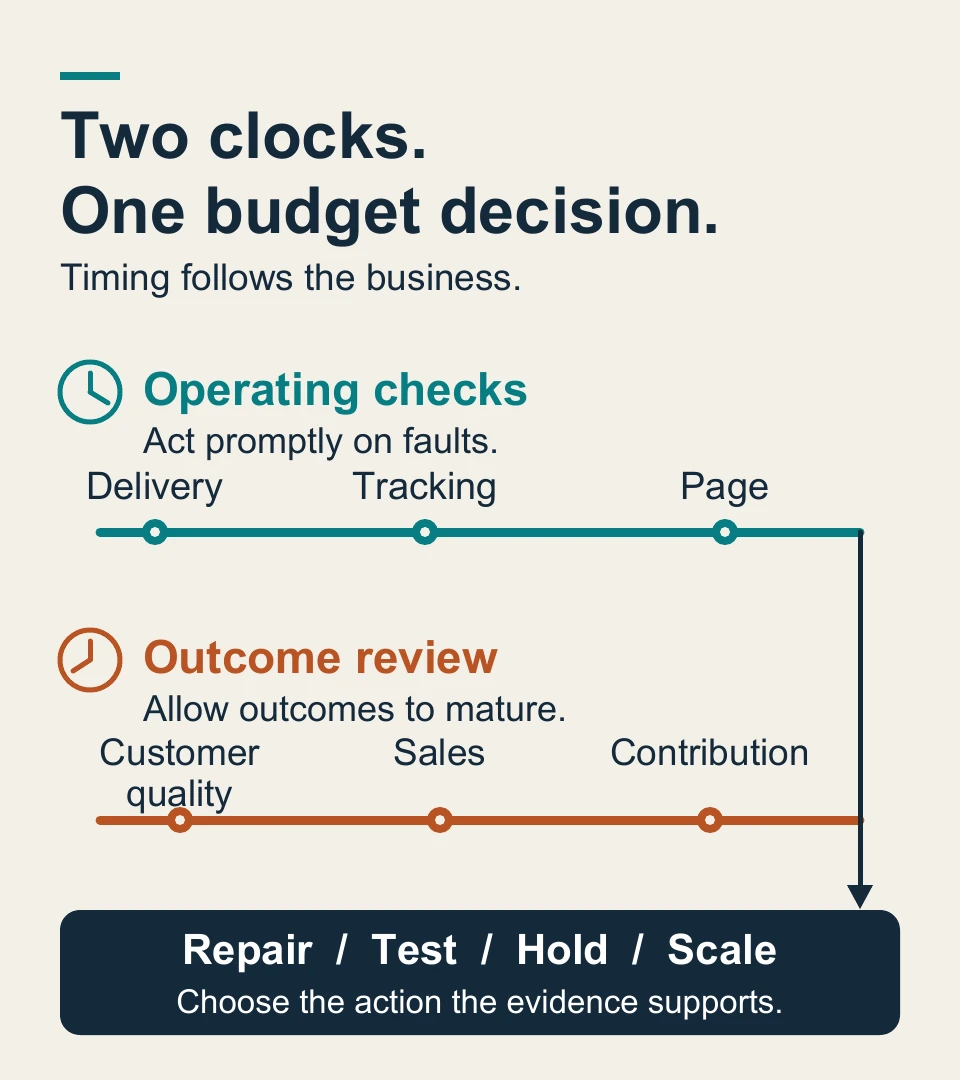
The operating clock: is the acquisition path functioning?
Budget pacing, delivery, approved offers, conversion signals and landing-page availability need monitoring appropriate to the account. A broken checkout or a lead form sending enquiries to the wrong place is a reason to investigate promptly.
Waiting for a monthly report would not make that problem easier to solve. Depending on the issue, the appropriate action might be repair, escalation or pausing affected spend while the fault is resolved.
The outcome clock: has this group had time to become customers?
Customer quality, lead-to-sale conversion, cancellations and contribution may become clear later. The review should compare groups with similar time to progress through the business process.
Here is a hypothetical example. Suppose a business normally evaluates lead-to-sale outcomes after seven days, based on its own sales cycle. A new creative test has been running for two days. Its forms work and the enquiries are being contacted, but few sales have closed yet.
I would not automatically classify that test as a failure by comparing it with an older group of leads that has already had its full review window. I would continue checking early quality signals and budget exposure while waiting for comparable outcomes.
If the same enquiries are never reaching the sales team because an integration broke, waiting seven days would be the wrong response. That is an operating fault, not a normal delay in customer outcomes. The seven-day assumption belongs only to this example.
Turn the review into a clear action
- Repair: address a delivery, measurement or conversion-path problem before interpreting it as campaign performance.
- Test: investigate a specific uncertain cause with a controlled change and an agreed review condition.
- Hold: maintain a bounded position when evidence is incomplete, documenting what is still needed and when to reconsider.
- Scale: increase exposure when customer economics and operational capacity support the next step, then review the additional acquisition.
A responsible management service should explain both why it made a change and why it sometimes chose to wait. Holding is a decision with a review condition, not permission to ignore the account.
How I would judge performance and the next budget decision
We should agree what success means before using a dashboard to declare it. The primary outcome needs to reflect the business model, with diagnostic metrics explaining why it changed.
Lead generation: connect enquiries to qualified demand and customers
For lead generation, I look beyond volume and CPL to qualification, contactability, lead-to-sale rate and customer acquisition cost. The definitions and reporting windows need to be consistent.
My broader experience associated with The DM School includes 10 lakh+ leads. That figure spans the documented experience there; it is not a Meta-only result or a forecast for a management client.
The relevant lesson is the importance of a feedback process at scale. CRM stages, qualification reasons and sales outcomes should help explain whether acquisition is producing suitable prospects.
When CPL improves but sales weaken, the next action depends on the cause. An ad may be attracting the wrong expectation. A form may need clearer qualification. Suitable leads may be receiving slow follow-up. Those situations require different actions and sometimes different owners.
Ecommerce: assess customer economics alongside platform ROAS
For ecommerce, I consider new versus returning customers, revenue per order, margins and relevant fulfilment costs. COD orders, cancellations and refunds can materially change what reported revenue means.
The hair-oil figure above is COD revenue, not a statement of net profit or collected revenue. That distinction also belongs in an active account’s reporting: the team needs a shared definition of the revenue being assessed.
A retargeting campaign may show attractive platform ROAS while adding relatively few new customers. That can still have a role, but it should not automatically absorb the next increase in acquisition budget.
I explain the measurement distinction in ROAS vs CAC. For a management review, the question is how the evidence changes allocation, rather than which ratio looks most impressive in a report.
The D2C ecommerce acquisition framework covers the wider product-to-fulfilment system. Ongoing Meta management should remain connected to it without pretending to control every part.
Scaling: review what the extra spend actually buys
A strong historical average does not establish that the next budget increase will be equally efficient. I want to understand the additional customer volume, acquisition cost and contribution after the change, allowing time for the relevant outcomes.
Some efficiency deterioration may be acceptable if additional acquisition remains economically healthy. Increasing spend is harder to justify when stock, fulfilment, creative supply or sales capacity cannot support it.
Before-and-after account results also do not prove that advertising alone caused every additional sale. Attribution, other channels, promotions and changes in demand can affect the picture. The level of confidence should be clear in the recommendation.
Reporting: show the decision, not just the numbers
A useful review should make the following visible:
- The business outcome and the period or customer group being assessed.
- The spend, customer-quality and economic signals behind the interpretation.
- What changed in campaigns, creative or the conversion path.
- What remains uncertain or blocked by missing information.
- The next action, its budget implication and the condition for another review.
The reporting format and frequency should be agreed for the engagement. More dashboards do not necessarily create more accountability. A clear explanation of a difficult trade-off can be more useful than another chart.
What I can influence, and what your business must still own
Campaign management can influence where spend goes, what gets tested, how performance is interpreted and which funnel problems are escalated. Product quality, stock, offer accuracy, fulfilment and sales follow-up remain business dependencies.
We should distinguish recommendations from implementation in the scope:
- Creative: strategy and test briefs are different from filming, design, editing and obtaining permission to use customer material.
- Landing pages: CRO diagnosis and recommendations are different from building pages or changing checkout code.
- Tracking: reviewing events and defining fixes is different from custom development or a full measurement implementation.
- CRM and sales: using qualification feedback is different from implementing a CRM, managing salespeople or making follow-up calls.
Any of these implementation responsibilities may require additional agreed scope or another owner. They should not disappear behind the phrase “end-to-end management”.
Your business also needs to supply accurate economics, timely approvals and usable customer feedback. If those inputs are unavailable, I can identify the uncertainty, but I should not present a confident scaling recommendation as if the missing information were known.
Accountability means owning agreed work, explaining decisions and exposing dependencies. It does not mean guaranteeing outcomes that also depend on the product, market and business operations.
When ongoing management fits, and what affects the cost
Ongoing management makes sense when you need repeated campaign execution, testing and review, and the business can support the required inputs. It may suit an existing account that lacks a consistent process or a new acquisition programme with a viable offer and readiness to learn.
A focused audit may be more appropriate when you need a defined problem diagnosed before committing to wider work. If your team already executes well and primarily needs direction, my Facebook Ads consulting approach addresses that advisory scope.
A freelancer arrangement can be suitable when the requirement is a focused individual execution relationship. An internal team may be preferable where continuous embedded collaboration is essential. The delivery model and the service scope are related decisions, but they are not the same thing.
How much do Facebook Ads management services cost?
The fee needs to follow the agreed work. Account complexity, products, markets, creative requirements, reporting needs and implementation responsibilities can all change the scope.
Separate the management fee from media spend and from production, software or development costs. Also clarify whether initial setup or a difficult account transition is included in ongoing management.
I would discuss the actual requirements before confirming commercial terms. This page does not set a standard package, minimum commitment, assigned team size or guaranteed performance target.
How quickly should results be evaluated?
Delivery and implementation can be checked early. Reliable commercial conclusions depend on conversion volume, the buying cycle, customer-quality feedback and the work being tested.
The two-clock review gives us a more useful basis than promising a universal number of days. It also prevents “we need more time” from becoming an excuse for an unresolved operational problem.
Request a strategy discussion about ongoing Meta Ads management
Share your offer, current campaign situation, approximate media spend and the outcome you need to improve. Include what your business can provide for creative, website changes and sales or customer feedback.
If you are comparing experience first, my Facebook Ads expert page provides the broader capability and proof context. For a management discussion, I want to establish the work the account needs repeatedly and whether the required responsibilities can be covered.
From there, we can discuss the appropriate scope, measurement approach and commercial terms. Access should be arranged through suitable account permissions, with your business retaining control of its assets.
The value of ongoing management is a better sequence of decisions: maintain a working acquisition path, learn from customers and direct the next budget where the evidence supports it.