When hiring a Facebook Ads freelancer in India makes sense
A Facebook Ads freelancer in India can be a good fit when you need an experienced person to plan, run and improve Facebook and Instagram campaigns, and your business can support the work around those campaigns. That means creative assets, landing-page changes, approvals and feedback on actual customers.
I would choose this model for clear execution ownership and direct collaboration. I would not choose it simply because one person’s fee looks lower than an agency proposal.
Almost 10 years of hands-on performance marketing experience has shaped how I evaluate that difference. A capable media buyer can make better campaign decisions. They cannot personally solve every production, website and sales problem just because the engagement is called “full management”.
The question is whether the complete acquisition workflow has enough coverage, with the freelancer responsible for a realistic part of it.
- Direct access needs a defined scope. Confirm who actually works in the account and which decisions they can make.
- Campaign management and creative production are different jobs. Agree how new ideas become usable ads.
- Reports should lead to decisions. Cheap leads or strong platform ROAS do not settle whether acquisition is healthy.
- Continuity belongs in the hiring discussion. Your business should retain access, campaign context and a usable handover.
What to check before choosing this working model
- What a hands-on freelancer should own
- My execution coverage test
- How the working relationship should operate
- What changes for ecommerce and lead generation
- Freelancer, consultant, agency or in-house?
- Evidence, fees, access and exit checks
- Discussing a hands-on scope with me
What a hands-on Facebook Ads freelancer should own
I expect the execution scope to describe work someone can perform and decisions someone can own. “Grow the business” is a goal. It is not a sufficient description of the engagement.
For Facebook advertising, that scope might cover campaign setup, ad copy, creative testing, budget allocation, optimization and performance reviews. Whether tracking implementation, design, video editing or development is included needs a separate answer.
Connect the plan to changes inside the account
A hands-on operator should be able to explain what they intend to test, build the agreed campaigns and review what happened. Strategy and execution should inform each other.
Before launch, I would want the offer, conversion goal, audience assumptions and budget boundaries understood. For an existing account, I would first establish what is working, what is uncertain and what could break during a transition.
That does not mean rebuilding everything to demonstrate activity. Some accounts need a cleaner test. Others need a tracking repair or a better landing page before another campaign is added.
My performance marketing audit framework explains the wider diagnosis. In a managed engagement, the useful next step is turning that diagnosis into work that has an owner.
Verify measurement without promising perfect attribution
I would ask who checks the relevant Meta Pixel or Conversions API implementation, conversion events and reporting definitions. If technical changes require a developer or specialist, name that dependency before the campaign depends on it.
A dashboard showing purchases does not establish that every recorded purchase is new, paid, fulfilled or profitable. For lead generation, a form submission is not automatically a qualified enquiry.
The operator needs enough measurement confidence to make decisions, plus a way to identify disagreements between platform reports and business records. They should explain limitations rather than promise flawless tracking.
Separate creative direction from creative production
A Meta Ads freelancer may recommend hooks, offers, formats and changes based on performance. That does not automatically mean they will shoot customer videos, edit every asset or design every product visual.
I would clarify who writes the brief, who produces the assets, who approves claims and who uploads the final ads. Creative coordination is valuable work, but it only produces a usable test when those handoffs happen.
Ask what happens after an ad idea is recommended. The answer should reach all the way to a launch-ready asset.
My execution coverage test: can the work keep moving?
Before agreeing a freelancer model, I would check three connected responsibilities: campaign changes, creative supply and business feedback. Then I would test what happens if the main operator becomes unavailable.
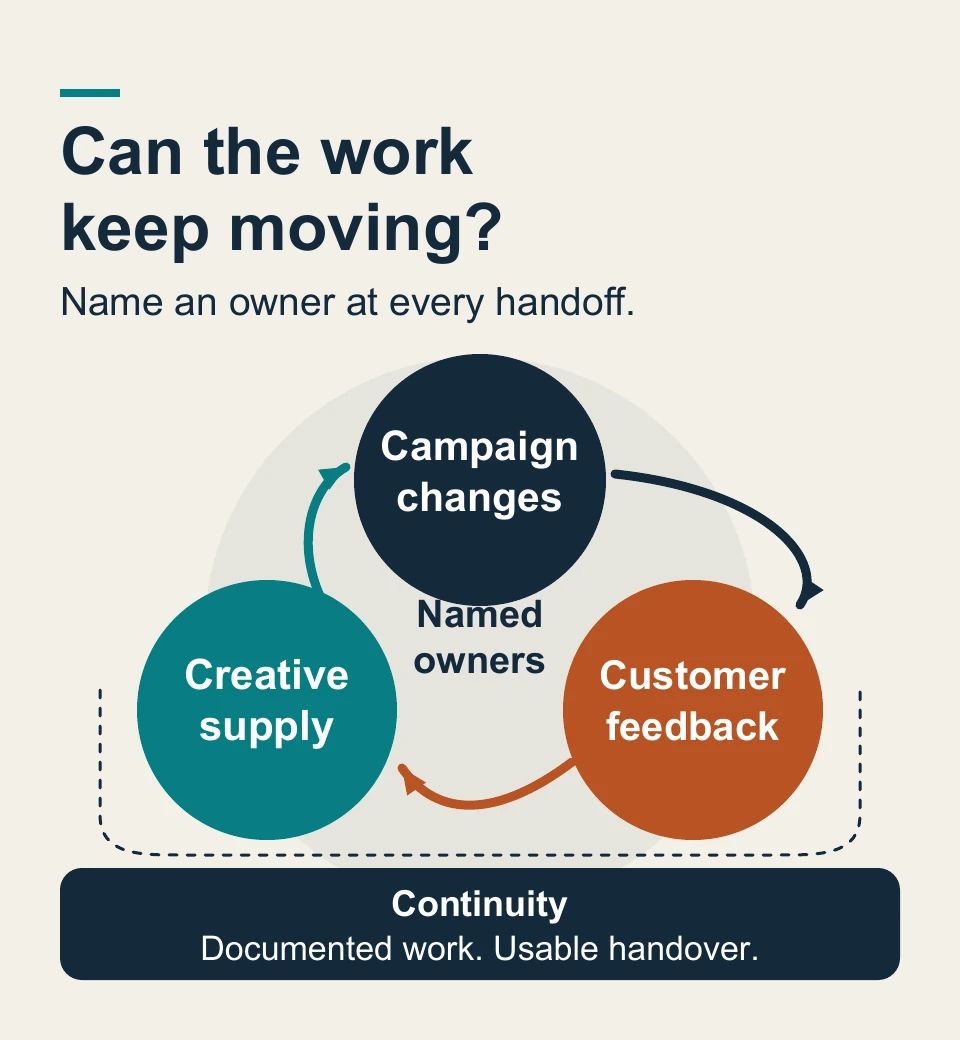
1. Campaign changes: who can act?
Name the person who builds tests, monitors delivery and makes approved changes. Define which budget decisions they can take independently and which need your approval.
Direct collaboration loses its value if every routine adjustment waits for several people to approve it. The opposite problem is unrestricted spending authority with no agreed boundaries.
2. Creative supply: what arrives when a test needs it?
Identify the person or team producing new assets and the material they need from the business. That might include product footage, customer permission, accurate offer details or a founder’s explanation of the product.
Suppose, as a hypothetical example, a D2C business hires an excellent media buyer but supplies only one old product video. The operator identifies a useful comparison angle. Nobody can film or edit it, so the next test never launches.
Hiring a second media buyer would not solve that bottleneck. Adding creative production capacity, or narrowing the plan to assets the business can actually supply, could. This is why I separate operating skill from the resources needed to use it.
3. Business feedback: what returns from customers?
For ecommerce, someone should report customer type, order quality, cancellations and relevant contribution economics. For lead generation, someone should return qualification and sales outcomes, with a clear definition of each stage.
“The leads are bad” is difficult to act on. “These enquiries are outside our service area” points towards a problem the operator can investigate in the promise, form or targeting assumptions.
Feedback needs a reliable owner and a useful level of detail. It should not depend on the freelancer chasing several disconnected spreadsheets whenever performance changes.
The continuity check: does the system survive an absence?
Ask where campaign logic, creative learning, access details and pending decisions are documented. Agree how urgent situations are covered and what a handover would include.
A backup arrangement does not have to resemble an agency team. It does need to be realistic. If the business requires uninterrupted specialist coverage that the engagement cannot provide, the model needs to change.
A freelancer can own campaign operation while other people own creative supply and customer feedback. The problem is an unowned handoff, not the existence of several owners.
How I would structure direct collaboration
Fewer communication layers can help, but direct access alone does not create a good working relationship. I would agree the operating rhythm before deciding how many meetings to hold.
Start with usable inputs
Share the offer, customer profile, business objective, current account history and available assets. Explain commercial constraints such as margins, stock, service geography or sales capacity.
If the account is already active, preserve the existing campaign history and document what is being inherited. A new operator should know which conclusions are supported by data and which are assumptions from an earlier conversation.
Access readiness, missing assets and unresolved measurement can affect launch timing. I would confirm the prerequisites rather than promise a universal number of hours from enquiry to launch.
Agree a review cadence and an escalation route
Routine reporting, decision reviews and urgent issues serve different purposes. Choose a cadence that suits the account’s spend, complexity and conversion cycle.
A review should explain what changed, what the evidence suggests and what will happen next. An urgent tracking failure, rejected offer or landing-page outage should have an agreed route outside that routine review.
For an India-based business, discuss working hours, language needs and regional creative approvals where relevant. Being in the same country does not automatically mean matching availability or knowledge of every regional audience.
Keep a short record of meaningful decisions
I would want major budget moves, test launches and pauses recorded with their reasons. The record should also show what remains blocked and who can unblock it.
This is more useful than a long activity list. “Changed three ads” says little. “Launched a clearer delivery promise after cancellations exposed a mismatch” connects execution to the business problem.
Frequent monitoring also does not require frequent changes. The operator should distinguish a genuine issue from normal variation and explain when more evidence is needed.
The execution model changes with the business outcome
For D2C ecommerce, creative coordination must connect to order quality
My documented hair-oil work generated ₹1.43 crore+ in COD revenue through Meta Ads. The approach included UGC, testimonials, audience testing and retargeting within the funnel.
The useful hiring lesson is that campaign work drew on creative and funnel inputs. That result is not evidence that one freelancer independently produced every asset, nor is COD revenue the same as net profit or collected revenue.
For a D2C engagement, I would ask who supplies usable product demonstrations, who approves the offer and who returns order-quality feedback. If an ad attracts orders that later cancel, the operator needs that information before judging the next budget increase.
Platform ROAS can also look healthy because returning customers are purchasing. A hands-on review should consider new-customer acquisition, margins and fulfilment outcomes alongside the account report.
My D2C paid acquisition framework covers the deeper system. Here, the hiring decision is whether those inputs and decisions are covered in the proposed scope.
For lead generation, sales feedback is part of the operating loop
I served as Head of Performance Marketing at The DM School from February 2021 to August 2026. That role involved paid acquisition, funnels, tracking and CRM-linked work alongside teams.
That experience informs how I think about coordination. A lead-generation operator needs a route back from enquiries to qualified prospects and paid customers. The business must make that feedback available.
If CPL falls but the sales team cannot contact or qualify the enquiries, I would investigate the promise, qualification process and follow-up before celebrating. If leads are suitable but follow-up is delayed, campaign edits may not address the actual issue.
Agree who updates the CRM, which qualification reasons are recorded and when a lead cohort is mature enough to assess. Comparing yesterday’s enquiries with older closed sales can create a misleading picture.
The distinction between ROAS and customer acquisition cost matters here. Platform efficiency should connect to customer economics, with media-only and wider acquisition costs kept clearly defined.
When I would choose another model
I would not describe a Facebook Ads freelancer as the default best choice for every business. Match the engagement to the work you need covered.
- Freelancer: consider a focused hands-on operator when campaign execution needs ownership and the surrounding production and business inputs are available.
- Consultant: consider advisory help when your team can execute but needs account diagnosis, strategic direction or a second opinion. My Facebook Ads consulting approach addresses that scope separately.
- Agency: consider a team when several execution disciplines are missing and you need coordinated capacity. Check the actual team and deliverables rather than assuming everything is included.
- In-house: consider an embedded role when continuous internal collaboration and long-term acquisition capability are important enough to justify building it.
A hybrid can also work: an internal designer and sales team supporting an external media buyer, for example. What matters is whether the responsibilities connect.
The fuller agency, freelancer and in-house comparison covers the wider trade-offs. I would not turn monthly ad spend into a rigid threshold for choosing between them.
What I would verify before hiring a Facebook advertising freelancer
Ask for evidence of the work, not only a result screenshot
Ask what the person actually owned in a relevant campaign. Did they manage media, direct creative, implement tracking or coordinate another team? What business outcome did the reported number represent?
A useful conversation can include an anonymized example or walkthrough where disclosure is permitted. You do not need access to another client’s confidential information to assess the candidate’s reasoning.
My Facebook Ads expert page covers broader capability and documented proof. On this page, I want you to connect that capability to the person, responsibilities and capacity involved in the engagement.
Confirm who performs the work and how much coverage is available
Ask whether the person you are speaking to will operate the account, whether anybody else assists and who handles your questions. Discuss competing commitments and realistic coverage without demanding somebody else’s client list.
Agree response expectations, review availability and absence handling in writing. “Direct access” should not be interpreted as unlimited calls, exclusive attention or round-the-clock support unless those terms are explicitly agreed.
How much does a Facebook Ads freelancer in India cost?
There is no single useful price without a defined scope. A campaign-management engagement and one that includes original creative production, tracking implementation and landing-page work are different purchases.
I would compare proposals after separating:
- Media spend paid to the platform from the professional fee.
- Initial setup or transition work from ongoing management.
- Creative direction from filming, design and editing.
- Recommendations from technical implementation.
- Routine scope from extra products, markets, languages or channels.
Ask what changes the fee and how additional work is approved. A cheaper proposal can leave expensive dependencies uncovered. A higher fee still needs a clear explanation of the capacity and work it buys.
Keep business ownership and a workable exit
Your business should retain ownership and appropriate control of its ad account and assets. Give the operator the access needed for the agreed work through the platform’s access controls rather than sharing personal passwords.
Before starting, confirm the handover expectations: active campaigns, creative files where agreed, tracking documentation, test learning and unresolved issues. Also agree how operator access will be removed at the end.
A good engagement should leave the business able to continue operating, rather than dependent on undocumented knowledge held by one person.
Discuss a hands-on Meta Ads scope with me
If you are looking to work with me on Facebook and Instagram acquisition, start with your offer, current account situation and the outcome you want to improve. Also explain who can supply creative, make website changes and return customer or sales feedback.
That gives us a basis to assess the work before agreeing an engagement. We can discuss whether you need hands-on execution, advisory input or a different level of team capacity. Availability, responsibilities and commercial terms need confirmation for your situation.
I would be cautious about a fit where the expectation is guaranteed ROAS, unlimited production or customer growth without reliable business inputs. Better campaign decisions matter, but they need a working system around them.
Choose a Facebook Ads freelancer for clearly owned execution, supported by creative supply, business feedback and continuity. Those are the conditions I would check before deciding whether this model makes sense.