How much does Facebook Ads management cost in India?
Facebook Ads management cost in India depends on what the provider actually owns. A focused campaign may carry a small monthly fee. A wider engagement may include strategy, several campaigns, tracking review, creative testing and regular decisions about lead or customer quality. The management fee is separate from the money paid to Meta for ads. Before comparing prices, ask each provider to price the same scope and show what your team must supply.
Public Indian provider pages currently show examples from ₹4,999 per month for a narrowly described campaign to ₹70,000 per month for a broader published Meta tier. Those are individual advertised offers, not a representative market range or a universal fair price. The work, spend thresholds, exclusions and contract terms differ. I have not published my own management fees, packages or retainers here; any commercial terms for working with me would need an agreed scope.
Four points to take away
- Separate ad spend, management, one-time setup and the creative or technical work needed to make the campaigns useful.
- Compare deliverables, decision ownership and excluded work before comparing two monthly figures.
- A fee linked to ad spend can rise even if the extra spend creates little extra management work; a flat fee can also become unsuitable when scope expands.
- Judge value against qualified customers, acquisition cost and contribution where you can measure them, not a low fee or a strong platform ROAS alone.
On this page
- What current public prices actually show
- How management pricing models work
- Why quotes vary by scope
- The actual paid acquisition operating cost
- How to compare two different quotes
- When a low fee becomes expensive
- Questions to ask before you sign
What do current Indian provider prices actually show?
I checked public Indian provider pages on 5 October 2026. They are useful as real examples of how offers are structured. They are not a survey of completed contracts, do not establish typical outcomes, and should be rechecked before you buy. Prices can change, and some pages display promotions or spend limits.
| Public provider offer | Advertised fee example | Scope clue that changes the comparison |
|---|---|---|
| HivePulse Media | From ₹4,999/month for a focused lead-generation or traffic campaign | Its page separately describes a fuller funnel at ₹10,000–₹15,000/month; ad spend is extra. |
| VGraple | ₹15,000/month Spark; ₹35,000 Amplify; ₹70,000 Dominate | Each tier covers a defined spend threshold and a different campaign, tracking and reporting scope; excess-spend charges apply. |
| Mediaverse Digital | Flat fees from ₹25,000/month, with ₹45,000 and ₹75,000 tiers by spend band | Ad budget is separate; its page says existing tracking avoids a setup fee and lists landing pages separately. |
| Laksvi Global | 10% of spend, minimum ₹5,000/month; one-time setup advertised at ₹16,000 | A percentage with a minimum plus setup is a different bill from a monthly flat retainer. |
The advertised figures are evidence of those sellers’ offers, not Deepak Singh’s prices. I would not average these numbers: one package covers a focused campaign, another covers more campaigns and technical work, and some have threshold fees or a minimum term. Ask for a written quote for your situation, including GST treatment and any work priced outside the headline fee.
How do Facebook Ads management pricing models work?
Monthly retainer
A fixed monthly retainer pays for a defined ongoing scope, such as campaign operation, testing, meetings and reporting. It makes the management line easier to forecast. It does not mean every creative asset, landing-page change or analytics fix is included. Check the number of accounts, brands, markets and campaigns covered, the review cadence, and the point at which the fee is renegotiated.
A flat fee can be attractive when spend rises but the operational scope stays similar. It can become a poor arrangement for either side if a one-product account turns into multiple markets, several funnels and continuous production without revisiting the scope. The question is whether the work changes, not merely whether the media budget changes.
Percentage of ad spend
Some providers charge a percentage of spend, often with a minimum fee. For a purely hypothetical illustration, 10% of ₹3 lakh of monthly Meta spend is ₹30,000 in management fees before any minimum, setup or tax. Agree whether the percentage applies to planned budget or actual delivered spend, whether taxes are included, and how refunds or unusual billing adjustments are treated. A published example is Laksvi Global’s 10% model with a minimum, but that is its own rate card, not an industry rule.
The benefit is that the fee can move with scale when bigger budgets create additional work. The risk is an incentive to raise spend even when the next increment is not profitable. A percentage should never replace a rule for reviewing qualified customers, contribution and the marginal result of added budget. Equally, a low flat fee does not guarantee disciplined spending.
One-time setup or fixed project fee
Initial account structure, event checks, catalogue work or a bounded audit may be priced as one-time work. Laksvi Global publicly separates a promotional setup fee from ongoing management. The buyer should ask what constitutes completion, whether the resulting account, assets and documentation stay in the business’s ownership, and whether the setup fee is charged again after a pause or relaunch.
A fixed project can suit a defined repair or launch. It is not the same as ongoing testing and budget decisions. If you need diagnosis before execution, my Facebook Ads audit service page explains that different decision. Do not mistake a campaign setup quote for a fully managed acquisition system.
Hybrid fee or tier with an excess-spend charge
A hybrid combines a base monthly amount with a variable charge above a threshold. VGraple’s public tiers illustrate this: its Spark fee covers spend up to a stated threshold and applies a percentage only to excess spend. Read the threshold and percentage together. If you expect to scale, ask for the bill at your current spend, your next budget step and a higher but plausible spend level.
Do not assume the label “performance fee” means payment depends on profit or customers. On a spend-based contract, it can simply mean a percentage of media outlay. The agreement should define the trigger in plain language.
Why can two management quotes be so different?
The same ad budget can support one offer in one city or many products across several regions. Spend affects the amount at risk and may expand testing, but complexity does not rise in a neat percentage of spend. I would map the work before deciding whether a higher quote buys anything useful.
Creative direction versus actual production
Creative direction may mean reviewing angles, briefs and test results. Production means writing, designing, filming, editing, adapting formats and securing approvals. Those are different workloads. Ask who will deliver usable new assets, how many concepts and variants are included, and who pays for reshoots or additional edits. A low media-management fee can fail if no one owns the creative supply that keeps testing alive.
Tracking, measurement and technical implementation
A provider may review Pixel events and report obvious gaps but expect your developer to fix them. Another may implement tags, Conversions API, offline events and CRM handoffs. Ask for the event map, testing method, implementation owner and ongoing QA responsibility. Better measurement does not create sales by itself, but weak signals can make the account hard to diagnose and encourage confident decisions based on incomplete data.
Landing pages, CRO and the sales journey
Ads can bring attention; the page, lead form, checkout or sales team turns that attention into a business outcome. “Landing-page support” might be a recommendation, a wireframe, copy, full development or repeated conversion experiments. Put the deliverable in writing. If a page change requires another vendor or your own team, include that cost and timeline when comparing proposals.
Strategy, reporting and account complexity
Two proposals may both promise a monthly report. One may summarize Meta metrics; another may connect spend to qualified leads, new customers, returns or sales feedback and recommend the next decision. Ask which data sources are reconciled, who attends review meetings and what action follows a poor result. Multiple markets, languages, products, campaigns, catalogues and stakeholders can increase coordination even before ad spend grows.
An ecommerce account may need product-feed health, new versus returning customer analysis, AOV, margins, fulfilment and return patterns. A lead-generation account may need qualification definitions, contactability, CRM stages and closed-sale feedback. Neither is automatically harder in every business. The fee should reflect the actual system and the work the provider owns.
Freelancer, consultant or agency structure
A freelancer may offer direct hands-on execution and a leaner cost base, while a team may cover more specialist production or technical work. A consultant may diagnose and direct a team rather than operate every campaign. Those are possible structures, not quality rankings or reliable price bands. Compare the named person doing the work, coverage if they are unavailable, and what your internal team must supply. My pages on freelance execution, consulting and agency selection cover those fit decisions in more depth.
The actual paid acquisition operating cost is larger than the management fee
For a buying decision, I would build one monthly view of the whole acquisition operation. It may include Meta ad spend, management, creative production, tracking or software, landing-page work, and the relevant time from your own team. One-time setup belongs in the launch period or can be spread across a clearly stated evaluation window. Count each cost once; do not quietly add the same designer or sales manager under two lines.
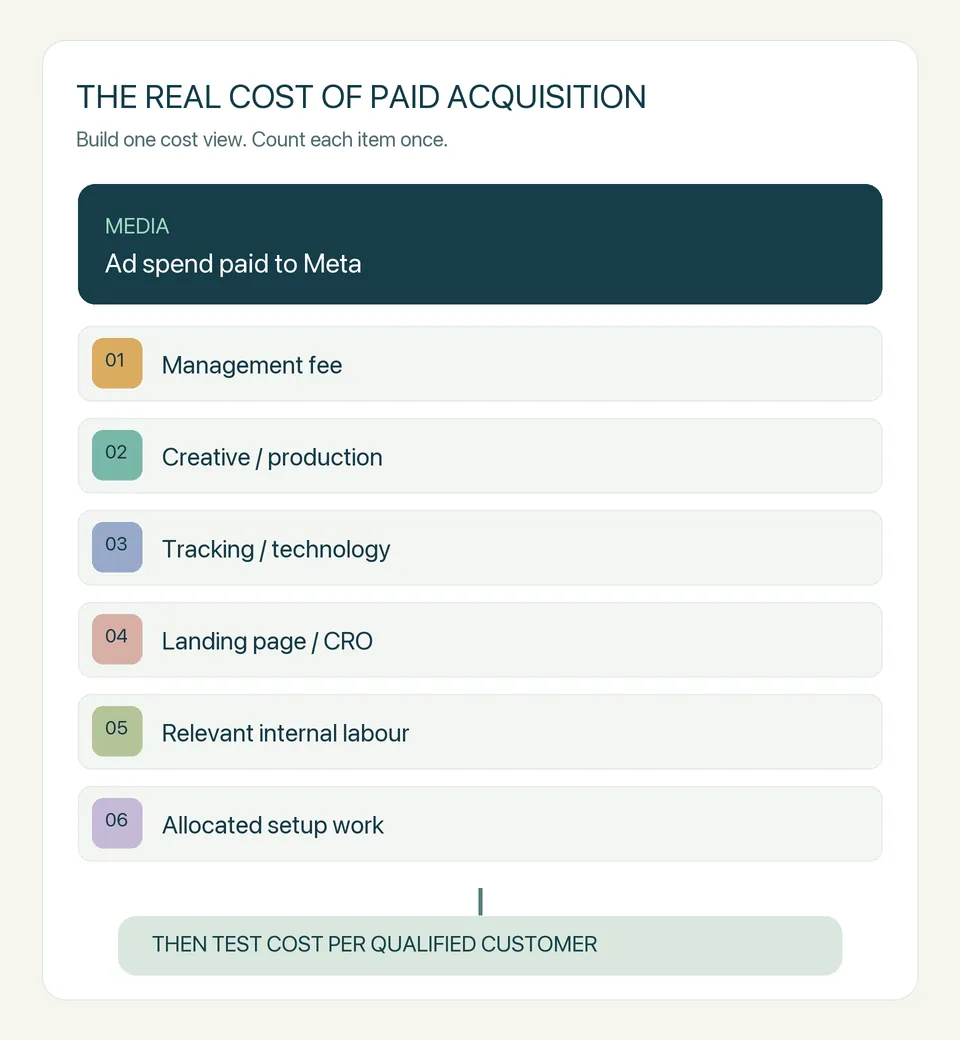
Actual paid acquisition operating cost = media spend + management fee + external creative and production + tracking and tech + landing-page or CRO work + relevant internal labour + allocated setup costs. This is a planning model, not an accounting standard. It makes excluded work visible. It also keeps management fees distinct from media-only platform metrics and from business-level acquisition cost.
Suppose, purely as a hypothetical comparison, you spend ₹3 lakh on Meta, pay ₹30,000 for management, ₹25,000 for creative production and ₹10,000 for tracking support in a month. The visible operating cost is ₹3.65 lakh before any relevant internal labour, page work or applicable taxes. If you divide only ₹3 lakh by customers, you get a media-only acquisition figure. If you include the relevant operating costs, you get a wider business measure. Neither number is wrong if labelled correctly; confusing them can make a quote appear cheaper than the system required to use it.
The complete business calculation can involve other channels and shared costs. Do not allocate every company expense to Meta without a defensible method. For deeper distinctions among platform ROAS, new-customer CAC and blended CAC, read my ROAS versus CAC guide.
How I would compare two Facebook Ads management quotes
I would ask both providers to respond to the same short operating brief: the offer, target customer, current spend, number of markets, conversion path, creative supply, tracking state, sales feedback and desired decision cadence. Then I would mark each responsibility as included, excluded or owned by the business. Only after that would I compare the fee.
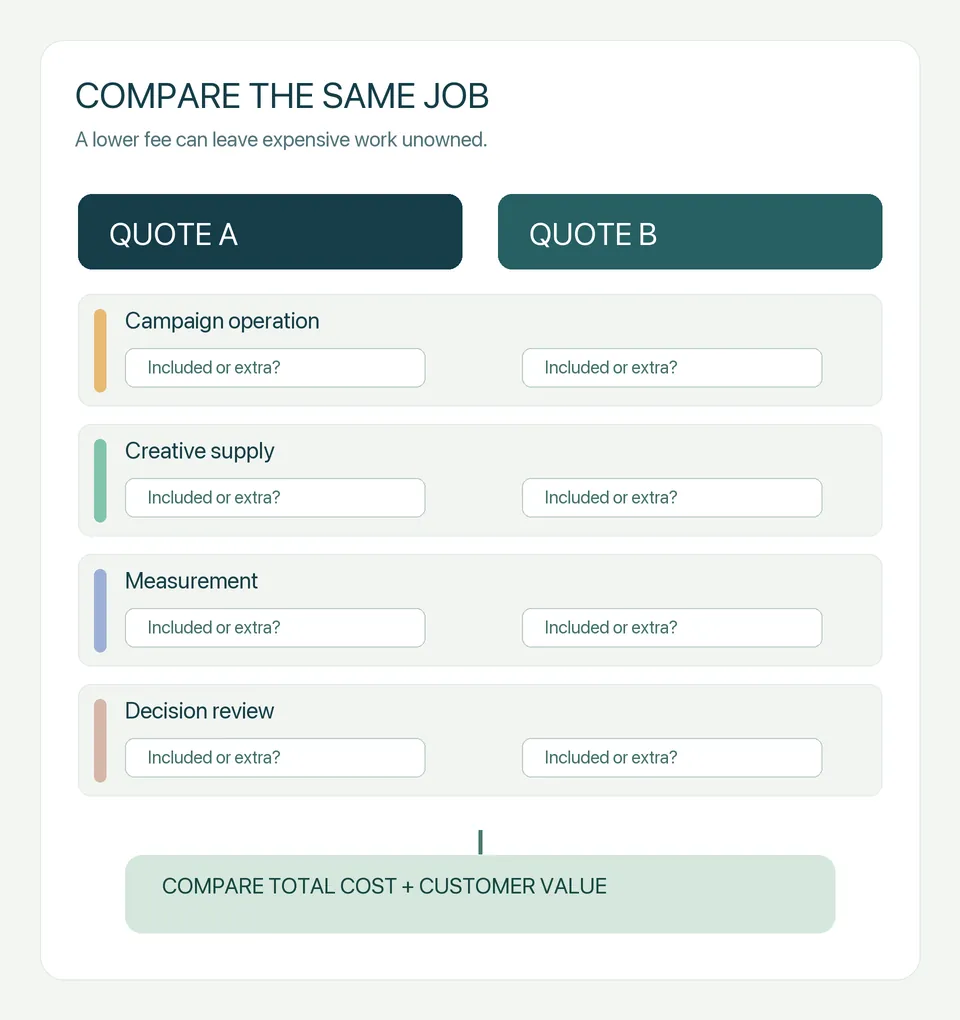
Consider a hypothetical choice. Provider A asks ₹15,000 per month and handles campaign changes and a monthly dashboard. Your team must produce ads, fix event tracking and decide which leads are qualified. Provider B asks ₹40,000 and includes creative testing coordination, tracking QA and a review of qualified leads, while production and technical implementation remain separate. Provider B is not automatically better: its extra work may be irrelevant or may overlap with your own team’s capability. Provider A is not automatically cheaper if the missing responsibilities require another ₹35,000 of work. The right comparison is the complete scope needed to reach a decision, not a contest between two invoice lines.
- Normalize the deliverable: compare the same campaigns, creative cadence, tracking tasks, page involvement and reporting outputs.
- Name the owner: identify the person or team responsible for each excluded dependency and their actual cost.
- Model the bill at scale: calculate flat, threshold and percentage fees at more than one realistic spend level.
- Test the decision: ask what evidence would cause the provider to increase, hold or reduce budget.
- Check the exit: confirm account ownership, access, documentation, contract term and handover.
This is where I see a common buyer mistake: purchasing an inexpensive operator while assuming strategy, creative production, CRO and sales feedback will somehow appear around them. A good operator cannot fix an unowned business process through campaign settings. A more expensive proposal is only worth more if the additional scope addresses a real constraint and is delivered by people who can act on it.
When does a low management fee become expensive?
A low fee becomes expensive when the work left outside the scope causes wasted media, slow learning or poor customer quality. It can also become expensive when the provider cannot explain why spend should change. I would ask for the reasoning behind the next budget decision, not merely a promise to reduce cost per lead.
For lead generation, cheap enquiries may not become qualified conversations or customers. Compare the cost of qualified opportunities, the contact and close process, and the time needed for sales outcomes to appear. If sales feedback is delayed or inconsistent, be honest about uncertainty before claiming that one provider caused better acquisition.
For ecommerce, a high platform ROAS may lean heavily on returning customers or remarketing. Look at new-customer acquisition, contribution after product and fulfilment costs, and the result of incremental spend. A higher management fee can be justified when it supports better decisions, but the price alone proves nothing. The converse also holds: a smaller, focused engagement can be enough when the business already has good creative, technical support and its own analytical capacity.
One spend increase can raise the fee under a percentage model without adding another creative concept, market or reporting decision. Another increase may truly require more production and measurement. I would look for the changed work and the changed business result. Protecting the highest historical ROAS while refusing profitable new customers can be as costly as scaling without regard to CAC and margin.
What should you ask before accepting a quote?
Send the same questions to each provider and request short written answers. You will learn more than from a generic package label.
- Is the price a monthly retainer, percentage of actual spend, setup fee, fixed project or hybrid? What are the thresholds, minimums, taxes and payment terms?
- Is Meta media spend billed separately from your own ad account, and who retains account, Pixel, audience and creative access?
- Which campaigns, brands, products, markets and languages are covered, and what triggers a scope change?
- Who plans, produces and approves new creative? How many concepts and edits are included?
- Who checks events and fixes tracking? Is implementation included or only recommendations?
- Who owns landing-page changes, CRO tests and CRM or sales feedback?
- What does reporting contain, how often will you review it, and who recommends the next budget decision?
- Which outcomes will you use beyond platform clicks, leads and ROAS? How will you distinguish media-only from wider CAC?
- What are the minimum term, notice period, extra-work approval process and handover deliverables?
If the proposal is really for ongoing account operation, my Facebook Ads management services page explains the operating scope I would discuss. This pricing guide helps you compare commercial terms; the service page explains the continuing work.
Choose the scope and economics before choosing the fee
There is no universal correct Facebook Ads management price for every Indian business. Public rate cards show how wide the quoted structures and service boundaries can be. The useful buying question is: what work will be done, who owns what is excluded, how will the bill change as you scale, and what customer-level evidence will tell you whether the investment is paying back?
If you are considering working with me, bring your current spend, account situation, offer, creative capacity and the business outcome you need. I can discuss a scope based on those facts. I have not stated or implied a fixed Deepak Singh fee on this page.