Should you hire a Facebook Ads agency in India?
Hire a Facebook Ads agency in India when the work you need requires a delivery team and the proposal makes clear who will own strategy, campaign execution, creative, tracking, reporting and the handoffs to your sales or ecommerce team. The right agency should connect those responsibilities to qualified leads or customers, not only to activity inside Ads Manager.
I work in performance marketing as a practitioner. I do not position myself as a traditional full-service Facebook Ads agency. This guide is for businesses evaluating an agency, and it also explains when direct expert-led involvement may be a better fit for the work you actually need.
A larger team is not automatically better, and a solo expert is not automatically better. Choose the operating model that covers your real constraints with clear ownership.
Three points to keep in view
- Ask an agency to name the person who will make decisions and the person who will operate your account.
- Separate work the provider controls from outcomes that also depend on your offer, landing page, sales follow-up, stock or fulfilment.
- Verify what the proposal means through work evidence, access and a clear exit plan before judging it by a case-study number or fee.
On this page
- What a Facebook Ads agency should own
- A practical test for an agency proposal
- How to evaluate the team and its work
- How to read agency case studies
- Agency, expert-led or in-house support
- How to compare scope, fees and contracts
- Questions to ask before signing
- Choose the partner that covers your constraint
What should a Facebook Ads agency actually own?
A provider’s responsibility should be defined in work that it can perform and show. Campaign setup and management, agreed creative work, tracking checks, reporting and optimisation are examples of controllable responsibilities. Revenue, profit or a particular return cannot be controlled by the media buyer alone because the offer, price, product, site, sales response and fulfilment also affect what happens after an ad interaction.
Before you compare proposals, ask the agency to separate three kinds of responsibility:
- Provider-owned work: account and campaign changes, agreed analysis, creative briefs or production, tracking QA, reporting and recommendations that are explicitly in scope.
- Shared work: campaign planning, landing-page improvements, lead feedback, event definitions and budget decisions that need input or approval from both sides.
- Business-owned outcomes: product-market fit, inventory, pricing, service availability, response time, sales conversations, payment collection, returns and customer experience.
This division is not an excuse for an agency to stop at clicks or form fills. It is a way to agree which signals the agency can change, which inputs your team must return and how the two sides will diagnose a weak result together. For lead generation, a useful report may need to connect enquiries to qualification and sales stages. For ecommerce, a purchase count should be read alongside order quality, cancellations and contribution where those data are available.
If you want the ongoing execution scope itself, my page on Facebook Ads management services explains how I approach campaign strategy, creative testing, tracking and repeated review. Here, I am focusing on how a buyer can verify what a prospective agency will actually own.
My Promise-to-Ownership Check for an agency proposal
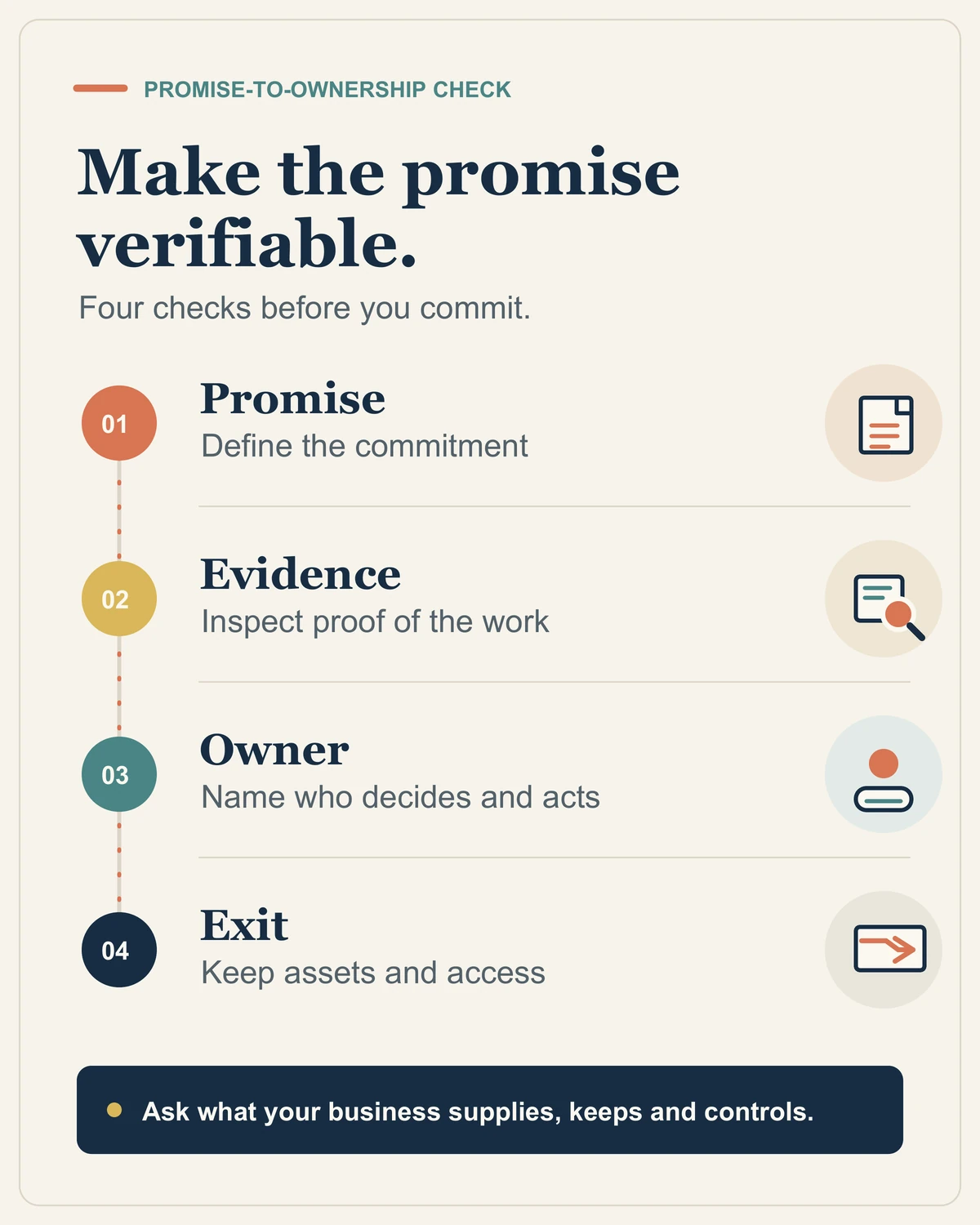
I use a simple buyer-side test when a provider makes an important claim. Do not leave it as a sentence in a pitch deck. Carry it through four checks: Promise, Evidence, Owner and Exit.
- Promise: What exactly will the provider do or deliver, by when, and for which part of the acquisition path? “We scale your business” is vague. A defined responsibility might describe campaign management, a creative review cycle, event QA or a reporting decision.
- Evidence: What real work artifact would let you verify the process? Ask for a suitably redacted report, creative brief, change log, measurement QA example, onboarding plan or handover checklist. A result screenshot alone may not show what the team did.
- Owner: Who is accountable for the work, and who performs it? Ask who approves strategy, who makes routine account changes, who leads creative feedback, and what your team must supply or implement.
- Exit: If the relationship ends, what access, data, audiences, creative files, tracking documentation and operating knowledge remain available to your business? Agree a handover process before it is urgent.
Move through the four checks in order: define the commitment, inspect evidence, identify the accountable owner and record the client’s dependencies and retained access at exit.
If one of the four answers is missing, the next step is to clarify the proposal, not to assume the agency will fill the gap later. This test also gives you a fair way to compare providers that promise different combinations of media buying, production, tracking and funnel support.
How to evaluate the team and the work behind its pitch
A Facebook Ads agency can have an impressive sales presentation and still leave practical questions unanswered. I would evaluate how the work moves from a business question to a decision inside the account, then back to the people who know what happened to the lead or customer.
Strategy access and the person who will make decisions
Ask to meet the person who will interpret the account after onboarding. The person who explains the proposal may be a strategist, salesperson or founder. That does not tell you who will review performance, recommend changes or be available when a decision becomes urgent.
Clarify how often you can speak with the senior person, what decisions the day-to-day operator can make independently, and how the agency records changes that affect budget or offer testing. Direct senior access matters most when the business is still learning which problem to solve. If you mainly need independent diagnosis or a strategic second opinion, my Facebook Ads consulting approach is a more specific description of that advisory role.
Execution ownership and continuity
Ask which named role will operate the account and what happens if that person is unavailable or moves to another client. A team only adds useful coverage when the responsibilities are clear enough for another specialist to understand the account without restarting every decision.
I have worked across teams of approximately 15 to 30 people while serving as Head of Performance Marketing at The DM School from February 2021 to August 2026. That experience made role clarity and handoffs important to me. Team size by itself does not tell you whether the strategist, media buyer, creative team and sales owner share the same picture of the customer.
Ask how campaign decisions are documented, where the current offer and customer definition live, and who takes over if an account manager changes. If a provider cannot describe continuity without relying on one person’s memory, you may inherit that gap later.
Creative direction is different from creative production
“Creative included” can mean very different work. It may cover concept direction, scripts, design, editing, creator coordination, production or only uploading assets your business supplies. Ask which of those activities are included, how approvals work, who owns the files and how the team decides what to make next.
For Meta campaigns, creative is one of the inputs I watch closely, but more output is not automatically better. The useful question is whether the team can explain what a creative test is meant to learn, how the offer and audience are reflected in the message, and how results will be read beyond click-through rate. Set a workable review rhythm based on the business’s creative capacity rather than accepting a production quota that your team cannot support.
Tracking should be checked, documented and understood
Ask who is responsible for the Meta Pixel, Conversions API (CAPI), event definitions and QA. The provider may configure them, work with your developer or only audit the setup. The proposal should say which. A connected event is not proof that every purchase, lead or qualified customer is being measured perfectly.
Request a short explanation of the events used for optimisation, what is sent from the website or CRM, how duplicate or missing events are checked, and where the implementation notes are stored. Also agree which reporting source is used for each decision. Meta Ads Manager, an analytics platform, your CRM and finance records can describe different parts of the journey.
For Page access specifically, Meta distinguishes task access from Facebook access with full control, and its guidance says full control can manage other people’s access. Use permissions that match the work and keep business ownership visible; the agency should explain which assets it needs and why. See Meta’s Facebook Page access guidance for that narrow distinction.
Landing-page and CRO responsibility needs a boundary
An agency may identify that a mobile page is slow, a form asks for too much information or the landing page does not continue the ad’s promise. That does not mean the agency will build or change the page. Ask whether it will diagnose, recommend, implement or test the change, and who approves code or copy updates.
I do not treat the ad and the page as unrelated. If click quality remains similar but qualified conversion falls, I look beyond the campaign: message match, mobile form friction, trust, offer clarity and the next step can all affect what the business receives. The key hiring question is who is allowed to act on each finding and how the agency will tell you if the fix belongs to your team.
Lead or customer feedback must return to the campaign
For lead generation, agree how the sales team will label a lead as reachable, qualified, disqualified, booked or converted. “Lead quality” is too broad to optimise until both teams use the same definition and return feedback on a reasonable schedule.
For ecommerce, clarify whether the agency will see order status, new versus returning customers, cancellations, COD confirmation or contribution data. A platform-attributed purchase is not automatically an incremental customer or a profitable order. My ROAS vs CAC comparison goes deeper into how I connect platform efficiency with business acquisition economics.
Reports should explain a decision, not only show a dashboard
Before signing, ask to see the format and cadence of a normal performance review. The report should state the period, spend, conversion definition, attribution basis and any major tracking limitation. It should also say what the team recommends next and what evidence would change that recommendation.
A useful report can show platform signals such as cost per result, but it should not treat those as the entire business outcome. Ask how the agency reports qualified leads or actual customers when those data are available, and how it separates new-customer acquisition from returning-customer or remarketing effects. On ecommerce accounts, the decision may depend on AOV, cancellations or contribution. On lead accounts, it may depend on contactability, qualification and sales close rate.
If you want to compare specific metrics in more depth, use the dedicated performance marketing metrics guide. The purpose of agency reporting is to turn the numbers into a decision for your account, not to add every possible metric to a slide.
How I would read an agency case study
A case study is useful when the number, channel, time period and conversion outcome are clear enough to understand what happened. Ask whether a revenue figure is platform-attributed, website-reported, collected, net of cancellations or simply the broader business result for the same period. These are different kinds of evidence.
For example, one documented D2C hair-oil result in my own work is ₹1.43 crore+ COD revenue generated through Meta Ads. That is COD revenue, not contribution or profit, and it does not guarantee the same outcome for another business. A separate women’s fashion result records ₹1.05 crore+ revenue and 493% growth, but the approved context does not attribute those figures to Meta alone. I keep those proof points separate because a buyer should not accept channel attribution that the evidence cannot support.
When reviewing a provider’s results, ask what the team personally did, which parts other teams supplied, and what changed between the before and after periods. A strong case study helps you judge the relevance of the experience. It is not a forecast for your business.
When does an agency team make more sense than expert-led support?
A larger agency can make sense when the work needs several capabilities at the same time and your business does not have them internally. Direct expert-led support can fit when one senior practitioner can make a meaningful difference and your team can supply the other inputs. Neither model is automatically better.
An agency team may fit when you need creative production, tracking, landing-page work and several account functions to move together. Ask which specialists will work on your account and how they hand off decisions. More people do not help if your strategist cannot reach the media buyer or the person who owns customer feedback.
Direct expert-led support may fit when Meta is the main paid channel, the work is narrow enough for one senior practitioner, and your team can supply creative assets, technical changes or sales feedback. Check the person’s capacity and continuity plan, and compare that with your need for a separate delivery bench. I work as a performance marketing practitioner, not a full-service agency. For day-to-day individual execution, see my Facebook Ads freelancer page; for the wider cross-channel choice, read the agency, freelancer and in-house comparison.
How should you compare agency fees and scope?
There is no single fee figure that tells you whether a Facebook Ads agency is right for your business. Public packages and directory listings use different service boundaries, team models and commercial units. A cheaper quote can exclude the creative, analytics or landing-page work you assumed was included. A higher quote can still be a poor fit if the extra capabilities do not address your constraint.
Compare written proposals on the same basis. Separate the provider fee from media spend paid to Meta, and ask whether the provider’s fee is fixed, spend-based, project-based or a combination. Then confirm what the fee covers: onboarding, campaign setup, management, creative direction, design or production, tracking review, CRO, reporting meetings, CRM feedback and handover.
Also check contract length, notice period, approval turnaround, response expectations, subcontracted tasks, access changes on exit and who retains creative and tracking documentation. I would rather see a precise scope with realistic client responsibilities than a large list of services with no accountable owner.
When an agency quotes performance-linked terms, understand which conversion is counted, which attribution source controls payment and how refunds, cancellations or lead quality affect the calculation. Incentives can change what a provider optimises. Put definitions in the agreement before budget starts moving.
Questions to ask before you sign
Use questions that reveal how the work will operate, not questions that invite another general promise.
- Who will personally make campaign decisions, and how often can I speak with that person?
- Can you show a redacted report, creative brief or change record that represents your normal work?
- Which creative tasks are included, who supplies the assets, and who owns the approved files?
- Who checks Pixel, CAPI and conversion events, and what implementation work depends on my developer?
- How will we return qualified-lead, sale, customer or order-quality feedback to the campaign?
- Which accounts and business assets will remain under my business’s control, and how will access change at exit?
- What is excluded from the quoted fee, what do you need from my team and what evidence would make you recommend reducing or pausing spend?
The answer does not need to be “we do everything.” It needs to show that each important task has an owner, a defined boundary and a path to the business information that informs the next decision.
Choose the partner that covers your constraint
A good Facebook Ads agency relationship starts with a shared definition of the work. The provider should be able to show what it will own, how it will judge progress, who will act on the evidence and what your business must return. You should be able to retain access to the accounts and knowledge that make the work transferable.
If your business needs a coordinated bench for creative, technical, funnel and campaign work, assess an agency on how those roles operate together. If you need direct access to a senior person who can both think through and work on Meta Ads, evaluate an expert-led arrangement against the capacity and support you already have. I am a performance marketing practitioner, not a traditional agency; my Facebook Ads expert page explains the experience behind that alternative.
Whatever model you choose, make the promise observable before you make the commitment. A clear owner, evidence trail and exit plan will tell you more about how the relationship is likely to work than a polished pitch or a single ROAS screenshot.