Performance Marketing vs Digital Marketing: The Difference I Actually Care About
I spent years working across different parts of digital marketing before I started thinking much more seriously in terms of performance marketing.
And for me, the difference is not just terminology.
It changes what I am responsible for.
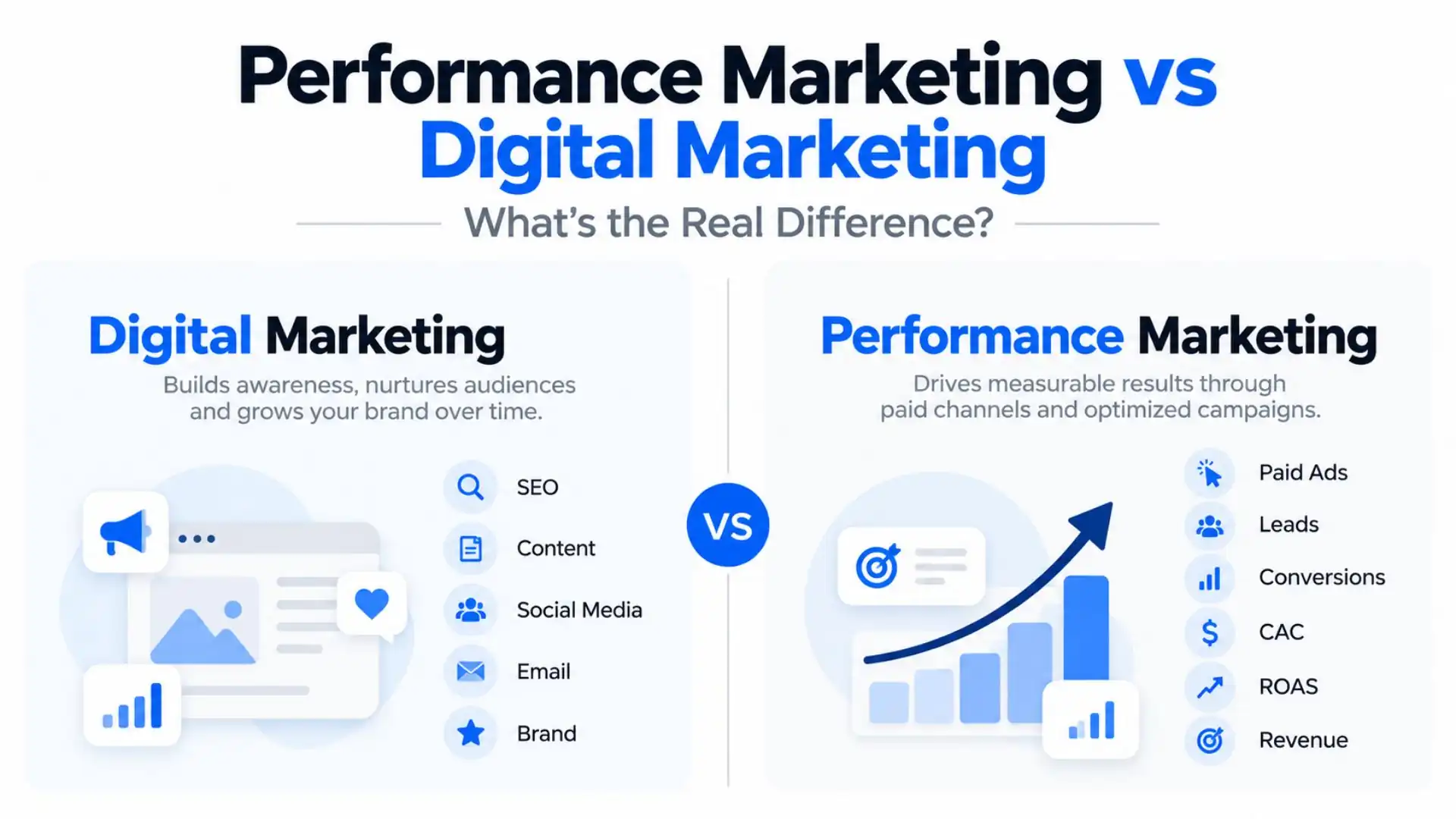
Digital marketing can include almost anything done online to grow awareness, traffic, engagement or demand.
Performance marketing becomes much more specific once the conversation turns to:
How much did we spend, what did that spend produce and can we keep doing it profitably?
I Do Not See Performance Marketing as Just Another Channel
This is where people sometimes get confused.
Meta Ads is not automatically performance marketing.
Google Ads is not automatically performance marketing.
YouTube Ads is not automatically performance marketing.
You can run all three platforms and still operate like a traditional digital marketer if the main focus is reach, traffic, views or engagement.
For me, the channel becomes part of performance marketing when I am connecting the spend to a measurable business outcome.
That may be a lead.
It may be a purchase.
It may be a qualified opportunity.
It may eventually be revenue or customer acquisition cost.
The Responsibility Is Different
If I am running a digital awareness campaign, I may care about reach, impressions, engagement, video views or traffic.
If I am responsible for performance marketing, those metrics are not enough.
I still look at them, but mainly because they help me diagnose what is happening.
The real question becomes whether the activity is helping the business acquire customers efficiently.
That is why I spend so much time thinking about CAC, conversion rate, lead quality, landing pages, tracking and what happens after the click.
I have explained that broader operating approach in my Performance Marketer in India guide.
Traffic Is Not the Same as Growth
I have seen campaigns generate a lot of traffic and still create very little business value.
I have also seen campaigns where the click volume was lower but the users were much more qualified and the economics were better.
That is one of the reasons I do not get too excited about traffic by itself anymore.
I want to know what happened after the traffic arrived.
Did people convert?
Did the leads qualify?
Did customers buy?
Did CAC stay inside a range the business can afford?
If the answer to those questions is weak, then strong traffic numbers do not mean much to me.
Digital Marketing Can Be Broader Than Performance Marketing
I still see digital marketing as an important broader category.
SEO, content, organic social, email, brand building, community and awareness can all contribute to growth.
But not every one of those activities is measured or optimized in the same direct-response way.
Performance marketing is where I personally become much more accountable to measurable commercial outcomes.
That is also why I describe my work more often as performance marketing rather than simply digital marketing.
The Way I Think About It Is Simple
Digital marketing asks: How do we grow online?
Performance marketing asks: Which activities are producing measurable business outcomes, at what cost, and how do we improve or scale them?
That second question is the one I have spent most of my career working on.
It is also the thinking behind how I approach paid growth across Meta Ads, Google Ads, YouTube Ads, CRO and tracking, which I have covered more broadly in my Performance Marketing Expert in India page.
The Biggest Difference for Me Is How Success Gets Measured
This is where digital marketing and performance marketing start to feel very different in practice.
With broader digital marketing, success can be measured through things like reach, website traffic, engagement, email growth, content consumption or brand visibility.
Those metrics can absolutely matter.
But when I am working in performance marketing, I usually want the measurement to move much closer to the actual business result.
I want to know:
What did we spend, what did we acquire and what did each customer or lead really cost us?
I Use Platform Metrics to Diagnose, Not to Define Success
CTR, CPC, CPM, view rate and engagement can tell me a lot about what is happening inside a campaign.
But I do not consider them final outcomes.
If CTR improves but lead quality becomes worse, I do not consider that a clear win.
If CPC falls but the landing-page conversion rate also falls, the cheaper traffic may not actually be helping.
If YouTube views are inexpensive but almost nobody moves into the funnel, the campaign may be creating attention without creating enough business value.
This is why I use those metrics more as diagnostic signals than as the main scorecard.
I Care Much More About What Happens After the Click
One of the biggest differences in how I work today is that I do not stop evaluating performance once the user reaches the website.
The click is only one stage.
I want to know what percentage converts.
For lead generation, I want to know whether those leads qualify.
If possible, I want to know which campaigns eventually produce customers.
For ecommerce, I want to understand whether the order came from a new customer, what the acquisition cost looks like and whether the margin supports further scale.
That is why CRO, tracking and CRM feedback become part of performance marketing for me rather than separate conversations.
A Low CPL Can Still Be Bad Performance
I have seen this enough times that I am very careful with front-end metrics.
Imagine one campaign produces leads at ₹200 and another produces leads at ₹350.
The first campaign looks better immediately.
But if 2% of those ₹200 leads become customers and 8% of the ₹350 leads become customers, the second campaign may be far more valuable to the business.
That is why I try to move the measurement as far down the funnel as the available data allows.
I do not want to optimize for the cheapest conversion if that conversion is not closely connected to revenue.
ROAS Is Useful, but I Still Ask What Is Behind It
The same thing happens with ROAS.
If somebody tells me a campaign is generating 5X ROAS, I still want more context.
How much is being spent?
How much of that revenue is coming from new customers?
Is branded demand included?
Is remarketing contributing heavily?
What margin is left after discounts, fulfilment and other costs?
A strong ROAS can be useful, but I do not want the number separated from the economics behind it.
This Is Why Tracking Matters So Much
Performance marketing depends heavily on knowing whether the conversion data is trustworthy enough to act on.
If the wrong event is firing, duplicate conversions are being counted or platforms are taking credit for the same customer in different ways, the dashboard can create false confidence.
I do not expect Meta Ads, Google Ads, GA4 and CRM data to match perfectly.
I do expect to understand why they differ and which numbers are reliable enough for budget decisions.
This is also one of the reasons I include tracking and attribution in my performance marketing consulting work rather than treating them as purely technical setup tasks.
Performance Marketing Pushes Me Toward Business Metrics
The deeper I go into the account, the more I want the conversation to move from:
Impressions → Clicks → Leads → Qualified Leads → Customers → Revenue
Not every business will have perfect data at every stage.
But the closer I can get to the actual customer and the actual economics, the better my decisions usually become.
That is the measurement difference I care about most.
Digital marketing can tell me whether people are seeing, visiting and engaging with the brand.
Performance marketing pushes me to ask whether those activities are turning into measurable growth at a cost the business can sustain.
The Channel Does Not Decide Whether Something Is Performance Marketing
This is one distinction I think is worth making because people often categorize channels too quickly.
Meta Ads is usually called performance marketing.
Google Ads is usually called performance marketing.
YouTube Ads is usually called performance marketing.
But I do not think the platform itself decides that.
The way the campaign is structured, measured and optimized matters much more.
The Same Platform Can Be Used for Completely Different Objectives
I can run a YouTube campaign purely to maximize reach and video views.
Or I can use YouTube to generate leads, track CPL, build remarketing audiences and optimize the funnel toward customer acquisition.
Same platform.
Very different operating mindset.
I have seen this difference clearly in my own YouTube work.
One education campaign generated more than 66,300 leads at approximately ₹76 CPL from around ₹50.4 lakh in spend.
At that point, I was not thinking about YouTube mainly as a video-view platform.
I was thinking about how video creative, audience quality, landing-page conversion and lead cost worked together as an acquisition system.
I have explained that approach in more detail on my YouTube Ads Expert in India page.
Meta Ads Can Be Brand Marketing or Performance Marketing
I can use Meta to run a reach campaign designed mainly to expose a new brand to as many relevant people as possible.
That can be useful digital marketing.
But if I am running Meta with a clear acquisition objective, tracking purchases or qualified leads, comparing CAC and continuously improving the funnel, I am operating much more like a performance marketer.
The platform has not changed.
The accountability has.
Google Ads Is Not Automatically Performance Marketing Either
Google Search naturally lends itself to performance because user intent is often easier to connect with a measurable action.
But even there, I can still run campaigns badly from a performance perspective.
If the account is optimized toward weak conversion actions, if branded traffic is hiding poor non-brand acquisition or if nobody knows what happens to the leads after they arrive, the presence of Google Ads does not magically make the operation performance-driven.
In my EdTech Google Ads case study and Ayurveda Google Ads case study, I focus on conversion volume, spend and cost per conversion because those numbers provide much more useful context than traffic alone.
Organic Channels Can Also Be Measured With a Performance Mindset
I would not normally call SEO, organic social or content marketing performance marketing in the same narrow sense as paid acquisition.
But I can still apply performance thinking to them.
If an SEO page generates qualified leads consistently, I want to know that.
If an email sequence increases repeat purchases, I want to measure it.
If organic content improves branded search and lowers acquisition costs elsewhere, that matters too.
Not every useful marketing activity has to be paid media.
This Is Why I Prefer Thinking in Systems Instead of Channels
A customer may watch a YouTube video, later click a Meta ad, search the brand on Google and finally convert through a direct visit.
If I evaluate each channel in complete isolation, I can misunderstand what is actually creating demand and what is simply capturing it.
That is why I care about the role of each channel in the journey rather than trying to force every activity into one label.
The Question I Ask Is Different
I do not ask:
“Is this a performance marketing channel?”
I ask:
“What job is this channel doing, how are we measuring that job and how does it contribute to the business outcome?”
For me, that is a much more useful way to think about the difference between digital marketing and performance marketing.
How the Day-to-Day Work Feels Different
The difference becomes even clearer when I look at what I actually spend my time doing.
In broader digital marketing, the work can include content planning, SEO, social media, email campaigns, website updates, brand communication and audience growth.
In performance marketing, my day usually becomes much more numerical and decision-heavy.
I am constantly asking:
What changed, why did it change and what should I do next?
I Spend More Time Diagnosing Than Publishing
A digital marketing role may involve creating and distributing content across multiple channels.
My performance marketing work is usually much more focused on diagnosing movement in the funnel.
If CAC increases, I want to know what moved underneath it.
Was CPM higher?
Did CTR fall?
Did CPC increase?
Did landing-page conversion weaken?
Did lead quality deteriorate?
Did sales conversion fall?
The answer tells me whether I need to change media, creative, landing pages or something further down the funnel.
I Spend a Lot of Time Deciding Where Budget Should Go
This is one of the clearest differences for me.
Performance marketing forces me to make allocation decisions constantly.
If Meta is still producing customers efficiently, should I increase the budget?
If Google Search is already capturing most of the available high-intent demand, should I keep forcing more spend into it?
If YouTube is creating demand but Google is capturing the final conversion, how much credit should each channel get?
Those are not really content or visibility questions.
They are capital-allocation questions.
I have gone deeper into how I make those decisions in my Performance Marketer in India guide.
I Work Much More Closely With Creative Than People Expect
One thing that surprises people is how much performance marketing depends on creative.
Especially on Meta and YouTube, the ad itself can completely change the economics of the campaign.
So I spend time looking at:
- Which hooks are attracting attention
- Which angles are bringing higher-quality users
- Which proof elements are working
- Which objections are not being addressed
- Which creatives are starting to fatigue
I do not want the creative team producing assets randomly.
I want campaign data feeding the next creative decision.
I Also Spend More Time With Landing Pages Than a Traditional Media Buyer Might
If I am paying for traffic, I care deeply about what happens after the click.
If the landing page is weak, improving CTR alone will not save the economics.
I look at headline clarity, message match, proof, mobile experience, page speed, form friction and whether the offer makes sense for the level of intent coming from that channel.
That is why I see CRO as part of performance marketing, not as a separate department I can ignore.
I Need Better Feedback From Sales and CRM
For lead-generation businesses, performance marketing becomes much stronger when I can see what happens after the lead is created.
If one campaign produces cheaper leads but another produces more paying customers, I need to know that.
If sales keeps saying a certain source produces weak enquiries, that feedback should influence media decisions.
The closer I can connect campaigns with qualified leads, customers and revenue, the better the optimization becomes.
I Spend More Time Thinking About Scaling
Getting a campaign to work is one problem.
Getting it to spend significantly more without destroying CAC is another.
As budgets increase, I start thinking about audience saturation, creative capacity, demand limits, marginal CAC and whether the rest of the business can handle the extra volume.
That scaling responsibility is a major part of why performance marketing feels very different from broader digital marketing to me.
The Role Becomes Much More Accountable
In digital marketing, some activities can be valuable even if their commercial impact is difficult to measure immediately.
In performance marketing, I am usually expected to explain what happened to the money.
How much did we spend?
What did we get?
Was the result good enough?
What should we change?
Can we scale it?
That level of accountability is probably the biggest reason I identify more strongly with performance marketing today.
Where SEO, Content, Email and Organic Social Fit Into the Picture
I do not think performance marketing replaces the rest of digital marketing.
In fact, some of the strongest paid acquisition systems I have seen become much better when the broader digital marketing work is already strong.
SEO, content, email, organic social and brand activity can all make paid acquisition easier.
The mistake is expecting every one of those channels to behave like a Meta Ads campaign where I can spend ₹1 today and immediately calculate what came back.
SEO Can Create Demand I Do Not Have to Keep Paying for
If a useful page ranks in Google and consistently brings relevant traffic, that traffic can continue arriving without paying for every individual click.
I still want to know whether the traffic contributes to leads, customers or assisted conversions.
But I would not judge SEO using exactly the same short-term expectations I use for paid Search.
SEO may take longer to build, but once the right pages start working, they can support the acquisition system for a long time.
Content Can Make Paid Media More Effective
Content is not valuable to me only because it creates organic traffic.
It can also make the brand easier to trust when somebody discovers us through an ad.
A potential customer may click a Meta ad, leave without converting, search the brand later and read three useful articles before making a decision.
If I only look at the original ad click, I may miss part of what helped that conversion happen.
This is one reason I like building useful topic clusters around areas where I want long-term authority rather than publishing disconnected articles just for traffic.
Email Is Often Where the Economics Improve After Acquisition
Paid media usually gets a lot of attention because it creates the initial customer or lead.
But email can become extremely valuable after that first conversion.
For ecommerce, better post-purchase communication, replenishment and repeat-purchase campaigns can increase customer value.
For lead generation, follow-up sequences can educate prospects who were not ready to buy immediately.
If customer value increases, I may also be able to afford a higher CAC at the acquisition stage.
That means an email improvement can indirectly give me more room to scale Meta or Google.
Organic Social Can Support Trust Even When I Cannot Attribute Every Sale to It
I do not expect every useful social post to generate a directly measurable purchase.
Sometimes its role is simply to make the business look credible when a prospect checks the brand after seeing an advertisement.
If I am spending heavily on paid acquisition but the social presence looks inactive or inconsistent, that can create unnecessary doubt.
I still want organic social to have a purpose.
I just would not force every post into a direct-response measurement framework.
Brand Building Can Improve Performance Marketing Without Appearing Inside the Campaign
This is one of the reasons I do not see brand and performance as enemies.
A stronger brand can improve click-through rates, conversion rates and branded search demand.
People may trust the offer faster because they already recognize the company.
That can make paid acquisition appear more efficient even though part of the advantage was created before the ad was ever shown.
This Is Why I Do Not Want Performance Marketing Working in Isolation
If SEO is producing useful demand, I want to know.
If content is answering objections before prospects speak to sales, I want that learning.
If email is increasing repeat purchases, that changes how I think about allowable CAC.
If organic social is revealing which messages the audience responds to, that can influence paid creative.
All of those channels can feed the performance marketing system.
The Difference Is Mostly in How I Judge the Role of Each Activity
I do not need every digital marketing activity to generate an immediate conversion.
I do want to understand why we are doing it.
Some activities create demand.
Some capture demand.
Some improve trust.
Some increase conversion.
Some increase customer value after the first purchase.
Performance marketing helps me connect those pieces back to acquisition economics, but I would not throw away broader digital marketing simply because every interaction cannot be perfectly attributed.
For me, the strongest setup is usually not digital marketing or performance marketing.
It is broader digital marketing creating demand and trust, with performance marketing making sure the business can measure, improve and scale the parts that directly drive acquisition.
When I Would Prioritize Digital Marketing and When I Would Prioritize Performance Marketing
I do not think every business should immediately build a performance marketing machine.
Sometimes the business has a more basic problem first.
Maybe nobody knows the brand.
Maybe the offer is not clear yet.
Maybe the website has very little useful content.
Maybe the business has not built enough trust for paid acquisition to work efficiently.
In those situations, broader digital marketing may deserve more attention before aggressively scaling ads.
If the Business Has Almost No Demand, I Would Build More Than Paid Campaigns
Paid media can create demand, but it becomes much harder when the rest of the brand gives the prospect nothing to trust.
If I click an ad and find a weak website, no useful content, no proof and almost no digital presence, the advertising has to work much harder.
I may still run paid campaigns, but I would also want the business strengthening the surrounding digital ecosystem.
That could mean better content, stronger landing pages, clearer positioning, useful organic presence and more proof.
If the Business Already Has Demand, Performance Marketing Becomes Much More Powerful
If people already understand the category, the offer is proven and the business knows what a good customer looks like, performance marketing becomes much easier to scale.
Now I can focus more aggressively on:
- Customer acquisition cost
- Conversion rate
- Lead quality
- Channel allocation
- Creative testing
- Tracking
- Scaling
The business is no longer trying to discover whether anybody wants the offer.
It is trying to acquire more of the right customers efficiently.
If the Problem Is Awareness, I Would Not Judge Everything by Immediate ROAS
There are times when the business genuinely needs more people to know it exists.
If that is the objective, I would not force every campaign to deliver an immediate purchase.
I would still measure useful signals, but I would judge the activity according to the job it is supposed to do.
This is where broader digital marketing and brand activity can play a valuable role before the performance layer captures the demand later.
If the Problem Is Acquisition Efficiency, I Would Go Much Deeper Into Performance
If the business already generates leads or sales but CAC is rising, conversion is weak or scaling has stalled, that is a very different problem.
I would spend much more time inside the acquisition system.
I would look at media, creative, landing pages, tracking, funnel conversion and what happens after the lead or purchase.
That is the kind of work I describe in my Performance Marketing Consultant in India page.
If the Business Is Very Early, I Would Avoid Overbuilding
I have seen businesses create complicated dashboards, attribution setups and multi-channel structures before they have even proved that one offer converts consistently.
I would usually keep things much simpler.
Find a clear offer.
Find a channel that can generate useful demand.
Get enough conversion data to learn.
Then build more sophistication once the business has something worth scaling.
If the Business Is Mature, I Want Both Working Together
For a more established business, I usually do not see digital marketing and performance marketing as competing priorities.
I want broader digital marketing creating visibility, demand, trust and customer touchpoints.
Then I want performance marketing measuring and improving the parts that directly influence acquisition and revenue.
One supports the other.
The Stage of the Business Changes the Answer
An early-stage brand may need positioning, content and trust before it needs another sophisticated ad campaign.
A business already spending ₹10 lakh per month may need a much stronger performance layer around CAC, attribution, CRO and budget allocation.
A mature business may need both operating at the same time.
That is why I would not ask whether digital marketing or performance marketing is better.
I would ask:
“What is currently stopping this business from growing?”
The answer to that question usually tells me which side deserves more attention first.
Can One Person Handle Both Digital Marketing and Performance Marketing?
Sometimes, yes.
But I would be careful about assuming one person can do everything equally well.
Digital marketing is a very broad field.
It can include SEO, content, email, social media, paid ads, analytics, CRO, automation and more.
Performance marketing goes deeper into the parts of that ecosystem that are directly tied to measurable acquisition and revenue.
The more complex the business becomes, the harder it is for one person to operate at a high level across all of it.
At an Early Stage, One Strong Generalist Can Be Enough
If the business is small and the marketing setup is simple, one person can often manage several areas together.
They may run Meta Ads, build basic landing pages, manage email campaigns, publish content and track conversions.
I actually think this can be useful early on because the person sees how everything connects.
There are fewer communication layers and faster learning.
The problem comes when the business starts scaling and the workload grows faster than the person’s capacity.
Paid Acquisition Gets More Demanding as Spend Increases
Once ad spend grows, performance marketing becomes a much deeper job.
I may need to review campaign performance daily, analyze creative fatigue, monitor conversion rate, check search terms, review lead quality, coordinate new creatives, investigate tracking issues and make budget decisions.
That can become a full-time responsibility by itself.
If the same person is also expected to write SEO articles, manage organic social, build email newsletters and handle every other marketing task, something usually gets less attention than it needs.
I Would Separate Roles Based on Where the Complexity Is
I would not split teams just because one role is called digital marketing and another is called performance marketing.
I would split them when the work becomes complex enough that specialization creates better results.
For example, I may want:
- A performance marketer owning paid acquisition, CAC, CRO and scaling
- A content or SEO specialist building organic demand
- A creative team producing ads and brand content
- An email or CRM specialist working on retention and follow-up
- An analytics or tracking resource supporting measurement
The exact structure depends on the business.
I Still Want One Person Looking at the Whole System
This is important.
Specialization can improve execution, but it can also create silos.
If the SEO team only cares about traffic, the paid team only cares about ROAS and the CRM team only cares about email opens, the business can lose sight of the actual customer journey.
I want somebody looking across those functions and asking whether they are collectively improving acquisition and customer value.
That may be a growth lead, marketing head or experienced performance marketer depending on the company.
This Is Why I Do Not Define My Role Only by Ad Platforms
My own work has gradually moved beyond just managing Meta Ads, Google Ads or YouTube Ads.
I still work deeply inside those platforms, but I also spend time on CRO, tracking, attribution, creative direction and funnel performance because those areas directly affect acquisition efficiency.
That broader way of working is what I describe in my Performance Marketing Expert in India page.
If I Were Hiring, I Would Hire for the Problem
If the business mainly needs organic visibility, I would prioritize SEO and content capability.
If the main problem is rising CAC and weak paid acquisition, I would prioritize performance marketing expertise.
If both matter equally, I would either hire multiple specialists or find a strong generalist who knows where their own limits are.
For me, the danger is not one person doing both.
The danger is expecting one person to be excellent at every part of digital marketing while also holding them fully responsible for paid growth.
As the business grows, specialization usually becomes less of a luxury and more of a necessity.
How I Use Digital Marketing and Performance Marketing Together in Practice
In real campaigns, I rarely think in terms of choosing one and ignoring the other.
The better question for me is:
Which activities create demand and trust, and which activities help me capture, measure and scale that demand?
That is how the two sides usually work together.
Paid Media Often Creates the First Measurable Signal
If I launch Meta Ads, Google Ads or YouTube Ads, I can usually see very quickly how the market responds.
I can see which message gets attention.
I can see which search intent converts.
I can see which offer produces leads.
I can see where the landing page starts losing people.
That performance data can then influence the broader digital marketing strategy.
Winning Ad Messages Can Become Content Topics
If one creative angle consistently performs better, I pay attention to that.
It may reveal a problem, objection or desire the market cares about much more than I expected.
That learning does not have to stay inside the ad account.
I can use it in landing pages, SEO content, email communication, organic social and sales messaging.
For me, paid media can become one of the fastest ways to learn what the market actually responds to.
Content Can Make Paid Traffic Convert Better
Not every visitor converts on the first click.
A person may see an ad today and research the business for several days before making a decision.
If they find useful articles, case studies, videos and proof during that research, the broader digital marketing work is supporting the original paid acquisition.
This is one reason I like documenting real campaign experiences rather than relying only on service pages.
For example, my EdTech Google Ads case study and Ayurveda Google Ads case study give a potential client much more context about how I actually think than a generic claim that I know Google Ads.
Email and Retention Can Change What I Am Willing to Pay for a Customer
Suppose an ecommerce business improves repeat purchase behaviour significantly.
The first order may not suddenly become more profitable.
But the lifetime value of the customer can improve.
That may allow me to accept a higher acquisition cost at the front end while still maintaining healthy overall economics.
So something that looks like an email or retention improvement can directly change my paid media strategy.
SEO Can Capture Demand Created Somewhere Else
A person may first discover the brand through Meta or YouTube and then search for the company later.
At that point, search visibility matters.
If the business owns useful pages around the questions that prospect is researching, SEO can help capture that demand instead of leaving the entire journey dependent on another paid click.
This is why I do not think about SEO and paid advertising as completely separate worlds.
Performance Data Can Also Tell Me What Not to Build
This is another advantage I have found over the years.
Before investing heavily in a new offer, landing page or content direction, paid campaigns can sometimes help validate whether the market is actually responding.
If several messages fail repeatedly, I want to understand why before building a large marketing system around them.
If one angle clearly wins, that gives me a stronger direction for the rest of the marketing.
I Want the Learning to Move in Both Directions
Performance marketing should not sit in one corner of the company producing dashboards.
And digital marketing should not sit somewhere else producing content without knowing what is happening in acquisition.
I want the learning to move both ways.
Paid media tells me what the market responds to.
SEO and content tell me what people are researching.
Sales tells me what objections people have.
Email tells me what existing customers respond to.
CRM data tells me which sources produce the strongest customers.
When those pieces talk to each other, the entire marketing system becomes smarter.
This Is the Combination I Prefer
I want digital marketing creating visibility, trust and useful demand around the brand.
Then I want performance marketing giving me the measurement and feedback loops required to improve acquisition.
That combination is much stronger than trying to force every activity into one category.
For me, the goal is not to decide whether digital marketing or performance marketing wins.
The goal is to make both contribute to a system that can acquire customers more predictably and grow more efficiently.
What Businesses Often Get Wrong About Performance Marketing
The more I work with paid acquisition, the more I notice that performance marketing is often misunderstood in ways that create bad decisions.
Most of the problems are not technical.
They come from expecting the wrong thing from the channel or judging it with the wrong metric.
Performance Marketing Does Not Mean Every Campaign Must Show Instant Profit
This is probably one of the biggest misconceptions.
There are situations where I am comfortable with a campaign that does not look amazing on first-touch ROAS if the wider customer economics support it.
A subscription business may make money over several purchases.
An ecommerce brand may acquire a new customer close to break-even because repeat purchase improves the economics later.
A lead-generation business may accept a higher CPL if those leads close at a much stronger rate.
The number I optimize depends on how the business actually makes money.
Performance Marketing Is Not the Same as Cheap Leads
I have seen businesses become obsessed with lowering CPL because it is an easy number to watch.
That can become dangerous.
If I reduce CPL by attracting weaker users, I have not improved performance.
I may have simply moved the problem further down the funnel.
I would rather generate 500 leads the sales team wants than 1,000 leads nobody can close.
More Ad Spend Does Not Automatically Create More Growth
If a campaign works at ₹5 lakh per month, increasing the budget to ₹10 lakh does not guarantee twice the result.
At higher spend, Meta may reach weaker audiences.
Google may run out of high-intent search demand.
YouTube may require fresh creative and broader audience expansion.
The funnel may also struggle to absorb the additional volume.
Scaling is not simply increasing a number inside the ad account.
Performance Marketing Cannot Rescue a Weak Offer Forever
I can improve campaign structure.
I can test new creatives.
I can improve targeting and landing pages.
But if people fundamentally do not want the offer at the price being asked, there is a limit to what media buying can solve.
This is one reason I sometimes recommend fixing the offer before pushing more budget.
Automation Does Not Remove the Need for Thinking
Meta and Google have both become far more automated.
That can be extremely useful.
But automation works toward the signals I give it.
If the conversion event is poor, the platform may become very efficient at finding more poor conversions.
If the business does not understand its CAC or lead quality, automated bidding does not solve that problem.
I use automation, but I still want to understand what the system is optimizing and whether the result makes business sense.
A Performance Marketer Is Not Just a Media Buyer
I think this is another important distinction.
Media buying is part of the job.
But if I am responsible for performance, I also care about creative, CRO, tracking, lead quality, attribution and what happens after the conversion.
That broader responsibility is why I describe my own work as performance marketing rather than only paid media buying.
I have explained that role in more detail in my Performance Marketing Expert in India guide.
Not Everything Valuable Can Be Attributed Perfectly
I like measurable marketing.
But I do not pretend attribution can explain every customer journey perfectly.
A person may see a YouTube ad, read an article, receive an email, search the brand and finally purchase directly.
Several activities may have contributed.
The fact that I cannot assign perfect credit does not mean those activities had no value.
I would rather work with an attribution model I understand than pretend a dashboard has captured the complete truth.
The Goal Is Not to Make the Dashboard Look Good
This is probably the simplest way I can explain it.
I do not want the lowest CPC.
I do not want the highest CTR.
I do not want the cheapest CPL if the leads are poor.
I do not want a high ROAS that exists only because the campaign is mostly capturing existing branded demand.
I want a marketing system that helps the business acquire useful customers at economics that allow it to keep growing.
That is the standard I come back to when I think about performance marketing.
Frequently Asked Questions About Performance Marketing vs Digital Marketing
Is Performance Marketing the Same as Digital Marketing?
No.
I see digital marketing as the broader category.
It can include SEO, content, social media, email, paid advertising, websites and other online marketing activities.
Performance marketing is more focused on measurable acquisition outcomes such as leads, customers, CAC, revenue and ROAS.
Is Performance Marketing a Part of Digital Marketing?
Yes, that is the simplest way I would describe it.
Performance marketing sits inside the broader digital marketing ecosystem, but it is usually much more accountable to measurable business outcomes.
What Is the Main Difference Between Digital Marketing and Performance Marketing?
For me, the biggest difference is accountability.
Digital marketing can be responsible for awareness, visibility, traffic and engagement.
Performance marketing asks what those activities actually produced, what they cost and whether the business can scale them sustainably.
Is Meta Ads Performance Marketing?
It can be.
If I am using Meta Ads to generate measurable leads, purchases or customers and optimizing toward acquisition economics, I would consider it performance marketing.
If the campaign is primarily focused on reach or awareness, I would see it more broadly as digital or brand marketing.
Is Google Ads Performance Marketing?
Google Ads is commonly used as a performance marketing channel because search intent can be connected directly with leads or purchases.
But the account still needs meaningful conversion tracking and a clear business objective.
Simply running Google Ads does not automatically make the marketing performance-driven.
Is SEO Part of Performance Marketing?
I normally think of SEO as part of broader digital marketing.
But I still like measuring how organic traffic contributes to leads, customers and revenue.
So I can apply performance thinking to SEO without treating it exactly like paid media.
Does Performance Marketing Only Mean Paid Advertising?
Most of my own performance marketing work is closely connected with paid acquisition across Meta Ads, Google Ads and YouTube Ads.
But the performance mindset goes beyond the advertising platform.
I also look at CRO, tracking, landing pages, lead quality, CRM data and customer economics because all of them affect the actual acquisition result.
Which Is Better, Digital Marketing or Performance Marketing?
I would not frame it as one being better.
The answer depends on what the business needs.
If the problem is awareness, trust or organic visibility, broader digital marketing may deserve more attention.
If the business already has demand and needs to improve CAC, conversion or scaling, performance marketing may become the bigger priority.
Can a Business Use Both at the Same Time?
Yes, and that is usually the setup I prefer for a mature business.
Digital marketing can create demand, trust and visibility while performance marketing measures and improves the parts of the system that directly influence acquisition.
What Does a Performance Marketer Actually Work On?
In my own work, that usually includes Meta Ads, Google Ads, YouTube Ads, creative strategy, CRO, landing pages, tracking, attribution, lead quality, CAC and scaling.
I have explained that day-to-day operating role in my Performance Marketer in India guide.
When Should a Business Hire a Performance Marketing Expert?
I would consider it when paid acquisition is already important enough that the business needs someone focused on customer acquisition economics rather than only marketing activity.
That becomes especially useful when CAC is rising, campaigns are difficult to scale, lead quality is inconsistent or several paid channels need to be managed together.
If you are evaluating someone for that role, my guide to choosing a performance marketing expert in India explains the criteria I would personally use.
How I Think About the Difference Today
After almost 10 years of working across paid acquisition, I do not see digital marketing and performance marketing as competing disciplines.
I see digital marketing as the broader system that helps a business create visibility, trust, demand and customer relationships online.
I see performance marketing as the part of that system where I become much more accountable to measurable acquisition outcomes.
That means understanding what we spent, what we acquired, what each customer or lead cost us and whether the economics are strong enough to scale.
My Own Work Has Gradually Moved More Toward Performance
I still care about content, SEO, email, organic social and brand.
But the work I spend most of my time on today sits much closer to paid acquisition, CRO, tracking, customer acquisition cost and scaling.
That is why I describe myself primarily as a performance marketer rather than using the broader digital marketer label.
If you want to see how I actually work across Meta Ads, Google Ads and YouTube Ads, you can read my Performance Marketer in India guide.
If you want a broader view of how I approach paid growth and acquisition strategy, my Performance Marketing Expert in India page goes deeper into that.
The Question I Would Ask Any Business
I would not start by asking whether you need digital marketing or performance marketing.
I would ask:
“What is the biggest thing stopping growth right now?”
If the answer is awareness, trust or organic visibility, broader digital marketing may deserve more attention.
If the answer is rising CAC, weak conversion, poor lead quality or difficulty scaling paid acquisition, performance marketing becomes much more important.
And for many established businesses, the answer is both.
The strongest marketing systems usually create demand, capture demand, measure what happens and use that feedback to improve the next decision.
That is the combination I would build.