Quick Answer
Should You Hire a YouTube Ads Agency, Freelancer or In-House Expert?
There is no single hiring model that fits every business.
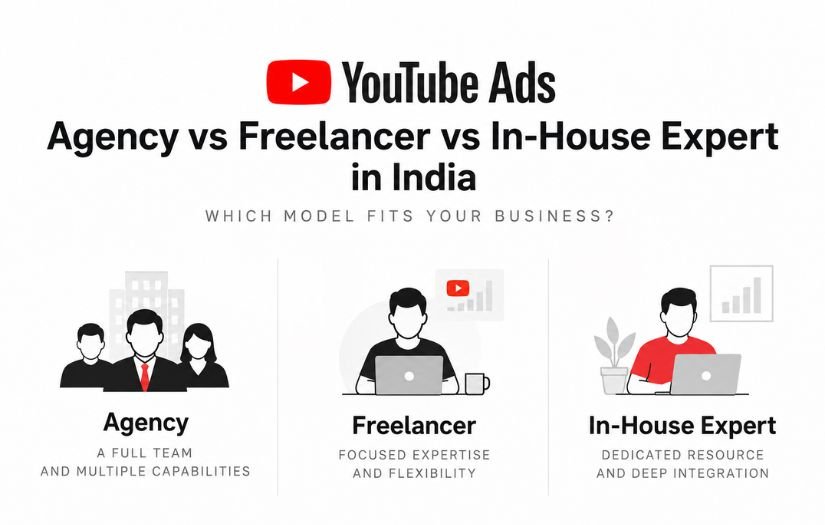
A YouTube Ads agency can make sense when you need access to a wider team and multiple marketing capabilities. A freelancer or specialist can work well when you want focused expertise without building a full internal team. An in-house expert can be valuable when paid acquisition is a permanent, high-volume function that needs close integration with the business.
I would make the decision based on factors such as ad spend, campaign complexity, internal resources, creative requirements, speed of execution, reporting needs and how important paid acquisition is to the company.
I’m Deepak Singh, Performance Marketing Expert based in New Delhi. Over the years, I have worked across agency-style execution, internal performance marketing teams, campaign strategy, training and direct acquisition systems.
My experience includes managing YouTube Ads, Google Ads and Meta Ads across education, ecommerce, coaching, real estate, digital products and lead-generation businesses.
In one education and coaching acquisition system, approximately ₹50.4 lakh in advertising spend generated more than 66,300 leads at an average CPL of approximately ₹76, along with more than 718,000 clicks.
That experience has also shown me that hiring the right person or team is only one part of the equation. The operating model around testing, creative, landing pages, analytics and decision-making matters just as much.
If you are evaluating individual specialists specifically, you can also read my guide on what to look for when choosing a YouTube Ads expert in India.
In this guide, I’ll compare the agency, freelancer and in-house models across expertise, cost structure, control, speed, scalability and accountability so you can decide which structure fits your business.
Written by Deepak Singh
Performance Marketing Expert
How I Compare a YouTube Ads Agency, Freelancer and In-House Expert
I look at these three models through a practical lens: who is responsible for strategy, who executes the work, how quickly changes happen, how much context they have and how easy it is to scale the system.
YouTube Ads Agency
An agency usually gives you access to a broader team rather than one individual.
That can include media buying, creative support, landing pages, analytics, tracking and account management depending on the agency structure.
The main advantage is breadth. You may be able to solve several marketing problems through one external partner.
The trade-off is that the person speaking with you may not always be the same person making daily campaign decisions.
YouTube Ads Freelancer or Specialist
A freelancer or independent specialist usually gives you more direct access to the person actually working on the account.
This can make communication faster and create clearer accountability around campaign decisions.
The model can work especially well when you already have internal support for design, landing pages, sales follow-up or analytics and mainly need paid acquisition expertise.
The limitation is bandwidth. One person cannot always provide the same depth across media buying, creative production, CRO, tracking and reporting at the same time.
In-House YouTube Ads Expert
An in-house expert works inside the business and usually has much deeper access to internal data, sales feedback, product changes and day-to-day business decisions.
This can make campaign optimization faster when the company has enough advertising activity to justify a dedicated resource.
The trade-off is that hiring one person does not automatically create a complete performance marketing function.
The business may still need creative resources, developers, landing-page support, analytics and strategic oversight around the media buyer.
The Real Difference Is the Operating Model
I do not think the decision should be based only on whether someone is an agency, freelancer or employee.
I would look at who owns strategy, who handles execution, how quickly data moves between marketing and sales, how creative testing happens and whether the model can support the current level of ad spend.
The right structure is the one that gives the business enough expertise, speed and accountability without creating unnecessary cost or management complexity.
When a YouTube Ads Agency Makes More Sense
An agency can make sense when the business needs more than one specialist and does not want to build that team internally.
You Need Multiple Capabilities at the Same Time
If the campaign depends on media buying, creative production, landing pages, analytics and tracking, an agency can be useful because several functions may already exist under one roof.
This can reduce the amount of coordination required from the internal team.
You Want an External Team That Can Scale With Spend
As budgets increase, the amount of testing, reporting and creative iteration can increase as well.
A strong agency may be able to add resources more easily than a single freelancer if the account becomes more complex.
You Do Not Have an Internal Performance Marketing Team
If the business has no dedicated paid acquisition team, an agency can provide both execution and strategic support.
This can be especially useful when the company wants to move faster without hiring several full-time people immediately.
You Need Cross-Channel Support
If YouTube Ads are only one part of a wider acquisition system involving Google Search, Performance Max, Meta Ads, landing pages and remarketing, an agency can sometimes provide better coordination across channels.
You Need Process and Continuity
An agency can offer more continuity than relying entirely on one individual, especially if responsibilities are documented and multiple team members understand the account.
Where the Agency Model Can Become Weak
The biggest risk is distance from the actual decision-maker.
If the person managing the relationship is not the person making campaign decisions, information can get diluted or delayed.
I would also look carefully at who actually works on the account, how often strategy is reviewed and whether the team understands lead quality and downstream business outcomes rather than only reporting platform metrics.
For YouTube Ads specifically, I would still want the agency to understand how targeting, campaign structure, remarketing and measurement connect. You can see the framework I use in my guide to YouTube Ads campaign structure.
When a YouTube Ads Freelancer or Specialist Makes More Sense
A freelancer or independent specialist can be a strong fit when the business wants direct access to the person actually making campaign decisions.
You Want Direct Communication
With an independent specialist, there is usually less distance between the business owner, marketing team and the person managing the ads.
This can make feedback loops faster when lead quality, offer changes or campaign performance needs immediate attention.
You Already Have Some Internal Support
The freelancer model works especially well when the business already has designers, developers, landing-page support or a sales team in place.
In that situation, the specialist can focus more deeply on acquisition strategy, campaign execution, testing and optimization.
You Need Specialist Expertise Without Building a Full Team
A business may not need an entire agency if the main requirement is strong YouTube Ads or performance marketing expertise.
An independent specialist can provide that focused capability without the cost and management responsibility of building a full in-house department.
You Want Faster Decision-Making
If one person owns both strategy and execution, campaign changes can often happen without multiple approval layers.
This can be useful when creative, targeting or budget decisions need to be made quickly.
You Want Clearer Accountability
It is easier to understand who is responsible when the same person is reviewing the data, making decisions and explaining the outcome.
This can make performance discussions more direct.
Where the Freelancer Model Can Become Weak
The biggest limitation is capacity.
One specialist may be excellent at paid acquisition but still depend on the business for creative production, landing pages, development, analytics or sales feedback.
The model can also become difficult if one person is expected to manage several channels, produce creatives, build pages, fix tracking and report daily at the same time.
I would therefore judge a freelancer not only by ad-platform knowledge, but also by whether they understand the complete acquisition system around the campaign.
If you are evaluating an individual specialist, my guide on how to choose the right YouTube Ads expert in India covers the checks I would make before hiring.
When an In-House YouTube Ads Expert Makes More Sense
An in-house expert can make sense when paid acquisition is important enough to the business that it needs a dedicated person working closely with the internal team every day.
You Have Consistent Advertising Volume
If YouTube Ads, Google Ads and other paid channels are running continuously at meaningful scale, a full-time specialist can become easier to justify.
The more campaigns, creatives, landing pages and reporting loops the business manages, the more valuable daily internal ownership can become.
You Need Deep Business Context
An in-house expert usually gets much closer to sales conversations, product changes, pricing decisions, customer feedback and internal priorities.
That context can improve campaign decisions because the marketer is not relying only on information passed through reports or meetings.
You Want Faster Feedback From Sales
For lead-generation businesses, one of the most useful advantages of an internal setup is the ability to connect media performance with real lead quality quickly.
If the sales team says one audience is producing stronger prospects than another, that feedback can be incorporated into campaign decisions much faster.
You Need Tight Coordination With Creative and Landing Pages
If the business has internal designers, developers or content teams, an in-house expert can work with them directly on new creatives, landing pages and funnel changes.
This can reduce delays between identifying a problem and actually shipping the fix.
You Want Paid Acquisition to Become an Internal Capability
Some businesses do not want long-term dependency on an external partner.
Hiring internally can help build campaign knowledge, reporting processes and testing systems inside the company over time.
Where the In-House Model Can Become Weak
Hiring one person does not automatically solve every performance marketing problem.
A media buyer may still need support from creative, CRO, development, analytics and sales operations.
There is also a risk of the internal team becoming too familiar with the existing approach and testing fewer outside ideas if there is no external perspective.
The Role Needs Enough Work to Justify It
If the account is small, campaign activity is limited or paid acquisition is not a major growth channel, a dedicated full-time specialist may create more fixed cost than the business actually needs.
I would usually consider the in-house model when the volume, complexity and strategic importance of paid acquisition are high enough to justify permanent ownership.
How I Would Choose Based on Business Stage
I would not choose between an agency, freelancer and in-house expert based only on price.
I would look at how mature the acquisition system already is and what the business actually needs next.
If You Are Just Starting With YouTube Ads
If the account is still early and the business is testing whether YouTube Ads can become a reliable acquisition channel, a specialist or freelancer can often provide focused expertise without creating a large fixed cost.
The priority at this stage is usually proving the funnel, understanding audience response and identifying whether the offer can acquire customers at sustainable economics.
If You Need Several Marketing Functions at Once
If the business also needs creative production, landing pages, tracking, analytics and support across multiple paid channels, an agency model may become more practical.
The value comes from having several capabilities available without hiring each role separately.
If Paid Acquisition Is Already a Core Growth Channel
When the business is spending consistently, running multiple campaigns and generating enough data every day, an in-house expert can become more valuable.
The closer integration with sales, creative and management can improve the speed of decision-making.
If You Have a Strong Internal Team but Need Paid Media Expertise
If designers, developers, sales and analytics support already exist internally, an external specialist can fit into that structure very efficiently.
The specialist can focus on campaign strategy and performance while the internal team handles the surrounding execution.
If Your Account Is Becoming Operationally Complex
If the business has multiple offers, markets, campaigns, creative pipelines and reporting requirements, I would look carefully at whether one person has enough capacity to manage everything properly.
At that stage, either an agency or a stronger in-house team may provide more operational coverage.
If Speed and Business Context Matter Most
An in-house setup usually has the strongest access to internal context, while an independent specialist can often provide very fast direct communication.
An agency can also move quickly, but that depends heavily on how the account team is structured and how many approval layers exist.
My Decision Framework
I would evaluate the options across expertise required, ad spend, internal support, campaign complexity, creative needs, speed of execution, accountability and long-term cost.
The right model is the one that matches the operating needs of the business rather than the one that simply sounds more established.
Cost, Control and Accountability: How the Three Models Differ
The agency, freelancer and in-house models can all work, but they create different trade-offs around cost, control and accountability.
Agency: Higher Breadth, Less Direct Control
An agency may cost more than working with one independent specialist, but the fee can include access to several capabilities at once.
The trade-off is that the business may have less direct visibility into who is making daily campaign decisions.
I would therefore look carefully at communication structure, account ownership and how often strategy is reviewed.
Freelancer: Lower Overhead, Higher Dependency on One Person
A freelancer or specialist can often provide focused expertise with lower overhead than a full agency or internal hire.
The business may also get more direct communication and clearer ownership.
The trade-off is concentration risk. If everything depends on one person, capacity and availability become important considerations.
In-House: Highest Control, Higher Fixed Cost
An in-house expert gives the business the strongest day-to-day control and deepest access to internal context.
The trade-off is that salary is only one part of the cost.
The business may still need creative, development, analytics and management support around that person.
Accountability Depends on Measurement, Not Job Title
I would not assume that an agency is automatically more accountable than a freelancer or that an employee is automatically more committed than an external partner.
Accountability comes from clear ownership, reliable tracking, transparent reporting and agreement on the business metrics that matter.
The Cheapest Model Is Not Always the Lowest-Cost Model
A lower management fee can become expensive if execution is slow, tracking is weak or the campaign produces poor-quality leads.
Likewise, a more expensive setup can still make sense if it improves customer acquisition economics enough to justify the additional cost.
That is why I would evaluate each model against CPL, lead quality, sales conversion and CAC rather than comparing management fees alone.
If you want to understand how I read those numbers, see my guide to YouTube Ads metrics that actually matter.
When a Hybrid Model Makes More Sense
In many businesses, the best setup is not purely agency, freelancer or in-house.
A hybrid model can work well when the business wants internal ownership but still needs external specialist support.
In-House Owner + External YouTube Ads Specialist
This can work well when someone inside the business owns marketing strategy, sales feedback and internal coordination while an external specialist focuses on YouTube Ads execution and optimization.
The internal person provides business context, while the specialist brings platform expertise and an outside perspective.
In-House Performance Marketer + Agency Support
A company may have an internal performance marketer but use an agency for creative production, landing pages, analytics or additional channel execution.
This can give the business more control without requiring every capability to be hired internally.
Agency + Internal Creative Team
If the business already has strong designers, video editors or content creators, the agency can focus more heavily on media strategy, campaign management and measurement.
This can improve creative speed because the company does not have to depend entirely on an external production pipeline.
Freelancer + Internal Sales and Analytics Feedback
For lead-generation campaigns, an independent specialist becomes much more effective when the business can quickly share data on lead quality, qualification and sales outcomes.
This prevents optimization from being based only on CPL and platform-reported conversions.
Hybrid Models Need Clear Ownership
The biggest risk with a hybrid setup is confusion over who owns each part of the funnel.
I would define responsibility clearly across campaign strategy, creative, landing pages, tracking, reporting, lead quality feedback and final budget decisions.
Do Not Add More People Without a Clear Reason
A hybrid model should solve a capability or capacity gap.
If adding another agency, consultant or internal role only creates more meetings and slower decisions, the structure has become more complicated without becoming more effective.
The goal should still be the same: the simplest operating model that gives the business enough expertise, speed, context and accountability to grow.
Common Hiring Mistakes I Would Avoid
The wrong hiring decision usually happens when the business focuses only on price, platform certifications or surface-level reporting.
1. Hiring Without Defining the Actual Problem
Before hiring anyone, I would clarify whether the business needs strategy, campaign execution, creative testing, landing-page support, tracking, reporting or all of these together.
If the requirement is unclear, even a strong marketer can be placed into the wrong operating model.
2. Choosing Only on the Lowest Fee
A lower fee can look attractive, but it does not matter much if the person or team cannot improve acquisition economics.
I would compare cost against the value of better campaign decisions, faster execution and stronger lead quality.
3. Assuming an Agency Automatically Means More Expertise
Some agencies have excellent specialists. Others rely heavily on junior account managers.
I would always ask who will actually work on the account and how experienced that person is with YouTube Ads and performance marketing.
4. Expecting One Freelancer to Do Everything
A strong media buyer should not automatically be expected to also produce videos, design landing pages, fix development issues, manage analytics and close sales.
I would define the specialist’s role clearly and make sure the surrounding support exists.
5. Hiring In-House Before the Workload Justifies It
A full-time hire creates fixed cost and management responsibility.
If the account does not have enough activity, the business may be better served by external expertise until paid acquisition becomes a larger function.
6. Ignoring Lead Quality and Sales Feedback
I would not evaluate a YouTube Ads manager only by impressions, views, clicks or even CPL.
The person or team should understand whether the leads are relevant and whether the campaigns are contributing to profitable customer acquisition.
7. Accepting Reporting Without Clear Decisions
A report should not just explain what happened.
I want it to support decisions around what to scale, what to stop, what to test and where the funnel needs improvement.
8. Giving Access Without Clear Ownership
The business should retain ownership of its Google Ads account, analytics properties, landing pages and core marketing assets wherever practical.
The operating model should not create unnecessary dependency on one external provider.
9. Hiring Based on Titles Instead of Evidence
I care less about whether someone calls themselves a consultant, agency, freelancer or performance marketer.
I would look for evidence of how they think about targeting, creative, conversion tracking, lead quality, campaign structure and business economics.
If you are comparing specialists, my guide on what businesses should look for in a YouTube Ads expert covers this evaluation in more detail.
Frequently Asked Questions About YouTube Ads Agency vs Freelancer vs In-House
Is a YouTube Ads Agency Better Than a Freelancer?
Not automatically.
An agency can provide broader capabilities and more team capacity, while a freelancer can offer more direct communication and focused specialist expertise.
The better fit depends on the size of the account, internal support, campaign complexity and how much external help the business actually needs.
When Should I Hire an In-House YouTube Ads Expert?
I would consider an in-house expert when paid acquisition is already an important growth channel, campaign activity is consistent and the business can benefit from daily integration with sales, creative and management teams.
Is a Freelancer Cheaper Than an Agency?
A freelancer often has lower overhead than an agency, but price should not be the only comparison.
I would also consider expertise, bandwidth, creative support, tracking capability, reporting and the quality of campaign decisions.
Can One In-House Expert Manage YouTube Ads, Google Ads and Meta Ads?
It can be possible depending on campaign volume and complexity.
But if the person is also expected to handle creative production, landing pages, analytics and reporting, the workload can quickly become unrealistic.
Should a Small Business Hire a YouTube Ads Agency?
It depends on what the business needs.
If the requirement is mainly campaign strategy and management, an independent specialist may be enough. If the business also needs creative, landing pages, analytics and multiple paid channels, an agency may provide more complete support.
What Should I Ask Before Hiring a YouTube Ads Specialist?
I would ask about campaign experience, how they approach targeting, how they test creatives, how they measure lead quality, how they handle conversion tracking and how they decide what to scale or stop.
Who Should Own the Google Ads Account?
I generally prefer the business to retain ownership of its advertising account, analytics properties and core marketing assets.
External partners can be given the access they need without the business giving up ownership of the underlying assets.
Can I Use Both an In-House Marketer and an External Specialist?
Yes.
A hybrid model can work well when the internal marketer owns business context and coordination while the external specialist adds platform expertise, strategic input or additional capacity.
Which Model Is Best for Scaling YouTube Ads?
I would not choose based on the label alone.
The model needs enough expertise, creative capacity, measurement quality and decision-making speed to support the level of spend the business wants to manage.
What Matters More Than the Hiring Model?
The operating system around the person or team matters more than the title.
I would focus on strategy, execution speed, creative testing, tracking, lead quality feedback, accountability and customer acquisition economics.
Sources & Methodology
This article combines my own experience across performance marketing, team management, campaign execution and training with practical considerations businesses should evaluate when choosing between an agency, freelancer and in-house expert.
Where I refer to my YouTube Ads results, the figures come from an education and coaching acquisition system that generated more than 66,300 leads at an average CPL of approximately ₹76, along with more than 718,000 clicks from approximately ₹50.4 lakh in advertising spend.
These figures represent a specific campaign and business context. They should not be treated as universal benchmarks or guaranteed outcomes for other advertisers.
The comparison in this article is based on how I evaluate operating models across expertise, cost structure, control, communication, speed, accountability, creative capacity, measurement and scalability.
I do not treat agency, freelancer or in-house as inherently better models. Each can work well or poorly depending on the people involved, the systems around them and the needs of the business.
The goal of this framework is to help businesses choose a structure that fits their current level of ad spend, internal capabilities, campaign complexity and long-term acquisition requirements.
Need Help Deciding the Right YouTube Ads Setup for Your Business?
If you are deciding between an agency, freelancer or in-house expert, I would start with the structure of your business rather than the label of the service provider.
Look at your ad spend, internal team, campaign complexity, creative requirements, reporting needs, speed of execution and how important paid acquisition is to growth.
You can also review my guide on how to choose a YouTube Ads expert in India, my YouTube Ads campaign structure, or the YouTube Ads metrics I use to evaluate performance.
If you want direct help with YouTube Ads strategy, campaign management or performance marketing, you can work with me.