Hiring a performance marketing expert in India is not difficult because there are too few options. It is difficult because almost everyone appears qualified on the surface.
Profiles mention Meta Ads, Google Ads, PPC, ROAS, lead generation, ecommerce, conversion tracking and scaling. Case studies show impressive dashboards. Proposals promise optimization and growth.
The harder question is whether the person can make good acquisition decisions when the numbers become messy.
If I were hiring a performance marketer for my own business, I would evaluate much more than platform knowledge.
I would want to know whether they understand the business model, measurement, creative, conversion rate optimization, customer acquisition cost and what happens after the advertising conversion.
These are the 10 things I would check before hiring a performance marketing expert in India.
1. Do they understand your business model before recommending channels?
A performance marketer should not begin with “You need Meta Ads” or “You should run Performance Max.”
The first discussion should be about the business.
Different businesses can use the same advertising platform but require completely different acquisition strategies.
For ecommerce, I would want them to understand
- average order value,
- gross or contribution margin where available,
- new versus returning customers,
- refunds and cancellations,
- COD behaviour where relevant,
- repeat purchase,
- product-level economics,
- inventory and fulfilment constraints.
For lead generation, I would want them to understand
- what qualifies as a lead,
- what qualifies as a good lead,
- contact rate,
- qualification rate,
- sales process,
- lead-to-customer conversion,
- average customer value,
- acceptable customer acquisition cost.
A ₹300 lead means very little if only 2% become customers.
A ₹700 lead may be commercially stronger if the people entering the funnel are significantly more qualified.
What I would ask
“Before looking at our ad accounts, what business numbers would you want to understand?”
The answer should extend beyond CTR, CPC, CPL and ROAS.
A performance marketing expert should understand what the advertising is ultimately expected to produce for the business.
2. Can they connect Meta Ads, Google Ads and other channels instead of treating them as separate worlds?
A performance marketer does not necessarily need to personally operate every advertising platform.
But if they claim to own performance strategy, they should understand how different paid channels play different roles in acquisition.
Meta Ads can create and capture demand differently from Google Search
A user scrolling Instagram may not be actively searching for your product at that moment.
Creative, offer and audience signals therefore play a major role in creating interest and moving someone toward action.
Google Search often begins with an explicit query.
The user may already be expressing a problem, product requirement, brand preference or buying intent.
YouTube can play another role by combining audience selection, video creative, education and demand generation.
The channels influence each other
Someone can discover a brand through Meta, later search for it on Google and eventually convert through another touchpoint.
That is why attribution is not simply a competition between dashboards.
Google Analytics describes attribution as assigning credit across the ads, clicks and other factors in a user’s path to a meaningful action.
The practical implication is that a performance marketer should understand the customer journey before declaring that one platform deserves all the credit.
What I would ask
“If Meta shows weak ROAS but branded Google searches and total revenue are increasing, how would you investigate whether Meta is contributing?”
I would not expect an instant answer.
I would expect them to discuss attribution, customer journeys, platform data, blended performance and the limitations of available measurement.
3. Do they understand conversion tracking, analytics and attribution well enough to trust the numbers?
Paid advertising becomes dangerous when the operator confidently optimizes unreliable data.
A performance marketer does not need to personally code every tracking implementation, but they should understand what is being measured and whether it represents the business outcome accurately enough.
Important measurement concepts include
- conversion actions,
- primary versus secondary conversions,
- Meta Pixel,
- Conversions API,
- Google Ads conversion tracking,
- GA4,
- Google Tag Manager,
- UTM parameters,
- CRM outcomes,
- offline conversion data where relevant,
- attribution windows and models.
Google Ads itself requires businesses to define the valuable actions they want to measure, such as purchases, sign-ups or phone calls.
That sounds obvious, but the conversion selected for optimization can materially affect what the advertising system learns to find.
Tracking is not just an implementation task
Imagine a lead-generation business optimizing toward every completed form.
If half of those forms represent irrelevant enquiries, technically accurate form tracking still does not give the advertising team the complete business signal.
The next measurement question becomes whether qualified leads, opportunities or customer outcomes can be fed back into decision-making.
What I would ask
“Meta, Google Ads, GA4 and our CRM show different conversion numbers. Which one would you trust?”
A strong answer should not automatically pick one dashboard.
The expert should first ask what each system measures, how attribution differs and which number is appropriate for the decision being made.
4. Can they show proof and explain the context behind the proof?
Case studies matter.
But a screenshot alone is not proof of repeatable performance marketing ability.
Any number needs context.
Suppose someone shows you 8X ROAS
I would want to know whether that is:
- one campaign or the whole account,
- prospecting or retargeting,
- new customers or blended customers,
- a short promotional period or sustained performance,
- attributed revenue or actual business revenue,
- before or after returns and cancellations where relevant.
The number may still be excellent.
The purpose of these questions is not to discredit the result. It is to understand what the result actually proves.
Lead-generation proof needs the same discipline
A ₹50 CPL sounds impressive until you ask what percentage of those leads were qualified.
Likewise, an expensive CPL can still support a strong business if qualification and sales conversion are high enough.
Examples from my own work
Across my broader performance marketing work, I have been involved in acquisition responsible for more than 10 lakh leads and more than 2 lakh paid customers.
Those are aggregate figures across acquisition activity. They should not be interpreted as one matched cohort or one lead-to-customer conversion rate.
For YouTube Ads in coaching and education, I have documented more than 66,300 leads at approximately ₹76 CPL from around ₹50.4 lakh in spend.
In Google Ads for an Ayurveda business, documented performance included approximately 5,030 leads at ₹87.65 CPL.
For ecommerce, documented Meta work includes ₹1.43Cr+ in COD revenue for a D2C hair-oil business and ₹1.05Cr+ revenue with 493% growth in women’s fashion.
Each result demonstrates a different type of experience.
None should be converted into a guarantee for another business.
What I would ask
“Show me one case study and explain what the headline number does not tell me.”
The quality of that answer can tell you more than another screenshot.
5. Can they diagnose where the acquisition system is actually breaking?
This is one of the most important capabilities I would evaluate.
Performance marketing is not simply adjusting campaigns until metrics improve.
It is identifying which part of the acquisition system is constraining growth.
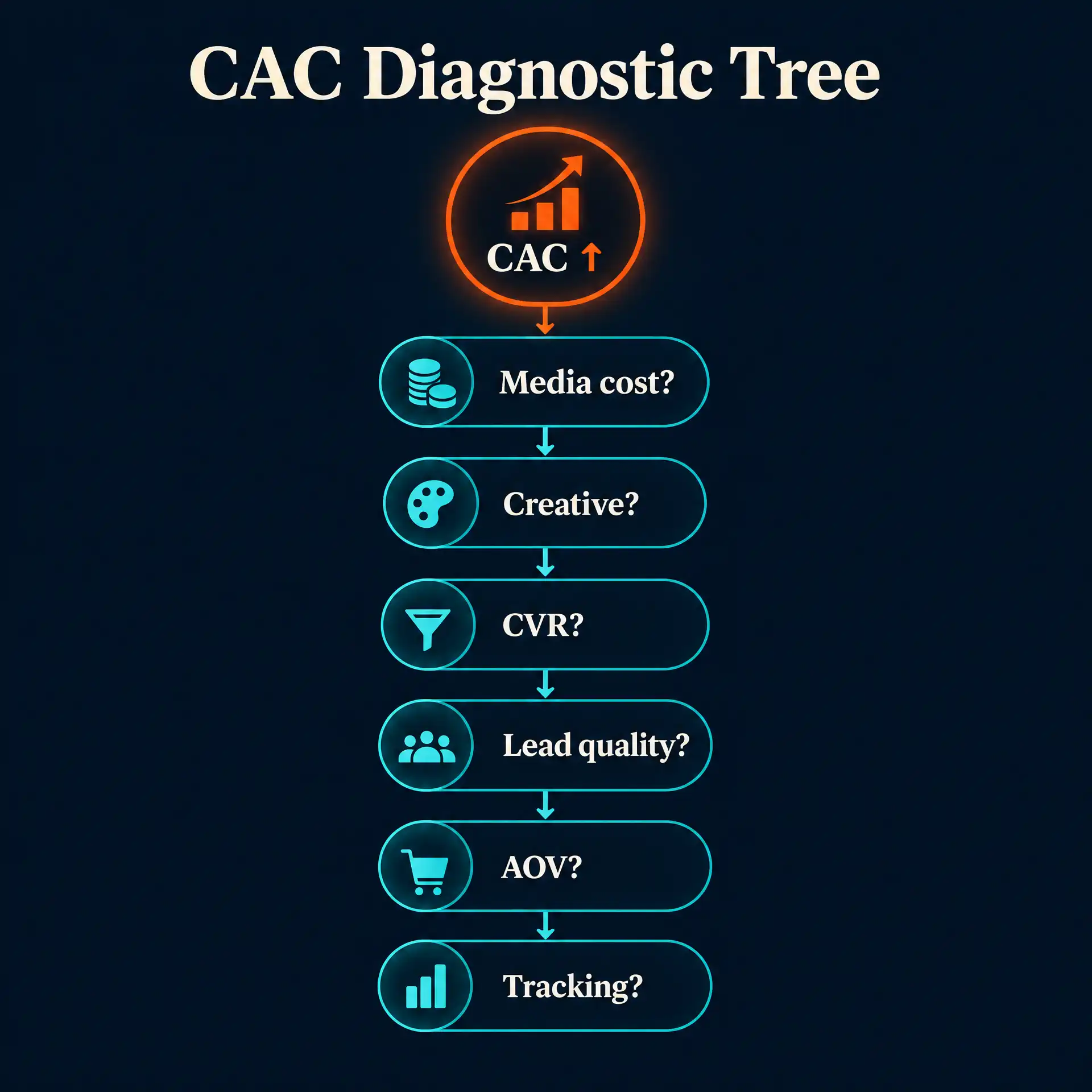
Suppose customer acquisition cost increases
That one symptom can come from many places.
Media costs may have increased.
Higher CPM or CPC can make each opportunity more expensive even if the rest of the funnel is stable.
Creative response may have weakened.
The same audience may simply be responding less strongly to the current message.
Landing-page conversion may have fallen.
Traffic can remain healthy while fewer visitors complete the desired action.
Lead quality may have changed.
Raw CPL may look stable while qualified lead cost increases.
Average order value may have changed.
Ecommerce ROAS can fall even when purchase volume remains relatively healthy.
Tracking may have changed.
A measurement issue can create apparent performance movement without the same magnitude of underlying business change.
The expert needs to separate these explanations
If the diagnosis is wrong, the optimization can make performance worse.
For example, rebuilding audiences will not fix a checkout problem.
Changing bids will not repair broken conversion tracking.
Launching ten more ads will not automatically solve weak lead follow-up.
What I would ask
“Our CAC increased 30% last month. Walk me through what you would check before recommending a change.”
I would listen for a diagnostic sequence rather than a list of favourite platform tactics.
My performance marketing audit framework goes deeper into how I approach this type of diagnosis.
6. Do they understand creative and CRO, or only media buying?
A performance marketer does not need to personally design every ad or build every landing page.
But they should understand how both affect acquisition efficiency.
Creative changes who enters the funnel
An ad is not merely a traffic generator.
Its message influences what the user expects, which problem they believe is being solved and why they should respond.
That means creative can affect:
- CTR,
- CPC,
- lead quality,
- purchase intent,
- conversion rate,
- customer acquisition cost.
The landing page determines what happens after the click
Suppose two performance marketers buy identical traffic.
One sends it to a page converting at 2%.
The other improves the offer, message match, proof and usability enough to reach 3% conversion.
The second marketer can generate 50% more conversions from the same number of visits without changing the media cost.
Simple example
Assume 10,000 paid visitors cost ₹10 lakh.
At a 2% conversion rate, that produces 200 conversions.
Cost per conversion is ₹5,000.
At a 3% conversion rate, the same traffic produces 300 conversions.
Cost per conversion falls to approximately ₹3,333.
No audience hack was required.
The acquisition system simply converted existing traffic more efficiently.
Why I consider CRO part of performance marketing
If you pay for traffic, what happens after the click directly affects the economics of that traffic.
That is why my performance marketing funnel connects ads, landing pages, conversion, qualification, remarketing and business outcomes.
What I would ask
“If our traffic quality looks stable but CPA rises because conversion rate falls, what would you do?”
An expert should be willing to investigate the page, offer and conversion journey rather than forcing every solution back into Ads Manager.
7. Can they interpret ROAS, CAC, CPL and other metrics in business context?
A good performance marketer should know the formulas.
A strong performance marketer should know when the formula can mislead the decision.
ROAS
ROAS = Attributed Revenue ÷ Advertising Spend
ROAS helps explain the relationship between reported revenue and paid media cost.
It does not automatically tell you profitability.
Two businesses with the same ROAS can have very different margins, fulfilment costs, customer mixes and repeat-purchase economics.
CPL
CPL = Advertising Spend ÷ Leads
Useful for lead generation, but incomplete when lead quality varies significantly.
Qualified lead cost
Qualified Lead Cost = Advertising Spend ÷ Qualified Leads
This begins connecting marketing activity to business-quality demand.
CAC
Customer acquisition cost can be defined differently depending on whether the business is analysing media-only acquisition or a fuller set of sales and marketing costs.
The definition needs to be explicit before teams compare numbers.
MER or blended efficiency
For ecommerce, blended revenue-to-marketing-spend views can provide useful context alongside platform attribution.
Again, the purpose is not to find one perfect metric.
The purpose is to know what each metric can and cannot answer.
What I would ask
“When would you accept a lower platform ROAS?”
A strong answer may include incremental scale, new-customer acquisition, margin, contribution, repeat purchase or another business-specific consideration.
If the answer is simply “never,” I would want to understand the logic.
I explain this distinction further in my ROAS vs CAC guide.
8. Can they decide where the next rupee should go?
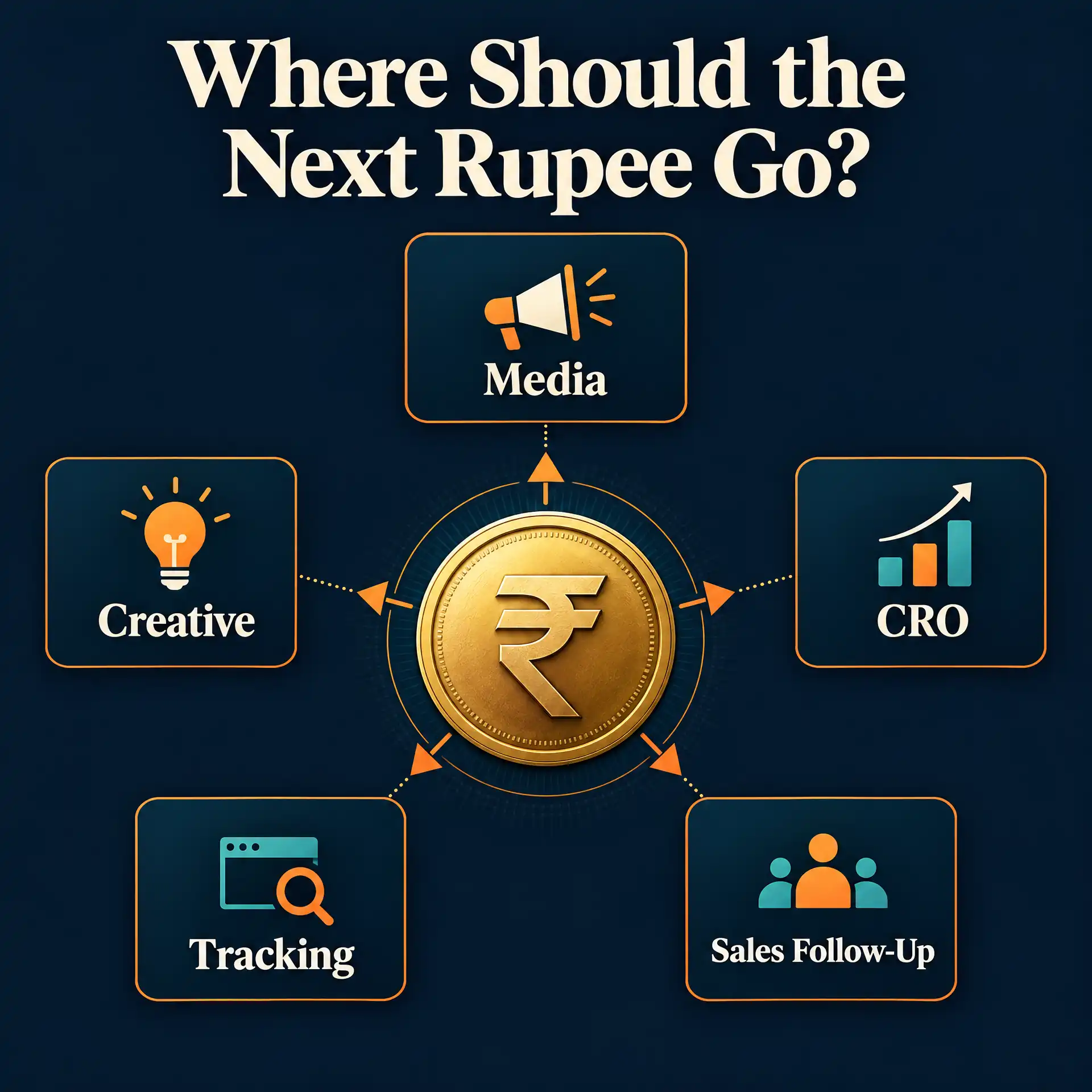
Performance marketing eventually becomes a budget-allocation problem.
You may have multiple Meta campaigns, Google Search campaigns, Performance Max, Shopping, YouTube, remarketing, landing-page work and creative production competing for the same marginal budget.
A strong performance marketer should help decide where additional investment has the highest expected value.
The highest current ROAS does not automatically deserve the next rupee
Suppose retargeting reports 8X ROAS and prospecting reports 3X.
Putting every additional rupee into retargeting may look obvious.
But retargeting is limited by the size of the warm audience.
Prospecting may be responsible for creating the new demand that later enters retargeting.
Similarly, branded Search can be extremely efficient while capturing demand created elsewhere.
That does not make branded Search unimportant.
It means allocation requires understanding the role of each campaign.
Sometimes the next rupee should not go into media at all
The highest-return investment may be:
- new creative,
- a better landing page,
- tracking repair,
- feed optimization,
- CRM integration,
- faster lead follow-up,
- checkout improvement.
This is one of the reasons I define performance marketing more broadly than media buying.
What I would ask
“If I gave you another ₹5 lakh next month, how would you decide where to deploy it?”
I would not expect a recommendation before seeing the account.
I would expect a clear explanation of the evidence required to make that decision.
9. Is it clear who will actually work on your account and what they will own?
This matters whether you hire an individual expert, freelancer, consultant or agency.
The person giving the pitch may not be the person making daily decisions.
Clarify ownership before engagement
Ask who owns:
- strategy,
- campaign execution,
- creative briefs,
- actual creative production,
- tracking,
- landing-page recommendations,
- reporting,
- analytics,
- CRM feedback,
- weekly or monthly reviews.
No provider needs to own everything.
The important thing is that the boundaries are explicit.
You should also understand account ownership
Your business should know who controls its ad accounts, analytics properties, pixels, datasets, domains, Merchant Center and other important marketing assets.
The operator generally needs appropriate access, not unnecessary ownership of the business infrastructure.
Ask what is not included
This is often more informative than asking what is included.
If someone provides performance marketing management but creative production is separate, you need to know who will produce the volume and quality of assets the campaigns require.
If they identify landing-page problems but do not implement CRO changes, somebody else needs to own execution.
Expert, freelancer, consultant or agency?
The right structure depends on the problem.
An individual expert may offer direct access and senior judgment.
A freelancer can be strong when you need hands-on execution without a larger team structure.
A consultant can work well when the biggest need is diagnosis, strategy, auditing or senior decision support.
An agency can make sense when the business needs broader execution capacity across multiple functions.
My agency vs freelancer vs in-house comparison goes deeper into these operating models.
10. Can they tell you when NOT to scale?
Almost every performance marketer talks about scaling.
I would pay close attention to the conditions under which they would refuse to increase spend.
More budget is not always the next move
I would hesitate to scale aggressively when:
- tracking is unreliable,
- lead quality is deteriorating,
- the landing page is clearly constraining conversion,
- creative supply cannot support additional delivery,
- customer acquisition cost is already near the economic ceiling,
- inventory or fulfilment cannot support growth,
- sales cannot process additional demand,
- the current performance is driven heavily by retargeting or existing customers and incremental acquisition is unclear.
Scaling can reduce average efficiency and still be correct
Imagine a campaign spends ₹5 lakh and generates ₹25 lakh in attributed revenue.
ROAS is 5X.
You increase spend to ₹10 lakh and attributed revenue rises to ₹40 lakh.
ROAS falls to 4X.
Was scaling a failure?
Not necessarily.
The additional ₹5 lakh created another ₹15 lakh in attributed revenue.
The decision now depends on contribution, customer mix, repeat value and the economics of the incremental revenue.
A performance marketer should be able to discuss this trade-off rather than treating ROAS as a score that must never decline.
What I would ask
“What would make you stop us from increasing the budget even if the campaigns currently look profitable?”
I would want them to think about the entire acquisition system, not only Ads Manager.
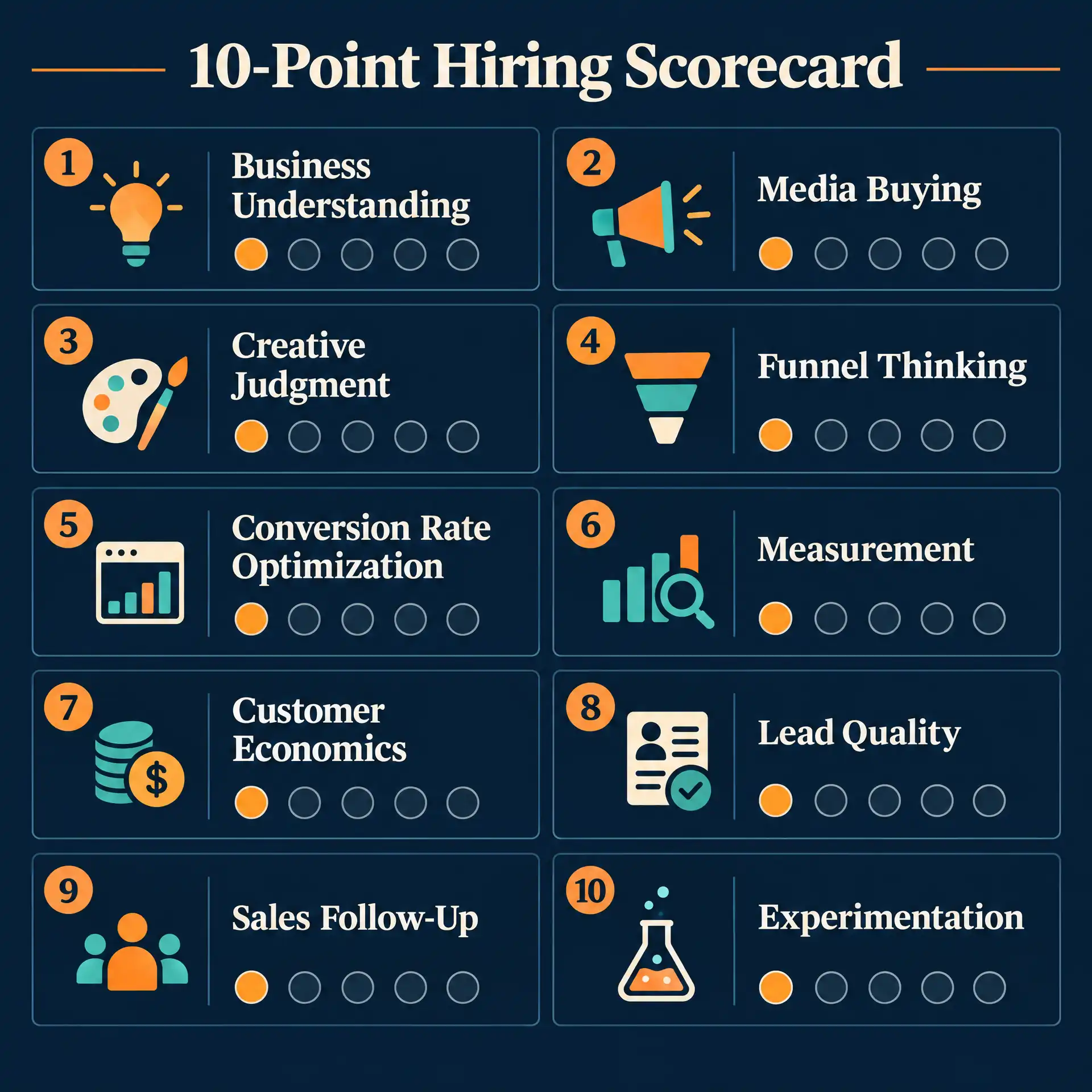
A 10-point scorecard for evaluating a performance marketing expert
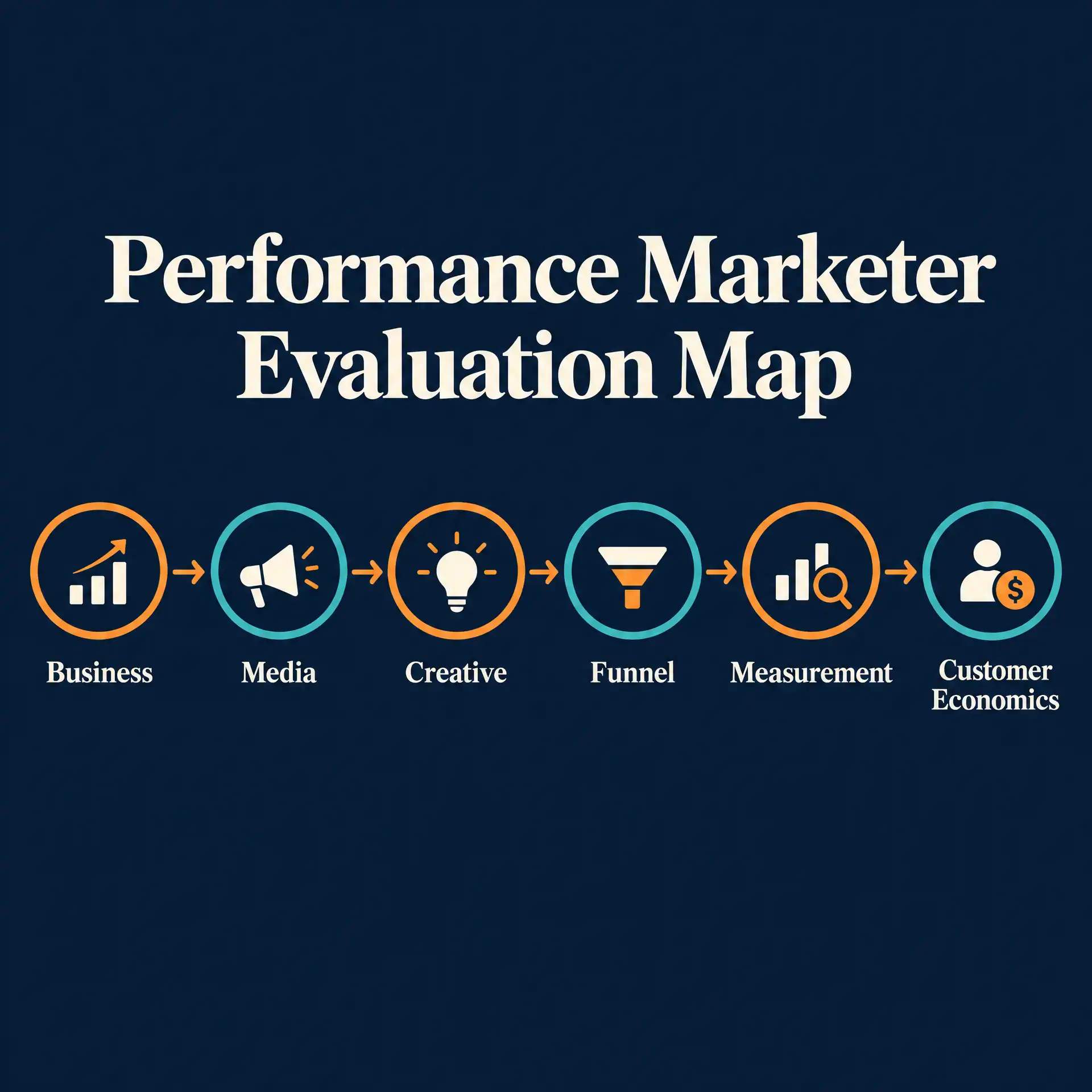
If I had to summarize the evaluation, I would score the person across these ten areas.
- Business understanding: Can they understand your unit economics and acquisition model?
- Channel judgment: Do they understand the role of Meta, Google, YouTube and other relevant channels?
- Measurement: Can they reason about conversion tracking, analytics and attribution?
- Proof: Can they explain case studies with proper context?
- Diagnosis: Can they identify where the acquisition system is actually breaking?
- Creative and CRO: Do they understand what happens before and after the click?
- Metric interpretation: Can they interpret ROAS, CAC, CPL, CVR and related metrics in business context?
- Budget allocation: Can they decide where incremental spend should go?
- Operating clarity: Is it clear who owns strategy, execution, tracking, creative and reporting?
- Scaling judgment: Do they know both when to scale and when not to?
You do not need every provider to be equally strong across all ten dimensions.
A specialist can deliberately have a narrower scope.
The important thing is matching their actual strengths to the problem your business needs solved.
Red flags before hiring a performance marketer
Some warning signs deserve further questioning before you hand over advertising budget.
They guarantee a specific ROAS before understanding the business
Targets and forecasts are useful.
A guarantee about an unseen acquisition system is different.
They talk about channels before understanding economics
“We will run Meta and Google” is an execution plan, not a growth strategy.
They only show platform screenshots
Ask what happened at the business level.
Every problem has the same solution
If every weak account needs new audiences, more creatives or a new Performance Max campaign, diagnosis may be too shallow.
They cannot explain tracking
The person does not need to implement every technical change personally.
But they should understand what needs to be measured and why.
They talk only about cheap CPL
Lead generation should eventually connect to qualification and customer acquisition.
They talk only about ROAS
Ecommerce decisions may also require context around CAC, new customers, AOV, contribution, fulfilment and repeat value.
They want unnecessary ownership of your advertising assets
Clarify account ownership and access before the relationship begins.
Questions I would ask before hiring a performance marketing expert in India
You do not need a 50-question interview.
These questions reveal a lot about how someone thinks:
- What business numbers do you need before recommending a strategy?
- How do you decide whether Meta, Google or another channel deserves the next rupee?
- If CAC suddenly increases, what do you investigate first?
- How do you distinguish an advertising problem from a landing-page or sales problem?
- How do you evaluate lead quality?
- What do you do when Meta, Google Ads and GA4 disagree?
- How do you decide which creatives to test next?
- What would make you accept a lower ROAS?
- What would make you refuse to scale an apparently profitable campaign?
- What parts of the acquisition system will you own, and what remains with our team?
I would focus less on whether their answers match one predetermined playbook and more on whether the reasoning is evidence-based.
Performance marketing expert vs consultant vs freelancer vs agency
These terms overlap, but the operating models can be very different.
Performance marketing expert
Useful when specialist expertise and senior acquisition judgment are the priority.
You can see my broader approach on my Performance Marketing Expert in India page.
Performance marketing consultant
Useful when you primarily need diagnosis, strategy, auditing, measurement design or ongoing senior decision support.
My performance marketing consulting approach covers that model separately.
Freelancer
Often useful for direct hands-on execution without the structure or overhead of a larger agency.
Agency
Potentially useful when the scope requires multiple specialists, high execution capacity or several marketing functions operating together.
In-house team
Can make sense when the business has enough ongoing complexity and spend to justify building acquisition capability internally.
None is automatically superior.
The right choice depends on the problem, budget, internal team, desired level of senior involvement and execution requirements.
Should category experience be mandatory?
Relevant category experience is useful, but I would not make it the only hiring criterion.
Someone who has already worked in your industry may understand customer objections, buying cycles and common funnel structures faster.
But category familiarity cannot compensate for weak measurement, poor diagnosis or shallow acquisition thinking.
I would evaluate transferability
Ask whether the expert has solved a similar acquisition problem, even if the exact product was different.
For example:
- high-consideration lead generation,
- subscription economics,
- COD ecommerce,
- high-AOV ecommerce,
- education enrolment,
- local lead generation,
- multi-product D2C,
- digital-product acquisition.
The underlying acquisition challenge can sometimes matter more than the industry label.
Should you hire based on certifications?
Certifications can demonstrate platform familiarity.
I would treat them as supporting evidence, not proof of performance marketing judgment.
An experienced operator needs to interpret imperfect data, diagnose unexpected changes, understand business economics and make decisions under uncertainty.
Those capabilities are difficult to verify through certification alone.
If choosing between a candidate with many certifications but weak case-study reasoning and another with strong documented decision-making, I would investigate the second candidate very seriously.
How I think about performance marketing expertise
I have spent almost 10 years working hands-on across performance marketing.
My work has included Meta Ads, Google Ads, YouTube Ads, lead generation, ecommerce acquisition, conversion optimization, tracking, analytics, attribution, CRM and marketing automation.
Across broader acquisition work, that experience includes more than ₹150Cr in attributed revenue, more than 10 lakh leads and more than 2 lakh paid customers.
Those numbers matter as evidence of operating scale.
But scale alone is not how I define expertise.
The more campaigns I have worked on, the more important diagnosis has become.
A weak campaign does not always need a new audience.
A low ROAS does not always mean the channel should be cut.
A cheap CPL does not always mean the campaign is working.
And the next rupee does not always belong in media.
Sometimes it belongs in creative.
Sometimes in the landing page.
Sometimes in tracking.
Sometimes in better sales feedback.
The role of performance marketing is to identify where that rupee has the highest probability of improving profitable acquisition.
Before you hire a performance marketing expert in India
Do not choose based only on who shows the highest ROAS screenshot.
Do not choose based only on who charges the lowest fee.
And do not choose based only on who knows the largest number of advertising platforms.
Evaluate how the person thinks.
Can they connect ads to customers?
Can they distinguish media problems from funnel problems?
Can they explain what the metrics mean in your business?
Can they identify what evidence would change their recommendation?
And can they tell you where the next rupee should go?
Those are the questions I would use to separate someone who can operate advertising platforms from someone who can genuinely help manage performance marketing.
If you are currently evaluating your paid acquisition strategy, you can review my performance marketing approach or see how I work as a performance marketing consultant in India.