Your Facebook Ads are generating leads. Ads Manager looks active. Cost per lead may even look reasonable.
But sales are not happening.
This is where many businesses conclude that Facebook Ads are bringing “bad leads.” Sometimes that is true. But I would not accept that diagnosis until I know exactly where the funnel is breaking.
A lead can fail to become a customer because the wrong person responded, the ad created the wrong expectation, the form failed to qualify them, nobody followed up properly, the CRM lost the lead, or the campaign is being judged on the wrong metric.
Those are very different problems. They need very different fixes.
If your Facebook or Meta Ads generate leads but not customers, these are the 10 areas I would investigate before rebuilding the campaign.
First: define what “not converting” actually means
Before changing targeting, creative or budget, separate the problem into stages.
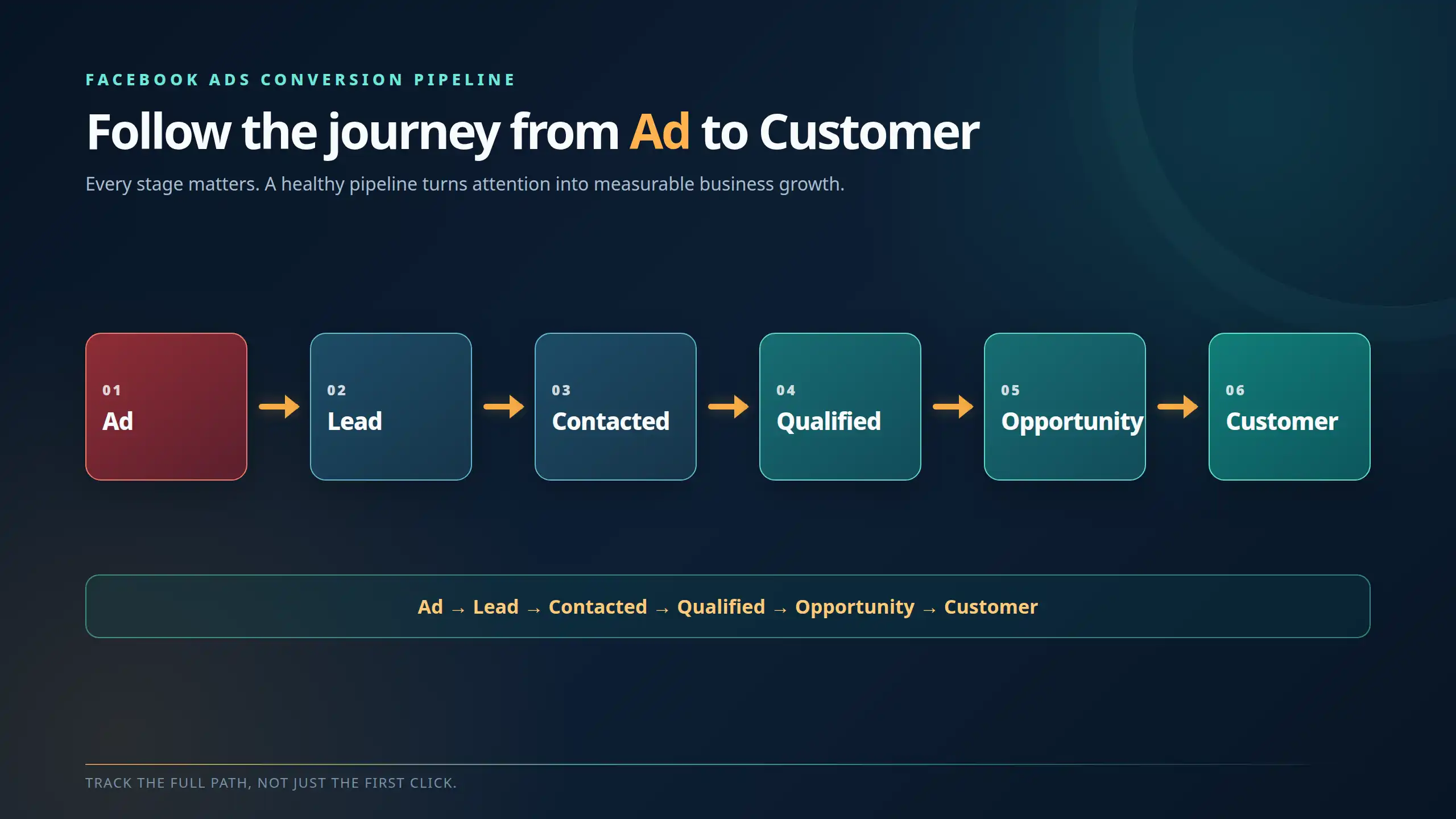
Your funnel may look something like:
Ad → Lead → Contacted → Qualified → Sales Opportunity → Customer
Now ask where the biggest drop actually occurs.
If 100 leads arrive but only 40 can be contacted, you have a different problem from an account where 90 can be contacted but only 10 meet the qualification criteria.
And both are different from a funnel where 50 qualified leads reach the sales team but almost nobody buys.
I call this separating the lead-generation symptom from the actual constraint.
1. You are optimizing for leads instead of business-quality leads
The first number many businesses monitor is CPL, or cost per lead.
That makes sense because it tells you how much advertising spend was required to generate the conversion event you selected.
But a lead is an intermediate event. It is not automatically a qualified prospect, sales opportunity or customer.
Why cheap leads can become expensive
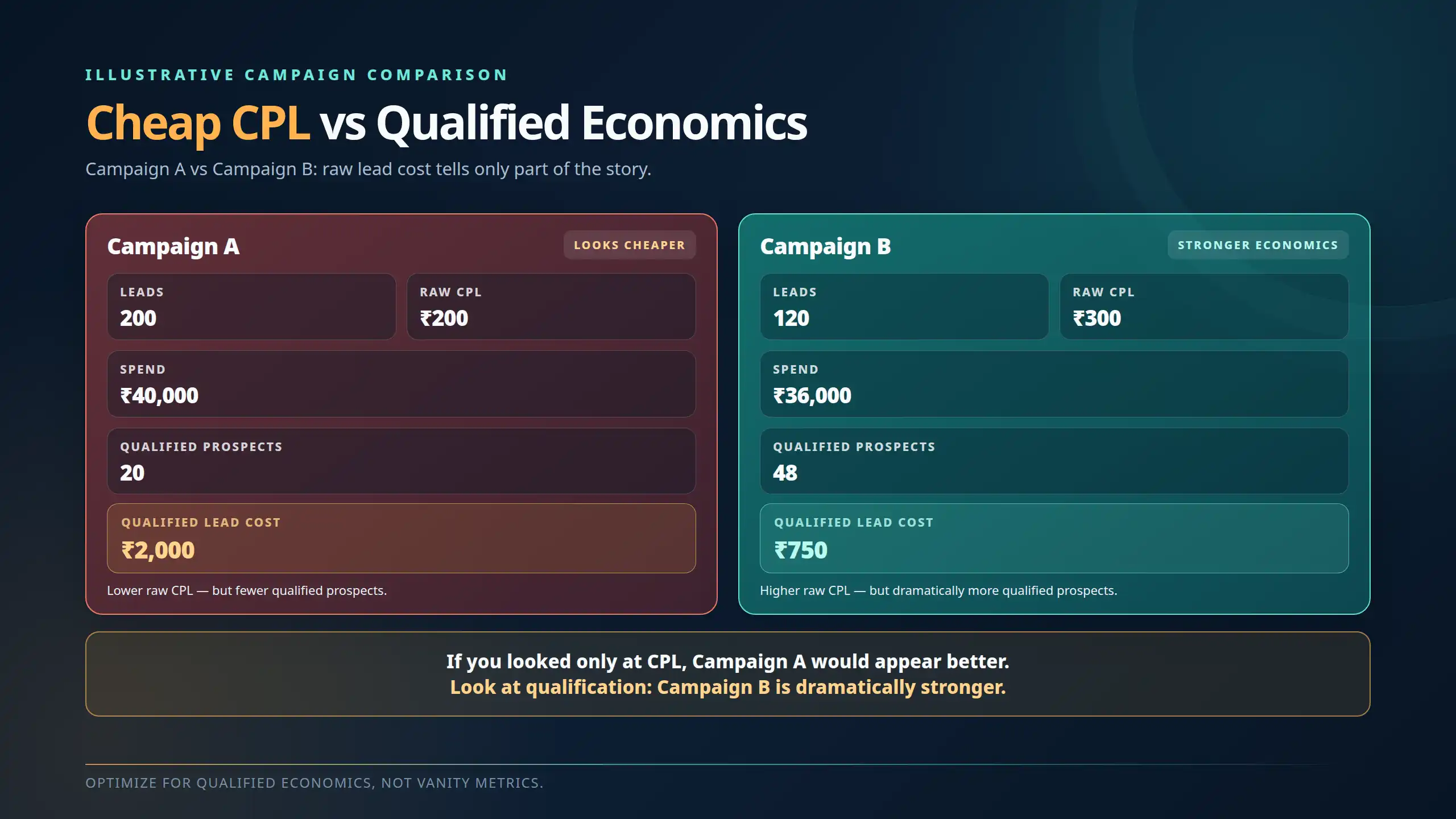
Imagine Campaign A generates 200 leads at ₹200 each.
Campaign B generates only 120 leads at ₹300 each.
If Campaign A produces 20 qualified prospects while Campaign B produces 48, the campaign with the higher raw CPL may actually be creating much stronger economics.
Campaign A: ₹40,000 spend ÷ 20 qualified leads = ₹2,000 qualified lead cost.
Campaign B: ₹36,000 spend ÷ 48 qualified leads = ₹750 qualified lead cost.
If you looked only at CPL, Campaign A would appear better.
If you looked at qualification, Campaign B would be dramatically stronger.
What I would inspect
I would compare campaign, ad set and creative performance against downstream stages where the data exists.
That may include contactability, qualification, appointment bookings, opportunities, purchases or actual customer acquisition cost.
This is the same principle behind my Facebook Ads lead-generation consulting approach: optimize toward business-quality acquisition, not simply the cheapest form completion.
2. Your offer is attracting curiosity rather than buying intent
Sometimes the campaign is doing exactly what the offer asks it to do.
The real problem is that the offer creates a very low threshold for response.
“Get a free consultation,” “Download this free guide,” “Know more,” or an unusually aggressive discount can generate plenty of responses.
But the people responding may be interested in the free thing, not necessarily in buying what comes after it.
The offer determines the type of intent you attract
Suppose an education business promotes a free counselling session.
One person may be actively evaluating programs and wants help deciding.
Another may simply be curious about available courses.
Both can submit exactly the same lead form.
Ads Manager records two leads. The business receives two very different commercial opportunities.
What I would check
I would compare the promise in the ad with the eventual sales conversation.
What does the prospect think they are signing up for?
What does the sales team expect the prospect to be ready for?
If those expectations are far apart, targeting changes alone are unlikely to solve the problem.
3. Your creative is attracting the wrong expectation
Creative does not only influence CTR and CPL.
It also pre-qualifies the prospect before the form is ever opened.
A broad, sensational or overly easy promise can increase response while weakening downstream intent.
The ad promise becomes part of lead quality
Imagine two creatives for the same service.
Creative A focuses heavily on a free benefit with almost no context around who the service is for.
Creative B clearly explains the problem, type of customer, expected commitment and next step.
Creative A may produce a lower CPL because more people feel comfortable responding.
Creative B may produce fewer leads but give sales a more informed prospect.
Neither creative is automatically better.
The correct decision depends on what happens after submission.
What I would inspect
I would compare creative angle against both lead volume and lead quality.
If one creative repeatedly generates cheaper leads that rarely qualify while another produces more expensive but commercially stronger leads, the creative decision should reflect the downstream economics.
That is why I do not treat creative testing as merely testing thumbnails, colours or different opening lines.
4. Your lead form has the wrong amount of friction
Lead forms create an important trade-off between response volume and qualification.
Too much friction can suppress genuinely valuable demand.
Too little friction can allow almost anyone to become a recorded lead.
The objective is not maximum friction. It is the right friction.
Instant Forms are not automatically the problem
Meta’s lead-generation products allow businesses to collect enquiries directly through its platforms, including Instant Forms. The lower-friction experience can be extremely useful when it fits the buying journey.
The mistake is assuming that every business should use the same form structure.
A local service with a simple purchase decision may need very little qualification.
A high-consideration service may benefit from questions that establish location, budget, eligibility, timing or another genuine buying criterion.
Every field needs a reason
Adding seven questions purely to make the lead “work harder” is not automatically smart.
Every question should help either:
- determine whether the prospect is suitable,
- prepare the sales conversation, or
- route the lead correctly.
If a field does none of those things, it may simply create unnecessary abandonment.
What I would test
I would compare not only form completion rate but qualified lead rate.
A form that produces 25% fewer leads may still be superior if qualification and customer economics improve enough to compensate.
5. Your audience and the signal Meta is receiving do not match the buyer you actually want
When lead quality deteriorates, targeting often gets blamed first.
Sometimes targeting genuinely is part of the problem.
But I would avoid the simplistic conclusion that broader targeting creates bad leads and narrow targeting creates good ones.
The quality of the signal matters
The platform can only work with the objective, conversion signal, creative, audience inputs and historical response patterns available to it.
If the campaign repeatedly rewards low-value form submissions, the system has limited evidence that your sales team values a different type of prospect.
The creative and offer also influence who responds within an eligible audience.
This is why audience, creative and conversion signal should not be diagnosed independently.
Before changing targeting, I would ask
Is poor quality concentrated in one audience, one geography, one placement, one creative or one form?
Or is quality poor across almost everything?
If every segment produces the same problem, rebuilding one audience may simply move the same underlying issue into a new ad set.
6. Your landing page and ad are telling different stories
This applies when Facebook Ads send users to a website or landing page rather than completing the entire conversion inside Meta.
A person clicks because of the expectation created by the ad.
The landing page then has to continue that expectation.
Message mismatch destroys intent
Imagine an ad promising a specific solution for business owners.
The click then lands on a generic homepage describing ten unrelated services.
The traffic may be relevant. The destination is forcing the visitor to rebuild the context themselves.
That can reduce conversion rate and also affect who eventually fills the form.
What I would compare
I would review:
- the promise in the ad,
- headline on the destination,
- offer details,
- proof,
- qualification information,
- form or CTA,
- mobile experience,
- and what happens immediately after submission.
For paid acquisition, the landing page is not separate from campaign performance.
My performance marketing funnel framework goes deeper into how I connect ads, landing pages, conversion and downstream outcomes.
7. The leads are fine, but your follow-up process is making them look bad
This is one of the most important distinctions in lead generation.
A lead can be commercially relevant when it is generated and still appear “bad” after poor follow-up.
The advertising team cannot diagnose lead quality properly without knowing what happened after handoff.
Contactability and intent are different metrics
A lead who never receives a timely call has not proven that they were unqualified.
A person who cannot be reached after a reasonable follow-up process is a different issue from someone who answers and clearly does not fit the offer.
Those outcomes should not be blended into one “bad leads” bucket.
I would separate statuses such as
- new lead,
- contact attempted,
- contacted,
- unreachable,
- not interested,
- not qualified,
- qualified,
- appointment or opportunity,
- customer.
The exact CRM stages can vary.
The important thing is distinguishing marketing quality from sales-process leakage.
What I would ask sales
How quickly are new leads contacted?
How many attempts are made?
Does the salesperson know which ad, offer or form generated the enquiry?
Are follow-up outcomes being recorded consistently?
If nobody can answer these questions, I would be cautious about making major advertising decisions based on the statement “these leads don’t convert.”
8. Your CRM or lead-routing process is losing leads before sales can work them
Sometimes the problem is even simpler.
The lead exists in Meta, but it does not reliably reach the person who needs to contact it.
That turns a marketing conversion into an operational failure.
Where routing can break
A lead can be delayed between the ad platform and CRM.
It can be assigned to the wrong salesperson.
Notifications can fail.
Duplicate records can create confusion.
Required context from the form can disappear during integration.
Some leads may remain inside a spreadsheet nobody actively monitors.
Run a simple end-to-end test
I would submit a test lead myself.
Then I would verify:
- Does the lead appear where expected?
- How long does it take?
- Are all important fields present?
- Is the correct owner assigned?
- Does the salesperson receive a usable notification?
- Can the outcome later be recorded?
This simple test can expose a problem that no amount of audience optimization will fix.
9. Marketing and sales do not agree on what a qualified lead actually is
“We need better leads” is not a measurable requirement.
Before advertising can be optimized around lead quality, the business needs an operational definition of quality.
Define qualification in observable terms
Depending on the business, qualification might involve:
- location,
- budget,
- eligibility,
- company size,
- decision-making authority,
- service requirement,
- timeframe,
- or another factor genuinely linked to the offer.
Not every business needs all of these.
The criteria should come from the real buying process rather than whatever is easiest to ask in a form.
A common reporting problem
Marketing may call someone a lead because they completed the required conversion event.
Sales may call the same person “bad” because they were not ready to buy today.
Neither definition is necessarily useful enough for optimization.
The business needs clear stages between raw response and customer.
What changes once the definition is clear
You can begin comparing campaigns by qualified lead cost rather than raw CPL alone.
You can identify which creatives attract stronger prospects.
You can see whether quality changes when forms, offers or audiences change.
And sales feedback becomes structured data rather than anecdotal frustration.
10. You are scaling based on CPL before understanding CAC
This is where a lead-generation problem becomes a budget problem.
A campaign produces cheap leads, so budget increases.
Lead volume rises.
But if qualification or lead-to-customer conversion falls as spend increases, the business may be scaling activity rather than acquisition.
The metric chain matters
CPL = Ad Spend ÷ Leads
Qualified Lead Cost = Ad Spend ÷ Qualified Leads
Media-only CAC = Ad Spend ÷ New Customers Attributed to the Cohort
These metrics answer different questions.
A lower CPL is useful when the downstream economics remain healthy.
It becomes misleading when lead quality deteriorates enough that CAC moves in the opposite direction.
Example
Suppose you increase spend from ₹1 lakh to ₹2 lakh.
At ₹1 lakh you generate 500 leads at ₹200 CPL, 100 qualified leads and 20 customers.
Your qualified lead cost is ₹1,000 and media-only CAC is ₹5,000.
At ₹2 lakh, you generate 1,250 leads at only ₹160 CPL.
That looks like an improvement.
But imagine only 125 leads qualify and 20 become customers.
Qualified lead cost is now ₹1,600 and media-only CAC has increased to ₹10,000.
You doubled spend and lowered CPL, but acquired no additional customers.
That is why I do not define scaling as spending more at a lower platform metric.
I define it as generating profitable incremental growth.
For the broader relationship between acquisition cost and platform return, see my ROAS vs CAC guide.
How I diagnose Facebook Ads leads that are not converting
I would not begin by switching off every campaign.
I would build a simple funnel using the best available business data.
Step 1: Leads generated.
How many conversions did the campaign actually produce, and can the measurement be trusted?
Step 2: Leads received.
Did those records reliably reach the CRM, sheet or sales system?
Step 3: Contactability.
How many prospects could the team actually reach?
Step 4: Qualification.
How many matched the agreed customer criteria?
Step 5: Opportunity.
How many progressed into a meaningful sales conversation, appointment or equivalent stage?
Step 6: Customer.
How many actually purchased?
Then I would segment the funnel by campaign, creative, offer, form, audience and other meaningful dimensions.
The objective is to locate where the deterioration begins.
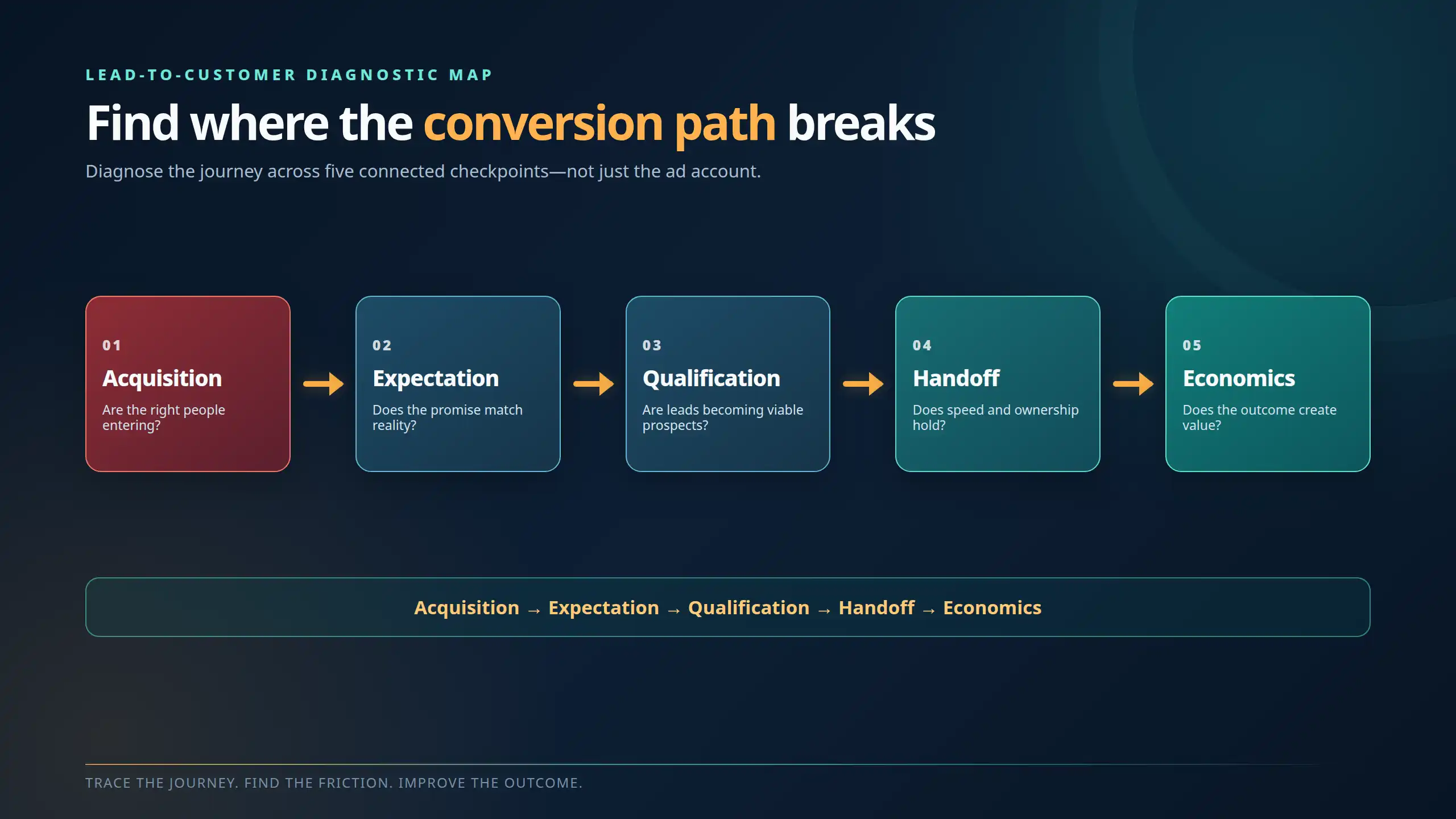
The Lead-to-Customer Diagnostic Map
I think about the problem as five possible constraint groups.
1. Acquisition constraint
The campaign is attracting people who are poorly matched to the offer.
Look at audience, creative, offer and conversion signal.
2. Expectation constraint
The person responding expected something materially different from what sales is offering.
Look at creative promise, pricing cues, eligibility and landing-page message match.
3. Qualification constraint
Too many people can become leads without demonstrating the criteria that matter to the business.
Look at forms, qualification questions and customer definition.
4. Handoff constraint
Potentially good leads are being lost between submission and the first useful sales conversation.
Look at CRM integration, routing, response time and follow-up process.
5. Economics constraint
The funnel converts, but at an acquisition cost the business cannot support.
Look at qualified lead cost, customer acquisition cost, close rate and customer economics rather than CPL alone.
This diagnostic approach is also why a Facebook Ads audit should inspect more than campaign settings.
Should you use Facebook Instant Forms or a landing page?
I would not make this decision using the rule “Instant Forms are low quality and landing pages are high quality.”
That is too simplistic.
Instant Forms can make sense when
- the action is relatively easy to understand,
- speed and mobile convenience matter,
- the sales process can qualify after submission,
- the form contains the information needed for useful follow-up,
- and downstream quality is being measured.
A landing page can make more sense when
- the offer needs more explanation,
- the buyer needs proof before responding,
- qualification requires context,
- the product or service involves a significant commitment,
- or the business needs more control over the conversion experience.
The correct choice depends on the economics of the complete funnel.
A landing page that cuts lead volume in half is not automatically better.
An Instant Form that doubles leads is not automatically better either.
Compare what happens to qualified lead cost and customer acquisition.
What metrics should you track beyond Facebook Ads CPL?
I would start with the stages your business can measure reliably.
Useful lead-generation metrics may include:
- Cost per lead: the cost of generating the initial response.
- Contact rate: the percentage of leads the team successfully reaches.
- Qualified lead rate: the percentage meeting agreed qualification criteria.
- Cost per qualified lead: spend divided by qualified leads.
- Appointment or opportunity rate: the percentage progressing into the next meaningful sales stage.
- Lead-to-customer conversion rate: the percentage becoming paying customers.
- Customer acquisition cost: acquisition cost at the customer level.
You do not need twenty KPIs on every dashboard.
You need enough visibility to know where the funnel is changing.
My performance marketing metrics guide explains how I interpret performance metrics in the wider acquisition system.
What I would not do immediately
If Facebook Ads are producing leads but sales are weak, I would avoid several reflex reactions.
I would not immediately narrow the audience
Unless the evidence indicates audience mismatch, this can treat the symptom rather than the cause.
I would not automatically switch from Instant Forms to a landing page
First establish whether form friction is genuinely the constraint.
I would not judge every salesperson’s feedback as proof that targeting is wrong
Sales feedback is extremely valuable, but it becomes much more useful when recorded through consistent outcome categories.
I would not scale because CPL looks cheap
Cheap volume can amplify a weak funnel.
I would not shut off Meta simply because raw lead-to-sale conversion looks low
The first question is where the drop occurs and whether the economics can be improved.
When the Facebook Ads campaign really is the problem
Not every lead-quality issue sits outside advertising.
The campaign itself may genuinely be generating poor demand.
I would become more suspicious of acquisition when poor quality is systematically concentrated around specific:
- creative angles,
- offers,
- campaigns,
- audiences,
- geographies,
- forms,
- or placements.
If sales follow-up and qualification are consistent but one campaign repeatedly generates materially weaker downstream outcomes, advertising becomes a stronger candidate for intervention.
Then the next test should be designed around the suspected cause rather than random optimization.
When the campaign may not be the main problem
If lead quality is similar across campaigns but customers still do not emerge, I would inspect what happens after acquisition.
Examples include:
- leads waiting too long for contact,
- weak sales routing,
- no consistent follow-up process,
- a pricing or offer objection that appears across almost every lead source,
- poor sales qualification,
- or incomplete CRM data.
Ads cannot solve every business constraint.
A performance marketer should be able to identify when advertising is not the highest-leverage place to make the next change.
My broader view on Facebook lead generation
Across my broader performance marketing work, I have worked with acquisition systems responsible for more than 10 lakh leads.
That is an aggregate figure across channels and campaigns, not a Meta-only lead count.
One lesson that becomes obvious at scale is that lead volume and business quality have to be evaluated separately.
You can make a dashboard look better by reducing CPL.
You build a stronger acquisition system by understanding what type of lead eventually becomes a customer and feeding that knowledge back into marketing decisions.
That is the difference between running a Facebook lead campaign and managing customer acquisition.
Facebook Ads generating leads but no customers? Start here
Do not begin with the assumption that Facebook Ads are producing bad leads.
Begin with the funnel.
Find out how many leads arrived, how many were received correctly, how many could be contacted, how many qualified and how many became customers.
Then segment those outcomes by campaign, creative, offer and other meaningful variables.
If the problem begins before the lead is generated, fix acquisition.
If it begins during qualification, fix the qualification system.
If strong leads disappear after handoff, investigate CRM and sales follow-up.
If everything converts but customer acquisition is still too expensive, work on the economics rather than celebrating a low CPL.
The goal is not the cheapest possible Facebook lead.
The goal is to create a repeatable path from paid media to profitable customers.
If you need help identifying where that path is breaking, see my Facebook Ads consulting approach for lead generation or how I conduct a Facebook Ads account audit.