A Facebook Ads audit checklist is useful when it helps you decide what deserves attention first.
It becomes much less useful when it gives equal importance to every setting, metric and warning inside Meta Ads Manager.
A broken conversion signal is not equivalent to an untidy naming convention. A landing page that cannot convert qualified traffic is not equivalent to one ad having a slightly higher CPM.
That is why I would not audit a Meta Ads account by simply collecting the largest possible number of “issues.”
I would first establish whether the data can be trusted. Then I would trace where money moves, where performance changes and whether the advertising is creating the business outcome it is supposed to create.
Below are 10 signs that tell me a Facebook Ads account deserves a deeper review.
How to use this Facebook Ads audit checklist
Do not treat every item below as an automatic failure.
Use three practical classifications:
- Pass: the evidence is clear enough to continue evaluating the account.
- Needs review: something looks unusual, but you need more evidence before recommending a change.
- Critical dependency: the issue makes later conclusions unreliable until it is understood or repaired.
This distinction matters because Facebook Ads account audits have dependencies.
If purchase tracking is materially wrong, for example, you should be careful about making aggressive ROAS-based budget decisions before understanding the measurement issue.
I think of this as the Audit Dependency Order:
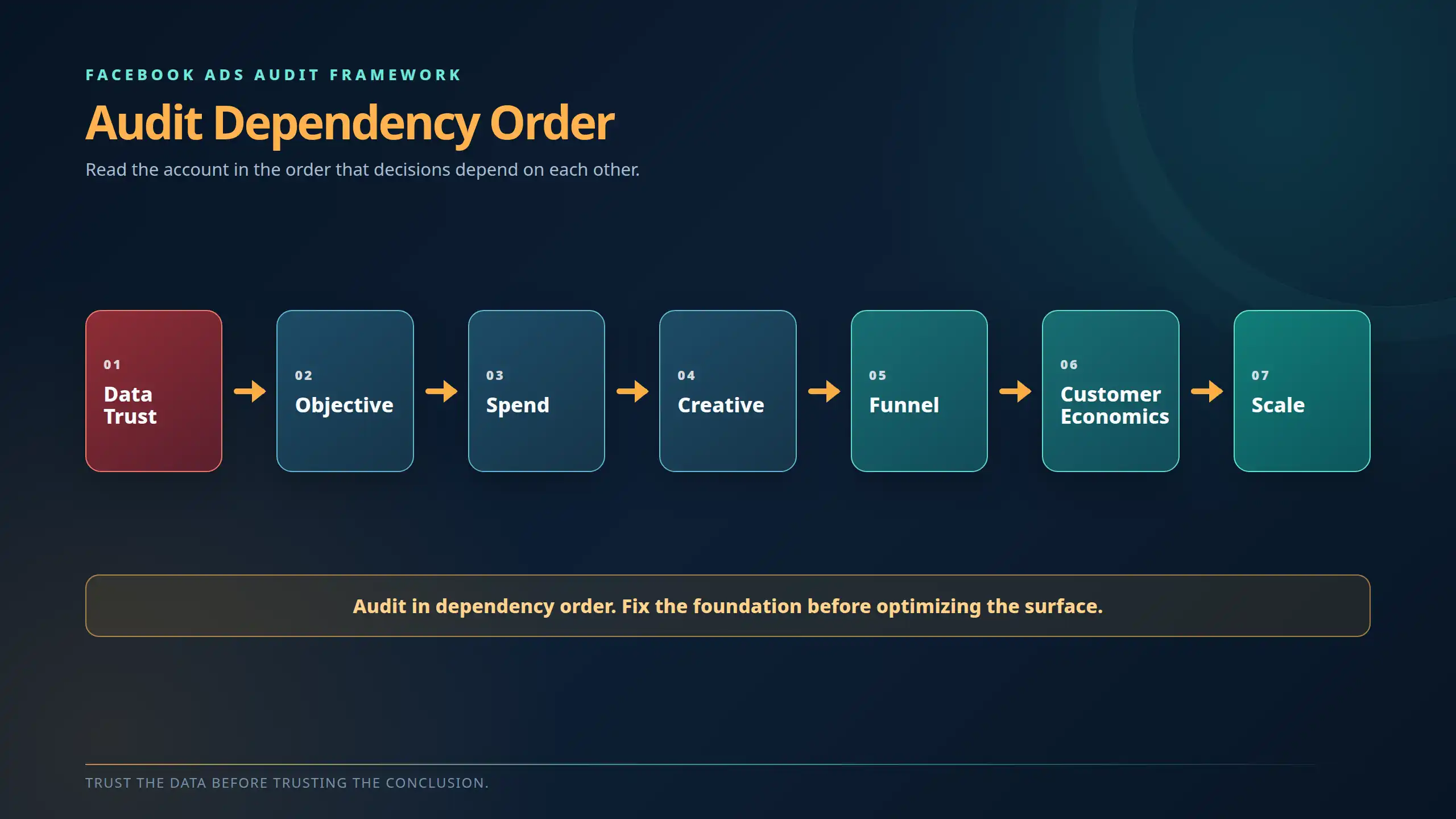
Data Trust → Business Objective → Spend → Creative & Delivery → Funnel → Customer Economics → Scaling Decision
You can inspect everything in the account, but the order in which you trust the conclusions matters.
1. You cannot confidently explain whether conversion tracking is trustworthy
This is one of the first things I would investigate in a Facebook Ads account audit.
If the conversion data is unreliable, every later discussion about CPA, CPL, ROAS or scaling becomes less certain.
What I would review
I would start with the conversion actions the account actually uses for optimization and reporting.
For an ecommerce account, that may include events such as ViewContent, AddToCart, InitiateCheckout and Purchase.
For lead generation, it may include Lead or another business-defined conversion event.
I would then compare the platform story with the website, CRM or order system where possible.
Look for discrepancies, not perfect equality
Meta, GA4, CRM systems and ecommerce platforms do not always report identical conversion numbers because they can use different attribution logic, event definitions and data-processing methods.
Different numbers do not automatically mean something is broken.
The audit question is whether the differences are explainable enough to support decisions.
Signals that deserve review
- Major changes in reported conversions without a matching business change.
- Purchase or lead events that appear to fire at unexpected stages.
- Large discrepancies that nobody on the team can explain.
- Changes to Pixel, Conversions API, website or checkout implementation near the date performance changed.
- Business records moving in one direction while platform conversions move sharply in another.
Why this becomes a dependency
Suppose Meta reports that Campaign A generated 100 purchases and Campaign B generated 60.
If the Purchase event is materially unreliable, the conclusion that Campaign A deserves more budget may also be unreliable.
That does not mean you stop every campaign.
It means you label the uncertainty before making a decision based on the number.
2. The campaign objective and optimization signal do not match the real business outcome
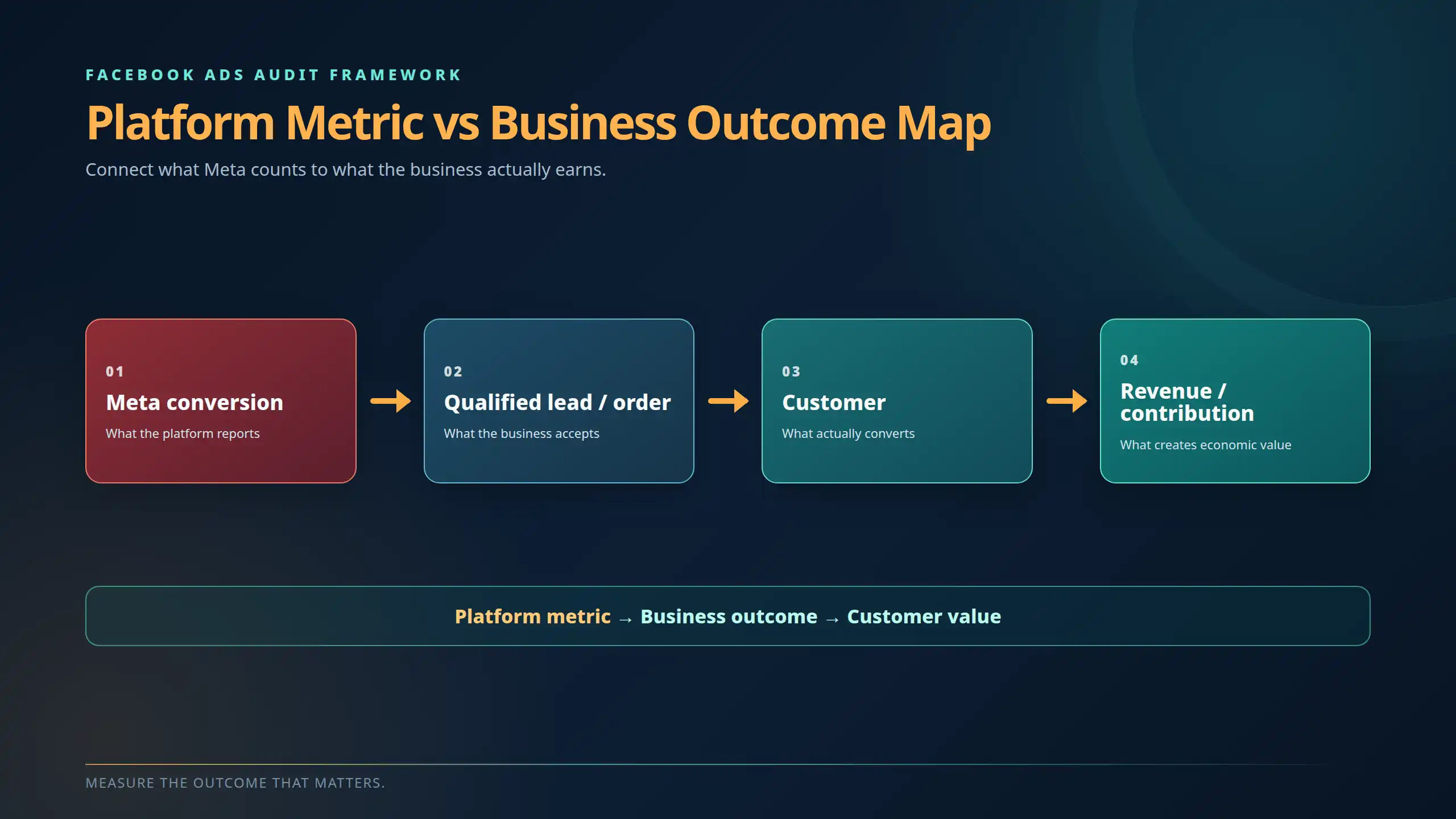
Once I have reasonable confidence in measurement, I look at what the campaign is actually being asked to optimize for.
A campaign can execute its optimization objective successfully and still disappoint the business.
Platform success and business success can be different
Imagine a lead-generation business that celebrates a falling CPL.
If Meta is finding more people willing to submit a form but qualification rate is falling, the campaign may be improving against the recorded platform event while weakening against the business outcome.
The same principle applies to ecommerce.
A campaign may generate attributed purchases efficiently while the business cares specifically about profitable new-customer acquisition.
What I would inspect
- The campaign objective.
- The conversion location.
- The optimization event.
- The business outcome the company actually cares about.
- Whether there is enough downstream information to evaluate the gap between them.
The objective is not to insist that every campaign optimize against the deepest possible event.
Sometimes the available data, conversion volume or funnel structure creates legitimate trade-offs.
The important question is whether the team understands what the chosen signal represents.
A useful audit question
If Meta became dramatically better at generating the event we selected, would the business definitely become healthier?
If the answer is no, I would investigate the gap.
3. Nobody can clearly explain where the budget is actually going
An account can have a reasonable total monthly spend while distributing that budget in ways nobody deliberately chose.
That deserves review.
Audit spend distribution, not just campaign budgets
I want to know which parts of the account consumed money during the period being evaluated.
That may include:
- campaigns,
- ad sets,
- prospecting versus retargeting,
- products or offers,
- creative concepts,
- geographies,
- placements,
- new versus existing customer activity where that distinction is measurable.
The goal is not to create dozens of breakdowns.
It is to understand whether spend is aligned with the business decision being made.
Why averages can hide the issue
Suppose an account reports 4X blended Meta ROAS.
That looks strong.
But imagine a large share of spend is concentrated in retargeting existing demand while prospecting, which is responsible for finding new customers, is struggling.
The blended number does not answer whether the business can acquire incremental customers at the next level of spend.
What would concern me
I become more interested when budget concentration changes significantly without an intentional strategy change.
I also want to know whether weak parts of the account continue receiving meaningful spend because nobody has reviewed allocation recently.
Budget allocation is ultimately a capital-allocation decision.
The audit should help answer:
Where should the next rupee go, and what evidence supports that decision?
4. Creative performance is deteriorating, but the account has no clear creative learning system
Creative is one of the most important variables in Meta advertising, but many accounts audit it too superficially.
They identify the ad with the lowest CPA, label it a winner and move on.
I want to understand why a creative is working and what the account has learned from it.
Creative fatigue is not just “frequency is high”
Frequency can be useful context, but I would not diagnose creative fatigue from one number alone.
I would look for a pattern across delivery and response.
For example:
- CPM changes.
- CTR or outbound response changes.
- CPC changes.
- conversion rate changes.
- CPA or CPL changes.
- frequency changes.
- spend concentration.
- how performance changes over time.
If CTR falls while CPM remains relatively stable and the same creative has absorbed substantial delivery, declining response may become a stronger hypothesis.
If CTR is stable but landing-page conversion falls, replacing the creative may not solve the real problem.
Audit concepts, not just individual ads
I would group creatives by meaningful ideas where possible.
That could include:
- problem-solution,
- testimonial,
- product demonstration,
- offer-led,
- objection handling,
- UGC,
- comparison,
- proof-led creative.
The question becomes more useful:
What type of customer message is creating efficient business outcomes?
That gives the next creative test a reason to exist.
5. Prospecting, retargeting and existing demand are being blended into one reassuring number
This is particularly important when someone points to a strong account-level ROAS as proof that everything is healthy.
Not every conversion represents the same acquisition job.
Retargeting can look efficient for good reasons
People who already visited your website, engaged with your brand or moved closer to purchase can naturally behave differently from people discovering you for the first time.
That does not make retargeting bad.
It means its reported efficiency should be interpreted in context.
The audit question is incremental acquisition
I want to know whether the account can continue reaching new demand at economics the business can support.
That may require looking beyond one blended platform number.
Depending on the available data, I may compare prospecting and retargeting activity, new and returning customers, first-time purchasers or other indicators of customer mix.
Not every account will have perfect customer-level data.
The audit should state that limitation rather than pretending the distinction is known precisely.
A misleading conclusion
“Retargeting has the highest ROAS, therefore it should receive most of the budget” is not automatically sound.
If prospecting is responsible for adding new people to the funnel, starving it can improve the short-term average while weakening future demand generation.
This is why my ROAS vs CAC framework treats platform return as one part of the acquisition decision rather than the entire decision.
6. The account is being optimized without reviewing what happens after the click
A Meta Ads account audit that stops inside Ads Manager can miss the actual constraint.
Advertising controls traffic acquisition.
It does not independently control the entire customer journey.
Audit the transition from ad to destination
I would compare:
- the promise made in the creative,
- the landing-page headline,
- the offer,
- proof,
- CTA,
- mobile usability,
- form or checkout friction,
- and the next step after conversion.
A strong ad can send relevant traffic to a weak page.
When that happens, changing the audience may lower or raise CPC without solving the conversion problem.
Use the metric chain
Consider:
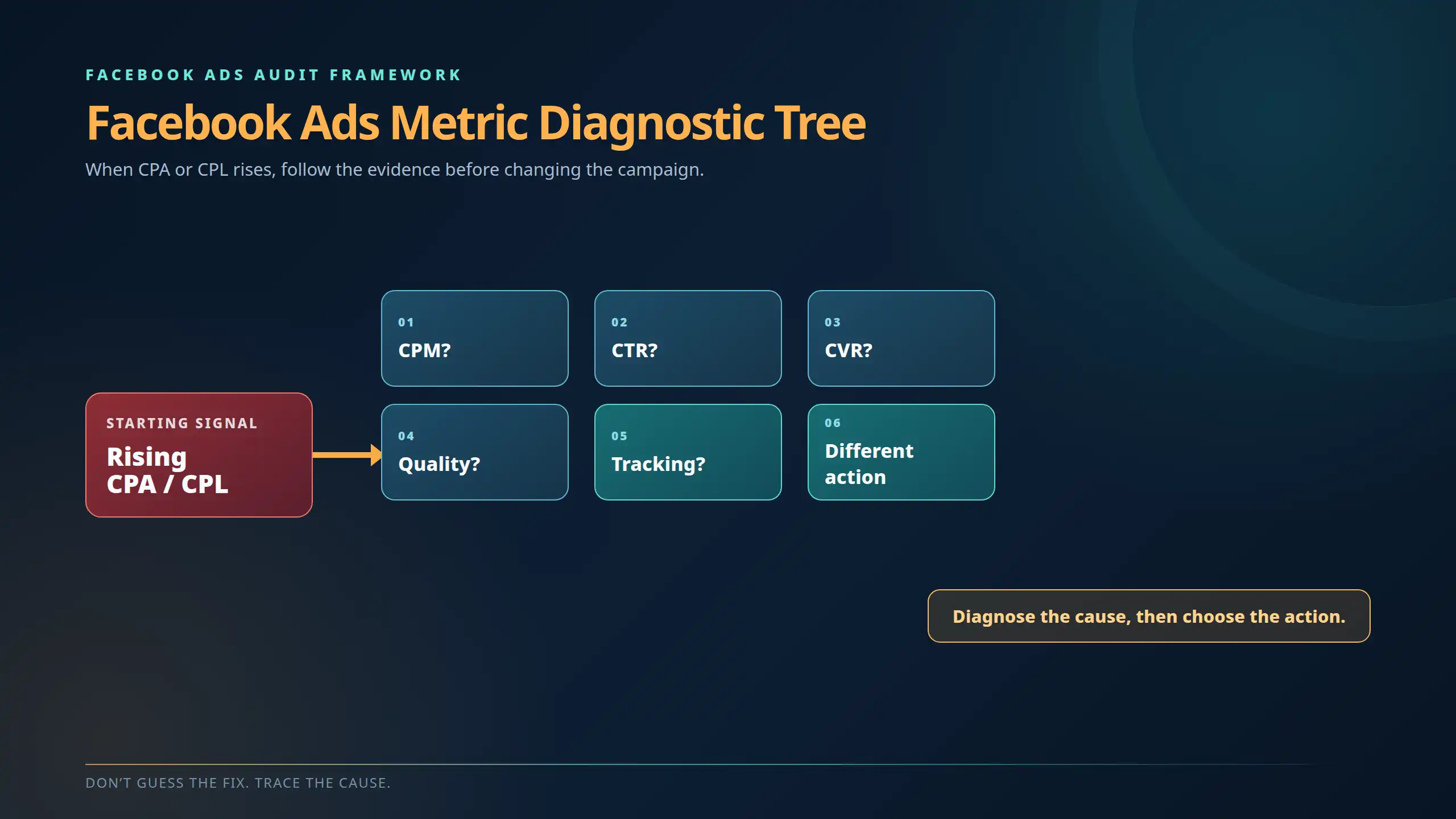
Impressions → Clicks → Landing Page Visits → Conversion → Qualified Lead or Purchase → Customer
If CPM rises, investigate delivery and auction conditions.
If CTR falls, creative or message relevance becomes more interesting.
If clicks remain healthy while page conversion deteriorates, inspect the destination and offer.
If leads remain healthy while sales collapse, look downstream.
This is why I consider CRO part of paid acquisition rather than a completely separate discipline.
My performance marketing funnel guide explains this relationship in more detail.
7. Lead quality, order quality or customer quality is invisible inside the audit
A Facebook Ads account can look healthy at the conversion-event level while producing weak downstream outcomes.
If the business has downstream data, ignoring it creates an incomplete audit.
For lead generation
I would want to know what happened after the form submission.
Useful stages may include:
- lead received,
- contact attempted,
- contacted,
- qualified,
- appointment or opportunity,
- customer.
The exact CRM stages depend on the business.
The principle does not.
A low CPL should be evaluated alongside what percentage of those leads become commercially useful.
If your account generates volume but customers are missing, my Facebook Ads leads-not-converting diagnostic goes deeper into that specific problem.
For ecommerce
I would look beyond the recorded Purchase event when operational data materially changes value.
For a COD-heavy business, placed revenue and fulfilled revenue may answer different questions.
Refunds, cancellations, contribution margin and customer mix can also change how much acquisition cost the business can support.
Why this matters for creative decisions
Suppose Creative A generates purchases at ₹700 while Creative B generates them at ₹850.
Creative A appears stronger.
But if Creative B attracts a materially better customer mix or stronger downstream economics, the platform-level CPA alone may not be enough to make the decision.
The audit should follow the outcome as far downstream as the available data reasonably allows.
8. Meta, analytics, CRM and business records tell materially different stories, and nobody has reconciled them
Different measurement systems will often report different numbers.
The red flag is not difference itself.
The red flag is when major business decisions depend on the numbers and nobody understands why they differ.
Each system may answer a different question
Meta Ads Manager is useful for platform delivery and attributed advertising outcomes.
Website analytics can help explain on-site behaviour and traffic.
CRM data can show what happened to leads.
Order systems and finance data can show what was purchased, fulfilled, refunded or recognized by the business.
I do not expect these systems to collapse into one perfectly identical number.
What I want from the audit
I want definitions.
What does Meta call a conversion?
What does the CRM call a qualified lead?
What does ecommerce reporting call revenue?
What period and attribution logic are being compared?
Once those definitions are understood, the differences become much more useful.
Watch for sudden unexplained divergence
If Meta conversions rise 40% while CRM-qualified leads remain flat, I want to know why.
If platform revenue falls but total store revenue does not, I want to understand the customer mix, attribution and channel movement before declaring Meta broken.
Audit measurement as a system, not a competition over which dashboard deserves to be called “the truth.”
9. The account changes so frequently that nobody can tell what actually caused performance to move
Constant optimization can create the appearance of active management while destroying the ability to learn.
If audiences, budgets, creatives, landing pages and offers all change at once, a later performance improvement tells you very little about which change mattered.
An audit should inspect change history
I would ask:
- What major changes were made?
- When were they made?
- What hypothesis justified them?
- What metric was supposed to change?
- Was enough comparable data available before another change was introduced?
This does not mean every test must be academically perfect.
Real advertising accounts require practical decisions.
But there should still be a connection between:
Hypothesis → Change → Observation → Decision.
Too many edits create attribution problems of their own
Suppose CPL improves after:
- three new creatives launch,
- the landing page changes,
- budget increases,
- retargeting expands,
- and qualification questions are removed.
The business may enjoy the improvement, but the team has learned very little about what caused it.
That becomes expensive later when performance weakens and nobody knows which lever mattered.
10. Scaling decisions are based on platform efficiency without checking whether incremental business economics still work
This is the final audit layer because it depends on many of the earlier layers being reasonably understood.
A campaign can be profitable at one spending level and become less attractive as budget increases.
That is normal.
Scaling changes the demand you reach
More spend may require the platform to find additional impressions, customers or leads beyond the easiest opportunities captured at lower spend.
As scale increases, several things can change:
- CPM,
- CTR,
- conversion rate,
- CPL or CPA,
- customer mix,
- creative performance,
- fulfilment capacity,
- sales-team capacity.
That is why I do not define successful scaling as “budget increased and the campaign stayed active.”
I define it as profitable incremental growth.
Example
Suppose an ecommerce campaign spends ₹5 lakh and produces ₹20 lakh in attributed revenue.
Platform ROAS is 4X.
If spend increases to ₹10 lakh and attributed revenue becomes ₹32 lakh, ROAS falls to 3.2X.
That does not automatically mean scaling failed.
The business acquired an additional ₹12 lakh in attributed revenue from an additional ₹5 lakh in spend.
The correct decision depends on margin, new-customer acquisition, contribution, repeat value and operational capacity.
If that incremental business is profitable and strategically useful, a lower average ROAS can still support growth.
What the audit should answer
Before recommending more spend, I want to know:
- Can we trust the conversion data?
- Is the campaign reaching new demand?
- Is customer or lead quality stable?
- Can creative support additional scale?
- Can the funnel handle more traffic?
- Can the business support the resulting CAC?
A scaling recommendation that ignores those questions is incomplete.
The 10-point Facebook Ads account audit checklist
If you want a fast first pass, use these 10 questions.
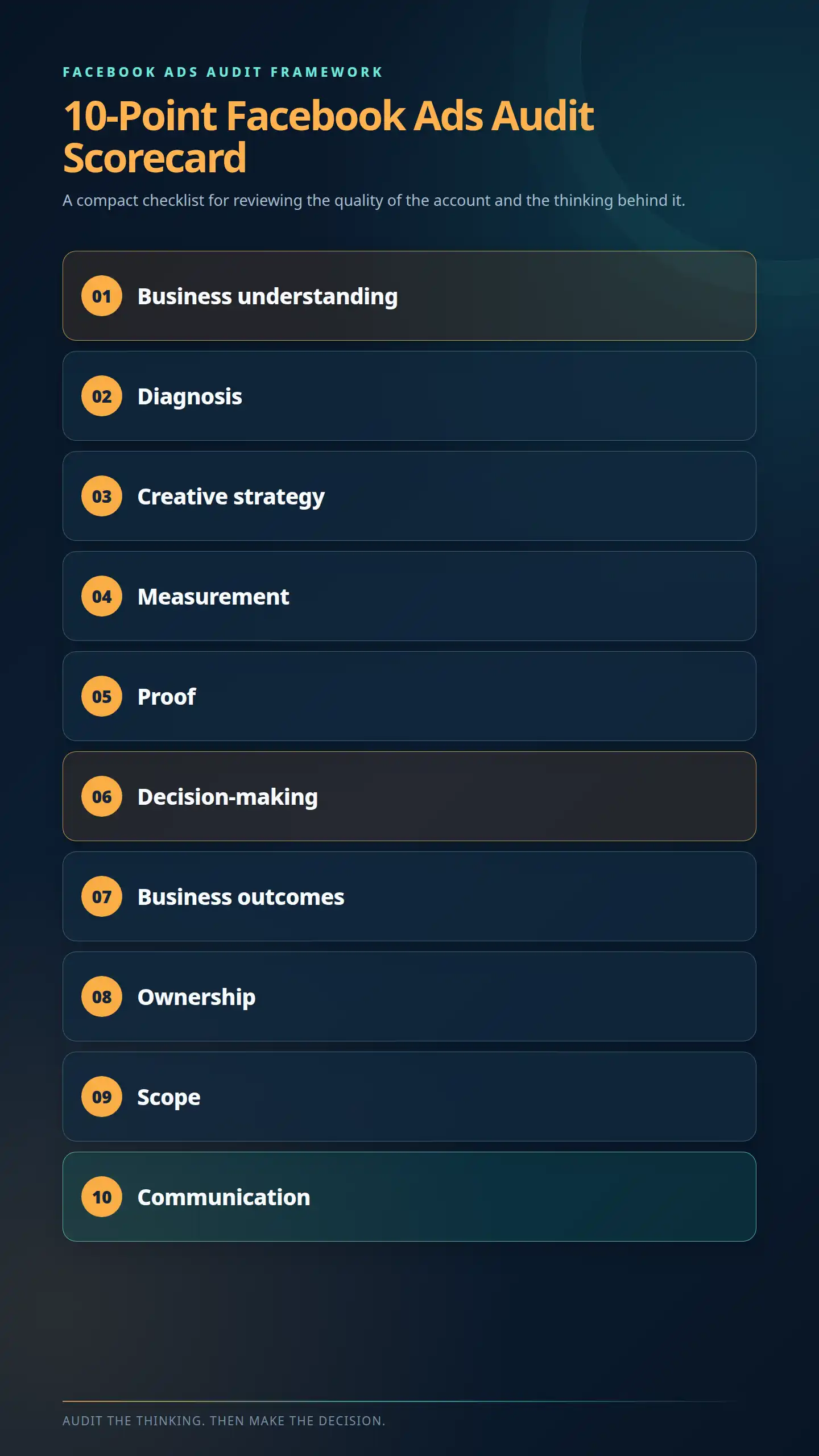
- Tracking: Can we trust the conversion events enough to make performance decisions?
- Optimization: Is Meta optimizing toward an event that represents the business outcome closely enough?
- Spend: Can we explain where budget is going and why?
- Creative: Do we understand which messages and concepts are driving performance?
- Demand mix: Are prospecting, retargeting and existing demand being interpreted correctly?
- Post-click funnel: Does the destination continue the ad promise and convert relevant traffic?
- Outcome quality: Are leads, orders or customers being evaluated beyond the initial Meta conversion?
- Measurement: Can we explain the differences between Meta, analytics, CRM and business records?
- Testing: Are account changes producing actual learning?
- Scaling: Does incremental spend still make sense against business economics?
If several answers are “I don’t know,” the account probably needs deeper review.
That does not automatically mean performance is bad.
It means the business is making decisions with more uncertainty than it may realize.
What should you fix first after a Facebook Ads audit?
Do not sort findings by how easy they are to change inside Ads Manager.
Sort them by dependency and business impact.
My preferred sequence is:
1. Fix data-trust problems first
If an issue materially undermines the numbers used for decision-making, understand it before aggressively reallocating spend.
2. Fix objective and signal mismatches
Make sure the system is being evaluated against the outcome the business actually cares about.
3. Address the largest acquisition constraint
That might be creative, offer, landing page, lead quality, checkout or something else.
4. Improve secondary efficiency
Only after the major constraint is understood would I prioritize smaller structural or tactical optimizations.
5. Scale after the system earns the next rupee
More budget should follow evidence that the acquisition system can use it productively.
This prioritization logic is also the difference between a checklist and an actual Facebook Ads audit service.
A checklist identifies things worth inspecting.
An audit should determine what matters, why it matters and what should happen next.
What is not automatically a Facebook Ads red flag?
This section matters because audit checklists can create false certainty.
Some conditions deserve context rather than automatic correction.
A high CPM is not automatically bad
A more expensive audience or auction can still produce stronger customer economics.
Evaluate what happens after the impression.
A high CPL is not automatically bad
If qualification and customer acquisition improve enough, a higher CPL can be commercially superior.
Broad targeting is not automatically bad
The correct audience strategy depends on the business, signal quality, creative, geography and available demand.
High frequency is not automatically creative fatigue
Frequency means different things in prospecting, retargeting and narrow high-intent audiences.
Combine it with response and conversion trends.
A complex account is not automatically sophisticated
More campaigns and ad sets can create fragmentation without creating better decisions.
A simple account is not automatically better either
Structure should reflect the decisions the business needs to make.
The point of an audit is not to enforce a fashionable account structure.
It is to determine whether the existing structure helps or prevents good acquisition decisions.
How often should you audit a Facebook Ads account?
I would separate ongoing performance review from a deeper audit.
Campaigns should obviously be monitored regularly.
A deeper account review becomes especially useful when the context changes or when the existing explanation for performance stops making sense.
Examples include:
- performance deteriorates materially,
- spend is about to increase significantly,
- a new operator or agency inherits the account,
- tracking or website infrastructure changes,
- lead or customer quality changes,
- the offer changes,
- the account has accumulated years of campaigns and decisions nobody fully understands,
- platform metrics and business results begin diverging.
I would not invent a universal rule that every account needs a complete audit every 30 days.
The right review depth depends on account complexity, spend, change velocity and business risk.
Can you audit your own Facebook Ads account?
Yes.
A structured self-audit can uncover a surprising number of issues, particularly when nobody has stepped back from daily campaign management for a while.
The limitation is not access to Ads Manager.
The limitation is that the person who built the current system may naturally share the assumptions that created it.
An external review can sometimes help because it asks questions the existing team stopped asking.
That does not mean every account needs an outside consultant.
If your team can explain the data, challenge its own assumptions and prioritize findings objectively, a self-audit can be extremely valuable.
When a checklist is no longer enough
A checklist tells you where to look.
It does not automatically tell you why performance changed.
If several parts of the system interact, you may need a deeper diagnostic process.
For example:
High CPL could originate from delivery, creative response, page conversion, offer, tracking or qualification.
Low ROAS could originate from media cost, conversion rate, AOV, customer mix, attribution, cancellations or margins.
The same dashboard symptom can therefore require opposite actions.
That is why my broader performance marketing audit framework starts with the decision and evidence rather than the desire to find as many issues as possible.
And if the problem is specifically inside Meta acquisition, you can see how I approach a deeper Facebook Ads account audit.
Final thought: audit for decisions, not for faults
The purpose of a Facebook Ads audit is not to prove that an account contains imperfections.
Every mature advertising account will contain historical campaigns, experiments, compromises and things that could look cleaner.
The useful question is whether any of those issues prevent the business from making the right acquisition decision today.
Start with data trust.
Then understand what Meta is optimizing for, where the money goes, what creative is learning, what happens after the click and whether customers are being acquired at economics the business can support.
Once those relationships are clear, the smaller account-level decisions become much easier to prioritize.
That is what I want from an audit: not a longer list of faults, but a clearer answer to where the next rupee should go.