Looking for a Google Ads Expert in India Who Understands Business Growth?
I’m Deepak Singh, a performance marketing professional with nearly 10 years of hands-on experience managing Google Ads, Meta Ads and YouTube advertising campaigns for businesses across India.
If you’re looking for a Google Ads expert in India who understands more than keywords, clicks and campaign budgets, I can help you connect paid advertising with measurable business outcomes.
My approach focuses on generating relevant leads, acquiring customers, improving conversion rates and understanding the actual economics behind your advertising investment.
Whether you’re running Google Search Ads for lead generation, Google Shopping campaigns for ecommerce, or Performance Max campaigns across Google’s advertising inventory, I look at how every campaign contributes to your wider customer acquisition strategy.
Google Ads Expertise Across Search, Shopping, PMax and Lead Generation
I work across different Google Ads campaign types and business models, with an emphasis on selecting the right advertising strategy for the objective rather than recommending every available campaign type.
- Google Search Ads: Reach potential customers actively searching for relevant products, services and solutions.
- Google Shopping Ads: Promote ecommerce products using Merchant Center feeds, product-level performance data and commercial acquisition metrics.
- Performance Max (PMax): Evaluate automated cross-channel campaigns using conversion quality, product economics, campaign insights and reliable measurement.
- Google Ads Lead Generation: Build acquisition strategies around relevant enquiries, qualified leads and eventual customer acquisition.
- Conversion Tracking and Measurement: Connect Google Ads, GA4, website conversion events and available business data to improve reporting and optimization decisions.
- Campaign Audits and Optimization: Identify inefficient spending, targeting issues, conversion tracking problems and opportunities to improve acquisition performance.
My Focus Is on What Happens After Someone Clicks Your Ad
A high click-through rate or low cost per click can be encouraging, but neither metric guarantees successful advertising.
For lead-generation businesses, I consider what happens after the enquiry: lead quality, contactability, sales conversion and customer acquisition cost.
For ecommerce businesses, I examine purchase conversions, advertising return, product economics and how reported platform performance relates to the wider business.
This is the difference between simply managing Google Ads campaigns and approaching them as part of a complete performance marketing system.
My experience includes documented Google Ads campaigns across education and Ayurveda-related lead generation. I’ll share the actual campaign results in the next section so you can evaluate the evidence behind my approach.
Need an experienced Google Ads specialist to review or manage your campaigns? Discuss your Google Ads requirements with me.
Google Ads Campaign Results: Real Performance Across Lead Generation and EdTech
When hiring a Google Ads expert in India, I believe businesses should evaluate more than certifications, platform knowledge or promises of better campaign performance.
Actual campaign results provide a more useful starting point for understanding someone’s experience with paid advertising, conversion optimization and customer acquisition.
My Google Ads experience includes managing campaigns across education, EdTech and lead-generation businesses, with documented results showing how advertising investment translated into measurable conversions.
Case Study 1: 5,030 Leads at ₹87.65 CPL Through Google Ads
In a Google Ads campaign for an Ayurveda-focused business, the campaign generated approximately 5,030 leads at an average cost per lead of ₹87.65.
| Campaign Metric | Recorded Result |
|---|---|
| Industry | Ayurveda |
| Advertising Platform | Google Ads |
| Total Leads | 5,030 |
| Average Cost Per Lead | ₹87.65 |
| Advertising Spend | Approximately ₹4.41 lakh |
These results demonstrate experience with measurable lead acquisition through Google advertising.
However, generating leads is only one part of a successful customer acquisition strategy. The next questions involve enquiry quality, lead qualification, sales conversion and the cost of acquiring paying customers.
I distinguish these business outcomes from the initial lead-generation metrics rather than assuming that every advertising lead becomes a customer.
Read the Ayurveda Google Ads Case Study
Case Study 2: Approximately 656 Conversions at ₹109 Per Conversion for EdTech
Another documented Google Ads campaign involved an EdTech business, where Google Ads recorded approximately 656 attributed frontend course conversions at ₹109 cost per conversion.
| Campaign Metric | Recorded Result |
|---|---|
| Industry | Education / EdTech |
| Advertising Platform | Google Ads |
| Attributed Conversions | 655.98 |
| Average Cost Per Conversion | Approximately ₹109 |
| Conversion Type | Frontend Course Conversion |
This campaign demonstrates experience managing Google Ads around course-related conversion objectives rather than evaluating performance only through impressions, traffic or clicks.
The fractional conversion count reflects Google Ads attribution reporting. It should not be interpreted as 656 verified unique customers or independently confirmed transactions.
For EdTech advertisers, understanding the difference between reported conversions, completed payments, actual enrollments and customer acquisition economics is essential when evaluating campaign performance.
Read the EdTech Google Ads Case Study
What These Google Ads Results Demonstrate
These two campaigns represent different advertising objectives, but both demonstrate hands-on experience with measurable Google Ads performance.
They also highlight why I don’t evaluate every advertising account using the same performance metric.
- For lead-generation campaigns: I evaluate cost per lead, conversion performance and, where data is available, lead quality and customer acquisition cost.
- For course and EdTech acquisition: I examine the defined conversion event, conversion costs and the relationship between advertising results and actual business outcomes.
- For ecommerce campaigns: I consider purchase data, ROAS, product-level economics, conversion tracking and the costs associated with acquiring customers.
The right Google Ads strategy depends on the business model, customer journey, available conversion data and economics of acquiring a customer.
These documented results demonstrate campaign experience, not guaranteed future CPL, CPA, revenue or profitability. Every new Google Ads account requires its own strategy based on the offer, market, competition and conversion funnel.
Google Ads Services I Can Help You With
As a Google Ads expert in India, I work with businesses that want to generate qualified leads, acquire customers and improve the performance of their existing advertising campaigns.
My work covers Google Search Ads, Google Shopping, Performance Max, lead generation, conversion tracking and ongoing campaign optimization.
However, I don’t believe every business needs every Google Ads campaign type. The right approach depends on what you’re selling, how customers discover your business and whether your advertising investment can generate sustainable results.
Google Search Ads Management
Google Search Ads allow businesses to reach potential customers who are actively searching for relevant products, services or solutions.
My approach to Search advertising focuses on matching keywords with commercial intent, building relevant advertisements and connecting search traffic with the right landing pages.
This includes keyword research, search intent analysis, match type selection, negative keywords, search terms analysis, ad copy testing, bidding and conversion performance reviews.
For example, a business targeting people searching for a specific service may need a different keyword and landing-page strategy from an ecommerce brand advertising individual products.
The objective is not simply to generate more clicks. It is to acquire traffic with a genuine likelihood of becoming valuable leads or customers.
Google Shopping Ads for Ecommerce Businesses
For ecommerce and D2C brands, Google Shopping Ads can connect product listings with shoppers searching for relevant items.
Shopping campaign performance depends on more than bidding. Product feed quality, pricing, availability, product titles, images and Merchant Center data can all influence how effectively products are advertised.
When reviewing Google Shopping performance, I consider product-level spending, conversion value, ROAS, customer acquisition cost and the economics of individual products or product categories.
A product generating high advertising revenue is not automatically the most profitable product to scale.
My focus is on connecting product advertising decisions with the commercial realities of the ecommerce business.
Performance Max (PMax) Campaign Management
Performance Max uses Google’s automated advertising system to access multiple Google channels through a single campaign type.
It can be valuable for businesses with suitable conversion goals, reliable measurement and sufficient information to guide automated optimization.
But I don’t treat Performance Max as a replacement for campaign strategy.
When evaluating PMax campaigns, I focus on conversion goals, bidding targets, asset quality, audience signals, product feeds where applicable, campaign insights and the relationship between reported results and actual business outcomes.
For ecommerce businesses, this includes understanding which products or product groups contribute to revenue and whether the acquisition costs make commercial sense.
For lead-generation businesses, the priority is ensuring that Google Ads is learning from meaningful conversion events rather than simply optimizing for low-value actions.
Google Ads Lead Generation Campaigns
I have hands-on experience managing Google Ads campaigns for lead-generation businesses, including education and Ayurveda-related advertising.
The objective is to connect relevant search demand with a clear offer and an effective enquiry or registration process.
My approach considers keyword intent, advertising messages, landing-page alignment, conversion tracking and how leads progress after entering the business.
I also differentiate between generating form submissions and acquiring qualified leads.
A campaign reporting a low CPL may still require significant improvement if enquiries are irrelevant, difficult to contact or unlikely to become paying customers.
Where reliable sales information is available, I prefer connecting Google Ads performance with qualified lead rates and customer acquisition costs instead of optimizing for CPL alone.
Google Ads Conversion Tracking and GA4 Measurement
Accurate conversion measurement is essential for evaluating Google Ads performance and making informed optimization decisions.
I review how Google Ads conversion actions, website events, GA4 reporting and available business data contribute to the measurement of advertising results.
Depending on the account, this may involve examining form submissions, purchases, transaction values, conversion counting, attribution settings and discrepancies between platform reports and actual business records.
For lead-generation businesses, CRM feedback can help distinguish genuine enquiries from low-quality or duplicate leads.
For ecommerce businesses, it is important to understand how reported advertising revenue relates to actual orders, attribution and business profitability.
My objective is to make campaign decisions using more reliable conversion data, rather than assuming every number reported inside Google Ads represents a verified business outcome.
Google Ads Account Audits and Ongoing Optimization
Not every business needs to rebuild its Google Ads account from scratch.
Sometimes the most useful starting point is an audit of existing campaigns to understand where advertising spend is being used effectively and where performance may be deteriorating.
Depending on the account, I review:
- Campaign structure: Whether campaigns, ad groups and budgets align with business objectives.
- Keywords and search terms: Whether advertising spend is going toward relevant search intent.
- Conversion tracking: Whether Google Ads is recording meaningful and reliable business events.
- Bidding and budgets: Whether spending decisions are supported by acquisition performance and realistic targets.
- Ads and landing pages: Whether advertising messages match the offer and conversion experience.
- Performance economics: Whether CPL, CPA, CAC and ROAS are being interpreted appropriately for the business model.
The outcome of an audit should be a prioritized understanding of what needs attention, not simply a list of settings that could be changed.
For businesses already investing in Google Ads, this can help determine whether the priority is better measurement, improving existing campaigns, testing new opportunities or reviewing the wider acquisition funnel.
Choosing the Right Google Ads Strategy for Your Business
The right advertising strategy depends on your objectives, existing demand, budget, conversion data and the economics of acquiring customers.
A service business may benefit from high-intent Search campaigns, while an ecommerce brand might require a combination of Shopping, Search and Performance Max.
An education business may need to evaluate lead generation, registrations and actual enrollment outcomes before deciding where to allocate more advertising spend.
If you’re planning a new campaign, you can also use my free Google Ads Budget Calculator to estimate how different CPC and conversion-rate assumptions affect your required advertising investment.
My approach is to recommend Google Ads campaigns based on what the business is trying to achieve, how success will be measured and whether the acquisition economics support further investment.
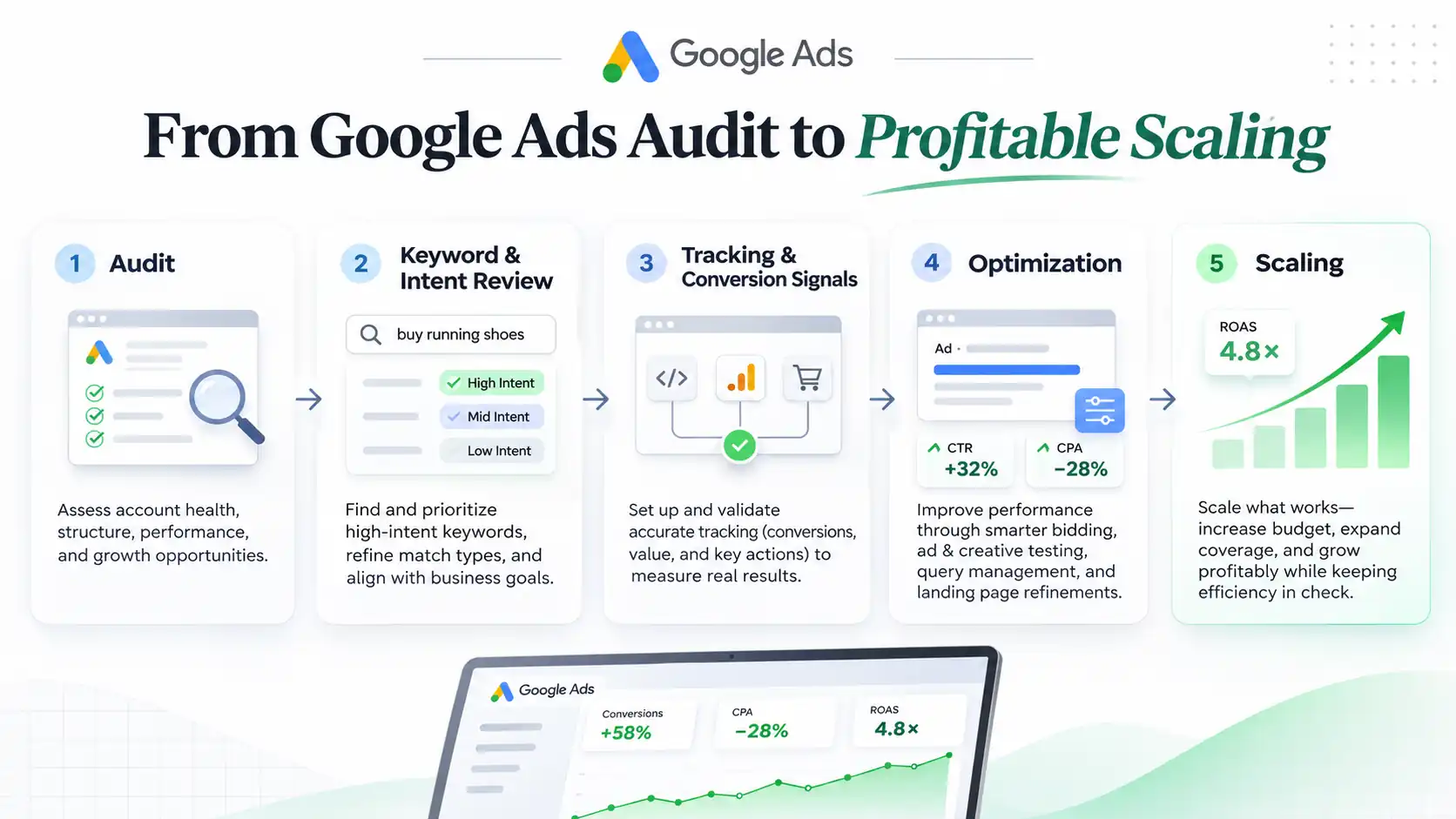
How I Approach Google Ads Campaigns: From Account Audit to Profitable Scaling
My approach to Google Ads management starts with understanding the business, not immediately creating campaigns or changing bidding strategies.
Before recommending a Google Ads strategy, I want to understand what the business sells, who its customers are, how conversions are measured and what acquisition costs it can sustainably afford.
As a Google Ads expert in India, I follow a structured process that connects campaign strategy, search intent, conversion tracking, advertising optimization and business profitability.
Here is how I approach the process.
Step 1: Google Ads Account Audit and Performance Analysis
For an existing Google Ads account, I begin by examining historical campaign performance to identify what is working, what is consuming unnecessary budget and where potential growth opportunities exist.
I review campaign structure, spending patterns, conversion actions, bidding strategies, search terms, audience and location performance, and the relationship between advertisements and landing pages.
However, my first priority is not necessarily finding the campaign with the highest CPC or lowest ROAS.
I want to understand whether the account is measuring the right business outcomes and whether its reported performance can be trusted.
For example, a campaign reporting inexpensive leads may appear successful until CRM data reveals that very few enquiries become qualified opportunities.
Similarly, an ecommerce campaign can report an attractive ROAS while acquiring customers at a cost the business cannot sustainably support.
The outcome of this stage: A prioritized understanding of the account’s performance problems, measurement gaps and potential growth opportunities.
Step 2: Keyword Research, Search Intent and Campaign Strategy
Once the business objectives and existing performance are clear, I determine which Google Ads campaign types and targeting approaches are most appropriate.
For Google Search Ads, this means identifying keywords that reflect relevant customer needs and distinguishing informational searches from commercial and transactional intent.
I evaluate keyword relevance, search terms, match types, negative keywords, landing-page alignment and potential conversion value rather than selecting keywords only because they have high search volume.
For Google Shopping and Performance Max campaigns, the strategic considerations are different.
Product feeds, Merchant Center information, product margins, conversion values and asset quality can become more important than traditional keyword-level campaign structures.
I also consider whether campaigns should be separated by business objectives, products, services, locations or other commercially meaningful differences.
The outcome of this stage: A campaign strategy designed around customer intent, business objectives, available advertising opportunities and budget allocation.
Step 3: Conversion Tracking, GA4 and Measurement Setup
Before making major optimization decisions, I want confidence that the campaign’s conversion data represents meaningful customer actions.
This involves reviewing Google Ads conversion goals, website events, GA4 measurement, conversion values and available CRM or ecommerce data.
For lead-generation campaigns, I distinguish between form submissions, qualified enquiries and customers wherever the business has sufficient data.
For ecommerce campaigns, I evaluate purchase tracking, transaction values, attribution differences and the relationship between advertising reports and actual business outcomes.
I also review whether conversion counting, attribution settings or duplicate events could be influencing reported performance.
Accurate tracking matters because Google’s automated bidding strategies use conversion information to support optimization decisions.
If the underlying signals are misleading, even a technically well-structured campaign can make inefficient spending decisions.
The outcome of this stage: More reliable measurement and clearly defined conversion goals that support meaningful campaign optimization.
Step 4: Campaign Optimization and Controlled Testing
Once the campaigns are running and collecting useful performance data, I focus on identifying improvements that can influence acquisition efficiency.
The specific actions depend on the campaign type and the problem revealed by the data.
For Google Search campaigns, this may involve reviewing search terms, improving ad relevance, refining negative keywords or testing landing-page messaging.
For Google Shopping, optimization may involve examining product-level performance, feed information, product availability or the distribution of advertising spend across products.
For Performance Max, I examine available campaign insights, asset performance, conversion signals, bidding targets and relevant business outcomes.
Where there are signs of weak conversion performance, I also look beyond the advertising account.
A poorly converting landing page, unclear offer or unnecessarily complicated enquiry process can increase acquisition costs even when the advertising traffic is relevant.
I prefer making changes based on a specific performance hypothesis rather than changing several campaign settings simultaneously.
The outcome of this stage: A repeatable optimization process that uses meaningful performance data to improve advertising efficiency and conversion outcomes.
Step 5: Scaling Google Ads Campaigns With Business Economics in Mind
Scaling is not simply increasing the daily advertising budget because a campaign generated conversions yesterday.
Before recommending additional investment, I evaluate whether the campaign has demonstrated sufficiently consistent performance and whether the business can support acquiring more customers at the expected cost.
For lead-generation campaigns, that means considering CPL, qualified lead rates, sales conversion rates and customer acquisition cost.
For ecommerce campaigns, I consider ROAS, conversion value, product margins, contribution economics and other available business data.
When the results support expansion, potential scaling opportunities may include increasing budgets, expanding relevant search coverage, testing additional products or services, and exploring new campaign opportunities.
However, higher budgets can change delivery patterns, traffic costs and acquisition efficiency.
That is why I prefer controlled scaling, continued measurement and regular performance reviews rather than assuming historical CPL or ROAS will remain unchanged as spending increases.
The outcome of this stage: A measured approach to increasing advertising investment while monitoring acquisition costs, conversion quality and profitability constraints.
Why My Google Ads Strategy Goes Beyond Campaign Settings
Google Ads performance is influenced by more than what happens inside the advertising dashboard.
Pricing, product demand, competition, landing-page experience, offer positioning, sales follow-up and conversion measurement can all affect the results a business achieves from paid advertising.
This is why I approach Google Ads as part of a broader performance marketing funnel, connecting advertising activity with the customer journey and measurable business outcomes.
For some businesses, the biggest opportunity may be better keyword targeting. For others, it may be fixing conversion tracking, improving the landing page or understanding why existing leads are not becoming customers.
My objective is to identify the changes most likely to improve customer acquisition, prioritize them based on evidence and scale advertising investment only when the business economics support doing so.
Google Ads for Different Business Models: Ecommerce, EdTech and Lead Generation
One of the most important lessons from my experience in performance marketing is that the same Google Ads strategy does not work equally well for every business.
An ecommerce brand selling physical products has different customer acquisition economics from an EdTech company selling online courses or a service business generating consultation enquiries.
As a Google Ads specialist in India, I approach campaign planning around the business model, customer buying journey, conversion objectives and the financial value of acquiring a customer.
Google Ads for Ecommerce and D2C Brands
For ecommerce and direct-to-consumer businesses, the objective is generally to acquire customers and generate purchase revenue at an economically sustainable advertising cost.
Google Search, Shopping and Performance Max can play different roles depending on product demand, feed quality, competition and available conversion data.
However, I do not believe a product generating the highest ROAS is automatically the best product to scale.
For example, two products might generate identical advertising revenue, but differences in product margins, delivery costs, returns and customer acquisition expenses can produce very different business outcomes.
When evaluating Google Ads for ecommerce, I focus on:
- Product-level economics: Understanding margins, average order value, acquisition costs and which products can support additional advertising investment.
- Google Merchant Center and product feeds: Reviewing product information, availability, titles and other attributes that affect Shopping campaign eligibility and relevance.
- Search and Shopping performance: Identifying commercially relevant demand and understanding which products or queries contribute to conversions.
- Conversion value and ROAS: Measuring advertising revenue while accounting for differences between attributed sales and business profitability.
- Scaling opportunities: Prioritizing products and campaigns with sufficient performance evidence and sustainable acquisition economics.
For D2C brands, my broader performance marketing approach for ecommerce also considers the relationship between paid advertising, landing-page conversion rates, customer acquisition costs and growth.
Google Ads for EdTech, Online Courses and Education Businesses
Education businesses have a different challenge. The advertising conversion is not always the final business outcome.
Depending on the offer, Google Ads may be used to generate webinar registrations, course enquiries, counselling appointments or direct course-related conversions.
The distinction matters because a low registration CPL does not automatically translate into an affordable student acquisition cost.
For EdTech and online course campaigns, I evaluate the relationship between search intent, course positioning, advertising messages, landing pages and the specific conversion action being measured.
My key considerations include:
- Course-specific search intent: Distinguishing people researching a subject from those evaluating a particular course or training program.
- Offer and landing-page alignment: Ensuring the advertisement accurately communicates the course, intended audience and next step.
- Conversion definitions: Separating registrations, enquiries, attributed course conversions and confirmed enrollments.
- Lead quality: Understanding whether prospective students meet the business’s qualification criteria when the campaign uses a lead-generation funnel.
- Acquisition economics: Evaluating advertising costs against enrollment or purchase outcomes where reliable downstream data is available.
My documented EdTech Google Ads case study recorded approximately 656 attributed frontend course conversions at around ₹109 per conversion.
That result demonstrates experience managing course-related conversion objectives, but the reported conversion count should not be confused with independently verified student enrollments.
Google Ads for Service Businesses and Qualified Lead Generation
For service businesses, Google Ads often provides an opportunity to reach people actively searching for a particular solution, provider or professional service.
However, generating enquiries is only the beginning. The business ultimately needs potential customers who are relevant, contactable and capable of progressing through the sales process.
This becomes particularly important for industries with longer customer journeys, such as B2B services, real estate, consulting and high-consideration services.
When planning Google Ads for lead generation, I focus on:
- Commercial keyword intent: Identifying searches that indicate a potential need for the service rather than general information gathering.
- Geographic relevance: Aligning campaign location settings and location-specific messaging with the business’s actual service areas.
- Search term quality: Identifying irrelevant traffic and opportunities to improve keyword and negative keyword coverage.
- Lead conversion experience: Reviewing enquiry forms, consultation booking processes, landing pages and conversion tracking.
- Qualified lead economics: Measuring CPL alongside qualification rates, sales feedback and eventual customer acquisition costs.
In an Ayurveda-focused Google Ads campaign, my documented results included 5,030 leads at approximately ₹87.65 CPL, demonstrating experience with measurable lead acquisition.
However, whether that CPL is commercially attractive depends on lead quality, subsequent conversions and the business’s financial targets.
Which Google Ads Strategy Is Right for Your Business?
The most suitable Google Ads strategy depends on what your business sells and how customers make purchasing decisions.
| Business Model | Primary Objective | Important Performance Metrics |
|---|---|---|
| Ecommerce and D2C | Product purchases and revenue | Purchase CPA, ROAS, CAC, product margins |
| EdTech and Online Courses | Course enquiries, registrations or purchases | CPL, conversion CPA, enrollment cost |
| Service Businesses | Relevant enquiries and consultation bookings | CPL, qualified CPL, lead-to-customer rate, CAC |
| B2B Lead Generation | Qualified opportunities and customers | CPQL, opportunity cost, CAC, pipeline outcomes |
These metrics are not exhaustive, and the appropriate measurement framework depends on the campaign’s objectives and available business data.
My approach is to choose the Google Ads strategy that fits your business model, measure the outcomes that matter commercially and optimize campaigns around sustainable customer acquisition rather than platform metrics alone.
How I Measure Google Ads Performance Beyond Clicks, CPC and ROAS
One of the biggest differences between running Google Ads campaigns and managing them for business growth is understanding what the advertising metrics actually represent.
As a Google Ads expert in India, I evaluate campaign performance using a combination of advertising data, conversion quality and business outcomes.
Metrics such as impressions, clicks, click-through rate (CTR), cost per click (CPC) and ROAS are important. However, none of them independently tells you whether your advertising investment is generating sustainable business growth.
Which Google Ads Metrics Matter Most?
The metrics I prioritize depend on the business model and the objective of the campaign.
| Metric | What It Tells Us | Why It Matters |
|---|---|---|
| CTR | How frequently people click after seeing an ad | Helps evaluate ad response and relevance |
| CPC | Average advertising cost per click | Helps evaluate traffic acquisition costs |
| Conversion Rate | How frequently eligible interactions generate conversions | Helps identify conversion efficiency |
| CPL | Advertising spend per recorded lead | Measures initial lead acquisition efficiency |
| Cost per Qualified Lead | Advertising spend per qualified enquiry | Connects lead generation with commercial relevance |
| CPA | Advertising spend per attributed acquisition or defined conversion | Helps evaluate the cost of the intended action |
| ROAS | Attributed conversion value divided by advertising spend | Helps evaluate advertising revenue efficiency |
| CAC | Customer acquisition cost under a defined cost methodology | Connects acquisition spending with actual customers |
For example, a lead-generation campaign can achieve a low CPC but still struggle with expensive customer acquisition if most visitors do not submit an enquiry or the resulting leads rarely convert into customers.
Similarly, a Google Shopping campaign can report strong ROAS while generating insufficient contribution margin after accounting for product costs, fulfillment, returns and other expenses.
Why I Compare Google Ads Data With GA4 and Business Records
Google Ads reporting helps explain how the advertising platform attributes conversions to campaigns, advertisements and other eligible interactions.
However, Google Ads, GA4, ecommerce platforms and CRM systems may report different figures because they use different attribution models, conversion definitions and reporting rules.
I do not assume that every difference represents a tracking error. Instead, I investigate whether the data is consistent enough to support reliable decisions.
For ecommerce businesses, this means reviewing attributed purchase values alongside actual order information where available.
For lead-generation businesses, it means comparing recorded advertising conversions with genuine enquiries, qualified opportunities and customer outcomes.
This additional context helps distinguish campaigns that generate activity from campaigns that contribute meaningfully to the business.
How I Decide Whether a Google Ads Campaign Is Ready to Scale
Before increasing advertising investment, I want to understand whether the campaign has demonstrated consistent results and whether the business can afford to acquire additional customers at the expected cost.
My assessment typically considers three questions:
- Performance: Is the campaign producing meaningful conversions at an acceptable acquisition cost?
- Measurement: Can we trust the conversion data and understand the quality or value of the resulting customers?
- Economics: Do margins, customer acquisition costs and other business considerations support additional investment?
A campaign that satisfies these conditions may be a candidate for controlled scaling, although performance can change as budgets and delivery expand.
For a deeper explanation of how these metrics work together, read my guide to performance marketing metrics, including ROAS, CAC, CPL and conversion rate.
My objective is not simply to make Google Ads reports look better. It is to help businesses understand which advertising investments are generating valuable outcomes and where the next opportunity for improvement exists.
Why Work With Me as Your Google Ads Expert in India?
When hiring a Google Ads expert in India, businesses need someone who understands both the advertising platform and the commercial objectives behind their campaigns.
I’m Deepak Singh, a performance marketing professional with nearly 10 years of hands-on experience across Google Ads, Meta Ads and YouTube advertising.
My experience spans lead generation, EdTech, ecommerce, D2C brands and service businesses, with a focus on connecting advertising performance to measurable customer acquisition outcomes.
1. Nearly 10 Years of Hands-On Performance Marketing Experience
My background goes beyond campaign setup and routine account management.
I’ve worked on paid acquisition strategies involving campaign planning, audience and keyword research, advertising creatives, landing pages, conversion tracking, performance analysis and scaling.
This cross-functional experience helps me evaluate advertising problems in context rather than assuming every performance issue can be solved by changing campaign settings.
2. Documented Google Ads Campaign Results
I believe campaign experience should be supported by evidence rather than generic promises about generating leads or improving ROAS.
My published Google Ads case studies include:
- Ayurveda lead generation: 5,030 leads generated at approximately ₹87.65 CPL through Google Ads.
- EdTech advertising: Approximately 656 attributed frontend course conversions at ₹109 cost per conversion.
Both campaigns demonstrate experience with measurable acquisition objectives. They are not guarantees of similar outcomes for every business.
3. Expertise Across Google Ads, Meta Ads and YouTube
Although this page focuses on Google advertising, my experience also includes managing performance campaigns across Meta and YouTube.
That broader perspective helps when evaluating how Google Search, Shopping and Performance Max fit into a business’s wider paid acquisition strategy.
For example, Google Search may help capture existing demand, while other advertising channels may play different roles in generating awareness, introducing offers or supporting subsequent conversions.
I consider these differences when evaluating channel performance, attribution and budget allocation.
4. A Strong Focus on Lead Quality and Customer Acquisition Economics
I don’t evaluate advertising success through impressions, clicks and reported conversions alone.
For lead-generation businesses, I want to understand whether enquiries are relevant and how efficiently they progress toward becoming customers.
For ecommerce businesses, I consider acquisition costs, advertising revenue and product economics when reviewing opportunities for growth.
This approach helps separate campaigns that look efficient inside Google Ads from those contributing meaningfully to business performance.
5. Practical Campaign Diagnosis Instead of Generic Recommendations
Every Google Ads account has different constraints. Some businesses struggle with irrelevant search traffic, while others have unreliable conversion tracking, weak offers or poorly converting landing pages.
My preference is to identify the problem, examine the available evidence and prioritize changes based on their potential impact.
That may involve improving an existing campaign rather than recommending an entirely new advertising structure.
What You Can Expect When Working With Me
My approach to a Google Ads engagement is built around understanding your business objectives and identifying the work required to improve advertising performance.
- Business-first discussion: Understand your offer, target customers, advertising budget and acquisition goals.
- Account assessment: Review the existing campaign strategy, conversion measurement and performance challenges where applicable.
- Prioritized recommendations: Identify which opportunities deserve attention first instead of changing everything simultaneously.
- Performance-focused execution: Align campaign work with relevant conversions, acquisition efficiency and available business data.
- Clear measurement: Distinguish reported advertising results from verified sales or customer outcomes whenever the underlying data permits.
The precise scope of an engagement depends on your business requirements, existing account setup and the level of support needed.
If you’re looking for a Google Ads specialist who combines hands-on advertising experience with an understanding of lead generation, conversion tracking and customer acquisition economics, I’d be happy to discuss your requirements.
Discuss Your Google Ads Requirements
Google Ads Expert vs Agency vs Freelancer: Which Should You Hire?
When businesses look for a Google Ads expert in India, they often compare independent specialists, freelance PPC professionals and digital marketing agencies.
Each option can be suitable depending on your advertising budget, campaign complexity, internal resources and the level of support you need.
One important distinction is that a Google Ads expert and a freelancer are not necessarily different categories. An experienced specialist may work independently, as a consultant, or within an agency.
The real question is who will manage your campaigns, what expertise they bring and how accountable they are for the work.
Comparing Your Google Ads Management Options
| Factor | Independent Google Ads Expert | Google Ads Freelancer | Google Ads Agency |
|---|---|---|---|
| Best Suited For | Businesses seeking specialist strategy and hands-on expertise | Businesses needing flexible campaign support | Businesses requiring multiple marketing services or a larger delivery team |
| Campaign Management | May be handled directly by the specialist | Generally handled by the individual | May involve account managers and specialists |
| Communication | Potential for direct specialist access | Usually direct communication | Depends on team structure |
| Scope of Services | Depends on individual expertise | Depends on skills and capacity | May cover advertising, creative, analytics and development |
| Pricing | Varies by experience and engagement | Varies by scope and expertise | Varies by agency size, services and account complexity |
These are general differences, not fixed rules. Some freelancers operate with extensive teams, while certain agencies provide direct access to senior Google Ads specialists.
What Should You Check Before Hiring a Google Ads Specialist?
Rather than choosing purely on price or agency size, I recommend evaluating the following:
- Relevant campaign experience: Has the professional worked with your business model and advertising objectives?
- Evidence of performance: Can they explain documented results, conversion definitions and campaign limitations?
- Hands-on involvement: Who will actually audit, manage and optimize your Google Ads account?
- Measurement capabilities: Do they understand conversion tracking, GA4, attribution and customer acquisition economics?
- Account ownership: Will your business retain appropriate access and control over its advertising account and data?
- Communication and reporting: How will campaign performance, recommendations and ongoing work be communicated?
When Does Working With an Independent Google Ads Expert Make Sense?
Working with an independent Google Ads specialist can make sense when you want direct involvement from an experienced practitioner and your primary requirement is improving paid acquisition performance.
An agency may be more suitable when your business also needs a coordinated team for creative production, website development, analytics and other marketing functions.
Neither arrangement automatically produces better results. The quality of execution, measurement, communication and business understanding matters more than the label.
My focus is on providing practical Google Ads expertise that connects campaign decisions with measurable lead generation, customer acquisition and advertising performance.
Before hiring anyone, make sure you understand who will manage your advertising budget, what services are included and how success will be evaluated.
Google Ads Management Fees in India: What Does It Cost to Work With an Expert?
Google Ads management fees in India depend on the complexity of your advertising account, monthly budget, campaign objectives and the level of support required.
Some businesses need an experienced Google Ads expert to audit and optimize existing campaigns, while others require complete campaign setup, conversion tracking, ongoing management and performance reporting.
As a result, there is no single management fee that applies to every business.
How Much Do Google Ads Experts Charge in India?
Published Indian agency and freelancer pricing examples in 2026 show monthly management fees starting around ₹10,000 to ₹25,000 for some smaller engagements, with more complex accounts and experienced providers charging substantially more.
Percentage-based arrangements are also common, with some providers charging approximately 10% to 20% of monthly advertising spend.
These figures are indicative market examples, not a fixed industry standard or my personal service rates.
Google Ads professionals typically use one of the following pricing models:
| Pricing Model | How It Works | When It May Make Sense |
|---|---|---|
| Fixed Monthly Retainer | A predetermined fee for an agreed management scope | Businesses requiring consistent campaign management |
| Percentage of Ad Spend | Management fee calculated as a percentage of advertising expenditure | Accounts where workload and complexity increase with spending |
| Hybrid Pricing | A base management fee combined with a variable component | Businesses requiring a customized engagement |
| One-Time Audit or Setup | A project-based fee for account assessment, setup or specific improvements | Businesses needing specialist help without ongoing management |
Google Ads Budget vs Management Fees: What’s the Difference?
Your Google Ads advertising budget and the fee charged by a specialist are two separate expenses.
Advertising budget: The amount allocated to Google’s advertising platform for displaying your advertisements and acquiring traffic or conversions.
Management fee: The amount charged for professional services such as campaign strategy, setup, optimization, tracking reviews and performance analysis.
Additional work involving landing-page development, creative production, advanced tracking or other technical requirements may be priced separately depending on the agreement.
Before hiring a Google Ads specialist, clarify which services are included, how advertising spend will be billed, whether applicable taxes are additional and who retains ownership of the advertising account.
What Should Be Included in Google Ads Management?
Rather than comparing professionals solely on their monthly fees, I recommend understanding what work will actually be performed.
A Google Ads management engagement may include:
- Account audit and campaign strategy
- Keyword research and search intent analysis
- Campaign setup and ongoing optimization
- Search term and negative keyword reviews
- Conversion tracking assessment
- Bidding strategy and budget management
- Ad copy and creative testing recommendations
- Landing-page improvement recommendations
- Performance reporting and strategic reviews
The exact deliverables should be agreed upon before the engagement begins.
How I Approach Google Ads Management Pricing
I prefer understanding your business requirements before discussing a management arrangement.
A business spending ₹50,000 per month on a single Search campaign may require a very different level of work from an ecommerce company managing multiple Shopping, Search and Performance Max campaigns.
Factors such as account complexity, conversion tracking requirements, advertising objectives and ongoing optimization needs should influence the scope of work.
My recommendation is to evaluate Google Ads management as an investment in better advertising decisions, measurement and customer acquisition, rather than choosing a provider based on the lowest quoted fee.
To discuss the appropriate scope and pricing for your business, share your Google Ads requirements with me.
Frequently Asked Questions About Hiring a Google Ads Expert in India
Who is a Google Ads expert, and what do they do?
A Google Ads expert is a professional who plans, manages and optimizes paid advertising campaigns across Google’s advertising platform.
Their responsibilities may include keyword research, Search Ads, Google Shopping, Performance Max, conversion tracking, bidding, budget management and campaign performance analysis.
An experienced Google Ads specialist should also understand how advertising contributes to lead generation, customer acquisition and business growth.
How do I choose the best Google Ads expert in India?
Start by evaluating relevant campaign experience, documented results, understanding of your business model and ability to explain advertising decisions clearly.
Ask who will manage your account, how conversions will be measured, what services are included and how performance will be reported.
The best choice is not necessarily the professional charging the lowest fee or making the biggest performance promises. Look for relevant expertise, transparent communication and a strategy aligned with your business objectives.
What is the minimum budget required to run Google Ads in India?
Google Ads does not have one universal minimum monthly advertising budget that applies to every business.
The appropriate budget depends on your industry, keyword competition, target location, expected cost per click, conversion rate and customer acquisition goals.
For example, a business targeting competitive commercial keywords may require a different budget from a company advertising niche services in a limited geographic area.
Before deciding your advertising budget, estimate the number of clicks and conversions needed to evaluate performance meaningfully.
How long does it take to see results from Google Ads?
Google Search campaigns can begin generating impressions and clicks after they become eligible to serve, but generating consistent, commercially valuable conversions may take longer.
The timeline depends on campaign setup, bidding strategy, competition, budget, conversion tracking and the quality of your landing page and offer.
Some campaigns generate enquiries or purchases early, while others require additional testing and optimization.
I recommend evaluating Google Ads performance using sufficient conversion data rather than expecting a guaranteed result within a fixed number of days.
Should I hire a Google Ads expert or manage campaigns myself?
Managing Google Ads yourself can make sense if you have the necessary platform knowledge, time and experience interpreting campaign performance.
Hiring a Google Ads professional becomes more valuable when your campaigns involve substantial advertising budgets, multiple campaign types, complex tracking requirements or ongoing performance challenges.
A specialist can help identify acquisition inefficiencies, prioritize improvements and connect advertising decisions with your business objectives.
However, hiring an expert does not remove the need for a competitive offer, effective landing pages and a commercially viable customer acquisition model.
Can a Google Ads expert guarantee leads, sales or ROAS?
No responsible Google Ads specialist should guarantee a specific number of leads, sales or ROAS without understanding the business and its advertising environment.
Campaign results depend on factors including competition, demand, pricing, creative quality, landing-page performance, conversion tracking and customer behavior.
A Google Ads expert can develop a strategy, manage campaigns, identify opportunities and work toward agreed performance objectives, but advertising outcomes cannot be guaranteed.
Will I own my Google Ads account if I hire an expert?
I recommend that businesses retain ownership and appropriate administrative access to their Google Ads accounts, conversion data and connected business assets.
A specialist or agency can be granted the necessary management permissions without requiring the business to surrender control of its advertising account.
Before starting an engagement, clarify account access, billing arrangements, reporting responsibilities and what happens if the working relationship ends.
Can you help with an existing Google Ads account that’s not performing well?
Yes. My Google Ads work includes reviewing existing campaigns to identify potential issues with keyword targeting, search terms, bidding, campaign structure, conversion tracking and acquisition performance.
An existing account audit can help determine whether the priority should be improving current campaigns, correcting measurement problems, refining the conversion funnel or testing new acquisition opportunities.
The recommendations depend on what the account data reveals. Not every underperforming campaign needs to be rebuilt from scratch.
Looking for an Experienced Google Ads Expert in India? Let’s Talk.
If you’re investing in Google Ads but struggling with expensive leads, inconsistent conversions, weak ROAS or uncertainty about where your advertising budget is going, I can help you evaluate the opportunities for improvement.
I’m Deepak Singh, with nearly 10 years of hands-on performance marketing experience across Google Ads, Meta Ads and YouTube advertising.
My approach combines advertising strategy, conversion measurement, campaign optimization and customer acquisition economics to help businesses make better decisions about their marketing investment.
Whether you’re planning your first Google Ads campaign or looking to improve an existing account, the starting point is understanding your business objectives and current acquisition challenges.
Discuss Your Google Ads Requirements
To make our initial discussion more productive, you can share your business website, advertising objectives, approximate monthly budget and the challenges you’re currently facing.
We can then discuss the type of Google Ads support that may be appropriate for your business.