What should a Facebook Ads expert for ecommerce actually improve?
A Facebook Ads expert for ecommerce should connect Meta delivery to a product that people want, a page that helps them buy, and customers the business can afford to acquire. I do not judge the work from reported ROAS alone.
If I am asked to increase spend, I want to know which product and buyer group will receive that extra budget. I also want to know what happens after Meta counts a purchase: whether the order is fulfilled, what it contributes, and whether the customer is new.
That is the difference between buying more attributed orders and building a healthier acquisition system. My role is to make those decisions clearer and to define what needs testing before a larger budget commitment.
- Start with the product and economics. A high-ROAS campaign cannot rescue an offer whose delivered orders leave too little contribution.
- Test buying reasons, not only ad formats. Creative should make a promise that the product page can support.
- Scale the next customer cohort. New-customer cost, order quality and available stock matter more than yesterday’s best dashboard colour.
On this page
- When a Meta ecommerce specialist is useful
- My relevant ecommerce experience
- The SKU-Cohort Scaling Gate
- What different account signals can mean
- What to expect when working together
- Discuss your Meta ecommerce account
When is a Meta Ads ecommerce specialist the right hire?
A specialist is useful when Meta is an important source of product discovery or acquisition, but the business cannot connect campaign changes to new customers and fulfilled orders. Creative, campaign structure, store conversion and acquisition economics need to be considered together.
That does not mean Meta is the right answer for every product. Some products already have strong search demand. Others need a better offer, clearer proof or a more reliable fulfilment process before additional paid social spend is sensible.
I would begin with the decision you need help making. Are you choosing which SKU to feature, replacing tired creative, explaining a drop in product-page conversion, or deciding whether prospecting can take more spend? Those are different assignments.
If the question is a bounded account diagnosis, my Facebook Ads audit service is the more specific starting point. If you need a wider Meta capability profile, see my Facebook Ads expert in India page.
What my documented ecommerce work does, and does not, prove
My documented D2C hair-oil work generated ₹1.43 crore+ in cash-on-delivery revenue through Meta Ads. The work included UGC, testimonials, broad and lookalike audiences, retargeting and funnel optimization.
That is relevant hands-on Meta ecommerce experience. It does not establish net profit, cash collected after delivery, a new-customer share, or the result another brand can expect. COD revenue still needs cancellation, delivery and contribution context.
My women’s-fashion work also includes ₹1.05 crore+ revenue and 493% growth. This supports broader ecommerce experience, but the available project evidence does not assign that outcome to Meta alone. I would not present it as a Facebook Ads case study.
These distinctions are useful when you evaluate any ecommerce specialist. Ask what the figure counts, which channel contributed, over what period, and whether it describes placed orders, collected revenue or profit. Bigger numbers are less useful when their boundaries are unclear.
My SKU-Cohort Scaling Gate: can this product earn the next Meta rupee?
I use the SKU-Cohort Scaling Gate to assess a proposed increase for one product and buyer group. It connects product contribution, the creative promise, product-page continuity, new-customer acquisition, fulfilled order quality and the next-spend test. If a gate lacks evidence, I name the gap before recommending more budget.
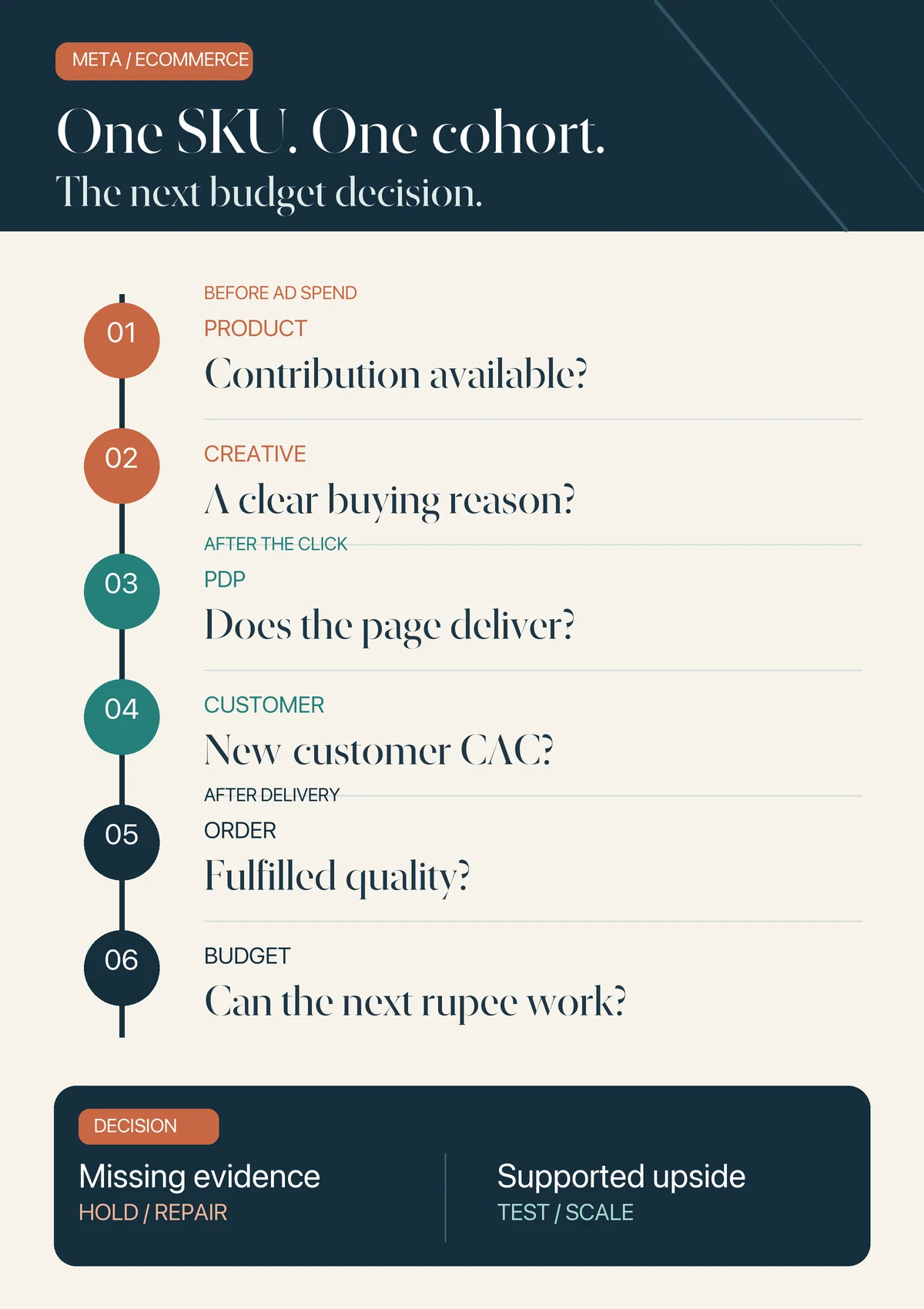
- Product contribution: What remains after the product, discount and variable order costs? If the basket cannot support acquisition, improve the offer or product choice before scaling traffic.
- Creative promise: Which buying reason does the ad test, and who is it likely to attract? If clicks come from the wrong expectation, change the message before judging the audience alone.
- Product-page continuity: Does the PDP deliver the same promise and remove the buyer’s main uncertainty? If relevant visitors hesitate there, page work may deserve the next rupee.
- New-customer acquisition: Are prospecting campaigns adding buyers at an acceptable cost, or is reported ROAS concentrated in returning customers and retargeting? Use a consistent new-customer definition.
- Fulfilled order quality: Do orders survive cancellations, returns and delivery costs? For COD, a placed purchase is not the last outcome to examine.
- Next-spend test: Which product-cohort combination has enough evidence and operational capacity for more spend? Define a hold, repair, test or scale decision and the signal that would reverse it.
This is a decision gate, not a claim that every product needs the same campaign structure. A product can pass the creative test and fail on contribution. Another can have healthy economics but too little creative evidence to justify an immediate increase.
Product and offer set the acquisition boundary
I start with the basket people actually buy, not only the listed product price. Discounts, packaging, payment costs, shipping and expected losses can change what remains to acquire a customer. The business should provide its own assumptions and decide what profit or payback it requires.
Average order value can rise without the acquisition becoming healthier. A bundle may add revenue and also add cost or increase returns. I want to see the contribution available after the order’s variable costs, not treat a higher AOV as permission to buy more traffic.
If repeat purchase supports a higher first-order acquisition cost, I need evidence from comparable customer cohorts and a cash-flow horizon the business can accept. I would not fund today’s spend with an optimistic lifetime-value number that has not materialized.
Creative should qualify the right buyer
On Meta, I want each creative test to express a buying reason. A demonstration may answer whether the product works as shown. A testimonial may address trust. UGC may make an explanation easier to believe, but its format does not make a weak claim accurate.
I separate a new idea from a new edit. Changing the first frame, colour or soundtrack can help delivery, but it may teach little if the buying reason remains identical. I would record which product, offer, objection and audience expectation the test is meant to examine.
Cheap clicks are not automatically cheap customers. If a dramatic promise attracts people the product cannot satisfy, it may improve early platform signals while harming purchase quality or raising returns later. Creative-market fit must survive the order experience.
The PDP and checkout must complete the promise
The product detail page should make the ad’s promise easy to verify. I look at the first mobile view, variant and size clarity, price, delivery terms, evidence, objections and the path to checkout. A campaign change cannot repair every page problem.
Suppose, hypothetically, that click volume holds steady while product-page purchases fall. I would compare the ad-to-page message, page behaviour, variant availability and checkout friction before declaring that Meta found the wrong audience. The same platform symptom can start after the click.
When the page owner and media buyer are different people, the decision needs a handoff. The media team can identify a mismatch and propose a test; the store team may need to implement it. Ownership should be agreed, not assumed.
New customers and fulfilled orders decide whether scale is real
Prospecting and retargeting do different jobs. Retargeting can help a known shopper complete a purchase, but its reported ROAS does not establish that the next prospecting rupee will acquire a new buyer at the same efficiency.
I would compare new-customer counts and acquisition cost with returning-customer activity where the store can provide a reliable definition. Platform purchase CPA is not automatically new-customer CAC. For a fuller explanation of that distinction, see my ROAS vs CAC guide.
For COD, I want to know how many placed orders were confirmed and delivered, and what cancellations or returns do to contribution. The hair-oil revenue proof shows Meta acquisition work at meaningful scale; it does not remove this order-quality question.
Inventory also matters. If the advertised SKU or popular variants cannot be replenished, more demand may buy clicks for products the customer cannot purchase. That is an operating constraint, not a targeting defect.
What I check when the dashboard and business disagree
ROAS looks strong, but new-customer growth is flat
I would separate prospecting from retargeting and compare the mix with the store’s new-customer trend. A high return from people who already knew the brand may still be useful, but it does not answer whether Meta is creating enough additional demand.
The next action may be a new buying-reason test or a more disciplined prospecting allocation, not simply increasing the campaign with the highest attributed ROAS. I would keep uncertainty visible because platform reports alone cannot prove a counterfactual sale.
Clicks look healthy, but product purchases weaken
I would inspect whether the creative and PDP tell the same story. If the product page loses the expected buyer, I would look at price, trust, variants, delivery promise and mobile friction alongside traffic quality.
A broader audience rebuild is not automatically the fix. The concern might be the offer or store experience. A focused page test could be a better use of the next budget than additional media spend.
Spend rises, but fulfilled-order economics deteriorate
I would compare the new spend with new customers, contribution, delivery status and stock capacity over a comparable period. Higher volume can be healthy even if reported ROAS softens, provided the additional customers remain economically worthwhile.
If cancellations or variable costs rise faster than acquired customer value, the account may need a hold or operational repair. A green purchase dashboard does not settle the business decision. These are conditional examples, not descriptions of an undocumented client campaign.
What should an ecommerce business expect from the expert?
I can assess Meta campaign direction, creative hypotheses, audience and budget logic, tracking signals and the conversion journey. The actual engagement should state which parts I will execute, which I will advise on, and which require your creative, store, finance or fulfilment teams.
Almost 10 years of hands-on performance marketing have taught me to treat those handoffs as part of the acquisition decision. A media buyer cannot guarantee the product margin, stock position or delivery outcome. Those inputs still determine whether the next budget increase makes sense.
If your team already runs campaigns and needs recurring strategic direction, Facebook Ads consulting may fit. If the need is repeated campaign operation and testing, the management-services page covers that scope. Neither label should silently promise creative production, page development or fulfilment work.
If the problem spans Meta, Google, YouTube and the wider store, my D2C performance-marketing guide explains the broader acquisition system. This page stays focused on the specialist judgment needed inside Meta.
What should you bring to an initial discussion?
- The product or category you want to grow, its offer and the buyer you want to reach.
- Recent Meta spend, major creative changes and the decision you are unsure about.
- Product-page and checkout links, plus available purchase and customer data.
- Margins or contribution assumptions, order status, returns and repeat-purchase evidence if you have them.
- Stock, variant, delivery and team constraints that could limit a successful test.
You do not need to send customer-level records or personal passwords to begin a conversation. First agree what question needs answering and what access, if any, the work requires. Where evidence is missing, I would identify it rather than imply the dashboard can fill every gap.
Does the store need to use Shopify?
No. The important issue is whether the store can show the product journey and connect campaign activity to customer and order outcomes. Shopify, WooCommerce or another platform may expose that evidence differently; the work should fit the actual store and the people who maintain it.
Can I promise a target ROAS or a fixed growth timeline?
No responsible expert can promise those for an unseen product and account. The useful first commitment is a defined question, scope, evidence basis and review point. A target must reflect the business’s margins, customer mix, fulfilment and appetite for investment.
Discuss your Meta ecommerce acquisition decision
If you are looking for a Facebook Ads expert for ecommerce, use this website’s contact options to share your store, the product you want to grow and the budget decision you face. Tell me whether the current concern is creative response, PDP conversion, new-customer CAC or fulfilled-order quality.
We can then define the evidence needed and decide whether a focused diagnosis, strategic support or ongoing execution is the right scope. The goal is not a more impressive dashboard. It is a better-supported decision about the next customer and the next rupee.