What should a Facebook Ads consultant in India help you decide?
A Facebook Ads consultant should help you understand what is limiting your Meta acquisition, decide which changes deserve priority, and give your team a practical way to implement and assess them. That can include an account audit, creative direction, funnel recommendations, tracking review and budget decisions. The scope should make clear whether the consultant advises, executes, or does both.
I’m Deepak Singh, based in New Delhi, with almost 10 years of hands-on digital and performance marketing experience. When a business approaches me for Facebook Ads consulting, I want to understand the decision it is struggling to make. Should you increase spend, change the offer, repair measurement, improve qualification, or give your existing team a different testing direction?
This page explains my consulting approach and what an advisory engagement needs to produce. For a broader view of my relevant campaign experience, see my Facebook Ads expert in India page. Here, the focus is the work between identifying a problem and giving someone responsibility for the next step.
Request a consultation about your Meta Ads decisions.
Before you engage a consultant
- Know the decision you need help with. “Improve ads” is too vague to define a useful engagement.
- Confirm who will implement. Advice cannot compensate for an absent media buyer, creative team or technical owner.
- Connect campaign evidence to customer outcomes. Cheap CPL and reported ROAS alone do not settle the budget question.
- Ask how a recommendation will be reviewed. A plan needs an evidence standard, not only a list of changes.
On this page
- Consulting versus campaign management
- What I review before recommending changes
- What a useful recommendation contains
- Budget allocation and scaling decisions
- Deliverables and implementation boundaries
- Fees, evidence and review timing
- Access and preparation
- Discuss your account
When consulting is appropriate, and when you need execution
Consulting is most useful when someone can run the account but the business needs stronger judgment. You may have an internal media buyer, an agency or a founder managing campaigns. The missing piece might be an independent diagnosis, a creative testing direction or confidence about the next budget decision.
For example, your agency may recommend increasing spend while your sales team reports poorer enquiries. A consultant can review the evidence behind both views and define a test that addresses the disagreement. Replacing the agency immediately would be a different decision, requiring its own evidence.
A focused audit answers a defined question
A one-off Meta Ads audit can suit a bounded concern: why acquisition costs changed, whether reporting supports a scaling proposal, or whether creative and landing-page promises match. Agree on the question and available evidence before setting the scope. An audit should not expand into an undefined promise to fix the entire business.
Ongoing advisory supports repeated decisions
Ongoing consulting can help when new tests regularly create choices your team needs to discuss. The value is in interpreting what changed, updating priorities and coordinating the people who own the next actions. A recurring meeting without new evidence or decisions is a weak reason to retain an adviser.
Management owns the daily operating work
If nobody can launch campaigns, monitor delivery, coordinate assets and apply approved changes, execution is a separate requirement. You may need management, consulting plus implementation, or a team with clearer responsibilities. Define that arrangement explicitly rather than assuming “consultant” includes everything.
Consulting can also work alongside an agency. The operating team brings account context; the adviser tests assumptions and helps resolve priorities. Decision rights should be agreed so that competing instructions do not reach the media buyer. If the real question spans Google, YouTube and overall channel allocation, my performance marketing consulting approach is the broader starting point.
What I review before recommending a Meta Ads change
I review enough of the acquisition system to answer the agreed question. That does not mean every engagement requires a complete rebuild, every tool or an exhaustive settings checklist.
The business decision and the customer definition
I want the intended outcome stated clearly. A lead-generation business might need qualified sales conversations rather than form submissions. An ecommerce business might need additional new customers within a contribution limit rather than more reported purchase revenue.
We need working definitions for qualified leads, new customers and acquisition cost. I also want to understand the sales cycle, margin constraints and capacity to handle more demand. Those definitions tell us what evidence should govern the recommendation.
Creative direction and the conversion journey
Creative strategy starts with what the prospective buyer needs to understand. I would review the promise, buying reason, objections, proof and call to action across Facebook and Instagram ads. A proposed test should say which misunderstanding or hesitation it addresses.
A brief asking for “more UGC” is incomplete. It should explain what the speaker demonstrates, which objection the asset answers and what action a suitable buyer should take. Your production team still needs to know which formats it can realistically deliver.
Then I follow the ad into the mobile landing page, form, product page or checkout. If the price appears late or the page contradicts the ad, a creative change alone may not solve the problem. CRO recommendations should identify the friction, the proposed change and how to assess customer quality alongside conversion rate.
Tracking, attribution and sales feedback
I would inspect what the counted conversion represents, whether events are recorded consistently, and how platform reports relate to store or CRM records. Relevant evidence can include Meta Pixel, Conversions API, GA4 and GTM. Their presence on a checklist does not establish that measurement is reliable.
Browser and server reporting paths deserve validation where both are used. I want the technical owner to demonstrate that the intended action is counted correctly, rather than treating a setup label as proof. A discrepancy needs investigation before we assume either that campaigns failed or that tracking explains everything.
Attribution also changes interpretation. Google Analytics explains how different attribution models assign credit to touchpoints. That is a reason to document the model and reporting basis when comparing numbers. Assigning credit is a different question from proving that an ad caused an additional sale.
For leads, I want feedback on contact attempts, qualification, rejection reasons and paid outcomes. “Bad leads” needs a definition. Wrong geography, an unsuitable budget and no response after delayed follow-up imply different actions. My performance marketing audit framework covers the wider diagnostic process; the consulting scope decides which parts need investigation now.
The audit output I want: a recommendation someone can act on
I use a recommendation brief to connect diagnosis with execution: evidence, decision, owner, dependency and review trigger. It keeps a sensible observation from becoming an instruction nobody can apply or evaluate.
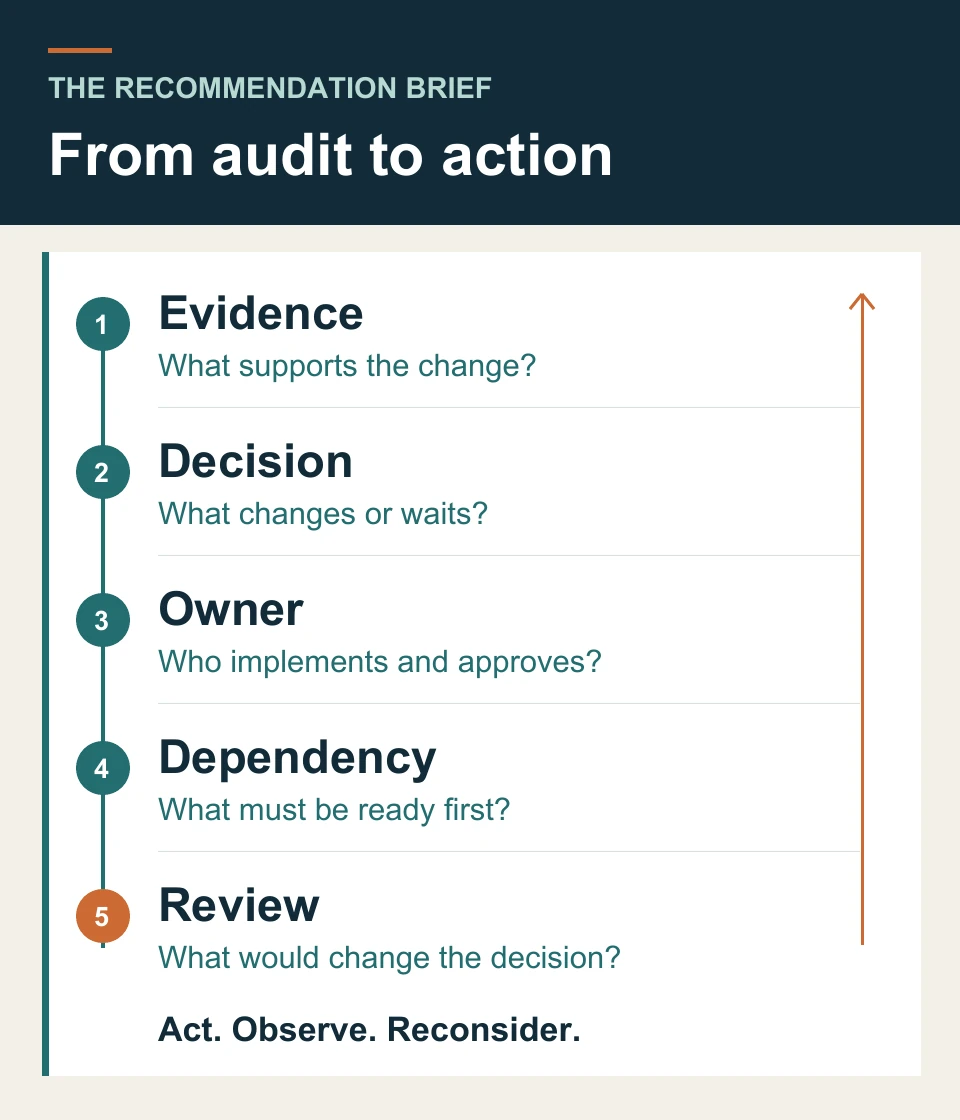
- Evidence: What observation supports the recommendation, and what remains uncertain?
- Decision: What should change, stay unchanged or wait?
- Owner: Who can implement it and who approves it?
- Dependency: What information, asset or technical work must exist first?
- Review trigger: What evidence will tell us to continue, revise or stop?
Here is a hypothetical recommendation, not a personal client result. Suppose an education business reports rising form submissions, but its CRM shows many prospects misunderstand the course price. The sales cycle has had time to mature, and the team has recorded consistent rejection reasons.
The decision could be to test clearer price and eligibility information in the ad and lead journey while holding the established campaign as a reference. The creative owner prepares the message; the media buyer runs the agreed test; sales applies the same qualification definition to both groups. The dependency is reliable source tagging and a consistent feedback process.
The review should compare qualification, paid-customer acquisition and follow-up coverage after enough comparable leads have matured. A higher CPL is not sufficient reason to reject the test if it produces better customer economics. Equally, improved qualification alone is insufficient if too few customers result.
The recommendation remains provisional. Perhaps the price explanation is the issue; perhaps a sales-process difference affected the evidence. Writing down the uncertainty makes it easier to challenge the diagnosis after the test.
A useful audit ends with a decision someone can implement and a condition under which that decision should be reconsidered.
How I approach budget allocation and scaling advice
A budget recommendation should explain what the next spend is expected to establish. I separate protecting proven acquisition, funding a defined test and expanding an approach whose customer economics remain acceptable. These uses of money deserve different review conditions.
A campaign with strong platform ROAS can contain returning customers or remarketing demand. That can be useful activity, but it does not automatically justify the next prospecting increase. I want the customer mix, order status and business acquisition trend visible before interpreting the number.
Average CAC can hide an expensive next step
Consider this simplified hypothetical scaling illustration. In one mature period, a business spends ₹1,00,000 on ads and acquires 100 unique new customers. In a comparable mature period, spend is ₹1,40,000 and the count is 120. Assume the customer definition and reporting basis are consistent.
- First-period media-only new-customer CAC: ₹1,00,000 ÷ 100 = ₹1,000.
- Second-period media-only new-customer CAC: ₹1,40,000 ÷ 120 = approximately ₹1,167.
- Additional-spend ratio: ₹40,000 ÷ 20 additional observed customers = ₹2,000.
If allowable acquisition spend is ₹1,500 per new customer, the second period’s average looks acceptable, while the additional-spend ratio deserves scrutiny. I would investigate before recommending another increase. The historical average alone is a weak basis for approving the next budget.
This comparison is a diagnostic clue, not causal proof of incremental CAC. Seasonality, promotions, other channels, customer mix and conversion lag could affect the difference. It also excludes consulting fees and other acquisition costs. For business-level CAC, agree which costs belong in the calculation and avoid counting the same customer across channels.
My ROAS and CAC comparison explains the metric distinctions in more detail. In consulting, the practical output is the proposed budget action, the assumptions behind it and the conditions for reassessment.
Contribution and fulfilment can change the recommendation
My documented D2C hair-oil work includes ₹1.43 crore+ COD revenue generated through Meta Ads, with UGC, testimonials, audience work, retargeting and funnel optimization. That is relevant Meta ecommerce experience. The revenue figure does not establish net profit, collected cash or the return your account should expect.
For a COD business, I would ask which orders were confirmed and delivered, and what cancellations, returns and fulfilment costs do to contribution. A higher basket value may raise revenue-based ROAS without improving the money available to acquire a customer. Optimistic repeat-purchase assumptions also need evidence and a payback period the business can afford.
My D2C paid acquisition framework covers that broader system. The consultant’s role here is to turn the economics into a defensible hold, test, reduce or increase decision, with the necessary operational checks.
What the engagement should deliver, and who implements it
Before work starts, I would define the output and its boundaries with you. Depending on the problem, a useful scope may include:
- A prioritized diagnosis separating observed facts, hypotheses and missing evidence.
- Campaign direction with the reason for each proposed change and what should be protected.
- Creative briefs covering message, objection, proof, format and destination.
- A funnel/CRO action list and a measurement issue log for the appropriate owners.
- A test and budget plan with review conditions, followed by an interpretation of the results.
These are possible deliverables to agree, not an assumption that every service is included. Creative recommendations are different from filming and editing. Tracking review is different from development. A CRM feedback design still needs the sales team to use it.
I served as Head of Performance Marketing at The DM School from February 2021 to August 2026. The documented role included campaign execution, CRO, tracking, CRM systems and management of teams ranging approximately from 15 to 30 people. That background is relevant to defining handoffs between specialists. It does not mean one adviser should silently own every function.
Agree who approves spend, who changes campaigns, who fixes events and who supplies customer feedback. If the same problem appears across several teams, identify one person responsible for moving the decision forward. A recommendation without an owner can remain technically sensible and operationally useless.
Consulting fees, ad spend and useful review timing
There is no published fixed consulting fee in this article. A quote needs the agreed scope: one account question, a broader audit, ongoing advisory or consulting with implementation. Account complexity, evidence availability, number of stakeholders and expected outputs affect the work.
Ask what the fee covers and what it excludes. Meta ad spend is separate from advisory work. Creative production, page changes and technical implementation may need separate ownership or costs. Compare proposals on the decisions and deliverables they support, rather than meeting count alone.
I would also separate a delivery date for the review from a date when business results can be judged. An event-counting issue can be investigated before a complete sales cycle finishes. Whether a new message improves paid-customer acquisition requires sufficient observations and time for those customers to emerge.
You do not need perfect data to start a discussion. If CRM evidence is incomplete, the first recommendation may be to improve it before committing more budget. A useful consultant should state what can be concluded now and what remains untestable. No fixed number of days guarantees improved performance.
What to prepare before a Meta Ads consultation
Start with the business goal and the unresolved decision. You can explain the situation before sharing account permissions.
- Your website, offer and intended customer, including price and geography where relevant.
- Recent spend and results, with reporting periods and definitions.
- The creatives and landing journeys currently used.
- Available qualification, sales or order-status evidence and the usual conversion delay.
- Previous tests, planned changes and the people available to implement.
For an agreed audit, use appropriate role-based access to the required assets. Keep business ownership under your control. Do not send personal passwords. Use aggregated or anonymized CRM evidence where it can answer the question, and agree any necessary additional access before providing customer records.
If an agency manages the account, include its context and previous test history. The aim is to assess the proposed actions fairly, not create a second reporting system that ignores what the operating team already knows.
Book a consultation about the decision your account needs
If you are looking for a Facebook Ads consultant in India, use this website’s contact options to request a consultation. Share your website, approximate spend range, current operating setup and the decision you need help making. For example: whether to scale, why qualified leads declined, or whether the next priority is creative, conversion or measurement.
We should first establish whether advisory work fits and who can implement the recommendations. The scope can then follow the actual problem, rather than a preselected package.
The output worth paying for is a better-supported decision your team can act on. You should understand the evidence, the person responsible for the next step and what would make us change direction. That is the standard I would bring to your Meta Ads consulting discussion.