Why Is Your YouTube Ads Cost Per Lead So High?
If your YouTube Ads CPL is too high, the problem is usually somewhere between the cost of attracting potential customers and the ability of your landing page or lead form to convert them.
You might be paying too much for traffic, reaching people with weak buying intent, using video creatives that generate views but not meaningful clicks, or sending interested viewers into a poorly converting lead-generation funnel.
But there is another possibility: your YouTube advertising campaign may be generating leads at a reasonable cost, while the business is measuring success against the wrong conversion event or an unrealistic CPL target.
That is why I would never start optimizing a high-CPL YouTube Ads campaign by immediately changing audiences, bidding strategies or campaign budgets.
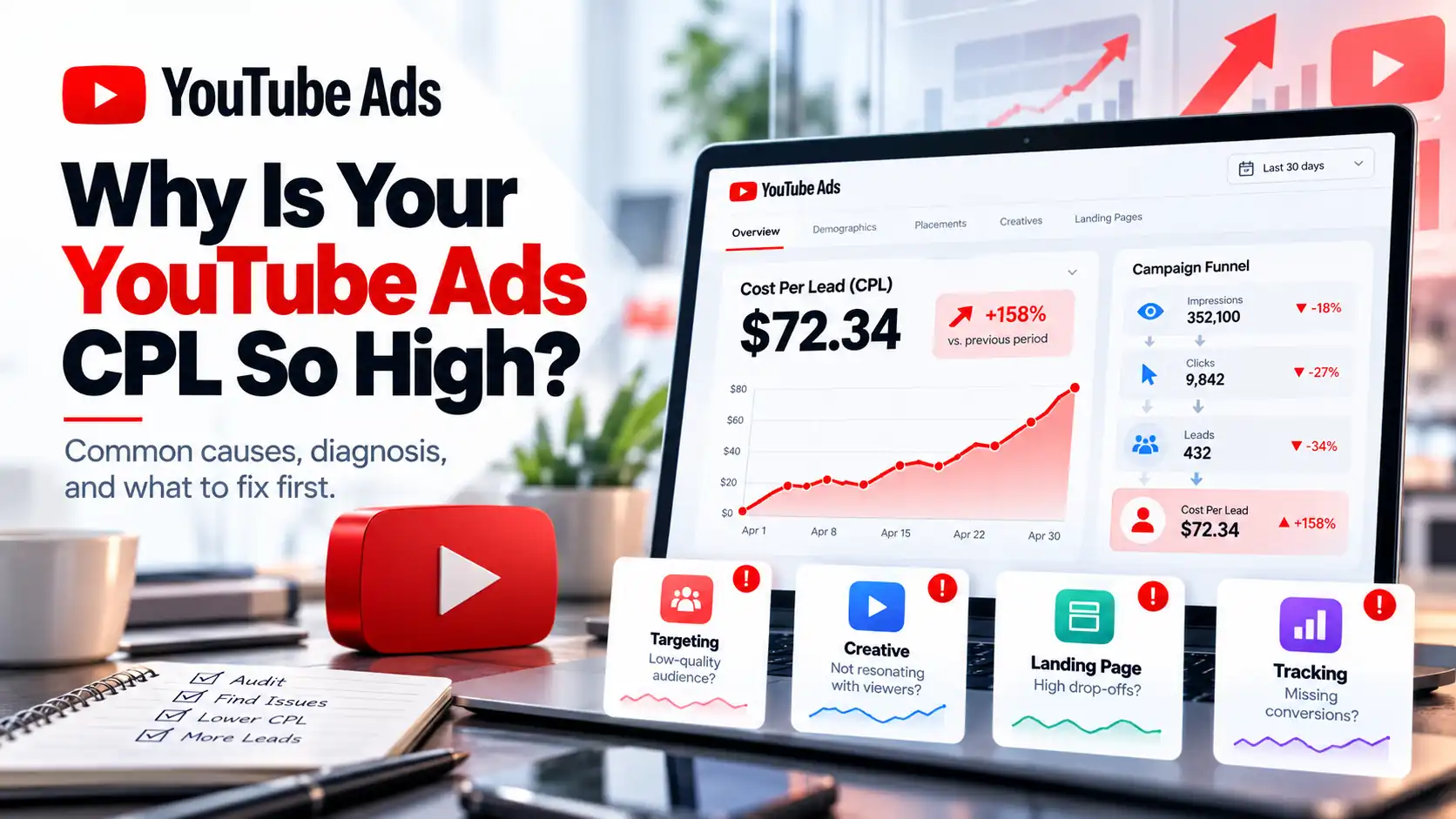
What Actually Causes High CPL in YouTube Advertising?
In Google Ads campaigns using YouTube inventory, several factors can influence the final cost per lead.
- Audience targeting: Your video ads may be reaching people who are interested in the content but unlikely to enquire about your product or service.
- Video ad creatives: Weak hooks, unclear offers or missing calls to action can generate impressions and views without enough qualified traffic.
- Media costs: Changes in CPM, CPC, bidding or competition can increase the amount you pay to attract potential leads.
- Landing-page conversion rate: Even relevant YouTube Ads traffic can become expensive when the landing page fails to convert visitors into leads.
- Offer positioning: Your lead magnet, consultation offer, webinar or enquiry proposition may not provide enough motivation to act.
- Campaign optimization: The conversion goal, bidding signals and available conversion data may not adequately support the lead-generation objective.
- Conversion tracking: Missing, incorrect or inconsistent lead events can distort reported CPL and campaign performance.
- Lead quality: A low cost per lead can still result in expensive customer acquisition when most enquiries fail to qualify.
These factors are connected. Changing one variable can improve YouTube Ads lead-generation performance, but only if that variable is genuinely responsible for the problem.
Cheap Video Views Do Not Guarantee Affordable Leads
One mistake I frequently caution against is treating inexpensive YouTube views as evidence that a lead-generation campaign is performing efficiently.
Metrics such as cost per view (CPV), click-through rate (CTR), cost per click (CPC) and cost per thousand impressions (CPM) are useful for understanding advertising delivery and audience response.
However, the business does not generate a qualified enquiry simply because someone watches a video ad.
The viewer still needs to respond to the offer, visit the relevant destination where applicable, and complete the desired conversion action.
A YouTube campaign can therefore generate substantial video engagement while producing very few leads. Another campaign may have more expensive traffic but a stronger lead conversion rate and lower overall CPL.
The correct comparison depends on the complete acquisition journey, not one video advertising metric.
High YouTube Ads CPL Is Not Always a Targeting Problem
When YouTube lead generation becomes expensive, audience targeting is often the first thing advertisers want to change.
They start testing custom segments, in-market audiences, geographic targeting, exclusions or entirely different campaign structures.
Those adjustments can help when the audience is genuinely mismatched with the offer.
But imagine your video ad is attracting relevant visitors at a reasonable cost while the landing page converts only a small percentage into leads.
In that situation, changing the audience may introduce more variables without fixing the actual conversion problem.
The same applies when the campaign generates leads but the sales team discovers that most enquiries are not commercially qualified.
The issue may involve the promise made in the video, the offer, qualification criteria or what happens after the enquiry reaches the business.
Lower CPL Should Not Come at the Cost of Lead Quality
My objective with YouTube Ads lead generation is not simply to generate the cheapest possible form submissions.
I want to understand whether the campaign is creating relevant demand that can eventually become paying customers.
That means evaluating cost per lead alongside qualified lead rate, cost per qualified lead and customer acquisition cost whenever downstream data is available.
For example, a campaign generating leads at ₹150 may be commercially stronger than another producing ₹80 leads if those higher-cost enquiries convert into customers much more efficiently.
These figures are illustrative, not results from a specific campaign.
This is also central to my broader YouTube Ads lead-generation approach: campaign performance should connect video advertising, conversion rates, lead quality and business outcomes.
The real question is not just why your YouTube Ads CPL is high. It is which part of the acquisition system is increasing that cost, and whether reducing it will actually improve customer acquisition.
Before You Optimize, Find Out What’s Actually Increasing Your YouTube Ads CPL
When your YouTube Ads cost per lead starts increasing, the first step is not to create another video ad, change your audience targeting or increase your campaign budget.
The first step is to identify which part of your lead-generation campaign is responsible for the increase.
In my experience managing paid acquisition campaigns, looking at CPL without understanding the metrics behind it makes optimization unnecessarily difficult.
A rising CPL can result from more expensive traffic, a declining conversion rate, changes in how conversions are attributed, or a combination of these factors.
Each situation requires a different response.
Start With the YouTube Ads Cost Per Lead Formula
Cost per lead (CPL) measures how much advertising spend is required to generate one recorded lead.
The basic formula is straightforward:
Cost Per Lead (CPL) = Total Advertising Spend ÷ Number of Leads
For example, imagine a YouTube advertising campaign spends ₹20,000 and generates 100 leads.
Its cost per lead would be:
₹20,000 ÷ 100 = ₹200 CPL
Now suppose the same campaign spends another ₹20,000 but produces only 50 leads.
Your reported CPL increases to ₹400, even though total advertising spend remains unchanged.
The important question is: Why did the campaign generate fewer leads from the same budget?
To answer that, we need to examine how much traffic the campaign generated and how effectively that traffic converted.
Break Down High CPL Into Traffic Cost and Conversion Rate
For a click-driven YouTube Ads campaign that sends visitors to a website, two useful diagnostic metrics are effective cost per click and click-to-lead conversion rate.
- Effective CPC: How much advertising spend is associated with each measured click.
- Click-to-lead conversion rate: What percentage of those measured clicks result in a lead.
When the spending, clicks and lead counts use the same reporting scope, the relationship can be expressed as:
Cost Per Lead = Effective CPC ÷ Click-to-Lead Conversion Rate
For example, if your effective CPC is ₹10 and 5% of clicks generate leads, your CPL is ₹200.
If your CPC remains ₹10 but the click-to-lead conversion rate drops to 2%, your CPL increases to ₹500.
Nothing changed about the traffic cost. The deterioration happened after people clicked.
However, if your conversion rate remains at 5% while effective CPC doubles from ₹10 to ₹20, CPL rises from ₹200 to ₹400.
That is a completely different problem requiring a different investigation.
Important: This simplified relationship is most useful for click-attributed website leads. Google Ads may also report eligible engaged-view or other attributed conversions for video advertising, so reported conversions do not always correspond one-to-one with website clicks. Keep attribution and reporting definitions consistent before using this calculation to diagnose an actual campaign.
Example: Three YouTube Ads Campaigns With Different CPL Problems
Consider three hypothetical campaign scenarios with identical advertising budgets but different traffic costs and conversion rates.
| Metric | Campaign A | Campaign B | Campaign C |
|---|---|---|---|
| Ad Spend | ₹20,000 | ₹20,000 | ₹20,000 |
| Website Clicks | 2,000 | 2,000 | 1,000 |
| Effective CPC | ₹10 | ₹10 | ₹20 |
| Click-to-Lead Rate | 5% | 2% | 5% |
| Leads | 100 | 40 | 50 |
| Cost Per Lead | ₹200 | ₹500 | ₹400 |
These are illustrative examples assuming the leads are attributed to the measured clicks, not actual results from my client campaigns.
Campaign A: Generates 100 leads at ₹200 CPL. This becomes our reference scenario.
Campaign B: Generates the same number of clicks at the same traffic cost, but the conversion rate drops from 5% to 2%. The first investigation should focus on landing-page performance, offer relevance, visitor quality and conversion measurement.
Campaign C: Maintains the same click-to-lead conversion rate as Campaign A, but effective CPC doubles. Here, the first investigation should focus on traffic acquisition costs, delivery distribution, audience response and bidding.
Both Campaign B and Campaign C have higher CPL than Campaign A, but optimizing them in exactly the same way would make little sense.
This is why I prefer identifying the specific source of the CPL increase before making changes to a YouTube Ads campaign.
Compare Your Current Performance Against a Consistent Baseline
The next step is to compare the period when your YouTube lead-generation campaign was performing efficiently against the period when costs increased.
Choose comparable reporting periods with enough data to make the comparison meaningful. Avoid drawing conclusions from a handful of clicks or one unusually weak day.
Inside Google Ads, I would begin by reviewing the following metrics:
- Ad spend: Did your campaign spend increase, decrease or remain relatively stable?
- Impressions and reach: Has the campaign changed how broadly it delivers advertising?
- CPM and CPV: Are impression or video-view costs changing, using the metrics relevant to that campaign?
- Clicks and effective CPC: Are you generating fewer website visits for the same advertising budget?
- CTR and video engagement: Is the audience responding differently to your creative?
- Landing-page performance: Has the number or percentage of visitors completing the lead action changed?
- Recorded conversions: Are fewer eligible lead events being attributed to the campaign?
- Cost per conversion: How much has the reported CPL changed relative to the baseline?
- Lead quality: Are qualified enquiries and eventual customers increasing or decreasing?
The objective is not to improve every metric simultaneously.
It is to identify which meaningful changes explain the higher acquisition cost and which are simply secondary effects.
For a deeper explanation of individual advertising metrics, you can read my guide to YouTube Ads metrics, including CPV, CTR, CPL, CAC and conversion rate.
Segment the Campaign Before Blaming the Entire YouTube Ads Strategy
Campaign-level CPL can hide important differences in performance.
For example, one video creative might produce efficient leads while another consumes substantial spend without generating enough enquiries.
Similarly, an audience segment, geographic location or device category may be contributing disproportionately to the campaign’s overall cost per lead.
Where the campaign type and available reporting support it, investigate performance by:
- Individual campaign and ad group
- Video creative and advertisement
- Audience and geographic location
- Device category
- Conversion action
- Landing page or lead-generation destination
- Advertising channel and format, particularly for Demand Gen campaigns using multiple Google surfaces
This last distinction is especially relevant when evaluating modern Google Ads Demand Gen campaigns.
A Demand Gen campaign can distribute advertising across YouTube and other eligible Google inventory. Its overall cost per conversion does not necessarily represent YouTube-only CPL.
When channel-level reporting is available, use it to understand which surfaces are contributing to leads and advertising costs before making YouTube-specific optimization decisions.
Verify That Your Conversion Tracking Is Measuring Real Leads
Before concluding that your YouTube advertising performance has deteriorated, make sure the conversion data itself is trustworthy.
A Google Ads account may record form submissions, imported CRM events or other configured conversion actions. Not every recorded conversion necessarily represents a unique, qualified lead.
I would check whether the primary conversion actions reflect genuine lead-generation outcomes and whether the conversion counts are broadly consistent with website and CRM records after accounting for attribution differences.
Pay particular attention to duplicate events, conversion action settings, attribution windows, missing form-tracking events and recent changes to the website or tracking implementation.
For YouTube advertising, also understand the distinction between click-through and engaged-view conversions, because their attribution paths can differ.
If tracking is incomplete or the campaign is optimizing toward a weak conversion signal, immediately reducing reported CPL may not solve the underlying acquisition problem.
Decide What Needs Fixing Before You Start Testing
Once you have reviewed traffic costs, conversion rates, campaign segments and conversion tracking, the next optimization step becomes much clearer.
- If effective CPC is increasing: Investigate bidding, audience response, delivery distribution and traffic acquisition efficiency.
- If conversion rate is declining: Investigate landing-page experience, offer positioning, visitor intent and form completion friction.
- If only certain segments are expensive: Examine those specific audiences, creatives, locations or advertising surfaces instead of restructuring the entire campaign.
- If reported leads do not match reliable business records: Resolve measurement discrepancies before judging campaign performance.
- If CPL is acceptable but qualified leads are expensive: Focus on lead quality, qualification signals, offer alignment and downstream conversion performance.
You can also use my free lead generation calculator to model how changes in spending, conversion rates and qualified lead performance influence acquisition economics.
My rule is simple: Diagnose the source of the cost increase first. Then optimize the specific variable responsible for it.
With that foundation in place, let’s examine the 10 most common reasons YouTube Ads CPL becomes expensive and what I would check for each one.
1. Your Campaign Is Optimizing for the Wrong Conversion Goal
One of the first things I check when YouTube Ads CPL is high is whether the campaign is optimizing for the right conversion action.
For example, if your business needs consultation enquiries but Google Ads is optimizing for newsletter subscriptions or other low-intent actions, the bidding system may prioritize conversions that offer little commercial value.
The campaign might report an attractive cost per conversion while the actual cost per qualified enquiry remains significantly higher.
What to check: Open Google Ads → Goals → Conversions → Summary. Review which conversion actions are marked Primary or Secondary. Then check the campaign’s selected conversion goals.
Primary conversion actions normally influence bidding when their standard goal is selected. Secondary actions are generally observation-only, although actions included in custom goals can also influence bidding.
How to fix it: Align the campaign’s conversion goals with meaningful business outcomes. For lead generation, this might mean optimizing toward genuine form submissions, consultation bookings or qualified leads, depending on tracking reliability and available conversion volume.
Avoid changing multiple bidding and conversion settings simultaneously. Give the system time to adapt and evaluate the quality of the resulting enquiries.
2. Your YouTube Ads Are Reaching People With Weak Buying Intent
Your YouTube advertising campaign can reach thousands of relevant-looking users without reaching enough people who are likely to become customers.
Someone interested in watching digital marketing tutorials, for example, is not necessarily interested in hiring a digital marketing consultant.
This difference between content interest and commercial intent can significantly influence YouTube Ads lead-generation performance.
What to check: Review available audience reporting, custom segments, demographic performance, geographic locations and conversion rates across your audience groups.
Look for segments consuming substantial advertising spend without generating enough relevant enquiries. Also examine whether your message attracts information seekers rather than potential buyers.
Remember that audience controls and expansion options vary by campaign type. Not every audience selection operates as a strict targeting restriction.
How to fix it: Test audiences with stronger commercial relevance, improve your message to qualify viewers earlier, and exclude clearly irrelevant segments where the campaign type supports it.
Do not blindly narrow targeting. Sometimes a broader audience combined with a more specific creative and offer can outperform overly restrictive audience targeting.
3. Your Video Creative Generates Views but Fails to Drive Action
A video ad can generate impressive view counts while producing very few enquiries.
This usually happens when the creative entertains or informs the audience but does not establish a compelling reason to take the next step.
For lead generation, the purpose of your video creative is not simply to attract attention. It must connect the audience’s problem with a relevant solution and a clear conversion action.
What to check: Compare video engagement, CTR, clicks and conversions across individual creatives. Identify videos attracting attention without producing sufficient relevant traffic or leads.
Review the opening hook, problem statement, offer positioning, proof, call to action and consistency between the video and landing page.
How to fix it: Develop creatives around specific customer problems and buying motivations rather than generic product features.
Test different hooks, opening visuals, problem-solution narratives and offers. Make the next step obvious, whether that means booking a consultation, requesting information or registering for a webinar.
The objective is not necessarily to maximize views. It is to attract viewers who are more likely to become valuable leads.
4. Your YouTube Advertising Traffic Costs Are Increasing
Sometimes the reason behind high YouTube Ads CPL is straightforward: the campaign is paying more to acquire traffic.
Changes in competition, audience response, bidding, delivery distribution and advertising costs can influence how many clicks your budget generates.
If your click-to-lead conversion rate remains unchanged but your effective CPC increases, the resulting cost per lead will also increase.
What to check: Compare effective CPC, clicks, CPM, relevant video-view costs and CTR across similar reporting periods.
Identify whether higher CPL coincides with rising traffic acquisition costs or declining click volume.
Also review performance by creative, device, location and other available reporting dimensions to identify concentrated cost increases.
How to fix it: Improve creative relevance, investigate expensive delivery segments and review whether your bidding strategy and targets are appropriate for the campaign’s conversion performance.
Avoid treating lower CPV as the ultimate objective. In conversion-focused video advertising, inexpensive views do not automatically produce affordable qualified leads.
Focus on the cost of generating relevant traffic and the business outcomes that follow.
5. Your Landing Page Is Converting Too Few Visitors Into Leads
You can have excellent video creatives and relevant audience targeting, but a poorly converting landing page can make your YouTube Ads CPL unnecessarily expensive.
Imagine two campaigns generating website clicks at ₹10 each. One landing page converts 5% of clicks into leads, while another converts only 2%.
Assuming the leads are attributed to those clicks, their CPLs would be ₹200 and ₹500 respectively.
The advertising traffic costs are identical, but the conversion economics are completely different.
What to check: Review mobile loading performance, landing-page engagement, form completion, click-to-lead conversion rate and consistency between the ad promise and landing-page content.
Look for unclear headlines, excessive form fields, distracting navigation, weak calls to action and missing trust signals.
How to fix it: Improve message match, simplify the conversion path, strengthen the offer presentation and make forms easier to complete.
Test landing-page changes independently wherever possible so you can identify which improvements actually increase conversions.
Before spending more on audience targeting, make sure the traffic you already acquire has a reasonable opportunity to convert.
6. Your Lead Generation Offer Isn’t Compelling Enough
Not every high-CPL problem comes from poor advertising execution. Sometimes the audience simply does not find the offer valuable enough to take action.
For example, a generic offer such as “Contact Us for More Information” may create less urgency or perceived value than a clearly defined consultation, demonstration or useful resource.
The effectiveness of each offer depends on the audience, buying stage and underlying business proposition.
What to check: Review the offer shown in the video creative and landing page. Does it address a specific problem? Is the benefit clear? Does the viewer understand what happens after submitting the form?
Compare conversion performance across different offers where reliable testing data is available.
How to fix it: Strengthen the value proposition and make the conversion action specific.
For example, a business might test a product demonstration against a general enquiry form, or a course counselling session against a generic admissions enquiry.
However, remember that more attractive offers can also attract lower-intent leads. Evaluate both CPL and downstream lead quality before deciding which offer performs best.
7. Your Demand Gen Campaign Is Mixing Different Channels and Ad Formats
This is an important consideration when analyzing YouTube Ads performance through Google Ads Demand Gen campaigns.
Demand Gen campaigns can serve advertisements across YouTube and other eligible Google surfaces, including Discover, Gmail and the Google Display Network.
As a result, the overall campaign CPL may include conversions from multiple advertising channels rather than YouTube alone.
Even within YouTube, performance can differ across skippable in-stream, in-feed and Shorts inventory.
What to check: Open the campaign reporting table and inspect the Network segmentation available for Demand Gen campaigns.
Compare spend, conversions and cost per conversion across different channels. Where available, review YouTube performance by ad format as well.
How to fix it: Identify which surfaces are contributing efficiently to your lead-generation objectives. Review channel controls and adjust the strategy when the available evidence supports doing so.
Consider creative suitability as well. A video designed for an in-feed environment may require different opening visuals or storytelling for Shorts.
Do not assume that the lowest-cost channel or format automatically provides the best lead quality.
8. Your Bidding Strategy Has Weak or Insufficient Conversion Data
Google Ads automated bidding relies on conversion signals to help identify opportunities for generating results.
When those signals are unreliable, delayed or inconsistent, evaluating and optimizing a lead-generation campaign becomes more difficult.
For example, a campaign with very few recorded conversions may provide limited evidence about which audiences, creatives and advertising opportunities are producing valuable enquiries.
Frequent changes to bidding targets, conversion goals and budgets can further complicate performance analysis.
What to check: Review recent conversion volume, tracking consistency, bidding strategy, target CPA settings and the campaign’s change history.
Check whether the campaign is constrained by targets that may be unrealistic relative to its recent acquisition costs.
How to fix it: Prioritize reliable conversion tracking, meaningful optimization events and consistent evaluation periods.
Where appropriate, consolidate unnecessary campaign fragmentation and avoid repeatedly resetting the strategy before useful performance data accumulates.
There is no universal minimum conversion count that guarantees successful bidding. The required data depends on the campaign, conversion objective and available signals.
9. Your Conversion Tracking or Attribution Is Misrepresenting CPL
Before assuming your YouTube Ads lead-generation strategy is failing, verify that Google Ads is measuring the intended conversions correctly.
A missing conversion event can make CPL appear higher than it should. Duplicate or irrelevant conversion events can make reported acquisition costs look artificially low.
YouTube advertising also has attribution considerations because conversions may follow clicks or qualifying video engagements rather than immediate website visits.
What to check: Review conversion action definitions, event firing, counting settings, attribution windows and recent tracking changes.
Compare reported lead conversions with website form submissions and CRM records, while accounting for reporting and attribution differences.
Where supported, segment Google Ads conversions by ad event type to understand how conversions are being attributed.
How to fix it: Correct missing or duplicate events, use appropriate conversion counting and make sure reporting clearly distinguishes different lead actions.
Where feasible, connect CRM qualification data to advertising measurement to understand which campaigns produce commercially valuable enquiries.
Do not optimize toward a lower reported CPL until you are reasonably confident that the underlying conversion data is trustworthy.
10. You’re Optimizing for Cheap Leads Instead of Qualified Leads
The final reason is one of the most important: your CPL target may not reflect the economics of acquiring actual customers.
A YouTube Ads campaign generating leads at ₹80 is not automatically better than one generating leads at ₹150.
If the ₹80 leads rarely qualify or convert into customers, their real acquisition cost can be significantly higher.
Consider a hypothetical comparison where Campaign A generates 100 leads at ₹80 each, but only 10 qualify. Campaign B generates 50 leads at ₹150 each, and 25 qualify.
Campaign A has a cost per qualified lead of ₹800. Campaign B has a cost per qualified lead of ₹300.
Despite its higher initial CPL, Campaign B is substantially more efficient at generating qualified enquiries.
What to check: Review qualified lead rate, cost per qualified lead, contactability, sales feedback, lead-to-customer conversion rate and customer acquisition cost.
How to fix it: Use more specific creative messaging, improve lead qualification, align your offer with genuine buyer intent and incorporate downstream CRM feedback into campaign decisions.
The objective should not be to generate the maximum number of form submissions at the lowest price.
The real objective is to acquire customers at a sustainable cost, using CPL as one diagnostic metric rather than the final measure of success.
How to Reduce YouTube Ads Cost Per Lead Without Sacrificing Lead Quality
Reducing YouTube Ads CPL is not about making random adjustments to targeting, bidding or creative until the numbers improve.
The objective is to identify the biggest source of inefficiency, make a targeted improvement and measure whether that change produces more qualified leads at a sustainable cost.
Here is the optimization sequence I recommend.
1. Fix Conversion Tracking Before Optimizing Anything Else
Start by confirming that your campaign is measuring genuine lead conversions accurately.
Check conversion goals, event firing, duplicate submissions and whether the selected actions match your business objectives.
If conversion tracking is unreliable, your reported CPL may not reflect actual campaign performance.
2. Identify Where Your Advertising Budget Is Being Wasted
Review campaign performance across available audience segments, locations, devices, video creatives and advertising channels.
For Demand Gen campaigns, examine channel-level performance so you can distinguish YouTube results from other eligible Google inventory.
Prioritize segments with meaningful spend and consistently weak conversion performance. Avoid excluding audiences or formats based on tiny data samples.
3. Improve Video Creatives Before Increasing Your Budget
Test video advertisements built around different customer problems, buying motivations, offers and opening hooks.
Make sure the creative communicates who the offer is for, why it matters and what the viewer should do next.
Evaluate creative performance using conversions and lead quality alongside engagement metrics. A video with fewer views may still generate more valuable enquiries.
4. Optimize the Landing Page and Lead Generation Offer
Review whether the landing page delivers what the YouTube ad promises.
Improve headline clarity, mobile experience, trust signals, form completion and CTA visibility.
Test whether a more specific consultation, demonstration, webinar or lead magnet improves conversions without attracting irrelevant enquiries.
Even a modest improvement in click-to-lead conversion rate can reduce acquisition costs without requiring cheaper advertising traffic.
5. Review Bidding Strategy and Budget Allocation
Once measurement, creatives and conversion experience are reasonably reliable, examine whether the current bidding strategy and CPA targets are appropriate.
Use historical acquisition costs and conversion performance to evaluate your targets rather than choosing an arbitrary CPL.
When reallocating budget, prioritize campaigns or segments producing valuable leads, not simply those reporting the cheapest conversions.
Avoid changing conversion goals, bidding targets and budgets simultaneously. Multiple changes make it harder to understand what actually improved performance.
6. Measure Qualified Leads, Not Just Form Submissions
Finally, connect advertising performance with the quality of enquiries received by the business.
Track how many leads are contactable, qualified and eventually converted into customers.
Where CRM data is available, calculate cost per qualified lead and customer acquisition cost alongside your initial YouTube Ads CPL.
This prevents you from scaling campaigns that appear efficient in Google Ads but generate weak commercial outcomes.
How to Know Whether Your YouTube Ads Optimization Is Working
Compare performance against a consistent baseline after allowing sufficient time for meaningful data to accumulate.
Look for improvement in relevant conversion volume, CPL, qualified lead rate and downstream acquisition costs.
Do not declare a successful optimization simply because CPC decreases or CTR increases. Those improvements only matter if they contribute to better lead-generation outcomes.
The goal is not the lowest possible YouTube Ads CPL. It is the lowest sustainable cost of acquiring leads that have a genuine chance of becoming customers.
What Is a Good YouTube Ads CPL in India?
One of the most common questions businesses ask is: What is a good cost per lead for YouTube Ads in India?
The answer depends on your industry, offer, target audience, lead quality and the economics of converting enquiries into paying customers.
A ₹100 CPL might be excellent for one business and completely unsustainable for another.
That is why I do not recommend judging YouTube Ads performance against a single industry-wide CPL benchmark.
My Experience: Generating 66,300+ Leads Through YouTube Ads
In an education-focused lead-generation campaign I managed, YouTube advertising generated more than 66,300 leads at an average cost per lead of approximately ₹76.
The campaign involved approximately ₹50.4 lakh in advertising spend.
| Campaign Metric | Result |
|---|---|
| Industry | Education |
| Advertising Platform | YouTube Ads |
| Total Leads | 66,300+ |
| Average Cost Per Lead | Approximately ₹76 |
| Advertising Spend | Approximately ₹50.4 lakh |
These figures demonstrate the scale and reported lead-acquisition cost of that campaign. They do not, on their own, establish lead qualification rates, customer acquisition cost or campaign profitability.
More importantly, ₹76 should not be treated as a universal benchmark for YouTube lead generation in India.
Campaigns targeting different industries, locations, offers and customer segments can have substantially different acquisition costs.
To understand whether your own CPL is good or bad, you need to calculate what your business can afford to pay for a lead.
How to Calculate Your Maximum Affordable YouTube Ads CPL
Instead of starting with an arbitrary CPL target, I prefer working backward from the maximum customer acquisition cost the business can sustainably support.
For example, suppose your business has the following targets:
- Maximum affordable customer acquisition cost: ₹5,000
- Lead qualification rate: 40%
- Qualified lead-to-customer conversion rate: 10%
Out of every 100 leads, approximately 40 would qualify. If 10% of those qualified leads become customers, the business would acquire approximately four customers.
That produces an overall lead-to-customer conversion rate of 4%.
Maximum Affordable CPL = Maximum Affordable CAC × Lead-to-Customer Conversion Rate
₹5,000 × 4% = ₹200
In this hypothetical scenario, the business could spend up to ₹200 per lead and still meet its ₹5,000 customer acquisition cost target, assuming those conversion rates remain consistent.
A YouTube Ads CPL of ₹150 would therefore be below the acquisition-cost ceiling, while ₹250 would exceed it under the same assumptions.
This does not automatically make ₹200 profitable. The maximum affordable CAC must first account for product margins, sales costs, customer value and the business’s profitability requirements.
You can model these relationships using my free lead generation calculator.
When Is a Higher YouTube Ads CPL Acceptable?
A higher CPL can be acceptable when the campaign generates better-qualified enquiries, stronger lead-to-customer conversion rates or customers with greater economic value.
For example, a B2B service provider selling a high-value contract may be able to sustain a much higher CPL than a business selling a low-ticket product.
Similarly, an education business should evaluate not just how many course enquiries are generated, but how effectively those enquiries turn into actual enrollments.
Before deciding that your YouTube Ads CPL is too high, answer three questions:
- What percentage of advertising leads become qualified opportunities?
- What percentage of those opportunities become paying customers?
- What is the maximum customer acquisition cost your business can sustainably afford?
The best YouTube Ads CPL is not necessarily the lowest number you can achieve. It is a cost that consistently supports profitable customer acquisition while maintaining acceptable lead quality.
High YouTube Ads CPL vs High Cost Per Qualified Lead: Which One Should You Fix?
When evaluating YouTube Ads lead-generation performance, cost per lead (CPL) and cost per qualified lead (CPQL) tell you two different things.
CPL measures how much you spend to generate an enquiry. CPQL measures how much you spend to acquire a lead that meets your business’s qualification criteria.
A campaign can generate affordable leads but still have a high CPQL if most enquiries are irrelevant, uncontactable or unlikely to become customers.
When Should You Focus on Reducing CPL?
Focus on CPL when your leads are reasonably qualified, but acquiring them is becoming unnecessarily expensive.
In this situation, investigate traffic costs, video creative performance, landing-page conversion rates, offer positioning and campaign efficiency.
Your objective is to generate more relevant enquiries from the existing advertising budget without reducing lead quality.
When Should You Focus on Reducing Cost Per Qualified Lead?
Prioritize CPQL when your Google Ads campaign generates plenty of leads, but only a small percentage meet your sales team’s qualification criteria.
In this situation, reducing CPC or increasing form submissions may not solve the problem.
Instead, investigate the audience-message fit, lead-generation offer, form qualification, conversion goals and feedback from your CRM or sales team.
A more specific video creative or stronger qualification process might increase your initial CPL while reducing the cost of acquiring commercially relevant leads.
My Recommendation: Evaluate Both Metrics Together
I prefer evaluating YouTube Ads campaigns using three connected acquisition metrics:
- CPL: How efficiently are we generating enquiries?
- CPQL: How efficiently are we generating qualified opportunities?
- CAC: How much advertising spend is required to acquire a paying customer?
Not every business has immediate access to complete sales and CRM data. In those situations, CPL remains a useful starting point, but it should not be mistaken for the full picture of acquisition performance.
The goal is to reduce wasted advertising spend while improving the number of qualified leads and customers your YouTube Ads campaign generates.
Frequently Asked Questions About YouTube Ads CPL
Why are my YouTube Ads getting views but very few leads?
High video views with low lead volume can indicate a mismatch between your creative, audience intent, offer and conversion experience. A video may attract viewers who enjoy the content but have little interest in taking the next step.
Check your creative’s call to action, website traffic, landing-page conversion rate and conversion tracking before assuming audience targeting is the problem.
Can YouTube Ads generate cheaper leads than Google Search Ads?
Yes, YouTube Ads can generate leads at a lower CPL than Google Search Ads in certain campaigns, but the opposite is also possible.
Search Ads typically capture users expressing intent through a search query, while YouTube advertising can introduce an offer to people before they actively search for it.
The better channel depends on your industry, offer, audience and conversion economics. Compare qualified CPL and customer acquisition cost rather than CPL alone.
Should I increase my YouTube Ads budget when CPL is high?
Increasing your budget does not automatically reduce cost per lead. If your campaign suffers from poor conversion rates, weak creative performance or incorrect conversion tracking, additional spending may simply increase wasted advertising costs.
Identify the cause of high CPL first. Increase budgets when the campaign demonstrates sustainable acquisition performance and there is evidence that additional spending can generate valuable leads.
How long should I wait before optimizing a YouTube Ads campaign?
There is no universal waiting period that applies to every YouTube Ads campaign.
The appropriate evaluation window depends on conversion volume, reporting delays, bidding strategy, budget and the significance of recent changes.
Avoid making decisions based on a few clicks or a single day’s performance. Instead, evaluate meaningful data over comparable periods and account for conversion delays before changing your strategy.
Can I reduce YouTube Ads CPL by changing my bidding strategy?
Changing your bidding strategy can influence acquisition performance, but it is not a guaranteed solution to high CPL.
Before switching strategies or adjusting target CPA settings, verify that your conversion goals are accurate and that the campaign has sufficient reliable data to support optimization.
If expensive leads are primarily caused by a weak offer or poorly converting landing page, changing the bidding strategy alone is unlikely to resolve the underlying problem.
Why is my Demand Gen campaign CPL different from my YouTube Ads CPL?
Demand Gen campaigns can deliver advertisements across multiple eligible Google surfaces, including YouTube, Discover, Gmail and the Google Display Network.
The overall campaign CPL can therefore reflect results from different channels rather than YouTube exclusively.
Use available channel-level reporting to distinguish YouTube performance from other inventory, and keep conversion definitions consistent when comparing acquisition costs.
Need Help Reducing Your YouTube Ads Cost Per Lead?
Generating affordable leads through YouTube Ads requires more than choosing an audience, launching video creatives and adjusting campaign budgets.
It requires understanding how audience intent, video advertising, conversion tracking, landing pages and lead quality work together to influence acquisition costs.
In one education-focused YouTube Ads campaign I managed, we generated 66,300+ leads at approximately ₹76 CPL, with around ₹50.4 lakh in advertising spend.
While those results are specific to that campaign and do not guarantee similar performance elsewhere, they demonstrate my hands-on experience managing YouTube advertising for large-scale lead generation.
If your YouTube Ads are generating expensive leads, inconsistent conversions or enquiries that rarely become customers, I can help you identify where the acquisition funnel needs improvement.
Explore my YouTube Ads consulting services in India or learn more about my approach as a YouTube Ads expert.
Ready to improve your YouTube Ads lead generation? Let’s discuss your campaign and identify opportunities to improve acquisition performance.