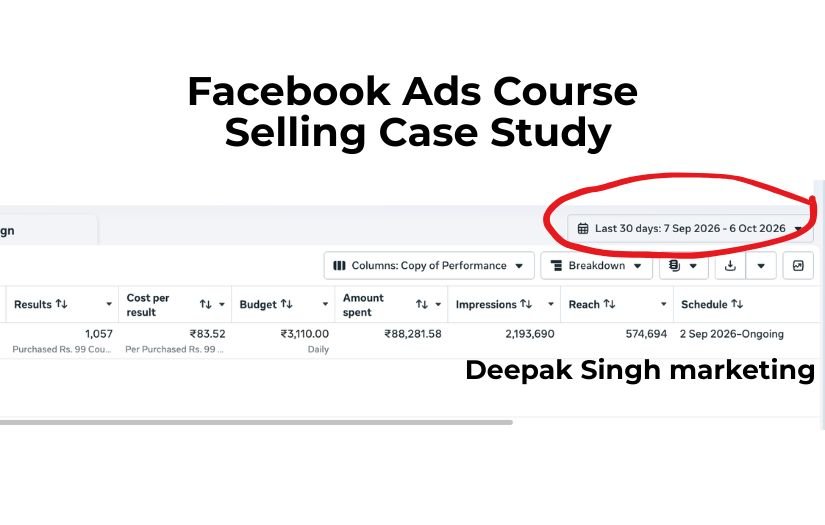
Facebook Ads Course Selling Case Study: 1,057 Purchases in 30 Days
Between 7 September and 6 October 2026, this Facebook Ads course selling campaign generated 1,057 recorded course purchases from ₹88,281.58 in Meta Ads spend.
The average cost per purchase was ₹83.52, making this a strong recent example of paid acquisition for an online course offer using Facebook and Instagram advertising.
- Recorded Course Purchases: 1,057
- Meta Ads Spend: ₹88,281.58
- Average Cost Per Purchase: ₹83.52
- Impressions: 2,193,690
- Reach: 574,694
- Campaign Period: 7 September to 6 October 2026
This was not a campaign optimized simply for traffic, video views, engagement or cheap clicks. The objective was to use Facebook Ads for online course sales and turn paid traffic into recorded purchase conversions at an acquisition cost the offer could support.
That distinction is important in course selling. A Meta Ads campaign can generate strong CTR, inexpensive CPC or large volumes of landing-page traffic and still fail if the course funnel does not convert enough visitors into buyers.
For an online course or digital product campaign, I therefore look beyond individual advertising metrics. I want to understand the complete acquisition path from creative → click → landing page → checkout → course purchase.
In this Facebook Ads case study, I’ll break down the campaign economics, course-selling funnel, Meta Ads strategy, purchase conversion logic, creative and audience decisions, and the lessons I would carry into another online course or digital-product advertising campaign.
The same approach guides my broader work as a Facebook Ads expert in India: platform metrics matter, but the real question is whether Meta Ads are producing commercially useful customer acquisition.
Important context: the figures above are recorded Meta Ads campaign results for this 30-day period. They support the purchase count, advertising spend, impressions, reach and cost per purchase shown here. They should not be interpreted as verified revenue, profit, fulfilled sales or unique customers unless those figures are established separately.
Why Facebook Ads for Course Selling Need a Different Acquisition Approach
Selling an online course through Facebook Ads is different from running a standard lead-generation campaign.
In a lead campaign, the immediate conversion may be a form submission, enquiry or registration. In a course-selling campaign, Meta Ads need to move the user much closer to an actual purchase.
That changes how I evaluate the campaign.
The goal is not just cheap traffic or cheap leads
For an online course offer, metrics such as CPM, CTR and CPC still matter because they help explain delivery and response.
But the commercial outcome is further down the funnel: course purchases at an acceptable acquisition cost.
A campaign can generate cheap clicks and still fail if the landing page, offer, checkout or purchase intent is weak.
The course-selling funnel matters as much as the ad account
For this type of Meta Ads campaign, I think about the acquisition journey as:
Facebook / Instagram Ad → Landing Page → Offer Evaluation → Checkout → Course Purchase
Every stage affects the final cost per purchase.
If the creative attracts the wrong type of user, the funnel starts weak. If the landing page does not communicate enough value, relevant traffic may still fail to buy.
If the checkout creates friction, the campaign may appear to have a media problem when the real constraint sits after the click.
Digital product advertising depends heavily on offer clarity
Online courses and digital products are intangible offers. The buyer cannot physically inspect the product before purchasing.
The ad and landing page therefore need to communicate what the course is, who it is for, what the buyer receives and why the offer is worth considering.
This makes creative-message fit and ad-to-landing-page continuity especially important in Facebook Ads for course selling.
Purchase volume alone is not enough
In this campaign, Meta recorded 1,057 course purchases at an average ₹83.52 cost per purchase.
That is the key advertising result available from the campaign data, but I would still avoid treating purchase volume alone as proof of profitability.
To evaluate the complete economics of an online course campaign, I would normally also want to understand the selling price, payment success, refunds, upsells, backend revenue and other funnel costs where that data is available.
This is the same reason I separate platform performance from broader business economics in my ROAS vs CAC framework.
The real question was acquisition efficiency
For this Facebook Ads course-selling campaign, the immediate performance question was simple:
Can Meta Ads repeatedly generate course purchase conversions at a cost the offer can support?
That is the lens I would use for the rest of this case study.
Facebook Ads Course Selling Results: What the 30-Day Campaign Data Actually Shows
The headline result from this Facebook Ads course selling campaign was 1,057 recorded course purchases in 30 days at an average ₹83.52 cost per purchase.
But a useful Meta Ads case study should go beyond one headline number. The supporting campaign metrics help us understand the scale at which those online course purchases were generated.
30-day Meta Ads performance snapshot
- Recorded Course Purchases: 1,057
- Total Meta Ads Spend: ₹88,281.58
- Average Cost Per Purchase: ₹83.52
- Impressions: 2,193,690
- Reach: 574,694
- Approximate Frequency: 3.82
- Campaign Period: 7 September to 6 October 2026
The approximate frequency comes from dividing total impressions by reach. In simple terms, the average person reached by the campaign was served an ad roughly 3.8 times during the 30-day period.
That does not mean every person saw exactly 3.8 ads. Frequency is an average, but it helps add context to how often the Meta Ads campaign was reaching the same audience.
What 1,057 purchases tell us
The most important point is that the campaign produced a substantial volume of recorded purchase conversions rather than stopping at clicks, landing-page views or leads.
For an online course sales campaign, that matters because the conversion event sits much closer to the actual commercial objective.
The campaign therefore provides evidence that Facebook and Instagram Ads were capable of generating repeated course purchase actions at scale during this specific 30-day period.
It does not automatically tell us how many unique customers bought, whether every payment was ultimately retained or what the final profitability of the course funnel was.
What the ₹83.52 cost per purchase means
Cost per purchase is one of the clearest performance metrics in a direct-response Facebook Ads campaign for online courses or digital products.
At ₹88,281.58 in spend and 1,057 recorded purchases, the average advertising cost required to generate one recorded course purchase was ₹83.52.
That makes the metric useful for evaluating the paid acquisition efficiency of the campaign.
But CPA should never be evaluated in isolation.
Whether ₹83.52 is excellent, acceptable or unsustainable ultimately depends on the economics of the course offer, including selling price, payment success, refunds, upsells, backend revenue and other acquisition costs.
Reach and impressions show the scale of distribution
The campaign generated more than 2.19 million impressions and reached approximately 574,694 people.
For a Meta Ads course selling campaign, these numbers help explain the amount of advertising exposure required to support the recorded purchase volume.
Large impression volume by itself is not success. A campaign can reach hundreds of thousands of people and still fail commercially if the creative, offer or course funnel does not convert.
The important relationship is between distribution and conversion: Meta needs enough opportunities to show the offer, but the acquisition system still has to turn a portion of that attention into purchases.
Why I would not judge this campaign from CPM, CTR or CPC alone
CPM, CTR and CPC are extremely useful diagnostic metrics in Facebook advertising.
They help explain whether media became more expensive, whether the creative is earning attention and what it costs to bring a visitor into the funnel.
But none of those metrics is the final objective of this campaign.
A low CPC with poor purchase conversion can still create an expensive customer acquisition system.
A higher CPC can sometimes be acceptable if the traffic converts into course buyers at stronger economics.
That is why I would read Meta Ads metrics as a chain rather than isolated scores:
Impressions → Reach → Click / Visit → Landing Page → Checkout → Purchase → Cost Per Purchase
If you want to calculate and compare metrics such as CPM, CPC, CTR, CPL, CPA and ROAS, I also built a free Meta Ads calculator for this exact type of analysis.
What these Facebook Ads results do not prove
This is equally important in a transparent case study.
The campaign data supports the recorded purchase count, ad spend, cost per purchase, impressions and reach for the stated period.
It does not by itself establish:
- total course revenue,
- ROAS,
- profit or contribution margin,
- payment success rate,
- refund rate,
- unique customer count,
- upsell or backend revenue,
- lifetime value.
Those would require additional business or payment data.
For this Facebook Ads course selling case study, the defensible conclusion is narrower and still meaningful: Meta Ads generated 1,057 recorded course purchases from ₹88,281.58 in advertising spend at an average ₹83.52 cost per purchase during the 30-day period.
That gives us a strong foundation for the next question: what had to work inside the online course acquisition funnel for paid traffic to convert into purchases at this volume?
The Course Selling Funnel Behind the Facebook Ads Campaign
A Facebook Ads course selling campaign does not succeed because of one ad, one audience or one campaign setting.
The purchase result is created by the complete acquisition journey from the first Meta Ads impression to the final course purchase.
For an online course or digital product funnel, I think about that journey as:
Facebook / Instagram Ad → Landing Page → Offer Evaluation → Checkout → Course Purchase
Each stage has a different job. If one stage becomes weak, the final cost per purchase can increase even when the other Facebook Ads metrics still look healthy.
Stage 1: The Facebook or Instagram ad has to create the right kind of interest
The first job of the ad creative is not simply to generate a click.
It needs to attract someone who is reasonably aligned with the online course offer and give that person enough reason to continue into the sales funnel.
This is particularly important in course selling because the product is intangible. The buyer cannot physically inspect the course before purchasing it.
The Meta Ads creative therefore has to help communicate things such as the problem being solved, the intended learner, the value of the course and why someone should consider the offer now.
Cheap clicks are not automatically useful clicks
A Facebook Ads campaign can produce a strong CTR and inexpensive CPC while still generating weak purchase economics.
If the creative earns curiosity clicks from people who were never likely to buy the course, the campaign may look efficient at the traffic level while becoming expensive at the purchase level.
That is why I would compare creative performance with downstream purchase behaviour rather than judging online course ads only by CTR or CPC.
Stage 2: The landing page has to continue the promise made in the ad
Once someone clicks the Facebook or Instagram ad, the landing page becomes part of the advertising system.
The visitor should not have to figure out why they landed there or whether the page is connected to the ad they just saw.
The headline, course positioning, offer and call to action should continue the expectation created by the Meta Ads creative.
This is what I mean by ad-to-landing-page continuity.
Message mismatch can increase Meta Ads cost per purchase
Imagine an ad that promotes a very specific course benefit.
The visitor clicks and lands on a generic page that talks broadly about the instructor, several products and multiple unrelated benefits.
The traffic may still be relevant, but the landing page is forcing the user to rebuild the buying context.
That extra friction can reduce purchase conversion rate and increase the effective cost of acquiring each course buyer.
This is why my broader performance marketing funnel approach treats the landing page as part of paid acquisition rather than something separate from advertising.
Stage 3: The course offer has to make the buying decision understandable
An online course sales page has to answer the questions that matter before the buyer reaches checkout.
Depending on the offer, those questions may include:
- What exactly is included in the course?
- Who is the course designed for?
- What problem does it help solve?
- How is the course delivered?
- What does the buyer receive after purchase?
- What makes the offer worth the price?
- Why should the buyer trust the course or instructor?
The purpose is not to make the page unnecessarily long.
The purpose is to remove enough uncertainty for a relevant visitor to make a confident purchase decision.
Offer strength can change Facebook Ads economics
Performance marketers often focus heavily on audience targeting and campaign structure.
But Meta Ads cannot completely compensate for an offer that visitors do not understand or value.
A stronger offer can improve conversion rate without reducing CPM or CPC.
That means the same amount of Facebook Ads traffic can produce more online course purchases and therefore lower the average cost per purchase.
Stage 4: Checkout friction can turn a strong campaign into an expensive one
A visitor reaching checkout is not the same as a completed course purchase.
The buyer can still abandon because of friction, confusion, payment problems or unnecessary steps.
For a direct-response course selling funnel, I therefore want to understand what happens between the buying decision and the final purchase event.
If Meta Ads are generating strong intent but the checkout loses too many buyers, changing audiences or creative may not solve the real constraint.
Purchase conversion rate connects the funnel back to advertising cost
The economics are straightforward.
If Meta Ads send the same amount of traffic at the same media cost, but more visitors complete the purchase, average cost per purchase falls.
If fewer visitors buy, cost per purchase rises even if CPM, CTR and CPC remain almost unchanged.
This is why I look at the relationship between advertising metrics and funnel conversion instead of optimizing them in isolation.
Stage 5: The purchase event has to represent the outcome we actually want
For this campaign, Meta recorded 1,057 course purchases during the 30-day period.
That makes Purchase the key downstream advertising event available in the campaign data we are using for this case study.
But even a purchase event needs context.
For a complete online course business analysis, I would ideally want to understand payment success, refunds, repeat purchases, upsells and other revenue outcomes where those data are available.
The Facebook Ads dashboard tells us how efficiently the campaign generated recorded purchase conversions. The wider business data tells us how valuable those purchases ultimately became.
How I Diagnose a Course Selling Funnel When Cost Per Purchase Changes
If the Meta Ads cost per purchase starts increasing, I would not immediately rebuild the campaign.
I would first identify which part of the course acquisition funnel changed.
If CPM increases
The campaign may simply be paying more to access impressions.
I would look at auction conditions, audience size, delivery patterns, seasonality and whether the campaign is reaching a more expensive segment of demand.
If CTR falls
The creative or message may be losing its ability to generate relevant response.
I would compare creative concepts, hooks, offer framing and how performance changed over time.
If CPC remains stable but landing-page conversion falls
The media may not be the primary problem.
I would investigate the course offer, message match, page experience, proof, pricing communication and checkout journey.
If purchases fall while traffic remains healthy
I would look further down the funnel.
The issue could involve the landing page, offer, checkout, payment flow or the way the purchase event is being measured.
If purchase volume grows but cost per purchase rises
The campaign may simply be moving beyond the easiest available buyers as spend increases.
That does not automatically mean scaling failed.
The correct decision depends on whether the additional course purchases are still being acquired at economics the offer can support.
The Core Course Selling Acquisition Model
For Facebook Ads and Meta Ads promoting online courses, I would summarize the system like this:
Relevant Creative → Qualified Traffic → Clear Course Offer → Low-Friction Checkout → Recorded Purchase → Sustainable Acquisition Cost
That is a more useful way to think about Facebook Ads for course selling than focusing only on targeting or campaign structure.
The ad account creates and directs demand, but the complete online course funnel determines how efficiently that demand becomes a buyer.
This broader acquisition thinking is also central to how I approach performance marketing for EdTech and Facebook Ads for EdTech.
Want to Improve Your Facebook Ads Course Selling Funnel?
This campaign generated 1,057 recorded course purchases in 30 days at ₹83.52 cost per purchase from ₹88,281.58 in Meta Ads spend.
The bigger lesson is not the headline number. It is that Facebook Ads for online courses work best when the creative, offer, landing page, checkout and purchase economics support each other.
If you are already running Meta Ads for an online course, digital product or education business and want to understand where your acquisition funnel can improve, I can help you review the complete path from ad delivery to purchase.
You can explore my Facebook Ads management services or see how I approach Facebook Ads for EdTech.
Need help with your Meta Ads campaign? Work with me.