What a Facebook Ads expert for EdTech should actually improve
A Facebook Ads expert for EdTech should connect Meta campaigns to suitable learners and paid enrolments, not stop at a low cost per lead. I would inspect the ad promise, the form or landing page, the quality of enquiries, the counselling handoff and the cost of acquiring a new paying student before recommending more budget.
That is a specific Meta Ads job. My broader performance marketing for EdTech framework covers how Search, YouTube, Meta and the wider acquisition system work together. Here I focus on the Facebook and Instagram decisions an EdTech team needs a specialist to make.
- Lead volume is a starting signal. Contactability, programme fit and payment reveal whether those leads helped the business.
- Creative qualifies before the form. A clear promise can attract fewer but more suitable people.
- The conversion event shapes the campaign. Meta can learn only from the signals the account can send reliably.
- Budget follows the constraint. The next rupee may belong in a better ad, a form test, CRM repair or counselling capacity.
Start with the programme and the person who decides
“EdTech” is not one buyer journey. A low-priced self-serve course can move from an ad to a course page and checkout. A programme that requires counselling may move through eligibility, an appointment, fee discussion and delayed payment. The campaign objective and report should reflect the actual path, not a generic education funnel.
I would ask which programme the team wants to grow, who uses it, who pays, what entry conditions apply, how long a decision normally takes and what capacity exists to serve new students. A parent may pay for a younger learner. A working professional may be both learner and payer. That difference changes the objection the ad has to answer.
A Meta specialist should also separate product problems from media problems. If the promised course outcome is vague, the fee is difficult to explain or the admissions team cannot state who qualifies, no audience setting will create a clean business signal. I would clarify those conditions before scaling the campaign.
Creative should reveal fit, not merely earn clicks
On Facebook and Instagram, the ad often introduces a programme to someone who was not searching for it at that moment. The creative has to earn attention, but attention alone is not the job. It should help a relevant learner recognise the course and understand the commitment.
I would test angles built around a real learner problem, a sample lesson, course format, credible teaching proof or a specific objection. Where relevant, the ad should state prerequisites, schedule, language or fee context. Those details may lower click-through or form completion while improving the share of leads the team can actually serve.
For example, an ad promising “a quick career change” may create inexpensive curiosity. A more precise ad describing the skills taught, expected effort and intended learner could draw fewer enquiries but better counselling conversations. That is a hypothesis to test against later outcomes, not a universal claim that more detail always wins.
When a creative brings many leads but weak programme fit, I first compare the message people saw with their reasons for enquiry. Did the ad imply a free course when the offer is paid? Was the certificate or job outcome overstated? Did the audience understand the time commitment? The answer points to a promise test before another targeting change.
I would keep the comparison programme-specific. A broad “learn a new skill” message and a detailed course demonstration may attract people at different decision stages. Compare those cohorts after counselling, not after the first click. If the detailed demonstration brings more suitable applicants but fewer forms, I would investigate whether its higher acquisition cost still fits the course contribution.
Creative fatigue has another signature: the same message reaches the same audience repeatedly, response weakens and cost rises while the programme and follow-up remain steady. Even then I would check placement, reach, auction cost and landing-page behaviour before declaring the asset exhausted.
A new hook is useful only if it attracts a better cohort, not simply a fresh spike in CTR.
My experience with Meta creative and EdTech acquisition informs that review, but I would not present an aggregate career number as a Meta-for-EdTech case study. The buyer should ask for the exact result definition behind any specialist’s claim.
Choose the capture route and the signal together
Meta can collect an enquiry through an instant form, while a website form sends the person to a landing page. Meta’s lead-generation guide describes both routes and options such as more-volume and conversion-lead goals. Availability and setup can change, so I would check the current account rather than assume every feature is available.
An instant form reduces steps. That can help when mobile visitors abandon a slow site, but a short form may also admit people who have not understood the course. A landing page can explain curriculum, prerequisites, delivery, fees and proof before the form, but its extra steps can lose suitable visitors too.
I would not declare one route the winner from CPL alone. I would compare the same programme and comparable lead cohorts on contact rate, qualification, booked conversations and paid students.
If a website form gives fewer but more suitable learners, its higher CPL may be a rational trade-off. If the site is slow or unclear, repairing it may matter more than moving the budget back to an instant form.
Form questions should earn their friction. Ask what the counsellor uses to determine fit or route the lead. A course-interest or experience question may be useful; a long list that nobody reads only increases abandonment. Any qualifying question should be reviewed against the rate of suitable paid students, not celebrated because it reduces raw leads.
A reliable downstream event is more useful than an impressive label
Meta Ads Manager can report a form submission, but the CRM may know whether the person was reachable, eligible or eventually paid. Those are different events. The Meta Pixel and Conversions API can help send website actions; where supported, CRM integration through Conversions API can pass later lead-quality signals. Meta’s Blueprint training explains that use for lead ads.
A connection does not make the labels trustworthy. I would first agree on what “qualified” means, make sure it is applied consistently and check whether leads are matched to the right source and programme. If one counsellor marks every conversation qualified and another requires payment intent, sending both labels back to Meta teaches an inconsistent definition.
Paid enrolment is the business outcome I want to see. Yet a long sales cycle or a small number of paid events may leave the campaign without a timely signal.
In that case, a well-defined qualified event can help operate the campaign while the business report continues to judge paid-student economics. The choice needs enough reliable volume and an honest account of delay.
I would verify event identity before drawing conclusions. If one enquiry creates both a browser event and a server event, the implementation must avoid treating those as two different leads. If CRM records are missing campaign or programme context, the offline stage cannot be attributed reliably.
I would test the full path with real sample records and compare platform totals with the CRM, rather than assuming an installed Pixel or integration is correct.
My Meta-to-Enrolment Decision Map
I use one lead cohort as the spine of the diagnosis: ad promise → capture route → contact → programme fit → counselling progression → paid enrolment. Each handoff needs a definition, an owner and a record. This map prevents a weak paid-student result from being labelled a targeting problem before the loss is located.
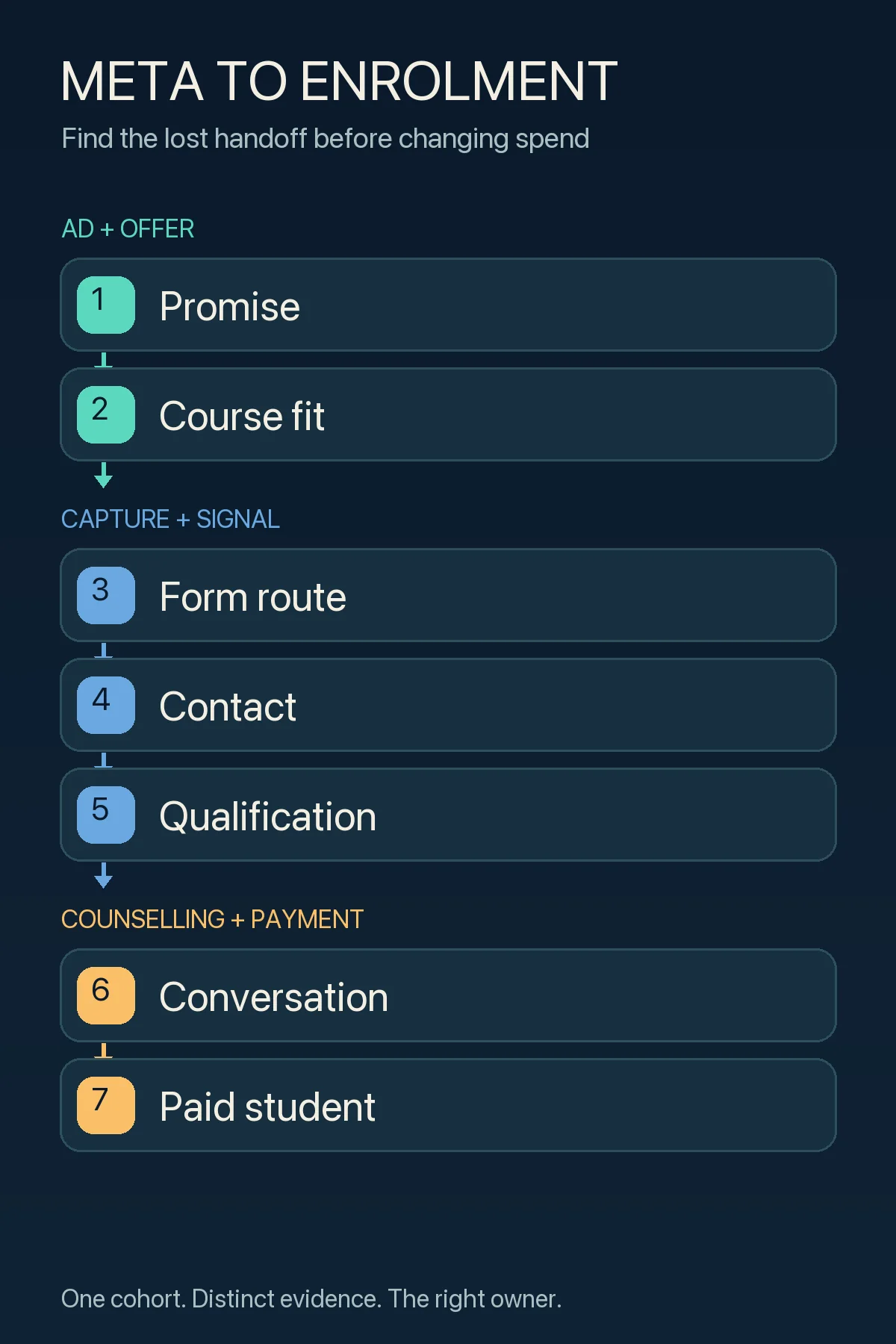
At the first stage, I compare creative and offer promises with the questions leads actually ask. At capture, I inspect form completion and whether people understood the course. At contact, I check routing, duplicates and response coverage. At qualification, I compare explicit programme criteria. At counselling and payment, I examine attendance, objections, fee expectations and delayed decisions.
The key is to follow the same group over a realistic decision window. This week’s enquiries and this week’s payments may come from different people. Mixing them can make a creative look better or worse for reasons unrelated to its lead quality.
I also separate new paid students from returning learners before using acquisition cost to choose a campaign. Existing students may respond to a new offer, but they do not belong in the denominator for new-student CAC.
My documented work as Head of Performance Marketing at The DM School included large-scale acquisition, tracking and CRM systems. The reported 10 lakh+ leads and 2 lakh+ paid customers are aggregate outcomes associated with that broader role, not a Meta-only EdTech case result.
The practical lesson is to preserve the path from platform event to actual customer rather than treating every lead as a sale.
Judge Meta by the cost of a new paying student
CPL is Meta spend divided by distinct enquiries. Qualified CPL uses the qualified subset. Media-only cost per new paid student uses the same spend divided by new students who paid.
A broader business CAC may include relevant creative, specialist, tool and sales costs. I label the cost basis so a media-only number is not compared with a fully loaded one. Count each cost once, and use a consistent time or cohort basis.
Consider this hypothetical example for two Meta tests with the same ₹60,000 spend and enough time for the lead cohorts to mature:
- Test A produces 600 enquiries, 90 suitable leads and 6 new paid students. CPL is ₹100; qualified CPL is approximately ₹667; media-only cost per paid student is ₹10,000.
- Test B produces 300 enquiries, 105 suitable leads and 12 new paid students. CPL is ₹200; qualified CPL is approximately ₹571; media-only cost per paid student is ₹5,000.
Test B has twice the CPL and half the media-only cost per paid student. I would investigate what changed: a clearer promise, a form that filtered unsuitable people, faster contact, or a different programme mix.
I would not give all the credit to the ad until those explanations are separated. The arithmetic is illustrative, not a claim about my campaigns or a recommended benchmark.
Allowable CAC depends on the actual course economics. Use fees collected, expected refunds or cancellations, delivery costs and contribution available to acquire a student. If future purchases support a higher acquisition cost, use observed learner cohorts rather than assumed lifetime value. A strong early CPL cannot make an unprofitable paid-student cohort healthy.
For a counselling-led programme, the sales effort has a cost and a capacity limit. A source that produces many weak leads may look cheap in Ads Manager while consuming counsellor hours that could serve better prospects.
I would compare cost per suitable conversation and cost per paid student, then ask whether the next cohort can be handled without weakening response and attendance.
When reporting by creative, keep the programme, cohort window and cost basis visible. An inexpensive programme and a high-priced counselling-led programme can have different acceptable acquisition costs. A blended number across both may conceal an expensive source of unsuitable leads or understate a useful campaign.
When leads rise but enrolments do not, diagnose the leak
The first question is whether enough time has passed for the new lead cohort to pay. If the cohort is mature and enrolments still lag, I separate contact, fit, counselling and payment before changing Meta settings. Each branch has a different owner and a different test.
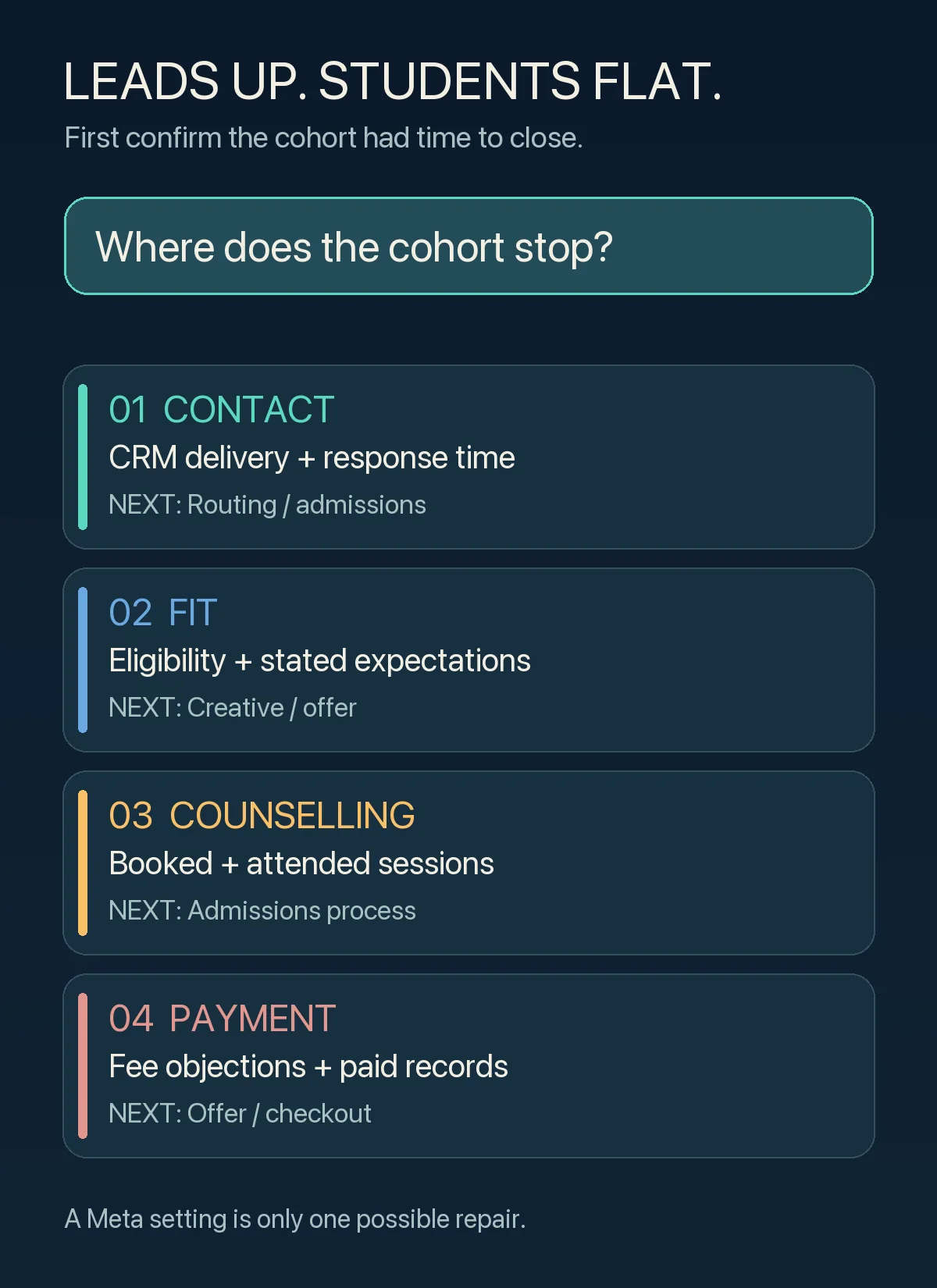
If people are not reached
Check whether leads reached the CRM intact, whether phone details are usable, when the first contact attempt happened, how many attempts were made and whether the team had capacity. A specific creative might draw accidental submissions, but slow routing or unanswered calls can produce the same dashboard symptom. Sample actual lead records before deciding.
If lead details are sound and contact is late, repair the handoff. If contact remains poor despite prompt follow-up, test the promise, form friction or confirmation step. Do not cut a campaign merely because a delayed sales team could not reach its leads.
If people answer but do not qualify
Compare disqualification reasons by programme, creative and capture route. Are people outside the course’s prerequisite, fee range, schedule or geography? If one message repeatedly attracts unsuitable learners, change that message. If every campaign has the same mismatch, the offer or eligibility explanation may be the constraint.
A lower qualified rate can also follow a stricter counselling definition. Before blaming Meta, check whether the team changed its rules or recording habits. Consistent CRM labels are necessary for any useful comparison and for any downstream optimization signal.
If qualified leads do not become paid students
Look at booking, attendance, application, payment attempt and actual fee collection. A qualified person may need more time, may object to the price, may have misunderstood the programme or may encounter payment friction. Those are not interchangeable causes.
Retargeting should address the actual unresolved question. A learner who watched a sample lesson may need curriculum detail; someone who attended counselling may need clarity on schedule or payment terms. Repeating a generic “admissions open” message to both groups wastes context. Where audience data and permissions support it, exclude paid students from new-student acquisition reporting.
If payment outcomes weaken across all sources, the problem may lie after advertising. I would bring the admissions team into the diagnosis instead of claiming a new Meta audience will repair it. For a wider account review, my Facebook Ads audit approach covers the checks that distinguish platform, tracking and funnel leaks.
Scale the next constraint, not the cheapest lead
When a creative and capture route produce suitable paid students, I still would not raise spend solely because CPL looks attractive. I would check whether the cohort has matured, whether new-student CAC remains within the course’s contribution limit and whether counselling and teaching capacity can absorb additional demand.
At higher spend, the next group of people may be less ready to buy or more expensive to reach. Rising CPL may be acceptable if incremental students remain profitable; stable CPL may be misleading if the qualified rate falls. I compare successive cohorts and keep a review window long enough for the real enrolment delay.
My next test follows the evidence. If creative response weakens, develop a new learner angle or proof format. If the form loses suitable visitors, test its route and questions.
If qualified leads wait too long, improve routing or counselling capacity. If payment is the constraint, improve the sales and checkout path. A budget change is one possible action, not the default action.
Meta’s campaign report and the business report can disagree because they answer different questions. I would examine attribution, duplicate leads, returning learners, refunds and payment timing before moving money. I want a plausible explanation of incremental new students, not only a favourable platform result.
What I would expect from an EdTech Meta Ads expert
A buyer should expect a specialist to inspect the programme and funnel before proposing a campaign structure. The work may include account and tracking review, creative hypotheses, lead-form or landing-page recommendations, campaign tests, CRM definitions, counselling feedback and budget decisions. It should specify which decisions the specialist owns and which require the EdTech team.
The business needs to provide access to real outcomes: programme-wise fees, eligibility rules, lead records, contact attempts, counselling stages, paid-student status, refunds and capacity. Without those inputs, an expert can optimize platform events but cannot responsibly promise student economics. A serious proposal should state its measurement limits.
Ask a candidate how they would respond to two situations: CPL falls while paid-student CAC rises, and qualified leads remain strong while appointment attendance falls. Useful answers should request the relevant cohort evidence and distinguish media changes from sales-process changes. A guaranteed CPL or enrolment number without seeing the programme and data would make me cautious.
If the need is broader strategic advice across Meta accounts and lead systems, my lead-generation consulting approach explains that advisory scope. For this page, the question is narrower: can a Facebook Ads expert improve the path from this EdTech programme’s Meta ad to an economically viable paid student?
The useful Meta decision starts after the lead
I would judge an EdTech Meta campaign by the evidence that links its promise to a suitable learner and a paid outcome. That requires good creative, a sensible capture route, consistent CRM stages and an honest view of counselling and course economics. An expert earns the role by locating the constraint and changing the right part of that system.
If you are evaluating Facebook Ads support for an EdTech programme, bring the current ads, course details, lead-stage report and payment outcomes to the first discussion. I can then explain what I would test first, what the account can measure reliably and where more budget would or would not help.