Quick Answer
What Does a Performance Marketing Expert in India Actually Do?
A performance marketing expert should do more than manage ad accounts.
My role is to connect paid media, landing pages, conversion tracking, CRO, analytics, remarketing and customer acquisition economics into one growth system.
I’m Deepak Singh, Performance Marketing Expert based in New Delhi, India. I have around 10 years of hands-on experience across Meta Ads, Google Ads, YouTube Ads, lead generation, ecommerce growth, CRO, analytics, attribution and marketing automation.
Across my work, I have contributed to more than ₹150Cr in attributed revenue, 10L+ leads and 2L+ paid customers across education, ecommerce, coaching, digital products, real estate and service businesses.
I have also managed campaigns across different spend levels, including acquisition systems operating at ₹5 lakh to ₹25 lakh+ in monthly media spend, along with large-scale YouTube Ads and Google Ads campaigns.
For me, performance marketing is not just about getting a low CPC or a high ROAS inside one platform.
The real question is whether the complete system can consistently turn advertising spend into qualified leads, customers and profitable growth.
That means I look at the full path:
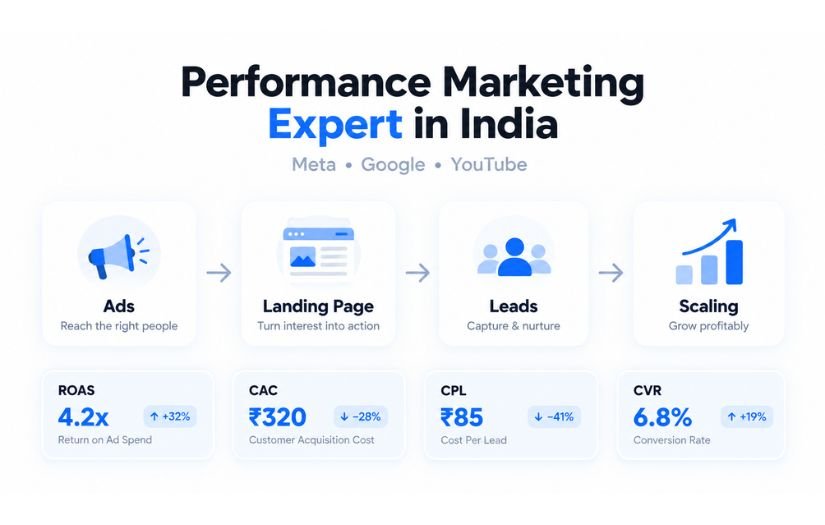
Audience → Ad Creative → Click → Landing Page → Conversion → Lead Quality → Sales → CAC → Revenue.
If any stage is weak, I do not assume the problem is automatically the ad platform.
This is also why my work spans Meta Ads, Google Ads, YouTube Ads, CRO, tracking and analytics rather than treating each channel as an isolated activity.
In this guide, I’ll explain how I approach paid growth, what I actually optimize, how I think about scaling and what businesses should evaluate when working with a performance marketing expert in India.
Written by Deepak Singh
Performance Marketing Expert
How I Approach Performance Marketing
I prefer looking at performance marketing as a connected acquisition system rather than a collection of separate ad platforms.
The objective is not simply to make Meta Ads, Google Ads or YouTube Ads look efficient individually.
The objective is to make the entire path from media spend to customer acquisition work together.
1. Start With the Business Economics
Before deciding how aggressively to spend, I want to understand what the business can realistically afford to pay for a lead or customer.
That means looking at pricing, margins, sales conversion, repeat value and the economics of the offer.
2. Choose the Right Channel for the Job
I do not believe every business should use every advertising platform.
Meta Ads, Google Ads and YouTube Ads behave differently because the user intent, creative environment and buying journey are different.
I choose channels based on where the demand exists and how the offer is best presented.
3. Build a Clear Acquisition Funnel
The ad is only the first step.
I look at what happens after the click, including the landing page, form, checkout, lead handling, remarketing and sales process.
If the post-click experience is weak, increasing media spend usually makes the problem more expensive rather than fixing it.
4. Make Tracking Reliable Before Scaling
I want confidence that the conversions being reported actually represent the business outcome we care about.
That means reviewing tracking, attribution and the connection between ad-platform data and downstream business results.
5. Test Creative and Audiences Systematically
I prefer testing clear hypotheses rather than changing several variables at the same time.
The objective is to understand which audience, message, creative angle or funnel variation actually improves performance.
6. Optimize Beyond CPL or ROAS
A low CPL can still produce poor-quality leads, and a strong platform ROAS can still hide issues in margin or customer quality.
I want to connect campaign performance with lead quality, sales conversion, CAC and revenue wherever the data is available.
7. Scale Only When the Economics Hold
I do not treat higher spend as proof of successful scaling.
Scaling means increasing volume while keeping the acquisition economics within a range the business can support.
8. Keep the System Simple Enough to Understand
I prefer clear campaign structures, useful reporting and a small number of meaningful decisions over accounts filled with unnecessary complexity.
The best performance marketing setup is the one that helps the business understand what is working, what is not and what should happen next.
What I Actually Optimize in a Performance Marketing Account
I do not optimize performance marketing by looking at one dashboard metric in isolation.
I work through the acquisition system stage by stage and try to identify where the biggest opportunity or bottleneck exists.
Audience Quality
I first want to understand whether the campaigns are reaching people who are genuinely relevant to the offer.
Cheap impressions or clicks are not useful if the traffic has weak commercial intent.
Creative Performance
I look at whether the ad is attracting the right person, communicating the value proposition clearly and giving the user a strong reason to take the next step.
Creative testing is not only about changing visuals. It can involve different hooks, problems, benefits, proof, offers and calls to action.
Traffic Efficiency
I monitor metrics such as CPM, CTR, CPC and view behaviour to understand how efficiently the campaign is turning reach into meaningful traffic.
These metrics help diagnose the top of the funnel, but they are not the final business outcome.
Landing Page Conversion
If traffic is arriving but not converting, I review the post-click experience.
I look at message match, headline clarity, offer strength, proof, page speed, mobile usability, form friction and the number of competing actions on the page.
Lead or Purchase Cost
CPL, CPA or purchase cost tells me whether the combined audience, creative and landing-page system is producing conversions efficiently.
I use these metrics as operational signals rather than treating them as the final definition of success.
Lead Quality
For lead-generation businesses, I want to know whether the leads are relevant, reachable and progressing through the sales process.
A campaign with a higher CPL can still be stronger if those leads convert into customers at a much better rate.
Customer Acquisition Cost
CAC becomes increasingly important as more downstream data becomes available.
It tells me whether the full acquisition system is producing customers at a cost the business can support.
Revenue and ROAS
For ecommerce, digital products and other directly measurable purchase funnels, I connect campaign performance with revenue and return on ad spend.
I still look beyond ROAS where possible because margins, refunds, repeat purchase behaviour and customer value can change the real economics.
Scaling Efficiency
Once the system is working, I watch what happens as spend increases.
The objective is to grow volume without allowing CAC, CPL or conversion efficiency to deteriorate beyond what the business can sustain.
For me, the job is not to make one metric look good. It is to improve the complete acquisition path from media spend to business outcome.
How I Work Across Meta Ads, Google Ads and YouTube Ads
I do not treat Meta Ads, Google Ads and YouTube Ads as interchangeable channels.
Each platform has a different role in the acquisition journey, and I structure them based on user intent, creative requirements and the business objective.
Meta Ads
I use Meta Ads heavily for demand generation, creative testing, lead generation, ecommerce acquisition and remarketing.
The platform is especially useful when the offer can be communicated visually and when creative iteration can influence performance quickly.
For Meta campaigns, I pay close attention to creative response, audience quality, CPM, CTR, conversion rate, CPA or CPL, frequency and downstream customer quality.
Google Ads
Google Ads is especially valuable when users already have clear search intent or when the business can capture existing demand efficiently.
I use Google Ads across lead generation, ecommerce, branded demand, high-intent search and broader acquisition strategies depending on the account.
I also look closely at search intent, conversion tracking, landing-page relevance and how much of the reported conversion volume is actually useful to the business.
You can see examples of this work in my EdTech Google Ads case study and Ayurveda Google Ads lead generation case study.
YouTube Ads
YouTube Ads can work well when the business needs to educate prospects, demonstrate an offer, create demand or build a scalable video-led acquisition funnel.
My YouTube Ads work has included audience testing, creative optimization, remarketing, lead generation and campaign scaling.
In one coaching and education acquisition system, approximately ₹50.4 lakh in advertising spend generated more than 66,300 leads at an average CPL of approximately ₹76.
You can see my wider approach in my YouTube Ads expert guide and YouTube Ads consulting framework.
Why I Use Multiple Channels Carefully
I do not add more platforms simply to increase channel count.
Each channel should have a clear role in the acquisition system.
For example, Google may capture existing intent, Meta may create and convert demand through creative, and YouTube may support education, scale and remarketing.
The goal is not to make every platform equally important. The goal is to allocate spend where it can create the strongest business outcome.
How I Use Landing Pages, CRO and Tracking to Improve Paid Growth
Performance marketing does not stop at the ad click.
In many accounts, the biggest growth opportunity sits after the traffic arrives.
Landing Page Message Match
I want the landing page to continue the same promise and context that brought the user there.
If the ad communicates one offer and the page creates a different expectation, conversion rate usually suffers.
Conversion Rate Optimization
I look at the elements that influence whether a visitor takes action, including headline clarity, proof, offer presentation, form friction, page speed, mobile usability and CTA placement.
The objective is not to redesign pages for appearance. It is to remove the friction that prevents relevant traffic from converting.
Tracking and Attribution
I want to know whether conversions are being measured correctly before using them to make budget decisions.
That can involve Google Analytics 4, Google Tag Manager, Meta Pixel, Conversions API and platform conversion tracking depending on the setup.
I also compare platform-reported results with downstream business data where possible because no single attribution system gives a perfect view of the customer journey.
Lead Quality Feedback
For lead-generation campaigns, the advertising dashboard only tells part of the story.
I want feedback on which leads are qualified, reachable and converting into customers so campaign optimization does not drift toward cheap but low-value conversions.
Remarketing
Users who interact with the business but do not convert immediately may need additional touchpoints.
I use remarketing based on behaviour and funnel stage rather than repeatedly showing the same message to every warm user.
Why CRO Can Be More Valuable Than Chasing Cheaper Traffic
If a campaign is already generating relevant traffic, improving conversion rate can sometimes create more impact than trying to reduce CPC further.
A stronger landing page can increase the number of leads or customers generated from the same media spend.
My View of the Funnel
I treat media buying, CRO and tracking as connected parts of the same acquisition system.
The goal is to understand where value is being created or lost across ad → landing page → conversion → sales → customer.
How I Think About Performance Marketing Metrics
I do not believe one metric can tell you whether a performance marketing system is healthy.
I read metrics based on the stage of the funnel they represent and how closely they connect with the actual business outcome.
CPM and Reach
These help me understand how expensive it is to access the audience and whether delivery is changing as spend increases.
They are useful diagnostic metrics, but they do not tell me whether the traffic is commercially valuable.
CTR and CPC
CTR helps me understand whether the ad is generating enough response, while CPC shows what it costs to move users from the platform to the next step.
I do not chase the cheapest click if the resulting traffic does not convert.
Conversion Rate
Conversion rate helps me understand how efficiently the landing page or funnel turns traffic into leads or purchases.
If CTR is healthy but conversion rate is weak, I usually look beyond the ad account and investigate the post-click experience.
CPL and CPA
For lead generation and conversion-focused campaigns, CPL or CPA tells me how efficiently the acquisition system is producing the desired action.
These are important operating metrics, but they still need to be connected with lead quality or customer value.
ROAS
ROAS can be very useful for ecommerce, digital products and other directly measurable purchase funnels.
But I do not treat a high ROAS as automatically strong if margins are weak, refunds are high or the campaign cannot scale.
CAC
Customer acquisition cost is one of the most important metrics once enough sales data exists.
It connects media performance with the actual cost of acquiring a paying customer.
LTV and Payback
For businesses with repeat purchases, subscriptions or longer customer relationships, lifetime value and payback period can change how much the business can afford to spend upfront.
This is especially important when comparing short-term ROAS with long-term customer value.
My Preferred Metric Hierarchy
I usually think about performance in this order:
Reach → Click → Conversion → Lead or Purchase → Qualified Customer → CAC → Revenue → Lifetime Value.
The closer the metric gets to the actual business outcome, the more weight I give it when making strategic decisions.
How I Decide What to Scale and What to Stop
Scaling performance marketing is not about increasing budget everywhere that looks profitable.
I try to separate temporary wins from repeatable performance before allocating more spend.
1. I Look for Consistency, Not One Good Day
A campaign can produce an excellent CPL, CPA or ROAS for a short period and still fail when more budget is added.
I prefer looking for performance that remains reasonably stable across enough data before treating it as a scalable winner.
2. I Check Downstream Quality
For lead-generation campaigns, I do not want to scale an audience simply because it produces the cheapest leads.
I want to know whether those leads are qualified, reachable and progressing toward customers.
3. I Protect Proven Campaigns
If a campaign is already working consistently, I avoid turning it into a testing ground for every new idea.
Major experiments can be separated so that new learning does not unnecessarily disturb a proven acquisition setup.
4. I Scale in Stages
I prefer increasing spend gradually while watching how CPM, CPC, conversion rate, CPL, CPA and CAC respond.
The objective is to understand where efficiency starts deteriorating rather than assuming the same economics will continue indefinitely.
5. I Stop Weak Tests When the Signal Is Clear
Not every audience, creative or funnel variation deserves more time.
If a test consistently produces weak signals after enough data, I would rather stop it and move to the next hypothesis than keep spending simply because the campaign is still active.
6. I Look for the Real Bottleneck Before Adding Budget
If the campaign is limited by landing-page conversion, lead quality or sales follow-up, increasing media spend can make the underlying problem larger.
I prefer fixing the weakest stage before trying to force more volume through the same funnel.
7. I Watch What Changes as Scale Increases
As spend grows, the campaign may reach broader audiences, creative fatigue can increase and conversion quality can change.
That is why scaling needs continuous monitoring rather than a one-time decision.
My Rule for Scaling
I scale when there is enough evidence that the business can absorb more volume without breaking the economics of the acquisition system.
For me, successful scaling means more useful customers or revenue at sustainable CAC, not simply a larger advertising budget.
Where My Performance Marketing Experience Comes From
My approach to performance marketing has been shaped by working across different business models, funnel types and advertising platforms rather than one narrow campaign category.
Education and EdTech
I have worked extensively with education, coaching and online learning businesses across lead generation, course sales, YouTube Ads, Google Ads, Meta Ads, remarketing and funnel optimization.
One of my larger YouTube-led education acquisition systems generated more than 66,300 leads at an average CPL of approximately ₹76 from around ₹50.4 lakh in advertising spend.
I have also documented an EdTech Google Ads campaign that generated approximately 656 attributed conversions at ₹109 cost per conversion.
D2C and Ecommerce
My ecommerce work has included fashion, apparel, hair care and other consumer brands across Meta Ads, Google Ads, funnel optimization and customer acquisition.
In these businesses, I look more closely at purchase conversion, ROAS, CAC, average order value, repeat behaviour and the ability to scale revenue without destroying margins.
Lead Generation Businesses
I have worked across businesses where the main objective is generating enquiries rather than direct online purchases.
For example, one Ayurveda Google Ads campaign generated approximately 5,030 leads at an average CPL of ₹87.65.
For lead-generation accounts, I try to connect media performance with lead quality and sales conversion rather than stopping the analysis at CPL.
Digital Products and Course Businesses
Digital product funnels have given me experience with lower-ticket frontend offers, upsells, remarketing, checkout optimization and high-volume paid acquisition.
These funnels are particularly useful for understanding how ad performance changes when acquisition, conversion rate and monetization are optimized together.
Real Estate and Service Businesses
I have also worked with lead-generation models where the sales cycle is longer and the value of each qualified opportunity is significantly higher than the cost of the initial lead.
In those environments, lead quality, follow-up and sales conversion often matter much more than achieving the lowest possible CPL.
Why Cross-Industry Experience Matters
Different industries behave differently, but the underlying performance marketing questions remain similar:
Are we reaching the right audience? Is the message strong enough? Does the funnel convert? Are the leads or customers valuable? Can we scale without breaking CAC?
Working across multiple industries has helped me separate universal acquisition principles from tactics that only work in one specific market or funnel.
What Businesses Should Evaluate Before Hiring a Performance Marketing Expert
I would not choose a performance marketing expert based only on job title, platform certifications or a few screenshots.
I would look at whether the person understands the complete acquisition system and can connect media decisions with business outcomes.
1. Evidence of Real Campaign Experience
I would look for documented results across meaningful spend levels, not just small test campaigns.
Useful evidence can include campaign screenshots, lead volume, revenue, ROAS, CAC, CPL and the context behind those numbers.
2. Understanding of Multiple Paid Channels
A strong performance marketer should understand how Meta Ads, Google Ads and YouTube Ads differ in intent, creative requirements and funnel role.
The goal is not to use every platform. It is to know which platform fits which acquisition problem.
3. Funnel and CRO Understanding
If the person only looks inside the ad account, they may miss the biggest performance bottleneck.
I would evaluate whether they understand landing pages, offer positioning, conversion friction and post-click behaviour.
4. Tracking and Attribution Knowledge
Performance decisions are only as good as the measurement behind them.
I would want the marketer to understand conversion tracking, analytics, attribution limitations and how platform data connects with actual business outcomes.
5. Lead Quality and CAC Thinking
A performance marketer should not celebrate cheap leads without understanding whether those leads become customers.
I would look for someone who can think beyond CPL and connect acquisition with lead quality, sales conversion and CAC.
6. Ability to Diagnose Performance Drops
Campaign performance will not remain stable forever.
I would want someone who can systematically identify whether the problem is creative, audience, traffic cost, landing-page conversion, tracking, lead quality or the sales process.
7. Ability to Scale Without Losing Control
Scaling should be based on evidence, not just higher budgets.
The person should understand how audience saturation, creative fatigue, conversion rate and CAC can change as spend increases.
8. Clear Communication
I prefer reporting that explains what changed, why it changed and what action should happen next.
A long dashboard is less useful than a clear decision.
9. Honest Claims
I would be cautious of anyone who guarantees a fixed ROAS, CPL or revenue outcome without understanding the business context.
Performance marketing involves testing, uncertainty and changing market conditions.
10. Business Understanding
The strongest performance marketers understand that the ad account is only one part of the business.
They should be able to connect acquisition decisions with margins, pricing, sales capacity, customer value and growth objectives.
That is the evaluation framework I would use when comparing performance marketing specialists in India.
Selected Performance Marketing Results From My Work
I prefer using real campaign evidence rather than broad claims about performance marketing expertise.
The results below come from different industries, platforms and acquisition models, so I do not treat them as universal benchmarks. They show the range of performance marketing problems I have worked on over the years.
₹150Cr+ in Attributed Revenue
Across my performance marketing work, I have contributed to more than ₹150Cr in attributed revenue across education, ecommerce, digital products and other acquisition-focused businesses.
10L+ Leads Generated
My lead-generation experience includes more than 10 lakh leads across paid acquisition campaigns.
This has included education, coaching, service businesses and other funnels where the objective was to convert paid traffic into enquiries or registrations.
2L+ Paid Customers
Across course businesses, ecommerce and digital products, my work has contributed to more than 2 lakh paid customers.
66,300+ Leads Through YouTube Ads
In one coaching and education acquisition system, approximately ₹50.4 lakh in advertising spend generated more than 66,300 leads at an average CPL of approximately ₹76, along with around 718K clicks.
You can see the wider strategy behind this work in my YouTube Ads performance marketing case breakdown.
EdTech Google Ads: Approximately 656 Conversions at ₹109
One EdTech Google Ads campaign generated approximately 655.98 attributed conversions from ₹71.2K in spend at ₹109 cost per conversion.
The underlying campaign data is documented in my EdTech Google Ads case study.
Ayurveda Google Ads: 5,030 Leads at ₹87.65 CPL
Another Google Ads campaign for an Ayurveda company generated approximately 5.03K leads from ₹4.41 lakh in advertising spend at an average CPL of ₹87.65.
You can review the campaign evidence in my Ayurveda Google Ads case study.
₹2.7Cr in Tracked Course Sales
My EdTech and online education experience also includes a course business where approximately ₹2.7 crore in tracked sales was generated through performance marketing and acquisition systems.
₹1.43Cr+ Revenue for a D2C Hair Care Business
My ecommerce work includes a D2C hair care campaign that generated more than ₹1.43 crore in revenue.
₹1.05Cr+ Revenue and 493% Growth for Women’s Fashion
In another ecommerce project, performance marketing contributed to more than ₹1.05 crore in online revenue along with approximately 493% growth.
Why I Use These Results Carefully
Each result belongs to a specific business, offer, market, time period and advertising environment.
I do not use these numbers to promise that another business will achieve the same outcome.
The value of the evidence is that it shows experience across lead generation, ecommerce, EdTech, YouTube Ads, Google Ads, Meta Ads, CRO and paid acquisition at meaningful scale.
You can explore more documented examples on my performance marketing case studies page.
How I Approach a New Performance Marketing Account
When I enter a new account, I do not start by changing campaigns immediately.
I first want to understand what the business is trying to achieve, what the existing data says and where the biggest performance constraint actually sits.
Step 1: Understand the Business Economics
I start with the offer, pricing, margins, customer value, sales process and current acquisition targets.
This helps define what a sustainable CPL, CPA or CAC could realistically look like.
Step 2: Audit the Existing Acquisition System
I review the active channels, campaign structure, audiences, creatives, landing pages, tracking and historical performance.
The objective is to find the biggest bottleneck before making unnecessary changes.
Step 3: Validate Measurement
I check whether the conversions being reported are reliable enough to guide optimization.
If tracking is weak, duplicated or disconnected from the real business outcome, fixing measurement becomes one of the first priorities.
Step 4: Identify the Highest-Impact Problems
I look for the areas where improvement could create the biggest effect on the overall acquisition economics.
That might be audience quality, creative response, landing-page conversion, lead quality, remarketing or sales follow-up.
Step 5: Build a Clear Testing Plan
I prefer a small number of meaningful tests rather than changing everything at once.
Each test should answer a specific question and produce a learning that can influence future decisions.
Step 6: Protect What Is Already Working
If parts of the account are already generating stable results, I avoid disrupting them unnecessarily.
New ideas can be tested separately while proven campaigns continue to produce volume.
Step 7: Connect Media Performance With Business Outcomes
I want to understand what happens after the platform reports a conversion.
For lead generation, that means looking at lead quality and sales conversion. For ecommerce, that can include revenue, CAC, repeat value and margins.
Step 8: Scale Based on Evidence
Once the system produces enough reliable data, I allocate more budget toward the audiences, creatives and funnels that continue to generate useful business outcomes.
My objective in the first phase is simple: understand the economics, fix the biggest bottleneck, establish reliable measurement and create a repeatable path to scale.
Common Performance Marketing Mistakes I Avoid
Many performance problems come from optimizing individual metrics without understanding how they affect the complete acquisition system.
1. Scaling Before the Funnel Is Ready
If the landing page, offer or conversion process is weak, increasing ad spend usually makes the inefficiency larger.
I prefer fixing the biggest bottleneck before pushing significantly more budget through the same funnel.
2. Optimizing Only for Cheap Leads
A low CPL can look impressive while producing poor-quality leads that rarely become customers.
I want to connect lead cost with qualification, sales conversion and CAC wherever possible.
3. Changing Too Many Variables at Once
If audience, creative, offer and landing page all change together, it becomes difficult to understand what actually caused the performance difference.
I prefer tests that produce a clear learning.
4. Treating Every Channel the Same
Meta Ads, Google Ads and YouTube Ads have different user behaviour, intent and creative requirements.
I avoid forcing the same campaign logic across every platform simply for consistency.
5. Ignoring Creative Fatigue
A campaign can deteriorate even when targeting and bidding remain unchanged because the audience has seen the same message too often.
Creative testing needs to remain part of the operating system, especially as spend increases.
6. Looking Only Inside the Ad Account
The real problem may sit in the landing page, checkout, form, CRM, lead follow-up or sales process.
I prefer following the customer journey beyond the platform before deciding what needs to change.
7. Trusting Attribution Without Question
Different platforms can claim credit for the same customer journey.
I use platform reporting as an important signal, but I also compare it with analytics and business data wherever possible.
8. Scaling One Good Day
Short-term performance can be affected by normal variation.
I look for enough consistency before treating a campaign, creative or audience as something worth scaling aggressively.
9. Reporting Without Making Decisions
A report that only lists CPM, CTR, CPC, CPL and ROAS is not enough.
I want reporting to answer three questions: what happened, why do we think it happened and what should we do next?
10. Optimizing Media Without Understanding the Business
A campaign cannot be evaluated properly without understanding pricing, margins, sales capacity and customer value.
For me, performance marketing works best when media decisions are connected directly with the economics of the business.
Frequently Asked Questions About Performance Marketing Experts in India
What Does a Performance Marketing Expert Do?
A performance marketing expert manages and improves paid acquisition across areas such as Meta Ads, Google Ads, YouTube Ads, landing pages, conversion tracking, CRO, remarketing and analytics.
The role should connect advertising activity with measurable outcomes such as leads, customers, CAC and revenue.
How Is a Performance Marketing Expert Different From a Digital Marketer?
Digital marketing is a broader field that can include SEO, social media, content, email, branding and other online channels.
Performance marketing focuses more heavily on measurable acquisition outcomes, paid media, conversion efficiency and return on advertising investment.
Which Platforms Should a Performance Marketing Expert Know?
The exact mix depends on the business, but common platforms include Meta Ads, Google Ads, YouTube Ads, Google Analytics 4, Google Tag Manager and related tracking systems.
I personally work across Meta Ads, Google Ads, YouTube Ads, CRO, analytics, attribution and marketing automation.
What Metrics Should a Performance Marketing Expert Track?
I usually look at the full chain from CPM, CTR and CPC to conversion rate, CPL or CPA, lead quality, CAC, ROAS and customer value.
The closer the metric gets to the actual business outcome, the more important it becomes for strategic decisions.
How Much Experience Should a Performance Marketing Expert Have?
Years of experience can provide useful context, but I would also look at the complexity of campaigns managed, industries worked in, spend levels, business outcomes and evidence of actual execution.
Can a Performance Marketing Expert Guarantee ROAS?
No responsible performance marketer should guarantee a fixed ROAS, CPL or CAC without understanding the business, offer, market and funnel.
Performance depends on multiple variables that can change over time.
Should I Hire a Performance Marketing Expert or an Agency?
That depends on whether you need one focused specialist or a broader team covering media, creative, landing pages, analytics and other functions.
The right operating model depends on your ad spend, internal capabilities and campaign complexity.
Can a Performance Marketing Expert Help With Landing Pages?
Yes. Even when the expert is not personally designing the page, they should understand conversion rate optimization and be able to identify whether the post-click experience is limiting campaign performance.
How Do I Evaluate the Best Performance Marketing Expert in India?
I would look at documented campaign evidence, experience across meaningful spend levels, understanding of Meta Ads, Google Ads and YouTube Ads, CRO knowledge, tracking ability, lead quality thinking, CAC understanding and the ability to scale without losing control of acquisition economics.
Do You Work Only With YouTube Ads?
No. My work spans Meta Ads, Google Ads, YouTube Ads, CRO, analytics, attribution, lead generation, ecommerce acquisition and marketing automation.
How Can I Work With You?
You can visit my Work With Me page and share details about your business, current advertising setup, monthly spend and the main performance problem you want to solve.
Sources & Methodology
This article combines my own performance marketing experience with first-hand campaign data, documented case studies and current platform practices across Meta Ads, Google Ads, YouTube Ads, analytics, CRO and paid acquisition.
Where I refer to my broader experience, the figures include more than ₹150Cr in attributed revenue, 10L+ leads and 2L+ paid customers across education, ecommerce, digital products, coaching, real estate and service businesses.
Where I refer to individual campaign results, I use documented examples such as the YouTube Ads campaign that generated more than 66,300 leads at approximately ₹76 CPL, the EdTech Google Ads campaign that generated approximately 656 attributed conversions at ₹109 cost per conversion, and the Ayurveda Google Ads campaign that generated approximately 5,030 leads at ₹87.65 CPL.
Each of these results belongs to a specific business, offer, market, funnel and period of execution. They should not be treated as guaranteed outcomes or universal performance benchmarks.
The frameworks in this article reflect how I personally approach performance marketing across business economics, paid media, creative, landing pages, tracking, CRO, lead quality, CAC, revenue and scaling.
For current platform functionality and measurement concepts, I refer to official documentation from Google Ads, Google Analytics and Meta where relevant.
The purpose of this article is to explain how I approach paid growth in practice and to separate documented campaign evidence from general performance marketing principles and interpretation.
Want Help Improving Your Performance Marketing?
If your paid campaigns are generating traffic but growth is inconsistent, I would first identify where the acquisition system is breaking before increasing budget.
The biggest opportunities usually sit across audience quality, creative performance, landing-page conversion, tracking, lead quality, CAC and scaling efficiency.
You can also review my YouTube Ads expertise and campaign approach, explore my performance marketing case studies, or learn more about my background on the About page.
If you want help auditing, restructuring or scaling your Meta Ads, Google Ads, YouTube Ads or broader paid acquisition system, you can work with me.