Quick Answer
Do YouTube Ads Work for EdTech Lead Generation?
Yes. YouTube Ads can be a strong lead-generation channel for EdTech and education businesses when the campaign connects the right audience, video message, offer, landing page and conversion system.
I do not approach EdTech advertising as a campaign that simply needs more views or cheaper clicks. The objective is to build an acquisition system that can generate consistent lead volume while maintaining acceptable CPL, lead quality and customer acquisition economics as spend increases.
I’m Deepak Singh, Performance Marketing Expert based in New Delhi. A significant part of my performance marketing experience has been in education, training and digital learning businesses.
In one education and coaching acquisition system, approximately ₹50.4 lakh in advertising spend generated more than 66,300 leads at an average CPL of approximately ₹76, along with more than 718,000 clicks.
You can see the complete campaign proof and methodology in my YouTube Ads case study with 66,300+ leads.
That result should not be treated as a universal EdTech CPL benchmark. Different programs, audiences, price points, funnels and sales processes can produce very different acquisition economics.
In this article, I’ll explain how I approach YouTube Ads for EdTech lead generation, including audience segmentation, video creative, landing pages, conversion tracking, lead quality, remarketing and scaling.
Written by Deepak Singh
Performance Marketing Expert
Why YouTube Ads Can Work Well for EdTech
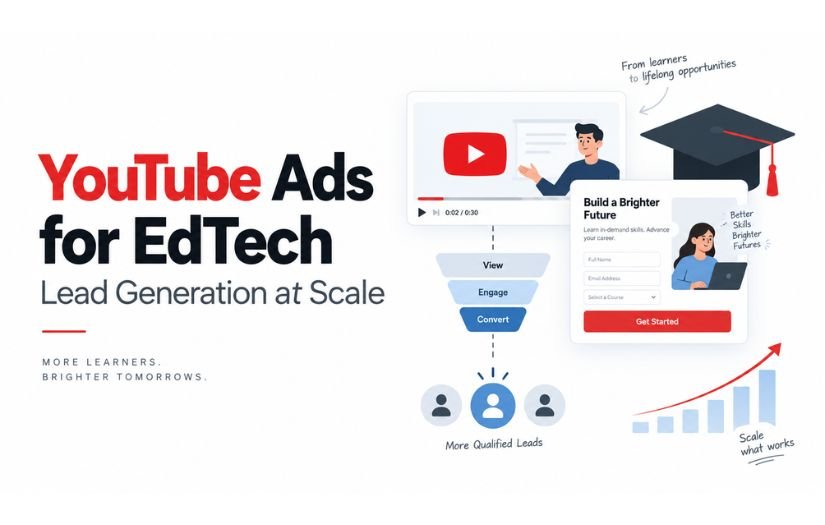
EdTech and education businesses often need more than one interaction before a user is ready to register, enquire or buy.
That makes video useful because it can explain the problem, build trust, demonstrate expertise and give the prospect enough context to take the next step.
Education Decisions Usually Need More Explanation
A course, program, coaching offer or educational product can require more consideration than a simple impulse purchase.
Video gives the business more space to explain the outcome, teaching approach, curriculum, proof, mentor, process or offer before asking the user to convert.
YouTube Can Reach Users Earlier in the Journey
Not every potential student or learner is actively searching for a specific course at the exact moment you want to advertise.
YouTube can help reach relevant audiences earlier, educate them and then move interested users into the acquisition funnel.
Creative Can Pre-Qualify the Audience
A good video ad can make the offer more specific before the user clicks.
If the video clearly explains who the program is for, what problem it solves and what the next step involves, some irrelevant users may filter themselves out before reaching the landing page.
Remarketing Becomes Valuable in Longer Decision Cycles
Education purchases can involve comparison, discussion and repeated consideration.
Users who watched the video, visited the landing page or started the registration process can become useful remarketing audiences for follow-up messaging.
The Real Goal Is Not Cheap Views
I would not evaluate an EdTech YouTube campaign based only on CPV, views or clicks.
The more important questions are whether the campaign is generating the right leads, whether those leads are progressing through the funnel and whether acquisition economics remain sustainable as volume increases.
This is why I connect YouTube targeting, creative, landing pages and measurement inside one broader YouTube Ads lead generation framework rather than treating them as separate activities.
How I Structure an EdTech YouTube Lead Generation Funnel
For EdTech campaigns, I prefer thinking in terms of a full funnel rather than a single ad followed by a form.
The structure I usually have in mind is:
Audience → Video Ad → Landing Page → Lead or Registration → Follow-Up → Remarketing → Qualified Opportunity → Customer.
1. Audience
The first step is understanding who the learner is, what stage of awareness they are in and what outcome they are actively trying to achieve.
For EdTech, that could mean separating users based on career goals, exam intent, subject interest, skill development, course category or previous interaction with the brand.
2. Video Ad
The video should quickly establish relevance by speaking to the learner’s problem, desired outcome or decision context.
I would usually test different angles around outcomes, proof, course value, educator credibility, urgency or the specific transformation the program is designed to support.
3. Landing Page
The landing page should continue the same message from the video and make the next action obvious.
Depending on the offer, that could be a webinar registration, counselling form, course enquiry, application, demo request or direct purchase.
4. Lead or Registration
I want the conversion action to be meaningful enough to indicate genuine interest without adding unnecessary friction.
For some EdTech funnels, a simple registration may be enough. For others, collecting additional qualification information may make sense.
5. Follow-Up
Lead generation does not end when the form is submitted.
The speed, quality and relevance of follow-up can have a major impact on how many leads ultimately become qualified prospects or customers.
6. Remarketing
Users who watched the video, visited the landing page or started the conversion process but did not complete it can be segmented for more relevant follow-up messaging.
That is where the audience strategy discussed in my guide to YouTube Ads targeting in India becomes especially useful.
7. Qualified Opportunity and Customer
I ultimately want to know which audiences and creatives are producing the strongest downstream business outcomes, not just the lowest front-end CPL.
That means connecting campaign performance with qualified lead rate, counselling outcomes, enrolments, sales or customer acquisition cost wherever the business has that data available.
How I Approach Audience Targeting for EdTech Campaigns
EdTech audiences are rarely one single group. Different learners can have different goals, levels of awareness, price sensitivity and urgency.
I prefer separating audience hypotheses based on intent, problem, program relevance and previous interaction with the business.
Career and Outcome-Based Audiences
Some learners are primarily motivated by a specific outcome such as getting a job, changing careers, improving a skill or qualifying for an exam.
I want the audience and creative to reflect that desired outcome rather than using one generic education message for everyone.
Program and Subject Interest
For businesses offering multiple courses or programs, I usually avoid grouping every category into one broad audience if the learner intent is meaningfully different.
A user interested in performance marketing, data analytics, competitive exams or professional certification may require very different messaging.
Higher-Intent Research Audiences
I may test custom audience hypotheses around users researching specific courses, certifications, career paths, exams, institutions or competing solutions.
The objective is to identify signals that suggest the user is actively exploring a relevant education decision.
Cold Discovery Audiences
Not every prospect will already be searching for the exact program.
For cold audiences, the creative usually needs to explain the problem and opportunity more clearly before asking the user to register or enquire.
Website and Video Remarketing
Users who have already visited the website, watched relevant videos or interacted with previous campaigns can be separated from completely cold traffic.
For these warmer audiences, I can often move more quickly toward proof, program details, FAQs, deadlines or the next step in the funnel.
Existing Lead or Customer Signals
If the business has reliable first-party data, existing lead and customer information can help improve audience understanding and campaign measurement.
I still want to validate whether those signals are producing better downstream outcomes rather than assuming first-party data will automatically improve performance.
Audience Quality Matters More Than Audience Size
I do not choose an EdTech audience simply because it has the largest reach or lowest CPV.
The audience that deserves more budget is the one producing the strongest combination of conversion rate, CPL, lead quality and eventual enrolment economics.
How I Approach Video Creative for EdTech Lead Generation
In EdTech, the video usually needs to do more than attract attention. It should help the learner understand why the program matters and whether it is relevant to their situation.
Lead With the Learner’s Problem or Desired Outcome
I prefer starting with the learner’s context rather than immediately talking about the brand.
That could mean addressing a career problem, exam challenge, skill gap, confusion about the next step or the outcome the learner wants to achieve.
Make the Offer Easy to Understand
The viewer should quickly understand what the program, course, webinar or consultation is offering and why it may be useful.
If the value proposition needs too much explanation, the ad can lose attention before the CTA appears.
Use Proof Carefully
Proof can include learner outcomes, testimonials, mentor credibility, course structure, platform demonstrations or other evidence that reduces uncertainty.
I prefer using proof that directly supports the decision rather than adding generic credibility elements that do not answer the learner’s real concerns.
Match Creative to Awareness Level
A cold user may need more context and education, while a warmer user may respond better to proof, urgency, objections or specific program details.
That is why I do not assume the same EdTech creative should be used across every audience segment.
Test Different Message Angles
I would rather test genuinely different ideas than create several versions of the same video with small visual changes.
For example, one ad might lead with the learner’s problem, another with the outcome, another with proof, and another with the program’s structure or offer.
Keep the CTA Clear
The next step should be specific, whether that is registering for a webinar, requesting counselling, applying for a program, downloading information or purchasing directly.
The creative should prepare the user for that exact action rather than ending with a vague call to action.
The broader creative logic is the same one I use across my YouTube Ads lead generation framework, but EdTech usually requires more attention to learner intent, trust and decision complexity.
How I Think About Landing Pages for EdTech Campaigns
In EdTech, the landing page has to continue the trust-building process started by the video.
If the ad creates interest but the page feels generic, confusing or disconnected from the promise, conversion rate can fall quickly.
Continue the Same Message From the Ad
The headline and core offer on the landing page should make the user feel that they reached the right place.
If the video talks about one course outcome and the landing page immediately shifts to broad institutional messaging, the user may lose confidence or interest.
Make the Program Easy to Understand
I want the page to answer the learner’s most important questions quickly: What is this? Who is it for? What will I get? Why should I trust it? What should I do next?
The page should reduce confusion rather than force the user to search for basic information.
Use Relevant Proof
For EdTech, useful proof can include learner outcomes, testimonials, mentor experience, course structure, placement support, certifications, curriculum or platform demonstrations depending on the offer.
I prefer proof that helps the learner make the specific decision in front of them rather than filling the page with generic trust badges.
Keep the Conversion Path Focused
If the campaign objective is a lead or registration, I prefer one clear primary action rather than several competing CTAs.
That could be requesting counselling, registering for a webinar, applying for a program or downloading more information.
Reduce Form Friction
Every field should have a reason to exist.
If the sales team only needs name, phone number and program interest initially, I would question whether asking for ten additional fields is helping or hurting conversion.
Track Landing Page Conversion Rate Closely
Two campaigns can generate traffic at similar CPCs and still produce very different CPLs because the landing pages convert differently.
This is why I connect landing-page performance with the wider economics covered in my guide to YouTube Ads cost in India.
Do Not Scale a Weak Conversion Experience
If relevant traffic is reaching the page but the conversion rate is poor, increasing spend can simply scale the inefficiency.
I would rather improve message match, page clarity, proof and form friction before pushing the budget much higher.
How I Measure Lead Quality in EdTech Campaigns
In EdTech, generating more leads is not enough. I want to understand whether those leads are actually relevant to the program and whether they are progressing toward enrolment.
Start With CPL, but Do Not Stop There
CPL tells me how efficiently the campaign is generating leads, but it does not tell me whether those leads are valuable.
A lower CPL can look attractive while still producing poor business results if the leads are irrelevant, unreachable or unlikely to convert.
Track Qualified Lead Rate
If the sales or counselling team can classify leads, I want to know what percentage of leads are actually qualified for the program.
This helps separate campaigns that generate volume from campaigns that generate useful demand.
Look at Counselling and Follow-Up Outcomes
For education businesses that use counsellors or sales teams, I would pay attention to whether leads answer calls, attend counselling sessions, complete applications or move further through the admission process.
Those signals can reveal differences in audience quality that CPL alone cannot show.
Connect Campaigns With Enrolments Where Possible
The strongest measurement comes when advertising data can eventually be connected with actual enrolments or purchases.
If one audience generates more expensive leads but converts into significantly more students, I may prefer that audience over a cheaper source of low-quality leads.
Use CRM Feedback to Improve Advertising Decisions
If the business has reliable CRM or sales data, I want that feedback to influence campaign decisions.
Knowing which campaigns, audiences and creatives are producing qualified prospects can help shift optimization away from simple form submissions toward more valuable outcomes.
Evaluate the Complete Acquisition Chain
For EdTech, I prefer looking at the full journey:
View → Click → Lead → Qualified Lead → Counselling or Application → Enrolment.
This is also why the 66,300+ lead YouTube Ads case study is useful as campaign proof, but the final business evaluation should always go beyond lead volume alone.
How I Use Remarketing for EdTech Lead Generation
EdTech decisions often take time. A learner may watch a video, visit a landing page, compare programs and still not be ready to register or enrol immediately.
That is why remarketing is an important part of how I approach YouTube Ads for education businesses.
Separate Users by Their Level of Engagement
I do not want every warm user to receive the same follow-up message.
Someone who watched a large portion of a video may need a different message from someone who visited the landing page, started an application or interacted with a previous campaign.
Use Proof and Objection Handling for Warm Audiences
Cold audiences often need more context, while warm audiences may respond better to proof, learner outcomes, FAQs, curriculum details, mentor credibility or answers to common objections.
The creative can move further down the decision journey because the user already has some familiarity with the program.
Remarket to Landing Page Visitors
Users who clicked the ad and reached the landing page have already shown stronger intent than someone who only viewed the video.
I may use remarketing to remind them about the offer, address uncertainty or give them another reason to complete the registration or enquiry.
Remarket to Incomplete Applicants
If the funnel allows it, users who started but did not complete an application, registration or enquiry can become a particularly valuable segment.
The follow-up message should be relevant to the point where they dropped off rather than simply repeating the original ad.
Do Not Overcomplicate the Remarketing Structure
I prefer a small number of meaningful audience groups rather than creating many tiny segments that do not generate enough volume to evaluate properly.
The goal is to make the message more relevant without making the account unnecessarily complex.
Remarketing Should Support the Main Funnel
Remarketing cannot fix a weak offer, poor landing page or irrelevant audience.
I use it as an additional layer after the core acquisition system is working, which is why it fits naturally into the broader YouTube Ads lead generation framework.
How I Scale EdTech Lead Generation Without Chasing Volume
Scaling an EdTech campaign is not just about increasing spend. The real challenge is increasing lead volume without allowing CPL, lead quality or enrolment economics to deteriorate too quickly.
Start With a Proven Audience and Creative Combination
Before increasing budget, I want to understand which audiences and creatives are producing the strongest combination of conversion rate, CPL and lead quality.
If the reason for good performance is unclear, scaling can make the account harder to diagnose.
Increase Spend Gradually
I prefer increasing budgets in a controlled way and watching how performance responds.
A campaign that works efficiently at one spend level may behave differently when the platform has to reach a much larger audience.
Keep Testing New Creative
As spend increases, the same creative reaches more people and can eventually lose effectiveness.
I prefer continuing to test new hooks, learner problems, proof points and offer angles rather than depending entirely on one winning video.
Watch Lead Quality as Volume Grows
More leads are useful only if the additional volume remains commercially valuable.
I want to know whether qualified lead rate, counselling outcomes and enrolment conversion remain acceptable as the campaign scales.
Expand Audiences Carefully
Once the strongest audience hypotheses are understood, I can test broader or adjacent audiences to find additional scale.
The audience expansion logic follows the same approach I explain in my guide to YouTube Ads targeting in India.
Protect the Funnel While Scaling
If the landing page, counselling team or follow-up process cannot handle the additional lead volume, increasing ad spend can create operational problems even if the campaign itself is performing well.
I want the complete acquisition system to be able to absorb the additional demand.
Use Customer Acquisition Economics as the Final Guardrail
CPL is useful, but the final scaling decision should be based on whether the business can continue acquiring students or customers at economics that make sense.
For me, successful EdTech scaling means increasing qualified demand without losing control of acquisition efficiency and downstream conversion quality.
Common Mistakes I See in EdTech YouTube Ads Campaigns
EdTech campaigns can generate large lead volumes, but scale alone does not make the acquisition system successful. Several mistakes can make the numbers look good at the top of the funnel while the business struggles further down.
1. Optimizing Only for Cheap Leads
A lower CPL can look attractive, but it becomes meaningless if the leads are irrelevant, unreachable or unlikely to enrol.
I prefer evaluating CPL alongside qualified lead rate, counselling outcomes and customer acquisition cost.
2. Using One Message for Every Learner
Students researching different programs, career outcomes or skill levels can have very different motivations.
Using one generic education message across every audience can reduce relevance and make it harder to understand which proposition is actually working.
3. Sending Traffic to a Generic Website Page
If the video promotes a specific course or outcome but users land on a broad homepage, the message continuity can break immediately.
I prefer landing pages built around the same program, learner problem and conversion action featured in the ad.
4. Asking for Too Much Information Too Early
Long application forms can create friction before the learner has built enough trust or intent.
I would collect only the information genuinely needed at that stage and move deeper qualification further into the funnel where appropriate.
5. Ignoring the Counselling or Sales Process
Advertising can generate strong leads, but slow follow-up or weak counselling can still produce poor enrolment outcomes.
I try to separate media performance from operational problems rather than assuming every conversion issue belongs inside Google Ads.
6. Treating Every Lead Source as Equal
Two audiences can generate the same CPL while producing very different enrolment rates.
That is why I want campaign decisions to incorporate downstream lead quality wherever the data is available.
7. Using Generic CPL Benchmarks as Targets
EdTech CPL can vary significantly depending on the program, price point, geography, funnel and what actually counts as a lead.
I would use published benchmarks only as context and judge performance using the business’s own economics. I explain this in more detail in my guide to YouTube Ads cost in India.
8. Scaling Faster Than the Funnel Can Handle
If the campaign suddenly generates far more leads than the counselling or follow-up team can process, lead quality can appear to deteriorate even when the media itself has not changed.
Scaling should account for both advertising performance and operational capacity.
9. Depending on One Winning Creative for Too Long
A strong video can carry a campaign for a period of time, but increased spend can eventually expose it to more of the available audience.
I prefer maintaining a pipeline of new hooks, proof points and creative angles instead of waiting for performance to collapse before testing again.
For me, the strongest EdTech campaigns connect media buying, creative, landing pages, counselling, lead quality and enrolment economics into one system rather than optimizing each part in isolation.
Frequently Asked Questions About YouTube Ads for EdTech
Do YouTube Ads Work for EdTech Companies?
Yes, YouTube Ads can work well for EdTech businesses when the audience, creative, offer, landing page, tracking and follow-up process are aligned.
I would evaluate performance based on lead quality and enrolment economics rather than views or clicks alone.
What Is a Good CPL for EdTech YouTube Ads?
There is no universal good CPL because the economics depend on the course price, program type, geography, lead definition, sales process and enrolment rate.
In one education and coaching acquisition system I managed, the average CPL was approximately ₹76, but I would treat that as a specific campaign result rather than a benchmark for every EdTech advertiser.
What Audience Should an EdTech Brand Target on YouTube?
I would usually test audiences based on learner intent, program interest, career goals, relevant research behaviour and previous interaction with the brand.
The strongest targeting strategy depends on the specific program and the type of learner the business is trying to attract.
Should EdTech Campaigns Use a Dedicated Landing Page?
In many cases, yes. A dedicated landing page can make it easier to maintain message consistency, explain the program clearly and focus the visitor on one conversion action.
I would avoid sending paid traffic to a generic homepage unless that page is specifically designed to support the campaign objective.
Are Webinars Good for EdTech Lead Generation?
Webinars can work well when the program requires education, trust-building or explanation before the user is ready to buy.
They can also create a useful intermediate conversion step between cold traffic and a higher-value enrolment decision.
How Important Is Remarketing for EdTech?
Remarketing can be particularly valuable because education decisions often involve repeated consideration.
Users who watched videos, visited program pages or started an application can be reached with more relevant proof, objections, FAQs or program details.
How Should EdTech Brands Measure Lead Quality?
I would go beyond form submissions and look at signals such as qualified lead rate, counselling attendance, application completion, enrolment rate and customer acquisition cost where the data is available.
How Do You Scale an EdTech YouTube Ads Campaign?
I prefer scaling only after identifying the audience, creative and funnel combinations producing repeatable performance.
As spend increases, I continue monitoring CPL, qualified lead rate, counselling outcomes and enrolment economics rather than assuming front-end performance will remain unchanged.
Sources & Methodology
This article combines my own performance marketing experience with current Google Ads documentation and first-hand campaign data from education and coaching campaigns.
Where I refer to my YouTube Ads results, the figures come from an education and coaching acquisition system that generated more than 66,300 leads at an average CPL of approximately ₹76, along with more than 718,000 clicks from approximately ₹50.4 lakh in advertising spend.
These figures represent a specific campaign and business context. They should not be treated as universal EdTech benchmarks or guaranteed outcomes for other advertisers.
The framework in this article reflects how I personally approach EdTech acquisition across audience strategy, video creative, landing pages, conversion tracking, remarketing, counselling feedback, lead quality and campaign scaling.
For current platform information, I refer to official Google Ads documentation covering YouTube advertising, Demand Gen, audience targeting, conversion tracking and campaign optimization.
The recommendations in this article are intended to explain how I think about building and scaling an EdTech lead-generation system rather than suggest that every education business should use the same funnel or campaign structure.
Need Help Scaling YouTube Ads for EdTech?
If your EdTech campaigns are generating leads but CPL, lead quality or enrolment performance becomes unstable as spend increases, I would look at the complete acquisition system rather than only the ad account.
That means reviewing audience targeting, creative, landing-page conversion, remarketing, counselling feedback, lead quality and customer acquisition economics together.
You can read my YouTube Ads lead generation framework, review my YouTube Ads targeting strategy, or see the full 66,300+ lead YouTube Ads case study.
If you want help with your EdTech paid acquisition strategy, you can also work with me.