Quick Answer
How Should You Target YouTube Ads in India?
I do not start YouTube Ads targeting by asking which audience is cheapest. I start by asking who is most likely to care about the offer, what problem they are trying to solve and how much awareness they already have.
For most lead-generation campaigns, I prefer testing a small number of clearly different audience hypotheses first rather than launching dozens of overlapping targeting groups.
Broadly, the audiences I usually think about first are cold interest or intent-based audiences, custom audiences built around relevant behaviour, and remarketing audiences based on previous engagement with the business.
I’m Deepak Singh, Performance Marketing Expert based in New Delhi. My approach to YouTube targeting comes from using paid video as part of a complete acquisition system rather than treating audience selection as an isolated Google Ads setting.
In one education and coaching acquisition system, approximately ₹50.4 lakh in advertising spend generated more than 66,300 leads at an average CPL of approximately ₹76. Audience testing was only one part of that system alongside creative, landing pages, remarketing and measurement.
You can see the wider acquisition framework in my guide to YouTube Ads for lead generation.
In this article, I’ll explain the audiences I test first, how I separate cold and warm users, how I evaluate audience quality, and why I do not choose targeting based on CPV or CPC alone.
Written by Deepak Singh
Performance Marketing Expert
The Audiences I Test First in YouTube Ads
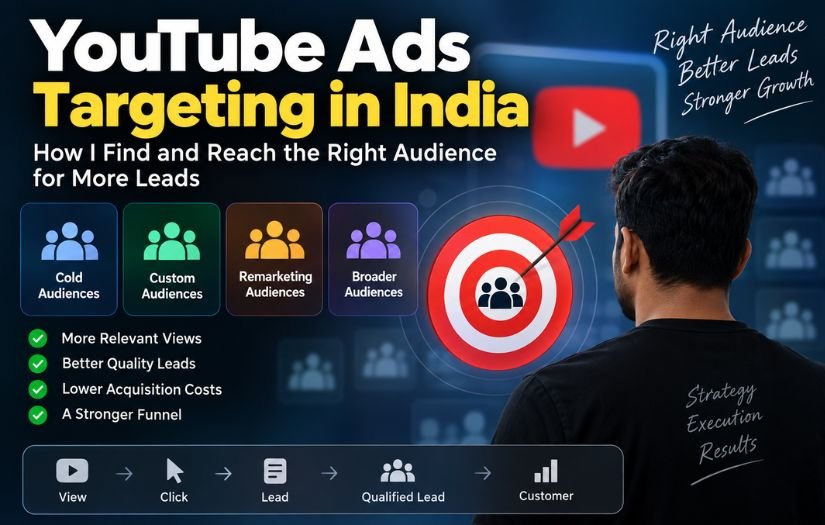
I prefer starting with a small number of clearly different audience hypotheses rather than creating too many overlapping segments from day one.
The objective is to learn which type of audience is producing the strongest combination of attention, clicks, conversions and lead quality.
1. Cold Interest and Intent-Based Audiences
These audiences are useful when I want to reach people who have not interacted with the business before but show signals that suggest relevance to the offer.
I would usually test them with broader creative that clearly explains the problem, value proposition and next step.
2. Custom Audiences
Custom audiences can help build more specific targeting around relevant search behaviour, websites, apps or other signals related to the category.
I use them when I have a clear hypothesis about what behaviour is likely to indicate stronger purchase or enquiry intent.
3. Remarketing Audiences
Remarketing audiences are built from users who have already interacted with the business in some way.
That can include website visitors, video viewers or users who entered the funnel but did not complete the desired conversion.
Because these users already have some level of familiarity, I often use a different message than I would for a completely cold audience.
4. Broader Audience Tests
Once I have enough conversion data, I may also test broader audience approaches and allow the platform more room to identify users who are likely to convert.
I would still evaluate these audiences based on downstream results rather than assuming broader targeting is automatically better or worse.
Why I Keep the Initial Structure Simple
If too many audience groups are launched at the same time, especially with a limited budget, it becomes harder to understand what is actually working.
I prefer creating a few meaningfully different tests, learning from the results and then expanding the audience strategy from there.
How I Build Custom Audiences for YouTube Ads
Custom audiences become useful when I have a specific hypothesis about what behaviour may indicate stronger relevance or buying intent.
I do not create them by adding every keyword, website or competitor I can think of. I prefer building each audience around one clear idea so I can understand what the test is actually telling me.
Search Behaviour Around the Problem
One audience hypothesis can be built around the types of searches people make when they are actively researching the problem the business solves.
For example, I would separate broad educational searches from searches that suggest someone is closer to comparing solutions or taking action.
Search Behaviour Around the Solution
Another audience can focus on people researching the specific category, service or solution being offered.
These users may already understand the problem, so the creative can often move more quickly toward the value proposition and offer.
Competitor and Alternative Research
In some markets, I may test an audience hypothesis around people researching competing brands, alternative solutions or closely related services.
The purpose is not simply to target competitor names. I want to understand whether that behaviour indicates meaningful purchase intent for the offer I am advertising.
Relevant Websites and Digital Behaviour
Websites, apps and other category-related signals can also help define an audience hypothesis when they are genuinely connected to the customer journey.
I prefer relevance over volume. A smaller set of closely related signals can sometimes teach me more than a large audience built from loosely connected interests.
Keep Different Intent Levels Separate
I try not to combine every type of behaviour into one custom audience.
If research-stage users, competitor researchers and high-intent solution seekers are mixed together, it becomes harder to understand which behaviour is actually contributing to conversions.
The Audience Still Needs the Right Creative
A strong audience does not automatically create a strong campaign.
The message still needs to match the user’s level of awareness and give them a relevant reason to take the next step.
That is why I treat targeting and creative as connected variables rather than optimizing either one in isolation.
How I Separate Cold, Warm and Remarketing Audiences
I do not want every user to receive the same message because someone discovering the business for the first time has a very different level of awareness from someone who has already visited the website or interacted with the brand.
Cold Audiences
Cold audiences have little or no previous interaction with the business.
The creative usually needs to establish relevance quickly by explaining the problem, opportunity or value proposition clearly enough for someone who may know nothing about the brand.
Warm Audiences
Warm audiences have already shown some level of interest, such as watching content, visiting the website or engaging with the business.
Because they already have some familiarity, I can often move the message further toward proof, differentiation, objections or the offer itself.
Remarketing Audiences
Remarketing becomes especially useful when I can identify users who entered the acquisition journey but did not complete the desired action.
For example, someone who visited the landing page but did not submit the form may need a different message from someone who only watched a small portion of a video.
Match the Message to the Funnel Stage
I prefer thinking about targeting and messaging together rather than building an audience first and deciding the creative later.
A cold user may need context and education, while a warmer user may respond better to proof, FAQs, objections or a stronger call to action.
Do Not Force Every Audience Into One Campaign
If users with very different levels of awareness are grouped together, it becomes harder to understand which message and audience combination is actually producing the result.
Separating the stages gives me cleaner learning and makes it easier to build a more deliberate YouTube lead generation funnel.
How I Evaluate Which YouTube Ads Audience Is Actually Working
I do not judge an audience only by how cheaply it generates views or clicks. I want to understand whether that audience is moving through the funnel and producing valuable conversions.
Start With Attention Metrics
CPV, view rate and CTR can help me understand how the audience is responding to the creative.
If an audience is producing very expensive views or almost no clicks, that can be an early signal that either the targeting or the message needs work.
Then Look at Landing Page Performance
Once users reach the landing page, I want to know whether they are actually converting.
Two audiences can have similar CPCs but very different CPLs because one group may be much more likely to complete the form or registration.
CPL Matters, but Lead Quality Matters More
An audience with a lower CPL is not automatically the better audience.
If another audience produces slightly more expensive leads but those leads are more qualified and convert into customers at a higher rate, I may prefer the second audience.
Look at Downstream Quality
As soon as enough data is available, I want to understand what happens after the lead is generated.
That can include qualified lead rate, appointment rate, lead-to-sale conversion and customer acquisition cost.
Do Not Compare Audience Cost Without Context
A higher CPV or CPC can still make business sense if the audience produces stronger conversion quality further down the funnel.
This is why I compare targeting performance with the wider economics explained in my guide to YouTube Ads cost in India.
My Preferred Evaluation Chain
I usually think about audience performance through this sequence:
Audience → View → Click → Landing Page → Lead → Qualified Lead → Customer.
The closer the metric gets to the final business outcome, the more weight I give it when deciding which audience deserves more budget.
How I Test Audience Targeting Without Creating Too Much Overlap
One of the easiest ways to make YouTube Ads targeting harder to understand is to launch too many similar audiences at the same time.
I prefer keeping the initial structure simple enough that each audience test has a clear purpose.
Test One Audience Hypothesis at a Time
If I am testing custom intent, broader interests and remarketing, I want each group to represent a meaningfully different hypothesis.
The objective is to learn something useful from the result rather than create multiple audiences that look different in the interface but behave almost the same.
Avoid Combining Too Many Signals Too Early
If too many interests, search themes, competitor signals and behaviours are mixed together, it becomes difficult to understand what is driving performance.
I prefer starting cleaner and expanding once I know which type of audience is producing the strongest downstream result.
Keep Creative Consistent During Early Audience Tests
When I am trying to compare audiences, I often prefer keeping the core creative reasonably consistent so that I am not changing too many variables at once.
If the audience and creative both change significantly, it becomes harder to know which factor caused the performance difference.
Then Test Message-Audience Fit
Once I understand which audiences are showing promise, I can start testing whether different messages work better for different levels of awareness or intent.
This is where targeting becomes more useful because I am no longer testing audiences in isolation. I am testing audience plus message fit.
Use Budget in a Way That Produces Learnings
If the total budget is divided across too many audience groups, each test may receive too little spend to produce meaningful data.
I would rather run fewer, clearer tests and learn something from them than spread the budget so thin that every audience remains inconclusive.
Scale the Strongest Combinations
Once I find an audience and creative combination that is producing acceptable CPL and lead quality, I can gradually increase spend while continuing to monitor downstream performance.
This approach keeps targeting decisions connected to the same acquisition logic I use across the wider YouTube Ads lead generation framework.
Common YouTube Ads Targeting Mistakes I Avoid
When targeting underperforms, the solution is not always to add more audience options. In many cases, simplifying the structure produces clearer learning.
1. Creating Too Many Audiences at Once
If the budget is divided across too many audience groups, each test may receive too little data to evaluate properly.
I prefer fewer, meaningfully different audience hypotheses rather than dozens of small segments.
2. Choosing Audiences Only Because They Are Cheap
A low CPV or CPC does not automatically mean the audience is valuable.
I would rather pay more for an audience that generates stronger leads and customers than optimize toward cheap traffic that does not convert.
3. Mixing Different Intent Levels Together
Someone casually interested in a topic and someone actively researching a solution can require very different messaging.
If those users are grouped together, it becomes harder to understand which level of intent is actually producing results.
4. Using the Same Creative for Every Audience
A completely cold user may need more context, while someone who has already visited the website may respond better to proof, objections or a stronger offer.
I prefer adapting the message once I understand how different audience groups behave.
5. Changing Audience and Creative at the Same Time
If both variables change together, it becomes difficult to know whether performance improved because of better targeting or better messaging.
I try to structure tests so that the learning remains clear.
6. Ignoring Remarketing Audiences
Businesses sometimes spend heavily acquiring cold traffic but do not build a strategy for users who already interacted with the videos or website.
Those users can represent valuable demand that should not automatically be treated the same as completely new prospects.
7. Looking Only at Platform Metrics
An audience can look strong inside Google Ads while producing poor-quality leads for the sales team.
As soon as enough downstream data is available, I want targeting decisions to reflect qualified leads, sales conversion and customer acquisition cost.
8. Assuming One Winning Audience Will Work Forever
Audience performance can change as spend increases, competition changes or the same users see the campaign repeatedly.
I prefer continuously testing new hypotheses rather than depending entirely on one targeting setup.
For me, strong YouTube Ads targeting is less about finding a hidden audience setting and more about continuously improving the relationship between audience, message, funnel and business outcome.
Frequently Asked Questions About YouTube Ads Targeting in India
What Is the Best Audience for YouTube Ads in India?
There is no single best audience for every business. The right audience depends on the offer, industry, customer journey and campaign objective.
I prefer testing a small number of clearly different audience hypotheses and then judging them based on conversion quality rather than assuming one targeting type will always perform best.
Should I Start With Broad or Narrow Targeting?
I usually start with enough structure to understand who I am testing, but I avoid making audiences unnecessarily narrow.
As conversion data improves, broader audience approaches can also become worth testing if the campaign has strong creative, reliable tracking and a clear conversion goal.
Are Custom Audiences Good for YouTube Ads?
They can be useful when they are built around a clear intent hypothesis, such as relevant search behaviour, category research or interest in competing solutions.
I would not build custom audiences simply by adding large numbers of loosely related signals.
Should I Target Competitor Audiences on YouTube?
Competitor-related behaviour can be one useful audience hypothesis, but I would not assume it will automatically outperform other targeting approaches.
The real question is whether those users respond to your message and move through the funnel at acceptable economics.
How Do I Know If My YouTube Audience Is Too Broad?
I would look at downstream performance rather than audience size alone.
If the campaign is generating large amounts of traffic but very weak conversion rates or poor lead quality, targeting may be one of the areas worth investigating alongside the creative and offer.
How Do I Know If My Audience Is Too Narrow?
A very narrow audience can limit available reach and make it harder to generate enough conversion data.
If delivery is restricted and the campaign struggles to generate meaningful volume, I would consider whether the audience definition is unnecessarily restrictive.
Should Remarketing Be Separate From Cold Targeting?
In many cases, yes. Someone who already knows the business can require a different message from someone seeing the brand for the first time.
Separating those audiences can make both the creative strategy and performance analysis clearer.
Should I Choose an Audience Based on CPV, CPC or CPL?
I would not make the decision based on CPV or CPC alone.
For lead generation, CPL becomes more useful, but I still want to understand lead quality, lead-to-sale conversion and customer acquisition cost before deciding which audience deserves more budget.
Can Better Targeting Reduce YouTube Ads Cost?
Better targeting can improve acquisition efficiency if it helps the campaign reach users who are more likely to respond and convert.
However, targeting is only one part of the system. Creative, landing-page conversion and offer quality can influence cost just as much, which is why I evaluate targeting alongside the wider YouTube Ads cost structure.
Sources & Methodology
This article combines my own performance marketing experience with current Google Ads documentation and first-hand campaign data.
Where I refer to my YouTube Ads results, the figures come from an education and coaching acquisition system that generated more than 66,300 leads at an average CPL of approximately ₹76, along with more than 718,000 clicks from approximately ₹50.4 lakh in advertising spend.
These figures represent a specific campaign and business context. They should not be treated as universal benchmarks or guaranteed outcomes for other advertisers.
The targeting framework in this article reflects how I personally evaluate YouTube audiences across cold traffic, custom audience hypotheses, remarketing, creative-message fit and downstream lead quality.
For current platform information, I refer to official Google Ads documentation covering audience segments, custom segments, remarketing, Demand Gen and conversion-focused campaign optimization.
The recommendations in this article are intended to explain how I structure and evaluate audience tests rather than suggest that one targeting type will always outperform another.
Need Help With YouTube Ads Targeting?
If your YouTube Ads are generating views and clicks but not enough qualified leads, I would look at the relationship between audience, creative, landing page and conversion quality before making major targeting changes.
You can read my complete YouTube Ads lead generation framework, review my 66,300+ lead YouTube Ads case study, or understand the economics in my guide to YouTube Ads cost in India.
If you want help diagnosing your audience strategy and paid acquisition system, you can also work with me.