Quick Answer
Can YouTube Ads Generate Leads?
Yes. YouTube Ads can be used as a measurable lead-generation channel when the audience, video message, offer, landing page, conversion tracking and follow-up process work together.
I do not approach YouTube lead generation as a video campaign alone. I treat it as an acquisition system built around Audience → Message → Landing Page → Conversion → Remarketing → Measurement → Scaling.
I’m Deepak Singh, Performance Marketing Expert based in New Delhi. In one education and coaching acquisition system, approximately ₹50.4 lakh in advertising spend generated more than 66,300 leads at an average CPL of approximately ₹76, along with more than 718,000 clicks.
Those numbers came from a specific campaign and business context, so I would not treat ₹76 CPL as a universal YouTube Ads benchmark.
In this guide, I’ll break down the framework I use for YouTube Ads lead generation, including how I think about audience intent, creative, landing pages, conversion tracking, remarketing, lead quality and scaling.
Written by Deepak Singh
Performance Marketing Expert
My YouTube Ads Lead Generation Framework
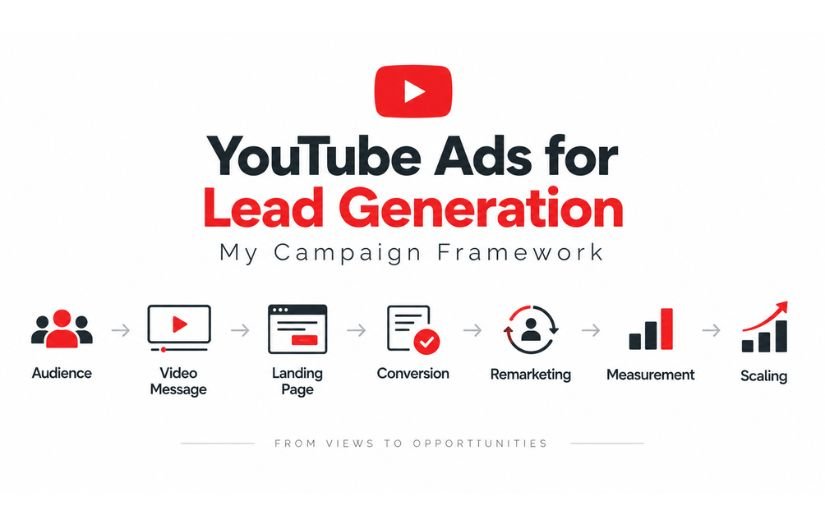
When I build a YouTube Ads lead-generation campaign, I think about the entire acquisition journey rather than treating the ad itself as the strategy.
The framework I use is:
Audience Intent → Video Message → Landing Page → Conversion → Remarketing → Measurement → Scaling.
1. Audience Intent
The first step is understanding who the campaign is trying to reach and what level of intent or awareness that audience already has.
A completely cold audience may need a different message from someone who has already visited the website, watched previous videos or interacted with the brand.
2. Video Message
The video needs to earn attention quickly, communicate a relevant problem or opportunity and give the viewer a clear reason to take the next step.
I usually think about the creative in terms of hook, problem, value proposition, proof and call to action.
3. Landing Page
The landing page should continue the message from the video rather than forcing the user to understand a completely different proposition after clicking.
I look at message match, page structure, clarity of the offer and the amount of friction involved in completing the form or registration.
4. Conversion
The conversion action needs to represent something meaningful for the business, whether that is a lead, enquiry, registration, appointment or another measurable step in the acquisition process.
I want the tracking setup to capture that action accurately before making major optimization or scaling decisions.
5. Remarketing
Not every user converts during the first interaction, so I prefer building remarketing around people who have already shown some level of interest.
That can include website visitors, video viewers or users who progressed through part of the funnel without completing the final action.
6. Measurement
I measure more than views and clicks. For lead generation, I want to understand metrics such as CTR, landing-page conversion rate, CPL, lead quality and eventually customer acquisition cost.
7. Scaling
I scale only after I understand which audience, creative and funnel combinations are producing the strongest results.
The goal is to increase volume while keeping acquisition economics under control, not simply to increase spend.
How I Choose the Right Audience for YouTube Lead Generation
Audience targeting is important, but I do not start by asking which audience option is cheapest. I start by asking who is most likely to care about the offer and what level of awareness they already have.
Cold Audiences
Cold audiences have little or no prior relationship with the business, so the video usually needs to do more work.
I focus on making the problem, value proposition and next step clear enough for someone who may be discovering the offer for the first time.
Custom Audiences
Custom audiences can be useful when I want to build targeting around specific search behaviour, websites, apps or other signals that indicate stronger relevance to the offer.
The objective is not simply to create more audience segments. It is to test clear hypotheses about who is most likely to convert.
Remarketing Audiences
Remarketing becomes important once enough users have interacted with the brand.
I may separate users based on actions such as watching videos, visiting the website or reaching a specific stage of the funnel without completing the conversion.
Do Not Judge Audiences Only by CPV or CPC
An audience with a higher CPV or CPC can still be more valuable if it produces a stronger landing-page conversion rate, better lead quality or lower customer acquisition cost.
That is why I prefer evaluating audiences through the complete funnel rather than optimizing only toward the cheapest top-of-funnel metric.
Use Audience Testing to Learn
Each audience test should answer a useful question.
I want to understand which groups respond best to the message, which ones convert efficiently and which ones continue producing acceptable lead quality as spend increases.
How I Think About Video Creative for Lead Generation
For YouTube lead generation, the video is not just a branding asset. It is part of the conversion system.
I want the creative to do three things well: earn attention, create relevance and move the right viewer toward the next action.
Start With the Hook
The opening needs to give the viewer a reason to continue watching.
I usually test hooks around the audience’s problem, desired outcome, proof, curiosity or a strong business insight rather than starting with a long introduction.
Make the Problem Clear
The viewer should quickly understand what problem the ad is addressing and whether it is relevant to them.
If the message is too broad, the campaign may attract attention without attracting the right prospects.
Communicate the Value Proposition Simply
I prefer a clear explanation of what the user will get and why it matters rather than trying to communicate too many benefits at once.
The strongest message is usually the one that makes the next step feel obvious.
Use Proof Where It Helps
Proof can reduce uncertainty and make the offer more believable.
Depending on the business, that can include customer outcomes, campaign data, product demonstrations, testimonials or a clear explanation of the process.
Keep the Call to Action Specific
The viewer should know exactly what to do next.
For lead generation, the CTA may be to register, request information, book a consultation, submit an enquiry or visit a landing page.
Test Different Angles, Not Just Different Edits
I prefer testing genuinely different ideas rather than creating multiple versions of the same message with minor visual changes.
For example, one creative might lead with the problem, another with proof, another with the offer and another with a strong insight.
This helps me learn which message is actually driving qualified response, not just which edit looks different.
Why the Landing Page Matters So Much for YouTube Lead Generation
Once a user clicks the ad, the landing page becomes one of the biggest factors influencing CPL.
You can have the right audience and a strong video, but if the page is unclear, slow or disconnected from the ad message, conversion efficiency can deteriorate quickly.
Keep the Message Consistent
The promise made in the video should continue on the landing page.
If the ad focuses on one problem or benefit and the page immediately shifts to something else, the user has to work harder to understand the offer.
Make the Offer Easy to Understand
The visitor should quickly understand what they are being asked to do and what they will receive in return.
I prefer simple pages with one clear objective rather than multiple competing calls to action.
Reduce Form Friction
Every additional field can create friction.
I usually ask whether each field is genuinely necessary at the lead-generation stage or whether that information can be collected later in the sales process.
Use Proof Where It Supports the Decision
Depending on the business, proof can include testimonials, case studies, customer outcomes, screenshots or a clear explanation of how the offer works.
The purpose is not to overload the page, but to reduce uncertainty.
Watch the Conversion Rate Closely
Landing-page conversion rate has a direct impact on CPL.
If traffic quality remains similar but the page converts better, the campaign can generate more leads without necessarily reducing CPC.
Do Not Scale a Weak Landing Page
If the page is converting poorly, increasing ad spend can simply scale the inefficiency.
I prefer improving the conversion environment before aggressively increasing budget.
Conversion Tracking: The Part I Would Fix Before Scaling
YouTube Ads can only optimize toward the signals it receives, so I want conversion tracking to be as reliable as possible before making serious scaling decisions.
Track the Conversion That Actually Matters
If the business objective is lead generation, I want the tracked action to represent a meaningful lead, registration, enquiry or appointment rather than a weak proxy metric.
The closer the tracked conversion is to real business value, the more useful the data becomes.
Validate the Tracking Setup
I would verify that important conversions are firing correctly and that duplicate, missing or irrelevant events are not distorting the data.
Depending on the setup, this can involve Google Ads conversion tracking, GA4, Google Tag Manager, CRM data or offline conversion information.
Separate Lead Volume From Lead Quality
A campaign can generate a high number of leads while still producing poor business results.
As soon as enough downstream data is available, I want to understand which campaigns, audiences and creatives are producing qualified leads rather than only form submissions.
Use Better Conversion Signals Over Time
If the business can reliably pass stronger signals back into the advertising system, I would prefer those over basic top-of-funnel actions.
That might include qualified leads, booked appointments, sales or other outcomes depending on the business model.
Do Not Scale Based on Broken Data
If tracking is incomplete or unreliable, increasing the budget can make the problem more expensive.
I would rather spend time fixing measurement first than optimize confidently against the wrong signal.
How I Use Remarketing in YouTube Lead Generation
Not every user who watches a video or visits a landing page is ready to convert immediately.
That is why remarketing is an important part of how I think about YouTube lead generation.
Separate Warm Audiences From Cold Audiences
Someone who has already watched a video, visited the website or interacted with the funnel should not always receive the same message as someone seeing the brand for the first time.
I prefer separating these users so the creative and offer can reflect their existing level of familiarity.
Build Audiences Around Meaningful Behaviour
Remarketing audiences can be created around actions such as video engagement, website visits or progress through specific funnel stages.
The objective is to identify people who have already shown interest and give them a relevant reason to come back.
Change the Message for Warm Users
A warm audience may not need the same level of introduction as a cold audience.
Remarketing creative can focus more heavily on proof, objections, urgency, FAQs, outcomes or the next logical step in the decision process.
Use Remarketing to Recover Lost Demand
Many users click an ad, visit the page and leave without converting.
Remarketing gives the business another opportunity to reach those users instead of treating every non-conversion as permanently lost traffic.
Do Not Judge Remarketing Only by Volume
Remarketing audiences are often smaller than cold audiences, so I do not expect them to generate the same scale.
I evaluate them based on whether they improve conversion efficiency and help move interested users further through the funnel.
Remarketing Should Support the Funnel, Not Replace It
If the original offer, creative or landing page is weak, remarketing will not solve the underlying problem.
I use it as another layer in the acquisition system after the core campaign and conversion experience are working properly.
The Metrics I Use to Evaluate a YouTube Lead Generation Campaign
I do not evaluate YouTube lead generation with one metric alone. Each number tells me something different about where the campaign is working or breaking down.
CPV: Cost Per View
CPV helps me understand how efficiently the campaign is generating video views.
It is useful for diagnosing attention and audience cost, but I would not use it as the final success metric for a lead-generation campaign.
CTR: Click-Through Rate
CTR helps me understand whether the video message and call to action are strong enough to move users from watching to clicking.
If CTR is weak, I would look at the hook, message, offer and CTA before assuming the audience is the problem.
Landing Page Conversion Rate
This tells me how effectively the page is turning traffic into leads.
If CPC looks acceptable but CPL is high, landing-page conversion rate is one of the first metrics I would investigate.
CPL: Cost Per Lead
CPL tells me the average advertising cost required to generate one lead.
It is an important acquisition metric, but I still want to understand what happens after the lead is generated.
Lead Quality
Lead quality tells me whether the campaign is attracting the type of prospects the business actually wants.
A low CPL becomes much less valuable if the majority of leads are irrelevant or unlikely to convert.
Lead-to-Sale Rate
This helps connect the advertising campaign with actual business outcomes.
If one audience produces more expensive leads but converts into customers at a much stronger rate, that audience can still be more valuable.
Customer Acquisition Cost
Customer acquisition cost is one of the most important numbers once enough sales data is available.
It tells me whether the complete acquisition system is commercially sustainable and whether increasing spend makes sense.
The Full Funnel Matters More Than One Cheap Metric
I prefer evaluating the complete chain:
View → Click → Landing Page → Lead → Qualified Lead → Customer.
That makes it much easier to understand where performance is being created and which part of the funnel needs improvement.
How I Scale a YouTube Lead Generation Campaign
I do not scale a YouTube campaign just because CPL looks good for a few days.
Before increasing spend, I want to understand which audience, creative and funnel combination is actually producing the result.
Start With Repeatable Performance
I prefer seeing enough conversion volume to understand whether performance is consistent rather than reacting to a short period of unusually strong results.
The exact amount of data required depends on the business, conversion rate and acquisition cost.
Identify What Is Driving the Result
Before scaling, I want to know which audiences are converting, which creatives are creating the strongest response and whether the landing page is supporting the traffic effectively.
If the reason for good performance is unclear, increasing spend can make the campaign harder to diagnose.
Increase Budget Gradually
I prefer increasing spend in a controlled way while watching how CPL, conversion rate and lead quality respond.
A campaign that works efficiently at one budget level may behave differently after spend increases.
Keep Testing Creative While Scaling
Scaling increases exposure, which can also increase creative fatigue.
I prefer continuing to test new hooks, messages and creative angles rather than relying entirely on one winning video.
Watch Lead Quality as Volume Grows
More leads are not automatically better if the additional volume is lower quality.
As spend increases, I want to monitor whether qualified lead rate and sales conversion remain acceptable.
Use Business Economics as the Final Guardrail
CPL is important, but the final scaling decision should be based on whether the business can continue acquiring customers profitably.
If customer acquisition cost starts deteriorating faster than the business can support, I would rather slow down and diagnose the system than keep increasing budget.
For me, scaling means increasing volume without losing control of acquisition efficiency and lead quality.
Common Mistakes I See in YouTube Lead Generation Campaigns
When YouTube Ads underperform, the issue is often not one single campaign setting. In many cases, the problem sits somewhere else in the acquisition system.
1. Optimizing for Views Instead of Leads
Cheap views can look impressive, but they do not automatically create business value.
If the objective is lead generation, I would use views and CPV as diagnostic metrics rather than the final measure of success.
2. Using Weak or Generic Creative
If the video does not clearly communicate the problem, value proposition and next step, better targeting alone may not fix performance.
I prefer testing meaningfully different hooks and messages rather than relying on one generic creative.
3. Sending Traffic to a Generic Page
A strong ad can lose effectiveness if the landing page does not continue the same message.
I want the user to immediately recognize that the page is relevant to what they just saw in the video.
4. Asking for Too Much Information
Long forms can create unnecessary friction, especially when the user is still early in the decision process.
I would only ask for information that is genuinely necessary at that stage of the funnel.
5. Looking Only at CPL
A low CPL can hide poor lead quality.
As soon as enough downstream data is available, I want to understand qualified lead rate, sales conversion and customer acquisition cost.
6. Ignoring Remarketing
Many users will engage with the ad or landing page without converting immediately.
Ignoring those users means the business may lose opportunities that could have been recovered through a more relevant follow-up message.
7. Scaling Before Understanding What Is Working
If a campaign starts performing well, increasing budget too quickly without understanding the source of that performance can create problems.
I prefer identifying the winning audience, creative and funnel combination before pushing spend significantly higher.
8. Making Too Many Changes at Once
If audience targeting, creative, landing page and campaign structure are all changed together, it becomes difficult to understand what actually improved or damaged performance.
I prefer making changes in a way that preserves enough clarity to learn from the result.
9. Treating the Lead as the Final Outcome
A lead is usually only one step in the acquisition process.
The stronger question is whether those leads eventually become qualified prospects and customers at economics the business can support.
For me, successful YouTube lead generation is not about producing the cheapest possible form submission. It is about building an acquisition system that can consistently generate valuable demand at sustainable economics.
Frequently Asked Questions About YouTube Ads for Lead Generation
Are YouTube Ads Good for Lead Generation?
Yes, YouTube Ads can work well for lead generation when the audience, creative, offer, landing page and conversion tracking are aligned.
I would evaluate the campaign based on lead quality and customer acquisition economics rather than views or clicks alone.
How Do You Generate Leads With YouTube Ads?
I approach YouTube lead generation as a complete system: Audience → Video Message → Landing Page → Conversion → Remarketing → Measurement → Scaling.
The ad creates interest, but the landing page, offer, tracking and follow-up process determine whether that attention turns into valuable leads.
What Is a Good CPL for YouTube Lead Generation?
There is no universal good CPL because lead value varies by industry, offer and business model.
In one education and coaching campaign I managed, more than 66,300 leads were generated at an average CPL of approximately ₹76, but I would not use that figure as a benchmark for every advertiser.
How Much Budget Do I Need for YouTube Lead Generation?
The budget should be large enough to generate meaningful conversion data while remaining financially sensible for the business.
I would start with the expected CPL or customer acquisition cost, estimate how many conversions are needed to evaluate performance, and work backward into the testing budget.
Should I Optimize YouTube Ads for Views or Leads?
If the business objective is lead generation, I would not optimize decisions purely around cheap views.
Views and CPV are useful diagnostic metrics, but the more important numbers are landing-page conversion rate, CPL, lead quality and eventually customer acquisition cost.
Do I Need a Landing Page for YouTube Lead Generation?
In many lead-generation setups, a dedicated landing page gives the business more control over the message, offer, form and conversion experience.
The important thing is that the page continues the promise made in the video and makes the next step clear.
Can YouTube Ads Generate High-Quality Leads?
Yes, but lead quality depends on the audience, messaging, qualification process, offer and follow-up system.
I would not assume that a low CPL automatically means high-quality acquisition.
How Long Should I Test a YouTube Lead Generation Campaign?
I would not use the same number of days for every business. The campaign needs enough traffic and conversions to evaluate the audience, creative and funnel with useful data.
A low-volume, high-value business may need a different testing window from a high-volume registration funnel.
Sources & Methodology
This article combines my own performance marketing experience with current Google Ads documentation and first-hand campaign data.
Where I refer to my own YouTube Ads results, the figures come from an education and coaching acquisition system that generated more than 66,300 leads at an average CPL of approximately ₹76, along with more than 718,000 clicks from approximately ₹50.4 lakh in advertising spend.
These figures represent a specific campaign and business context. They should not be treated as universal benchmarks or guaranteed outcomes for other advertisers.
The framework in this article reflects how I personally approach YouTube lead generation across audience strategy, creative testing, landing pages, conversion tracking, remarketing, lead quality and campaign scaling.
For current platform information, I refer to official Google Ads documentation covering YouTube advertising, Demand Gen, audience targeting, conversion tracking and campaign optimization.
The recommendations in this article are intended to explain the decision-making process behind a lead-generation system rather than present one fixed campaign structure that every business should copy.
Need Help Building a YouTube Lead Generation System?
If you want to use YouTube Ads for lead generation, I would start by looking at the complete acquisition system rather than only the campaign settings.
The key questions are whether the audience is right, the creative is creating enough intent, the landing page is converting, tracking is reliable and the leads are turning into valuable business outcomes.
You can read my YouTube Ads case study with 66,300+ leads at approximately ₹76 CPL, compare the economics in my guide on YouTube Ads cost in India, or review how to choose the best YouTube Ads expert in India.
If you want help with your paid acquisition strategy, you can also work with me.