Quick Answer
How Should You Choose the Best YouTube Ads Expert in India?
The best YouTube Ads expert for a business is not necessarily the person with the most certifications, the biggest social media following or the lowest management fee. I would evaluate an expert based on real campaign experience, measurable results, understanding of the complete acquisition funnel, conversion tracking knowledge, creative strategy and the ability to connect advertising metrics with actual business outcomes.
I’m Deepak Singh, Performance Marketing Expert based in New Delhi with 10 years of experience across YouTube Ads, Google Ads, Meta Ads, customer acquisition, CRO, analytics and attribution.
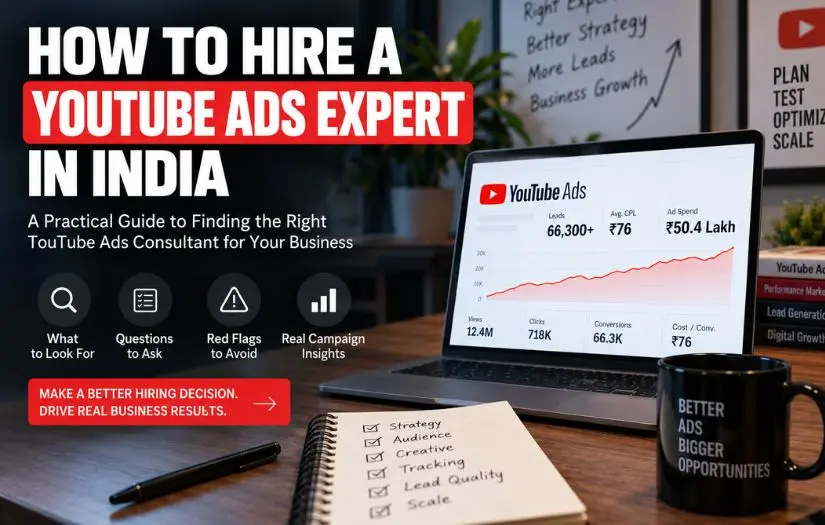
In one education and coaching acquisition system, I managed approximately ₹50.4 lakh in advertising spend and generated more than 66,300 leads at an average CPL of approximately ₹76, along with more than 718,000 clicks.
I do not believe businesses should choose a YouTube Ads consultant based on claims such as “best” or “top expert” alone. The better approach is to look at the evidence behind those claims and understand how the person thinks about acquisition, measurement and scaling.
In this guide, I’ll explain the criteria I would personally use when evaluating a YouTube Ads expert in India and the questions I would ask before hiring one.
Written by Deepak Singh
Performance Marketing Expert
What Actually Makes Someone a Strong YouTube Ads Expert?
For me, a strong YouTube Ads expert is not someone who simply knows how to create campaigns inside Google Ads. The real job is to understand how audience targeting, video creative, landing pages, conversion tracking, remarketing, lead quality and customer acquisition economics work together.
YouTube Ads can generate large volumes of views and clicks, but those numbers do not automatically translate into business results. An expert should be able to identify where performance is breaking down and whether the problem is coming from the campaign, creative, audience, landing page, tracking or the sales funnel.
I would evaluate a YouTube Ads consultant across three broad areas: Can they acquire the right audience? Can they convert that audience efficiently? Can they measure whether those conversions are actually valuable to the business?
Campaign Knowledge Is Only the Starting Point
Knowing campaign settings, bidding strategies and audience options is important, but platform knowledge alone is not enough. The person managing the account should also understand how the advertising campaign connects with the business model and the customer journey.
If a campaign produces a high number of clicks but very few leads, the answer may not be another targeting change. If CPL looks excellent but the leads never become customers, the campaign may be optimizing toward the wrong outcome.
Business Outcomes Matter More Than Vanity Metrics
I would be cautious about evaluating an expert purely on metrics such as views, impressions or CPV. Those numbers can help diagnose performance, but they are not the final objective for most businesses.
For lead-generation campaigns, I would eventually want to understand metrics such as landing-page conversion rate, CPL, qualified lead rate, lead-to-sale rate and customer acquisition cost.
Real Experience Should Be Verifiable
Anyone can say they are a YouTube Ads expert. I would look for examples of campaigns they have actually managed and ask them to explain what the objective was, what they changed, what went wrong and how they made scaling decisions.
For example, I have documented a YouTube Ads lead-generation campaign that generated 66,300+ leads at an average CPL of approximately ₹76. The important part of that case study is not just the final number. It explains the acquisition framework, campaign measurement and scaling approach behind the result.
That combination of platform expertise, funnel understanding, measurement and firsthand campaign experience is what I would look for before trusting someone with a meaningful advertising budget.
7 Things I Would Check Before Hiring a YouTube Ads Expert in India
If I were hiring someone to manage a serious YouTube Ads budget, I would not make the decision based on one case study, one certification or one sales call. I would evaluate how the person thinks across the entire acquisition system.
1. Can They Show Real Campaign Experience?
I would ask for examples of campaigns they have personally managed, including the objective, spend level, conversion volume and what they actually changed to improve performance.
The strongest evidence is not a screenshot with one impressive number. It is the ability to explain what happened, why it happened and what decisions were made next.
2. Do They Understand the Full Funnel?
YouTube Ads does not end at the click. The landing page, form, registration flow, follow-up and sales process can all influence the final result.
I would want the person managing the campaign to understand how these stages connect rather than treating Google Ads as an isolated platform.
3. Can They Diagnose Why Performance Is Weak?
If CPL increases, the answer is not always to change the audience or bidding strategy. The problem could be weaker creative, lower CTR, landing-page conversion, tracking issues, audience saturation or poor lead quality.
A strong YouTube Ads expert should be able to identify which part of the system needs attention before making changes.
4. Do They Understand Creative Strategy?
Video creative is one of the biggest variables in YouTube advertising. I would ask how the expert thinks about hooks, messaging, offers, proof, calls to action and creative testing.
If the entire strategy depends on campaign settings while creative is treated as an afterthought, I would consider that a major weakness.
5. Is Conversion Tracking Reliable?
I would want confidence that important conversion actions are being tracked correctly. Decisions made on incomplete or inaccurate conversion data can quickly waste budget.
The person should understand how Google Ads tracking connects with tools such as GA4, Google Tag Manager, CRM data or actual sales outcomes where relevant.
6. Do They Look Beyond CPL?
A low CPL can be useful, but it is not enough on its own. If the leads are poor quality or do not convert into customers, a cheap CPL can create a false sense of performance.
I would prefer someone who eventually looks at qualified lead rate, lead-to-sale conversion and customer acquisition cost in addition to platform metrics.
7. Can They Explain How They Scale?
I would ask what happens when a campaign starts performing well. Do they simply increase the budget, or do they first understand which audience, creative and funnel combination is producing the result?
For me, good scaling is about increasing spend while continuously checking whether acquisition efficiency and lead quality remain acceptable.
If an expert can explain all seven of these areas clearly and support their answers with real experience, I would consider that a much stronger signal than labels such as “top” or “best YouTube Ads expert in India.”
Real Campaign Proof Matters More Than Marketing Claims
One of the easiest ways to evaluate a YouTube Ads expert is to separate marketing claims from verifiable campaign evidence.
Statements such as “I am the best YouTube Ads expert in India” or “I deliver the highest ROI” are easy to make. What matters more is whether the person can show real campaigns, explain the business objective, discuss the spend level and walk you through the decisions behind the result.
What I Would Want to See
I would look for evidence such as:
- Actual campaign spend
- Lead or conversion volume
- Cost per lead or customer acquisition cost
- Landing-page conversion performance
- Examples of creative testing
- Audience and remarketing strategy
- Explanation of what was changed during optimization
- How performance behaved when the campaign was scaled
Why Context Matters
A single metric can look impressive without telling the full story. For example, a ₹50 CPL may look better than a ₹100 CPL, but that comparison is meaningless unless you know the industry, offer, lead quality, conversion process and value of the customer.
The same applies to ROAS, CTR, CPV and other advertising metrics. I prefer looking at the numbers in the context of the complete acquisition system rather than treating one metric as proof of expertise.
An Example From My Own YouTube Ads Work
In one education and coaching acquisition system, I managed approximately ₹50.4 lakh in advertising spend and generated more than 66,300 leads at an average CPL of approximately ₹76, along with more than 718,000 clicks.
I have documented the campaign in detail here: How I Generated 66,300+ Leads at ₹76 CPL Through YouTube Ads.
The reason I reference this case is not to suggest that every business should expect the same CPL. The value of the case study is that it shows the scale of the campaign and the way I approached audience strategy, creative testing, landing pages, remarketing, measurement and scaling.
When comparing YouTube Ads consultants in India, I would give more weight to this kind of transparent campaign evidence than to generic claims about being the “best” or “top” expert.
Questions to Ask Before Hiring a YouTube Ads Consultant in India
The quality of the questions you ask before hiring can reveal a lot about how a YouTube Ads consultant actually thinks. I would focus less on sales promises and more on how they approach strategy, measurement and decision-making.
1. What Types of YouTube Ads Campaigns Have You Personally Managed?
I would ask for specific examples rather than general statements. The objective is to understand whether the person has hands-on experience with campaigns similar to your business model, funnel or acquisition objective.
2. What Business Metrics Will You Optimize For?
If the answer focuses only on views, impressions, CPV or CTR, I would ask what happens after the click. For a lead-generation business, metrics such as CPL, lead quality, lead-to-sale rate and customer acquisition cost can become much more important.
3. How Do You Decide Whether the Problem Is the Ad or the Landing Page?
This is a useful diagnostic question. A strong answer should consider multiple signals rather than assuming every performance issue can be fixed inside Google Ads.
I would expect the consultant to look at the relationship between creative engagement, click-through rate, landing-page conversion and downstream lead quality.
4. How Do You Approach Video Creative Testing?
I would ask whether they test genuinely different hooks, messages, offers and creative angles or simply make minor variations of the same ad.
Creative testing should generate useful learning about what motivates the audience, not just produce more versions of a video.
5. How Is Conversion Tracking Set Up and Verified?
I would ask which conversion actions will be tracked, how those actions are verified and whether the setup can connect with GA4, Google Tag Manager, CRM data or offline sales outcomes when required.
If the measurement layer is unreliable, campaign optimization can also become unreliable.
6. How Do You Evaluate Lead Quality?
This question becomes especially important for businesses where a lead is only the beginning of the sales process.
I would want to know whether the consultant looks at what happens after the form submission and whether campaign decisions can eventually incorporate qualified leads, appointments, sales or customer acquisition data.
7. What Do You Do When CPL Starts Increasing?
The answer should tell you how the person diagnoses performance. I would listen for discussion around creative fatigue, audience performance, landing-page conversion, competition, tracking, offer strength and lead quality rather than an immediate recommendation to increase or decrease budgets.
8. How Do You Decide When to Scale a Campaign?
I would ask what signals need to be present before increasing spend and what metrics are monitored after the budget increases.
For me, scaling should be based on repeatable performance and acceptable acquisition economics, not simply because a campaign had a few good days.
9. What Reporting Will I Actually Receive?
A useful report should help the business understand what happened, why it happened and what will be tested next. I would prefer clear decision-oriented reporting over dashboards filled with metrics that do not change business decisions.
10. What Would Make You Tell Me That YouTube Ads Are Not the Right Channel?
This is one of the most useful questions I would ask. A good consultant should be willing to explain when the audience, offer, economics, creative resources or funnel make another acquisition channel more appropriate.
I would be more comfortable hiring someone who can explain when not to use YouTube Ads than someone who believes YouTube is the right answer for every business.
Red Flags to Watch For When Choosing a YouTube Ads Expert
There are also a few warning signs I would pay attention to before handing someone responsibility for a meaningful YouTube Ads budget.
1. Guaranteed Results or Guaranteed CPL
I would be cautious if someone guarantees a fixed CPL, ROAS or number of leads before understanding the business, offer, audience, funnel and conversion process.
Advertising performance depends on too many variables for responsible guarantees to make sense.
2. Heavy Focus on Views Instead of Conversions
If most of the discussion is about generating cheap views, impressions or reach, I would ask how those metrics connect to actual leads, sales or customer acquisition.
For performance campaigns, attention is useful only when it contributes to a measurable business outcome.
3. No Interest in the Landing Page or Funnel
If a consultant only wants access to Google Ads and shows little interest in the landing page, form, offer or follow-up process, they may be looking at only one part of the acquisition system.
I would prefer someone who is willing to investigate the complete customer journey.
4. No Clear Conversion Tracking Plan
I would be uncomfortable scaling a campaign if nobody can clearly explain what is being tracked, where the conversion data comes from and whether those conversions represent meaningful business actions.
Measurement should be discussed before serious optimization begins, not after the budget has already been spent.
5. Too Many Changes Without a Clear Reason
Frequent campaign changes can make an account look active without necessarily making it better.
I would want each meaningful change to have a clear hypothesis behind it and enough time or data to understand the result where possible.
6. Case Studies Without Context
A screenshot showing an impressive CPL or ROAS is not enough by itself. I would want to know the industry, campaign objective, spend level, conversion definition and whether the number represents a short test or sustained performance.
7. Treating Every Business the Same
A local service business, education company, ecommerce brand and high-ticket B2B business can have very different customer journeys and acquisition economics.
I would avoid anyone applying the exact same YouTube Ads strategy to every business without first understanding how that business actually acquires customers.
8. No Discussion About Lead Quality
If the campaign objective is lead generation, I would expect lead quality to eventually become part of the conversation.
Generating more leads is not automatically valuable if the sales team consistently finds that those leads are irrelevant, unqualified or unlikely to convert.
None of these signals automatically proves that someone is a poor YouTube Ads consultant. But if several of them appear together, I would ask more questions before making a hiring decision.
Agency vs Freelancer vs YouTube Ads Specialist: Which Should You Hire?
Businesses often compare agencies, freelancers and independent specialists when looking for help with YouTube advertising. I do not think one model is automatically better than the others. The right choice depends on the complexity of the account, the level of support required and how much direct access you want to the person making campaign decisions.
Hiring a YouTube Ads Agency
An agency can make sense when a business needs support across multiple areas such as media buying, creative production, landing pages, analytics and reporting.
The advantage is access to a broader team. The trade-off is that the person selling the service may not always be the same person managing the account day to day.
Before choosing an agency, I would ask who will actually manage the campaigns, how experienced that person is and how directly I will be able to communicate with them.
Hiring a Freelance YouTube Ads Manager
A freelancer can be a good fit for businesses that want a more flexible engagement or direct communication with the person managing the campaigns.
The main thing I would evaluate is whether the freelancer’s expertise goes beyond campaign setup and includes creative testing, tracking, funnel analysis and business-level measurement.
I would also understand how much support is available if the account requires landing-page work, analytics implementation or creative production.
Hiring an Independent YouTube Ads Specialist
A specialist can make sense when YouTube Ads is an important acquisition channel and the business wants deeper strategic involvement from someone with relevant campaign experience.
The value of a specialist should come from the ability to diagnose performance, connect media buying with the wider acquisition funnel and make decisions based on actual campaign economics.
How I Would Make the Decision
If I needed a large team handling multiple marketing functions, I would consider an agency. If the requirement was relatively simple and execution-focused, a freelancer could be enough. If YouTube Ads represented a meaningful acquisition budget and I wanted direct strategic involvement, I would look closely at an experienced specialist.
Regardless of the model, I would make the final decision based on who is actually managing the account, what evidence they can show and how well they understand the complete customer acquisition system.
What Good YouTube Ads Management Should Actually Include
YouTube Ads management should involve more than launching campaigns and adjusting bids. For a serious acquisition program, I would expect the work to cover the complete system that influences whether advertising spend turns into qualified leads or customers.
Campaign Strategy
The starting point should be a clear understanding of the business objective, target audience, offer, funnel and conversion action.
I would want the campaign structure to reflect the actual acquisition goal rather than simply using whatever campaign type happens to be available inside Google Ads.
Audience Strategy
Audience selection should be based on clear hypotheses about who is most likely to respond to the offer.
Depending on the business, that may involve audience segments, custom audiences, remarketing groups and other targeting signals available within Google Ads.
Creative Strategy and Testing
Video creative should be treated as an ongoing performance variable. I would expect testing across hooks, messages, offers, proof elements and calls to action rather than relying on one video indefinitely.
The objective is not simply to produce more ads. It is to learn which messages create the strongest response from the right audience.
Landing Page and Funnel Review
If YouTube Ads traffic is reaching a landing page, that page becomes part of campaign performance.
I would expect the person managing acquisition to pay attention to message match, page structure, form friction and conversion rate rather than assuming every problem exists inside the ad account.
Conversion Tracking and Measurement
Important business actions should be tracked as accurately as possible before major scaling decisions are made.
Depending on the setup, this can involve Google Ads conversion tracking, GA4, Google Tag Manager, CRM data and offline conversion information.
Remarketing
Not every interested user converts during the first interaction. I generally want a plan for reaching relevant users again based on actions such as video engagement, website visits or progress through the funnel.
Performance Diagnosis
Good management should explain why performance is changing, not just report that it changed.
If CPL increases, I would investigate the relationship between audience performance, creative response, CTR, landing-page conversion, conversion tracking and downstream lead quality.
Scaling
Scaling should happen when there is enough evidence that the acquisition system can support more spend.
I would monitor whether conversion efficiency and lead quality remain acceptable as budgets increase rather than treating budget growth as the objective itself.
Reporting and Business Feedback
Reporting should connect advertising data with decisions. I want to know what happened, what we learned, what changed and what we are doing next.
Where possible, feedback from the sales team or CRM should also flow back into the advertising process so that campaign optimization reflects lead quality and customer outcomes, not just form submissions.
That is the level of involvement I would expect when hiring a serious YouTube Ads consultant in India to manage performance-focused campaigns.
How I Approach YouTube Ads
My approach to YouTube Ads is built around one principle: the ad platform is only one part of the acquisition system.
I do not start by asking which campaign type or bidding strategy should be used. I start by understanding the business objective, target audience, offer, conversion action and economics of the funnel.
1. Start With the Business Goal
The first question is what the campaign is actually supposed to achieve. That could be leads, registrations, enquiries, purchases, appointments or another measurable business action.
The campaign structure should support that goal rather than optimizing for a convenient platform metric.
2. Build Around Audience Intent
I want to understand who the audience is, what problem they are trying to solve and how much awareness they already have about the offer.
That context influences targeting, creative messaging and the type of landing-page experience I would use.
3. Treat Creative as a Performance Variable
I prefer testing different hooks, messages, offers, proof elements and calls to action rather than assuming one video will work across every audience.
The objective is to learn which creative ideas consistently produce better downstream outcomes, not just higher view rates.
4. Make the Landing Page Continue the Conversation
The promise made in the video should continue naturally on the landing page.
If the ad talks about one problem or benefit and the landing page immediately shifts to a different message, conversion friction increases.
5. Measure Beyond the Lead
I initially monitor campaign metrics such as CPV, CTR, landing-page conversion rate and CPL, but I do not want the analysis to stop there.
As more downstream data becomes available, I prefer looking at lead quality, qualified lead rate, lead-to-sale conversion and customer acquisition cost.
6. Use Remarketing as Part of the Funnel
Many users will engage with the video or landing page without converting immediately. I prefer building remarketing audiences around those interactions where it makes sense for the buying journey.
7. Diagnose Before Making Changes
If performance deteriorates, I try to identify which part of the system changed before making major adjustments.
A rising CPL could come from the creative, audience, landing page, tracking, competition, offer or lead quality. Changing campaign settings without understanding the cause can create more noise than improvement.
8. Scale Based on Economics
I increase spend when the campaign has enough evidence of repeatable performance and the wider acquisition economics still make sense.
The goal is not to spend more for the sake of growth. The goal is to increase volume without losing control of efficiency and lead quality.
This is broadly the same framework I used in the YouTube Ads campaign that generated 66,300+ leads at approximately ₹76 CPL, although the exact campaign structure and tactics will always depend on the business and the current Google Ads environment.
Evidence From My Own YouTube Ads Campaigns
If I were evaluating a YouTube Ads expert, I would want to see evidence that goes beyond platform knowledge and theory. The strongest proof is real campaign experience at meaningful scale.
66,300+ Leads at Approximately ₹76 CPL
In one education and coaching acquisition system, I managed approximately ₹50.4 lakh in advertising spend and generated more than 66,300 leads at an average CPL of approximately ₹76.
The campaigns also generated more than 718,000 clicks during the acquisition process.
You can read the complete breakdown here: YouTube Ads Expert in India: How I Generated 66,300+ Leads at ₹76 CPL.
What I Consider More Important Than the Final Number
The 66,300+ lead figure is useful because it demonstrates campaign scale, but I do not think one headline metric is enough to evaluate expertise.
The more important questions are how the campaign was structured, how audiences and creatives were tested, how the landing-page funnel performed, what happened as spend increased and whether the acquisition economics remained acceptable.
Experience Beyond One YouTube Ads Campaign
My broader performance marketing experience spans YouTube Ads, Google Ads, Meta Ads, customer acquisition, CRO, analytics and attribution across EdTech, ecommerce, coaching, digital products, real estate, service businesses and lead-generation models.
Across my performance marketing work, I have generated more than 10 lakh leads, acquired more than 2 lakh paid customers and worked on campaigns responsible for more than ₹150 crore in attributed revenue.
I mention these numbers because YouTube Ads rarely operates in isolation. Experience across acquisition channels, funnels and analytics helps me evaluate YouTube performance in the context of the wider marketing system.
Why First-Hand Experience Matters
Platforms change. Campaign types change. Automation increases. Targeting options evolve.
What remains valuable is the ability to look at real data, identify where performance is breaking down and make decisions based on what is actually happening inside the acquisition funnel.
That is why I would give significant weight to first-hand campaign experience, transparent evidence and the ability to explain decisions when comparing YouTube Ads experts or consultants in India.
Frequently Asked Questions About Choosing a YouTube Ads Expert in India
Who Is the Best YouTube Ads Expert in India?
There is no single objective answer because the right expert depends on the business, industry, funnel, budget and acquisition goal. I would compare experts based on real campaign evidence, relevant experience, measurement ability, creative strategy, funnel understanding and customer acquisition economics rather than relying on self-declared rankings.
How Do I Find a Good YouTube Ads Consultant in India?
Start by reviewing the campaigns they have actually managed. Ask about spend levels, conversion volume, CPL or customer acquisition cost, how they measure lead quality and what they changed when campaign performance deteriorated.
I would also check whether they understand landing pages, conversion tracking, remarketing and the wider acquisition funnel rather than focusing only on Google Ads settings.
What Should I Ask a YouTube Ads Expert Before Hiring Them?
Ask what campaigns they have personally managed, how they approach creative testing, what conversion actions they optimize for, how they diagnose rising CPL, how they measure lead quality and what conditions need to be present before they scale a campaign.
How Much Does a YouTube Ads Expert in India Charge?
There is no standard fee that applies to every consultant or agency. Pricing can vary based on advertising spend, campaign complexity, number of markets, creative requirements, tracking setup, landing-page involvement and the level of ongoing strategic support required.
I would evaluate the fee in relation to the scope of work and the amount of responsibility being handled rather than choosing solely on the lowest management cost.
Should I Hire a YouTube Ads Expert or a Google Ads Expert?
It depends on the acquisition strategy. YouTube advertising operates within the Google Ads ecosystem, so a strong YouTube specialist should understand Google Ads, conversion tracking and bidding systems.
If YouTube is expected to become a major acquisition channel, I would also look specifically for evidence of hands-on video advertising experience rather than assuming experience with Search or Shopping campaigns automatically translates into YouTube expertise.
Do Google Ads Certifications Prove Someone Is a Top YouTube Ads Expert?
Certifications can demonstrate familiarity with the platform, but I would not use them as the primary evidence of expertise. Real campaign experience, transparent results and the ability to diagnose acquisition problems are more useful signals when making a hiring decision.
Should I Choose the YouTube Ads Expert With the Lowest CPL?
Not necessarily. CPL without context can be misleading. A higher-cost lead that converts into customers may be more valuable than a cheaper lead that consistently fails qualification or never reaches the sales stage.
I would compare lead quality, lead-to-sale conversion and customer acquisition cost alongside CPL whenever enough downstream data is available.
Can a YouTube Ads Expert Guarantee Results?
I would be cautious about guaranteed CPL, ROAS, lead volume or revenue claims. Advertising results depend on variables such as the offer, audience, competition, creative, landing page, sales process and market conditions.
A credible expert should be able to explain the strategy, measurement framework and evidence behind previous results without presenting historical performance as a guaranteed future outcome.
Sources & Methodology
This article combines my own performance marketing experience with current Google Ads documentation and first-hand campaign data.
Where I refer to my YouTube Ads results, the figures come from campaign and funnel data associated with the education and coaching acquisition system discussed in this article, including 66,300+ leads, approximately ₹76 average CPL, 718,000+ clicks and approximately ₹50.4 lakh in advertising spend.
These results represent a specific campaign and business context. They should not be treated as universal benchmarks or guaranteed outcomes for other businesses.
For current platform information, I refer to official Google Ads documentation covering YouTube advertising, Demand Gen, conversion tracking, audience targeting and campaign optimization.
The recommendations in this article reflect how I personally evaluate YouTube Ads campaigns and consultants based on campaign experience, measurement quality, funnel performance, lead quality and customer acquisition economics.
